Nigeria and Canada have signed an expanded bilateral air transport agreement allowing direct scheduled flights.
The deal permits multiple airlines from both countries to operate passenger and cargo services.
Designated airlines will be allowed up to 14 weekly passenger flights and 10 weekly all-cargo flights each.
The agreement is expected to boost trade, tourism, investment and educational exchanges between both countries.
Main story
Nigeria and Canada have signed an expanded bilateral air transport agreement that will, for the first time, allow direct scheduled flights between both countries.
The agreement was signed on Thursday in Abuja by the Director of Air Transport Management at the Ministry of Aviation and Aerospace Development, Mohammed Ahmed Tijjani, and Canada’s Chief Air Negotiator for Global Affairs, Shendra Melia.
Tijjani represented the Minister of Aviation and Aerospace Development, Festus Keyamo, at the signing ceremony.
According to a statement by the minister’s Special Adviser on Media and Communications, Tunde Moshood, the agreement followed a technical review of the existing bilateral air services framework by officials from both countries.
Under the expanded agreement, Nigeria and Canada can each designate multiple airlines to operate scheduled passenger and cargo services between the two countries.
The framework also provides for 14 weekly passenger flights and 10 weekly all-cargo flights for designated airlines from each country.
In addition, both countries agreed to grant Fifth Freedom Traffic Rights for all-cargo operations, allowing designated cargo airlines to transport freight between two foreign countries, provided the service originates from or terminates in the airline’s home country.
The ministry said the agreement would improve air connectivity, reduce travel time, lower logistics costs and strengthen commercial, cultural and people-to-people relations between Nigeria and Canada.
It added that the expanded aviation framework would also support business travel, tourism, educational exchanges, investment and family reunification.
Moshood noted that the Nigeria-Canada Air Transport Agreement was originally negotiated in 2014 as a code-share-only arrangement before it was formally signed in March 2025.
He said the latest agreement represents the first major expansion of the bilateral air services framework since it was negotiated more than a decade ago.
The issues
Direct air connectivity is expected to improve passenger convenience while reducing travel time and operating costs for airlines and businesses. The expanded agreement could also stimulate bilateral trade, tourism, cargo movement and investment by providing greater flexibility for airlines operating between Nigeria and Canada.
What’s being said
“The agreement is expected to improve air connectivity by paving the way for direct flights, reducing travel time, improving passenger convenience, lowering logistics costs, and strengthening commercial and cultural ties between both nations.”– Tunde Moshood, Special Adviser on Media and Communications to the Minister of Aviation and Aerospace Development:
“The current agreement represents the first major expansion of the bilateral air services framework since its negotiation over a decade ago.”– Tunde Moshood, Special Adviser on Media and Communications to the Minister of Aviation and Aerospace Development:
What’s next
The two countries are expected to designate eligible airlines and complete the regulatory and operational processes required to commence direct scheduled passenger and cargo flights under the expanded agreement.
Bottom line
The expanded air transport agreement marks a significant step towards establishing direct air links between Nigeria and Canada, with the potential to strengthen trade, tourism, investment and bilateral relations.
Tanzania has opened its Treasury bills and government bonds to all non-resident investors.
The reform follows amendments to the Foreign Exchange Regulations, 2026.
Previously, participation was largely limited to investors from the EAC, SADC and the Tanzanian diaspora.
The move is expected to deepen Tanzania’s domestic capital market and attract more foreign investment.
Main story
The Bank of Tanzania has opened the country’s Treasury bills and government bonds to all non-resident investors, removing restrictions that previously limited participation largely to investors from the East African Community (EAC), the Southern African Development Community (SADC) and members of the Tanzanian diaspora.
The central bank announced the policy change in a public notice issued on Wednesday following amendments to the Foreign Exchange Regulations, 2026, which were gazetted on July 17.
Under the revised regulations, all non-resident investors are now eligible to invest in government securities issued by the Government of Tanzania through approved Central Depository Participants (CDPs), subject to applicable foreign exchange laws and operational requirements.
The Bank of Tanzania said the reform is aimed at deepening the country’s domestic financial markets and strengthening Tanzania’s attractiveness as an investment destination.
The central bank noted that broadening access would expand participation in the government securities market while supporting ongoing efforts to develop the country’s financial sector.
Foreign investors seeking to participate in the market will be required to invest through approved Central Depository Participants in accordance with the amended regulations and other applicable laws.
The Bank of Tanzania also directed interested investors to its website for the full Foreign Exchange (Amendment) Regulations, 2026, and advised market participants to contact approved depository participants or the central bank for further guidance.
The issues
Opening the government securities market to all foreign investors significantly expands Tanzania’s potential investor base. Increased foreign participation could improve liquidity in the domestic bond market, diversify government funding sources and strengthen investor confidence. The reform also aligns with broader efforts by African economies to deepen domestic capital markets and attract long-term foreign portfolio investment.
What’s being said
“The amendments, among other things, permit all non-resident investors to invest in Treasury bills and bonds issued by the Government of the United Republic of Tanzania.”– Bank of Tanzania:
“The reform is intended to deepen the country’s domestic financial markets and strengthen Tanzania’s position as an attractive investment destination.”– Bank of Tanzania:
What’s next
The Bank of Tanzania expects eligible foreign investors to begin accessing Treasury bills and government bonds through approved Central Depository Participants as the amended regulations take effect. Market participants will also receive further guidance on operational requirements where necessary.
Bottom line
By opening its government securities market to investors worldwide, Tanzania is seeking to attract more foreign capital, deepen its domestic capital market and strengthen long-term financing for economic development.
Analysis of roughly 850,000 U.S. tech job postings between January 2025 and March 2026 shows hiring hit a three-year high even as layoffs surged
Amazon Web Services (AWS) appeared in 30% of all postings, making cloud infrastructure — not AI hype — the single most demanded skill category
Q1 2026 alone accounted for 39% of all postings in the dataset, representing 3.7 times more hiring activity than the same period a year earlier
Nearly 42% of all postings required knowledge of at least one major cloud platform, confirming that the backbone of the internet remains the backbone of tech careers
Tech, Data & Telecom companies posted 45% of all listings, with California, Texas, and New York leading geography
MAIN STORY
The American technology job market is in the middle of one of its most confusing chapters. Companies are cutting thousands of workers with one hand while posting record numbers of job listings with the other. Since January 2026, more than 170,000 tech jobs have been eliminated — roughly 832 per day — while venture capitalists poured $300 billion into AI startups in Q1 2026 alone. The question workers and analysts are asking is simple: what does a tech professional actually need to survive this moment?
A new report from Oxylabs, a web intelligence company based in Vilnius, Lithuania, offers the clearest data-driven answer yet. The firm analysed approximately 850,000 U.S. tech job postings published between January 2025 and March 2026, cross-referencing employer demand for specific technology tools, platforms, and skills. The findings puncture a number of widely held assumptions about what the market wants and reveal a hiring landscape shaped not by trending topics on social media, but by the unglamorous, load-bearing infrastructure skills that keep systems alive at scale.
The headline number is striking: Q1 2026 alone accounted for 39% of all postings in the dataset — 3.7 times more activity than Q1 2025. While company executives were justifying layoffs with AI efficiency narratives, their HR departments were simultaneously flooding job boards with a record volume of listings. The paradox is real, and it has a simple explanation: AI is not eliminating tech work. It is reorganising which tech work gets done by humans — and which humans get to do it.
The Oxylabs dataset, sourced from Coresignal’s multi-source jobs database, covered five major role categories — Software Engineering (38%), Data Science & AI/ML (14%), Tech & Engineering Management (14%), DevOps/Cloud/SRE (12%), and Data Analysis & BI (11%) — which together accounted for nearly 90% of all postings analysed. What emerged from that data is a hierarchy of skills that is at once familiar and instructive.
THE ISSUES
The most structurally significant finding from the Oxylabs research is not which tool ranked first — it is the distance between what trends online and what employers actually hire for. Cloud platforms and DevOps tooling together accounted for 77% of all tool mentions across the dataset. Meanwhile, the AI and machine learning tools that dominate conference keynotes and social media arguments appear as narrower, role-specific requirements rather than universal expectations.
This gap between hype and hiring reflects two underlying tensions. The first is the lag between industry narrative and employer behaviour: companies talk about AI transformation in press releases but continue to build systems on cloud infrastructure that requires experienced human management. The second is what might be called the infrastructure paradox — the more AI is deployed at scale, the more cloud infrastructure, DevOps tooling, and data engineering capacity is needed to run it. AI does not replace cloud skills; it deepens demand for them.
A separate tension exists in the geography of the market. California generates 13% of all postings, Texas 8%, and New York 5%. But Virginia — which does not appear in the top three on absolute volume — posts nearly three times as many tech jobs per capita as the national average, driven by the enormous concentration of data centres supporting the hyperscale cloud providers. The infrastructure economy is not just a technology story; it is a real estate, energy, and logistics story that is reshaping where tech talent actually needs to be.
For African tech professionals watching the U.S. market — whether as aspirants, diaspora workers, or talent competing in a globally distributed workforce — the data carries a clear message: the skills that cross borders most reliably are the same skills that dominate this dataset. Cloud certifications, DevOps tooling, and data engineering fluency travel well.
HERE ARE THE 10 MOST IN-DEMAND TECH SKILLS IN AMERICA RIGHT NOW — AND WHAT EACH ONE MEANS FOR YOUR CAREER
1. Amazon Web Services (AWS) — 30% of All Postings
AWS is not simply the most popular cloud platform. It is, by the data’s measure, the single most universally required technical skill in the American tech job market. Appearing in 30% of all 850,000 postings analysed, it outpaces the next closest competitor — Microsoft Azure — by approximately 1.2 times, and leads Google Cloud Platform by 2.1 times.
The dominance is not uniform across all roles. For Backend Engineers, AWS demand reaches 51% of postings. For DevOps and Site Reliability Engineers, the figure climbs to 58%. For Data Engineers, AWS appears in 47% of listings. Even Technology Managers — roles one might expect to be insulated from hands-on tool requirements — are expected to carry solid cloud familiarity.
AWS and Azure together appear in 15% of all postings, making multi-cloud literacy the single most valuable credential combination in the dataset. For anyone building a cloud career from scratch, AWS remains the non-negotiable starting point.
2. Microsoft Azure — 24% of All Postings
Azure’s 24% share of postings places it firmly in second position, but the more interesting story is geographic. While AWS leads in most U.S. states, Azure takes the top position in a cluster of Upper Midwest and Southern states — including Minnesota, Indiana, and Tennessee — likely driven by the heavy Microsoft 365 enterprise adoption in those regional economies.
For DevOps professionals, Azure appears in 45% of postings. For Data Engineers and Architects, the figure is 42%. The platform’s deep integration with Microsoft’s enterprise productivity stack — including Power BI and Excel, both of which appear elsewhere in this list — makes Azure fluency particularly valuable in Finance, Insurance, and Corporate IT environments.
The AWS-Azure gap is meaningful but not enormous. In practical terms, a professional who can work fluently across both platforms is positioned better than one who has committed exclusively to either.
3. Git — 21% of All Postings
Git’s position at number three on this list carries a specific message for early-career professionals: version control is not a beginner skill to learn and forget. It is a permanent, career-wide expectation. At 21% of all postings, Git outranks GCP, Kubernetes, Docker, and every business intelligence tool in the dataset.
Git’s universality cuts across role categories in a way few tools match. Software Engineers need it to manage codebases. Data Engineers use it to version pipeline code and configurations. ML practitioners use it to track model experiments. DevOps teams use it at the centre of CI/CD workflows. Git does not appear in this dataset as a specialised skill — it appears as a baseline competency, the professional equivalent of knowing how to type.
The practical implication is simple: if a tech professional does not have Git fluency, they are not fully functional in a modern engineering environment, regardless of their seniority or specialisation.
4. Microsoft Excel — 15% of All Postings
Excel’s presence at 15% of all postings — ahead of GCP, Kubernetes, and Docker — is one of the most counterintuitive findings in the entire report. In an era of cloud-native analytics platforms and modern BI tools, Excel remains a required skill across a substantial portion of the technical job market.
The Oxylabs report describes Excel as a “hygiene factor” — a baseline expectation that is so common in certain roles that its absence is disqualifying. In Data Entry and IT Support postings, Excel appears in 46% of listings. For Data Analysts and BI professionals, the figure is 41%.
The data also shows that Excel comfortably outpaces Google Sheets in employer demand. The Microsoft productivity ecosystem — Excel, Power BI, Azure — functions as an integrated suite in enterprise environments, and employers hiring for data-adjacent roles are not choosing between old tools and new ones. They are expecting both.
5. Google Cloud Platform (GCP) — 14% of All Postings
GCP’s 14% share places it third among the cloud platforms and tied with Kubernetes in the overall rankings. Its relative position — roughly half of AWS’s share and slightly below Azure’s — reflects the current state of the enterprise cloud market, where Google remains a strong third player with particular depth in data-intensive and AI-native applications.
For Data Engineers and Architects specifically, GCP appears in 24% of postings, making it more relevant to that role category than its overall ranking might suggest. The platform’s strengths in BigQuery, Dataflow, and Vertex AI align with data-heavy workloads, and its association with AI-native development gives it a specific niche in ML infrastructure hiring.
Regionally, GCP tends to cluster in California, driven by the concentration of tech firms and startups in the Bay Area where Google’s ecosystem has the deepest footprint.
6. Kubernetes — 14% of All Postings
Kubernetes and GCP are statistically tied at 14%, but they serve very different functions in the market. Where GCP is a cloud platform with broad application, Kubernetes is a container orchestration system that sits at the centre of modern DevOps and cloud-native application deployment.
For DevOps and SRE professionals — the role category with the highest overall infrastructure demand — Kubernetes appears in 39% of postings. The tool enables teams to manage containerised applications across multiple cloud environments, making it particularly valuable in multi-cloud and hybrid infrastructure setups.
Kubernetes’ position just ahead of Docker in this dataset is significant. The two tools are closely related — Docker creates containers, Kubernetes manages them at scale — and they frequently appear together in job descriptions. Kubernetes’ slight edge likely reflects the increasing expectation that DevOps professionals can move beyond building containers to orchestrating entire production environments.
7. Docker — 13% of All Postings
Docker appears in 13% of all postings, trailing Kubernetes by a single percentage point. The proximity is not coincidental. Docker and Kubernetes form what is arguably the most important two-tool combination in modern DevOps, and their near-equal demand reflects the reality that most employers hiring for infrastructure roles expect both.
Docker’s role in the stack is fundamental: it enables developers to package applications and their dependencies into portable, consistent containers that run identically across development, testing, and production environments. This portability is what makes cloud-native development possible at scale.
For professionals building a DevOps skill set, Docker is the logical entry point before advancing to Kubernetes. Understanding how containers are built before learning how they are orchestrated is both the pedagogically correct sequence and the career-relevant one.
8. Power BI — 9% of All Postings
Power BI’s 9% share of all postings, ahead of Tableau at 7.5%, reflects Microsoft’s growing dominance in the enterprise business intelligence market. The tool’s deep integration with the Microsoft 365 ecosystem — Excel, Azure, Teams — makes it the default BI platform in corporate environments where Microsoft is already the primary productivity vendor.
For Data Analysts and BI professionals, Power BI demand reaches 43% of postings, making it the single most required tool in that role category. The Oxylabs data suggests the market is settling into a Microsoft-first BI stack for enterprise data work, with Tableau remaining relevant in organisations with existing Salesforce relationships or legacy implementations.
The business intelligence category as a whole — covering Power BI, Tableau, and related tools — accounts for 18% of all tool mentions in the dataset, making it the third-largest tool category after Data Storage & Infrastructure (47%) and DevOps & Developer Experience (30%).
9. Terraform — 8% of All Postings
Terraform’s 8% share places it ninth overall, but its role concentration tells a more pointed story. Among DevOps and SRE professionals, Terraform appears in 38% of postings — a figure that reflects the tool’s position as the standard for Infrastructure as Code (IaC) in cloud environments.
Terraform, built by HashiCorp, allows engineers to define and provision cloud infrastructure through configuration files rather than manual console interactions. In environments where cloud resources are created and destroyed dynamically — and where reproducibility and auditability matter — IaC is not optional. It is operational standard.
The combination of Kubernetes (39%) and Terraform (38%) in DevOps postings illustrates the emerging baseline for senior infrastructure professionals: the ability to both orchestrate containerised workloads and define the cloud infrastructure those workloads run on, written as code, version-controlled, and deployable across environments.
10. Tableau — 7.5% of All Postings
Tableau rounds out the top ten at 7.5%, appearing in 36% of Data Analyst and BI-specific postings. While it trails Power BI in overall demand, Tableau retains strong relevance in organisations where its visualisation depth, flexibility, and Salesforce integration outweigh the convenience of Microsoft’s native ecosystem.
Tableau’s position in this dataset reflects a broader market reality: the business intelligence space is not winner-take-all. Power BI dominates the Microsoft-aligned enterprise, but Tableau holds ground in data-mature organisations with more complex visualisation requirements and analyst teams that prefer its interface and flexibility.
For BI professionals, dual fluency in Power BI and Tableau — alongside the Excel baseline — represents the most defensible skill profile in the current market.
WHAT’S BEING SAID
The research has landed in the middle of an industry-wide conversation about what AI actually means for tech employment, and the responses have been pointed.
Andrius Kūkšta, Tech Lead at Oxylabs, framed the findings directly: “The picture we saw after analyzing close to a million job postings largely confirms what experienced developers would guess — cloud, infrastructure, and data skills are in high demand. Where it gets more interesting is in the proportions: cloud platforms and DevOps tooling dominate job ads even more heavily than survey-based rankings suggest, while some high-visibility skills — the ones trending on X or headlining conference talks — appear less often than you might think.”
The observation about hype versus hiring demand aligns with a broader pattern analysts have documented across the industry. Workforce researchers have described what they are calling the “AI employment paradox” — the same companies eliminating tens of thousands of roles are simultaneously committing to the largest capital investment cycle in the industry’s history. Amazon Web Services, Microsoft Azure, Google Cloud, and Meta collectively plan to spend between $635 billion and $665 billion in 2026, a 67 to 74% increase over 2025, the overwhelming majority earmarked for AI data centres, chips, and infrastructure.
A study by The Pragmatic Engineer, which surveyed more than 900 engineers, found that while participants said they felt 20% more productive with AI tools, their actual demonstrated results showed a 20% decrease in productivity on average — a trust paradox that complicates the narrative companies are using to justify workforce reductions.
The human cost of that narrative is not abstract. According to outplacement firm Challenger, Gray & Christmas, AI was the most cited reason for tech layoffs through May 2026. Tech’s share of total U.S. layoff announcements has ballooned to nearly a third of all cuts — a concentration last seen during the post-pandemic correction of 2022-2023.
Yet the Oxylabs data suggests that even within this disruption, employers remain willing to invest in professionals with expertise in the infrastructure that actually runs the systems AI is supposed to be automating. The market is not contracting. It is reorganising — and the Oxylabs top 10 is, in effect, a map of where the demand is landing.
WHAT’S NEXT
The Oxylabs dataset covers postings only through March 2026. Given that Q1 2026 already represented 3.7 times the activity of Q1 2025, subsequent quarterly data releases will indicate whether the hiring surge has sustained through Q2 and Q3 — or whether it represents a front-loaded burst of post-AI-investment demand.
Goldman Sachs has forecast that sectors integrating AI strategically will create opportunities for reskilled professionals, particularly in data analysis, machine learning, and AI operations. The Q3 2026 hiring data will begin to show whether AI-adjacent roles are absorbing workers displaced from legacy tech positions.
Virginia’s per-capita dominance in tech job postings — driven by data centre concentration — signals that infrastructure geography is shifting. Monitor state-level hiring data for indications that data centre expansion is creating distributed tech employment beyond the traditional California-Texas-New York corridor.
The AWS Certified Security Specialty certification saw a 73% demand surge in one year, according to separate cloud hiring analysis, driven by AI systems creating new attack surfaces. Cybersecurity hiring data through the rest of 2026 will reveal whether that trend is sustained or front-loaded.
BOTTOM LINE
The Bottom Line: The American tech market’s headline paradox — mass layoffs running alongside record job postings — resolves cleanly when you look at what employers are actually hiring for. Cloud infrastructure, DevOps tooling, and foundational data skills are not collateral damage in the AI transition; they are the plumbing through which AI investment flows. The professionals most at risk are those whose roles existed primarily to manage organisational growth that has now slowed; the professionals most in demand are those who can keep systems running reliably at scale. For tech workers in Nigeria and across Africa who are building careers with one eye on the global market, the Oxylabs data offers a practical compass: AWS, cloud fluency, and infrastructure skills remain the most portable and most demanded credentials in the world’s largest tech economy — and that is unlikely to change while AI infrastructure spending continues its historic acceleration.
Sources: Oxylabs Research (July 2026); Challenger, Gray & Christmas; Layoffs.fyi; The Pragmatic Engineer; Goldman Sachs Research; TechCrunch; TechJournal; ThinkCloudly; Technerdo
Oxylabs analysed nearly 850,000 U.S. tech job postings from January 2025 to March 2026 and found AWS mentioned in 30% of listings — the clear leader
Cloud platforms (AWS, Azure or GCP) appear in nearly 42% of all postings; Q1 2026 alone accounted for 39% of the dataset — 3.7 times the activity of Q1 2025
Software engineering roles dominate at 38% of postings, followed by data science/AI-ML and tech management at 14% each
DevOps and infrastructure tools (Git, Kubernetes, Docker, Terraform) form a second major demand cluster at 30% of tool mentions
For Nigerian professionals, the data underscores that cloud fluency and core infrastructure skills remain the highest-leverage entry points into remote U.S. and global tech roles
Main Story
American tech employers are simultaneously cutting staff and posting record numbers of new roles. Companies have cited AI-driven efficiency as justification for layoffs through 2025 and into 2026. At the same time, tech job postings reached a three-year high in early 2026. The first quarter of 2026 alone accounted for 39% of all listings in a major dataset — 3.7 times more activity than the same period a year earlier.
To understand what employers actually want, Oxylabs Research examined approximately 850,000 U.S. tech job postings published between January 2025 and March 2026. The analysis, last updated 31 July 2026, cuts through developer surveys and social-media hype to show which tools appear most frequently in real job descriptions.
The top 10 most-mentioned tech tools are:
Amazon Web Services (AWS) — 30%
Microsoft Azure — 24%
Git — 21%
Excel — 15%
Google Cloud Platform (GCP) — 14%
Kubernetes — 14%
Docker — 13%
Power BI — 9%
Terraform — 8%
Tableau — 7.5%
Cloud platforms form the foundation. Nearly 42% of all postings required knowledge of at least one of the three major providers. AWS appears roughly 1.2 times more often than Azure and 2.1 times more often than GCP. AWS and Azure co-appear in 15% of postings — the most common duo. Kubernetes slightly edges Docker. Power BI leads Tableau, driven by Microsoft 365 integration. Excel remains a hygiene factor, especially in data-entry and IT-support roles where it is mentioned in 46% of listings.
Tool categories by share of mentions show clear priorities: Data Storage & Infrastructure (mainly cloud) 47%, DevOps & Developer Experience (Git, Docker, Kubernetes, Terraform) 30%, Business Intelligence & Analytics 18%, Data Ingestion & Transformation 4%, and Orchestration & Observability 1%.
Role breakdown concentrates demand: Software Engineering 38%, Data Science & AI/ML 14%, Tech & Engineering Management 14%, DevOps/Cloud/SRE 12%, and Data Analysis & BI 11%. The top five categories account for nearly 90% of postings.
Role-specific patterns sharpen the picture. Backend engineers see AWS in 51% of listings. DevOps and SRE roles show the heaviest infrastructure demand: AWS 58%, Azure 45%, Kubernetes 39%, Terraform 38%. Data engineers and architects require AWS (47%), Azure (42%) and GCP (24%), plus Spark, Snowflake and Databricks. Data scientists and AI/ML specialists still lead with cloud platforms. Data analysts and BI specialists shift toward Power BI (43%), Excel (41%) and Tableau (36%). Even managers are expected to show solid cloud familiarity.
Industry concentration is equally clear. Tech, Data & Telecom accounts for 45% of postings, followed by Professional/Legal/Business Services (17%), then Manufacturing/Industrial/Defense and Finance/Insurance/Real Estate (8% each). Geographically, California leads with 13%, Texas 8%, New York 5% and Virginia 4%. Virginia stands out on a per-capita basis because of its dense data-centre footprint. AWS leads in most states; Azure leads in a cluster of Upper Midwest and Southern states.
The Issues
The data exposes a structural mismatch between public narratives and employer requirements. Layoffs continue under the banner of AI efficiency, yet hiring for the people who keep systems running at scale has accelerated. Foundational infrastructure tools dominate job ads more heavily than survey-based rankings or conference buzz suggest. High-visibility skills that trend on social platforms appear less often than expected.
For job seekers, the risk is chasing the newest specialised pipeline tools without first mastering cloud fundamentals and core DevOps practices. Demand remains concentrated in tech itself and in data-heavy industries. The market continues to reward people who can keep large systems reliable even as companies pursue AI-driven productivity gains. Specialised tools matter, but only after the infrastructure layer is solid.
What’s Being Said
“The picture we saw after analyzing close to a million job postings largely confirms what experienced developers would guess – cloud, infrastructure, and data skills are in high demand. Where it gets more interesting is in the proportions: cloud platforms and DevOps tooling dominate job ads even more heavily than survey-based rankings suggest, while some high-visibility skills (the ones trending on X or headlining conference talks) appear less often than you might think,” said Andrius Kūkšta, Tech Lead at Oxylabs.
Kūkšta added: “Chasing the most ‘advanced’ or talked-about tools without building cloud fundamentals first is a risky strategy. The data suggests professionals should first identify their target role category, then master the toolset specific to that path.”
Independent coverage of the same dataset has reinforced the same conclusion: cloud fluency is no longer optional for most technical and even many managerial roles in the U.S. market.
What’s Next
The Oxylabs analysis covers postings through March 2026. Subsequent quarterly data will show whether the early-2026 hiring surge sustained or moderated. Nigerian professionals targeting remote U.S. or global roles should monitor certification pathways (AWS Solutions Architect, Azure Administrator, Kubernetes, Terraform) and platform-specific experience, as these remain the clearest filters in international hiring. Local Nigerian demand in fintech, banking and telecom already mirrors the same cloud and analytics priorities, creating a dual track of domestic and remote opportunity.
The Bottom Line:
The 850,000-posting dataset shows that America’s tech labour market is not collapsing; it is reallocating toward people who can run and scale the infrastructure that AI and modern software depend on. For Nigerian talent, the message is direct: prioritise AWS and the core cloud-plus-DevOps stack. Those skills remain the highest-probability bridge into the roles that are still being filled at scale.
Nigeria will host the inaugural Nigeria NOW! Global Investors Expo on November 19
The event aims to connect credible investment projects with local and international investors
Solid Minerals Minister Dele Alake says the expo supports efforts to diversify Nigeria’s economy
Main Story
Nigeria has launched the inaugural Nigeria NOW! Global Investors Expo, an investment summit designed to showcase bankable projects and strengthen partnerships between government, investors and the private sector across key sectors of the economy.
The expo, scheduled for November 19, is being organised by EnergyNet Ltd. with support from the Federal Ministry of Solid Minerals Development. Minister of Solid Minerals Development, Dele Alake, will serve as the event’s patron.
Speaking at the official inauguration in Abuja, Alake, represented by the Director-General of the Mining Cadastre Office, Obadiah Nkom, said the initiative aligns with the Federal Government’s strategy to diversify Nigeria’s productive base and attract long-term investment into priority sectors.
He said the solid minerals industry requires patient capital, technical expertise and strategic partnerships capable of supporting sustainable development while creating employment and promoting technology transfer.
The minister added that state governments would play a central role by presenting investment-ready projects and infrastructure opportunities to domestic and international investors during the event.
“The ministry will continue to interface with EnergyNet Limited and relevant institutions throughout the preparatory period to ensure that the event is properly coordinated and capable of delivering tangible outcomes beyond speeches and ceremonial participation,” Alake said.
What’s Being Said
EnergyNet Portfolio Manager and Head of Corporate Development, Abdoulaye Sylla, said the initiative is intended to bridge Nigeria’s foreign direct investment gap by bringing together international investors, development finance institutions, technology providers and project developers.
Youth Energy Summit Ambassador, Damilola Balogun, said the accompanying Youth Energy Summit will equip young Nigerians with skills and opportunities needed to participate in Nigeria’s energy transition and broader economic development.
What’s Next
The Nigeria NOW! Global Investors Expo will take place on November 19.
State governments are expected to present investment-ready projects across multiple sectors.
The event will include a Youth Energy Summit focused on skills development and youth participation in Nigeria’s energy transition.
The Bottom Line: The success of the Nigeria NOW! Global Investors Expo will ultimately depend on whether it converts investor interest into bankable projects and actual capital inflows. For Nigeria, attracting long-term investment remains critical to diversifying the economy beyond oil and accelerating infrastructure development.
Dangote Refinery supplied more than 400,000 tonnes of jet fuel to Europe in July
The refinery accounted for about 20% of Europe’s total jet fuel imports during the month
Nigeria’s flagship refinery has now surpassed the United States as Europe’s largest jet fuel supplier for two consecutive months
Main Story
Dangote Petroleum Refinery & Petrochemicals has retained its position as Europe’s largest supplier of imported jet fuel for the second consecutive month, exporting more than 400,000 tonnes of aviation fuel to the continent in July, according to commodities intelligence firm Kpler.
The 700,000-barrels-per-day refinery accounted for roughly one-fifth of Europe’s total jet fuel imports of 2.06 million tonnes during the month, extending a lead first established in June when it exported a record 466,000 tonnes and overtook the United States as the region’s biggest external supplier.
The sustained export performance highlights the refinery’s growing role in international refined petroleum markets and demonstrates its ability to consistently meet Europe’s stringent aviation fuel quality standards.
Dangote’s export momentum has been supported by rising production levels. Jet fuel loadings from the refinery’s Lekki export terminal reached a record 550,000 tonnes in June, while crude oil deliveries increased to an all-time high of 660,000 barrels per day, providing sufficient feedstock to sustain higher exports.
The development also comes as European buyers continue to diversify supply sources amid changing global energy trade patterns and periodic disruptions around the Strait of Hormuz.
“Beyond aviation fuel, the refinery has continued to expand exports of diesel, gasoline and other refined petroleum products to destinations across Europe, Africa and other international markets, further strengthening Nigeria’s position as a net exporter of high-value petroleum products,” said David Bird, Managing Director/Chief Executive Officer, Dangote Petroleum Refinery & Petrochemicals.
What’s Being Said
Industry analysts say Dangote Refinery is reshaping traditional Atlantic Basin fuel trade flows by offering European buyers a competitive alternative to established suppliers from the United States, the Middle East and Asia.
The refinery’s strategic Atlantic location, combined with its large processing capacity and modern infrastructure, has strengthened its competitiveness in the international aviation fuel market.
What’s Next
Dangote Refinery is expected to sustain exports as crude supply to the facility continues to rise.
European import patterns will be closely watched to determine whether the refinery maintains its leadership position in the coming months.
The refinery is also expected to expand exports of diesel, petrol and other refined products into additional international markets.
The Bottom Line: Dangote Refinery’s continued dominance of Europe’s jet fuel import market signals Nigeria’s emergence as a significant exporter of high-value refined petroleum products. The milestone strengthens the country’s position in global energy trade while reducing dependence on crude oil exports alone.
Global demand for lithium is set to more than triple by the early 2030s, and Nigeria is moving fast to claim a share of it — $3 billion in investment in three years, new reserves in Kaduna, a $250 million processing plant. The reserves, the policy and even the financing appetite are in place. What built cement, the refinery and, more unevenly, sugar was Nigerian capital willing to take the risk. Lithium does not have that yet.
BizWatch INTELLIGENCE DESK
The Investment Case
Nigeria’s mining ministry has spent the past 18 months turning a geological curiosity into an investment thesis. What began as scattered reports of lithium-bearing pegmatite in Nasarawa, Kwara and Kogi has hardened into a national bet, backed by policy: that Nigeria can move beyond digging up rock and shipping it abroad, and instead capture a slice of the value chain feeding the world’s electric-vehicle and battery-storage boom. Solid Minerals Minister Dele Alake puts the investment secured so far at $3 billion across lithium, gold and other strategic minerals over three years, a figure officials describe as unprecedented given the long gestation periods typical of mining projects globally.
The evidence of momentum is visible on the ground. A $250 million lithium processing facility built by Chinese firms Jiuling and Canmax, operating under Diamond New Energy, opened in Nasarawa State in July, with capacity to process three million metric tonnes of ore a year. A separate $600 million plant in the same state is awaiting commissioning, alongside a $200 million facility near Abuja. In June, government geologists announced a further discovery: a ‘world-class’ polymetallic province in Kaduna State containing lithium alongside platinum-group metals, gold, nickel, copper and rare earths, plus a standalone reserve of 3.3 million metric tonnes near Abuja identified by indigenous operator Steron Mining, part of a wider resource estimated at close to 95 million tonnes.
The Demand Side: Why Investors Are Paying Attention
The investment case rests on a global demand curve that is difficult to ignore. Market researchers put the global lithium market at roughly $52 billion in 2026, projected to climb to somewhere between $96 billion and $194 billion by the early-to-mid 2030s, depending on the model, at annual growth rates of 15 to 18 percent. McKinsey’s broader estimate of the full lithium-ion battery value chain — mining through recycling, puts potential revenues above $400 billion by 2030, with as many as 18 million jobs tied to the sector globally. Batteries already account for the large majority of lithium consumption, and electric-vehicle demand alone is expected to keep pulling global lithium consumption higher through the decade.
The supply side is where Nigeria’s opening lies. Global lithium production remains tightly concentrated: Australia, Chile and China together supplied roughly 85 percent of mined lithium in 2024, with Argentina adding another meaningful share. That concentration is a structural vulnerability for battery manufacturers and governments trying to de-risk supply chains, and industry analysts flag the possibility of supply deficits emerging after 2029 if new mining and processing capacity outside the traditional producers is not brought online in time. A credible new entrant with high-grade deposits like Nigerian spodumene has in some cases been reported to grade above the global commercial average and has a genuine window to matter, provided the capital and infrastructure arrive on a comparable timeline.
The Policy Architecture
The government’s response to that opening has been deliberate. Minister Alake has pursued what he describes as a shift from a consumption-driven economy to a production-based one, built on three levers: tighter licensing, an outright discouragement of raw-ore exports, and incentives for processing to happen on Nigerian soil. Chinese investors alone are estimated to have put around $1.3 billion into Nigerian lithium processing capacity between 2023 and 2025.
The clearest enforcement mechanism is a scheduled ban on exports of raw lithium concentrate, due to take effect in January 2027. Miners have already asked for more time to get processing facilities built before the deadline bites — a sign the policy is being taken seriously enough to generate pushback, and a reminder that the investment timeline is tight relative to the capital and engineering required to stand up ore-processing plants at scale. Alake has also moved against speculative licence-holding, revoking more than 3,000 dormant or defaulting mineral titles to push idle capital-in-waiting toward actual production.
The Economic Impact Case
The headline projections for Nigeria specifically are substantial, projections rather than results. Industry estimates put the country’s addressable lithium reserves at more than $34 billion in value, with the potential to supply close to a tenth of global battery-grade demand and to generate at least $1.2 billion in annual mineral exports, alongside more than 90,000 jobs, if the sector matures as forecast. Some recent domestic coverage, citing sources close to the ministry, has put the figure as high as $92 billion across the full resource base, though such estimates vary widely depending on which deposits and grades are counted. For a government trying to diversify federal revenue away from oil, and for a naira under structural pressure, a new, scalable export earner sitting outside the petroleum complex is strategically attractive on its own terms — provided the revenue materialises as royalties rather than remaining, as some analysts warn, concentrated in one-off licensing fees.
A separate concern for the investment case is how much of the sector’s reported progress so far reflects productive mining activity rather than administrative fees. An industry analysis published in June found that the bulk of the N68 billion the solid minerals sector generated in 2025 appeared to come from licensing charges rather than royalties tied to minerals actually extracted, processed and sold — raising questions about whether high fees are pricing out legitimate investors and pushing production into informal channels that generate no traceable royalty at all. The transfer of royalty collection from the ministry to the Nigeria Revenue Service in January 2026 is a structural improvement, separating the regulator from the revenue collector in line with international practice, but analysts caution the reform only matters if it comes with the operator-level, mineral-level disclosure systems needed to make compliance genuinely auditable.
There is also a geopolitical dimension to the investment case. As global lithium supply concentrates around a handful of countries, a credible Nigerian supply source gives the government a stronger hand in trade and technology negotiations, and ties Nigeria more deeply into the supply chains of manufacturers racing to diversify sourcing away from single-country dependency — a strategic asset that compounds in value as demand accelerates through the decade.
Is This the Next Cement, Refinery or Sugar Story?
2002, the government adopted a Backward Integration Policy that restricted cement import licences to companies building local factories, backed by tariffs and duty waivers on production equipment. Domestic cement output rose from under two million tonnes a year in 2002 to over 45 million tonnes by 2018, turning Nigeria from one of the world’s largest cement importers into a net exporter to West Africa. Dangote Cement a wholly Nigerian-owned conglomerate, led the building of that capacity— mining its own limestone, building the kilns, and taking on the debt.
The Dangote Petroleum Refinery makes the same point on an even larger scale, and it is instructive for a different reason: it shows the model evolving rather than staying static. The roughly $19 billion, 650,000-barrel-a-day Lekki refinery — now Africa’s largest and the world’s largest single-train facility, was built primarily on Dangote’s own balance sheet, shareholder equity, bank loans and debt capital market issuances, with no comparable precedent for a privately financed project of that size anywhere on the continent.
What has changed since is the financing structure for its expansion: in July 2026, the refinery raised $2.5 billion in a private equity placement, described as Africa’s largest publicly disclosed primary equity placement with the Africa Finance Corporation and an Afreximbank-facilitated vehicle, India Infra Buildco, among the anchor investors, ahead of a planned public listing. That progression, from one man’s balance sheet to a syndicate of African development-finance institutions and, soon, public shareholders, is roughly the financing trajectory any Nigerian-led lithium champion would need to follow, and it demonstrates the institutional capital — AFC, Afreximbank — is already active and willing to back Nigerian-founded, Nigerian-controlled industrial projects at multi-billion-dollar scale.
Sugar is the third leg of the comparison, and it complicates the story usefully rather than simply reinforcing it. Nigeria’s National Sugar Master Plan dates to 2012, and Dangote Sugar Refinery has been the dominant private vehicle executing it, committing more than $700 million to backward integration across cane estates in Numan, Tunga and Lau/Tau, and raising a further N485.88 billion (roughly $340 million) in a 2026 rights issue to keep funding the buildout. Yet more than a decade in, Nigeria still imports the bulk of the sugar it consumes — annual consumption is estimated at around 1.8 million metric tonnes against domestic output well short of that — and the federal government has publicly acknowledged that implementation has been slower than anticipated, pointing to a shortage of affordable long-term ‘patient capital’ as a core constraint even for a project with Dangote’s balance sheet behind it.
The lesson for lithium is not that a Dangote-scale investor guarantees the cement outcome — it is that even committed Nigerian capital, at real scale, can still take well over a decade to reach self-sufficiency in a sector with agricultural gestation periods, land-acquisition friction and financing that has to be patient rather than short-term. Mining and mineral processing carry a different risk profile again: heavier upfront capital intensity than sugarcane cultivation, but shorter payback horizons than a multi-year agricultural cycle once a plant is operational. Which precedent lithium ends up resembling — cement’s decade-and-a-half sprint to self-sufficiency, the refinery’s single-project mega-financing, or sugar’s slower, still-unfinished grind — will depend less on whether a Nigerian investor shows up at all, and more on how much patient capital that investor, or a syndicate behind them, is willing to commit before returns materialise.
That is where the lithium story currently diverges from all three, and it is the more uncomfortable half of the comparison. Reporting from inside the Ministry of Solid Minerals indicates that Chinese-led firms including Avatar, Ganfeng, and the Jiuling-Canmax partnership behind the Nasarawa plant, have taken the dominant position across the North Central region that holds most of Nigeria’s proven reserves, and that no Nigerian investor is currently a significant player in lithium beyond artisanal, small-scale mining. Industry watchers attribute this less to disinterest than to the capital intensity, technical risk and long gestation periods that mining projects demand, combined with limited local awareness of how to structure entry.
That distinction matters because the mechanism that made cement, the refinery and, more slowly, sugar work was not just protectionist trade policy or available financing — it was that Nigerian capital was the vehicle executing it, which meant the profits, the balance-sheet growth, and the equity value created stayed onshore and compounded into other sectors, from Dangote’s own expansion into salt, fertiliser and now petrochemicals to BUA’s diversification into food and real estate. If lithium processing and, eventually, battery manufacturing scale up primarily on Chinese balance sheets, Nigeria may still get jobs, royalties and export volumes, but it will not get the same domestic wealth-compounding effect that Dangote has achieved on the Nigerian Exchange. Replicating any of these outcomes, not just the underlying policy, requires a Nigerian industrialist or conglomerate willing to take the same scale of balance-sheet risk that Aliko Dangote took repeatedly across cement, sugar and refining — and none has yet emerged in lithium.
Does Nigerian Finance Have the Depth?
The financing picture has genuinely improved, which is worth stating plainly. The Central Bank’s two-year bank recapitalisation exercise concluded in March 2026, with the industry raising ₦4.65 trillion (about $3.38 billion) in fresh capital and 32 of 33 banks meeting the new minimum thresholds. The top five banks now carry a combined equity base of roughly ₦19 trillion, and higher single-obligor limits mean the industry is, in principle, able to syndicate a loan in the range of ₦3.5 trillion — over $2 billion — for a single large project, according to banking-sector analysts. That is a materially stronger starting point than Nigerian banks had when Dangote began building Obajana and Ibese, when much of that capital came from a mix of domestic bank debt, Eurobond issuance and development-finance institutions such as the IFC rather than the domestic banking system alone.
The honest caveat is that this new capacity is still modest against what a fully integrated lithium industry would cost. The three Nasarawa-area processing plants announced so far total roughly $1.05 billion combined — meaningful, but well short of the multi-billion-dollar price tag typically attached to a single battery-cell gigafactory internationally, before Nigeria even considers the precursor-chemical and cathode plants that would sit between ore processing and finished cells. Naira-denominated bank lending also does not solve the foreign-exchange problem: processing and cell-manufacturing equipment is imported and dollar-priced, so even a well-capitalised domestic banking sector would likely need to work alongside foreign currency lines, Eurobond markets, or institutions such as Afreximbank, the Africa Finance Corporation and the Nigeria Sovereign Investment Authority — the same layered financing structure that built the cement industry, rather than Nigerian banks financing it alone.
One relatively new name belongs in that list. Nigeria became the European Bank for Reconstruction and Development’s (EBRD) 77th shareholder in February 2025, was granted recipient-country status in July 2025, and the EBRD opened a Lagos office in July 2026 to begin actual project origination. The institution is a genuinely useful fit for the lithium value chain specifically: its mandate is private-sector project finance rather than sovereign lending, it operates a Green Economy Transition Strategy for 2026-30 that explicitly targets renewable energy and resource efficiency, and it has already flagged sub-Saharan critical minerals value chains — local processing infrastructure for battery and clean-energy inputs, by name — as a priority under an expanded €70 million EU-backed green investment guarantee facility announced in July 2026.
A parallel memorandum with Sustainable Energy for All, signed in June 2026, points EBRD financing toward decentralised renewable energy and mini-grids in Nigeria specifically, which is the demand-side complement to any lithium-battery capacity built onshore. The bank is new enough to Nigeria that it has not yet written a lithium-sector cheque, but its stated risk appetite for exactly this kind of project — private, green, processing-stage, in a market still considered too high-risk for conventional lenders — makes it a natural co-financier to watch alongside Afreximbank and the AFC, rather than a substitute for domestic capital.
In short: Nigerian financial institutions are better positioned than at any point in the last two decades to back a large domestic industrial project, but ‘ready’ is relative. They can plausibly anchor or co-finance a processing-scale expansion; they are not, on current capital levels, positioned to single-handedly bankroll a Dangote-scale leap into cell manufacturing without international capital alongside them.
What To Watch
Three things will determine whether Nigeria’s lithium story becomes an industrial policy success or another commodity cycle that enriches exporters without transforming the domestic economy. First, whether the January 2027 concentrate-export ban holds, and whether processing capacity is genuinely ready by then, or whether it is quietly extended under industry pressure. Second, whether a Nigerian conglomerate or investor group — the equivalent of a Dangote — steps into lithium processing and manufacturing with the kind of balance-sheet commitment that built the cement industry, rather than leaving the value chain to foreign capital alone. Third, whether royalty and revenue reporting becomes transparent enough for BizWatch and other independent analysts to verify that mining-sector growth is being driven by production rather than by licence fees. A fourth, newer signal worth tracking alongside those three: whether the EBRD’s freshly opened Lagos office translates its green-financing mandate into an actual lithium or battery-materials transaction, which would mark the first concessional-plus-private capital entering the sector outside the existing Chinese-dominated financing base.
On the cement, refinery and sugar precedents, the timeline is instructive rather than comforting: cement took roughly a decade and a half from policy introduction in 2002 to full self-sufficiency by the late 2010s; the refinery took over a decade from conception to first production in 2024; sugar, despite a committed Nigerian investor and over $700 million spent, is still short of self-sufficiency after 14 years. In all three, dominant Nigerian capital drove execution from year one — the variable was how long that capital took to pay off, not whether it showed up. Lithium’s policy scaffolding — the export restriction, the licensing reform, the local-content pressure — is arguably further along at this stage than any of those three was in its first 18 months. What is missing is the equivalent of Dangote: a domestic capital allocator prepared to build the next stage of the chain rather than watch it built by others.
For now, the accurate framing is not that lithium has been discovered and manufacturing will follow. It is that Nigeria has used a discovery to force a policy choice — process locally or lose the right to export — and is still in the early, contested stages of finding out whether that choice can be enforced, financed by Nigerian as well as foreign capital, and turned into an industrial base rather than a marginally more valuable version of the same raw-export economy it is trying to leave behind.
The Alternative Bank hosted the “Beyond Interest” forum to promote non-interest finance as a catalyst for long-term economic growth.
Lagos Governor Babajide Sanwo-Olu said government should create conditions that attract private capital rather than compete with investors.
Former Lagos Governor Babatunde Fashola urged investors to prioritise productive, long-term investments over short-term returns.
Financial sector leaders called for ethical capital allocation to strengthen infrastructure, job creation and sustainable economic development.
Main story
Senior policymakers, investors and financial sector leaders have called for greater adoption of non-interest finance as a strategy for mobilising long-term capital into productive sectors of Nigeria’s economy.
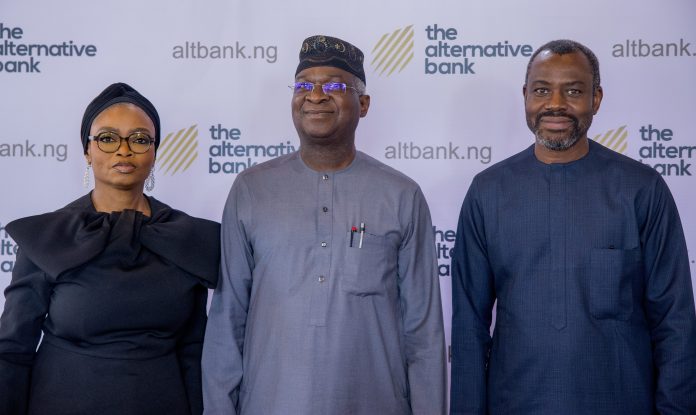
The call was made on Thursday at the “Beyond Interest” private intelligence forum organised by The Alternative Bank in Victoria Island, Lagos.
The event brought together investors, entrepreneurs, wealth creators and institutional decision-makers to explore how ethical finance can support infrastructure development, enterprise growth and sustainable wealth creation.
Chairman of The Alternative Bank, Muhtar Bakare, said Nigeria’s biggest challenge was not a shortage of capital but the absence of patient capital capable of supporting long-term economic transformation.
He said investments should be evaluated not only by the financial returns they generate but also by their ability to build productive capacity, create jobs and strengthen economic resilience.
Lagos State Governor Babajide Sanwo-Olu said government should serve as an enabler of private investment by providing infrastructure and creating a conducive business environment.
Represented by the Commissioner for Finance, Abayomi Oluyomi, the governor cited Lagos’ infrastructure programme, recent dual bond issuance and development of the Lekki corridor as examples of public investments designed to improve private-sector confidence.
Former Lagos State Governor and former Minister of Works and Housing, Babatunde Fashola urged investors to focus on financing productive assets capable of delivering lasting economic and social value rather than pursuing short-term financial gains.
Promoter of Non-Interest Banking in Nigeria and Board Member of Sterling Financial Holdings Company Plc, Abubakar Suleiman, said The Alternative Bank had evolved from a non-interest banking window established in 2014 into an institution with assets approaching ₦500 billion and nearly one million customers.
He said ethical finance should assess investments based on their impact on customers, employees, communities, infrastructure and the environment, alongside financial returns.
Suleiman cited the bank’s WasteBanc recycling initiative and Nigeria’s sovereign Sukuk programme as examples of investments capable of delivering both commercial returns and measurable developmental impact.
Also speaking, Group Chief Innovation and Technology Officer at Meristem, Dr Stanley Jacob, argued that Africa’s primary financial challenge was inadequate infrastructure rather than insufficient liquidity.
Executive Director of Tugrande Alliance Limited, Ajibola Tobi-Osho, said Nigeria’s challenge had shifted from macroeconomic instability to inefficient capital allocation, noting that significant liquidity remained parked at the Central Bank instead of financing productive businesses.
The issues
Nigeria continues to face a significant financing gap despite improved liquidity within the financial system. Experts argue that much of the available capital is concentrated in short-term investments rather than sectors capable of driving industrialisation, employment and infrastructure development. Advocates of non-interest finance believe ethical investment models can mobilise patient capital, strengthen financial inclusion and improve long-term economic productivity while delivering competitive returns.
What’s being said
“What we lack is not effort. We lack capital that stays long enough to turn effort into capacity, capacity into durable jobs and durable jobs into stability. That is why the distinction between extractive and productive capital matters.”– Muhtar Bakare, Chairman, The Alternative Bank:
“The future of finance is not only about the price of capital; it is increasingly about the quality of the economic activity that capital enables. Lagos is not only open for business; Lagos is prepared to do business.”– Babajide Sanwo-Olu, Governor, Lagos State (represented by Abayomi Oluyomi, Commissioner for Finance):
“The Alternative Bank has shown that non-interest banking can grow, win customers, and generate profit. The business case for ethical capital already exists. Our task is to apply it with discipline.”– Abubakar Suleiman, Board Member, Sterling Financial Holdings Company Plc:
What’s next
Stakeholders are expected to continue advancing discussions on expanding non-interest finance, attracting long-term investment into productive sectors and strengthening partnerships between government, financial institutions and private investors to support sustainable economic growth.
Bottom line
Participants at the forum argued that Nigeria’s long-term economic transformation will depend less on the availability of capital and more on directing patient, ethical investment towards infrastructure, businesses and productive sectors capable of creating lasting economic value.
Every admission season, thousands of Nigerian students ask the same question:
“Will I get admission this year?”
The first thing many people do is compare their JAMB score with the school’s cut-off mark. If their score is above it, they become hopeful. If it is below, they start considering a change of institution.
But admission into Nigerian universities is rarely that simple.
Meeting a school’s minimum score only makes you eligible to be considered. Whether you eventually secure admission depends on several factors working together. If you’re trying to determine your chances of gaining admission in 2026, here’s what you should realistically assess.
Your JAMB score is only the starting point
A high UTME score certainly improves your chances, especially for competitive courses, but it is not a guarantee of admission.
For example, a score of 240 may be competitive for one course at one university but fall short for another institution where hundreds of candidates scored even higher.
Likewise, a candidate with 190 may still gain admission into a less competitive programme if other admission requirements are met.
Instead of asking, “Is my score high?” ask a more useful question:
How does my score compare with other candidates applying for the same course?
Admission is a competition, not just a qualification exercise.
Your O’Level grades matter more than many students realise
Some candidates focus so much on JAMB that they overlook the importance of their WAEC or NECO results.
For many universities, O’Level grades contribute to the overall screening process. Even where they are not assigned numerical points, strong grades can strengthen a candidate’s profile.
Candidates with mostly A and B grades generally stand on stronger ground than those with the minimum five credits, particularly when applying for highly competitive courses.
Beyond grades, ensure your subject combination matches your intended course. Missing a required subject can affect your eligibility regardless of your UTME score. Universities also require candidates to satisfy their O’Level requirements before admission.
The course you chose changes the competition
Not every course is equally competitive.
Medicine, Nursing, Law, Pharmacy, Computer Science and Engineering programmes usually attract far more applicants than departments such as Fisheries, Crop Science, Education or some Arts courses.
That means two candidates with exactly the same JAMB score may have completely different admission prospects simply because they applied for different programmes.
If your preferred course consistently admits candidates with much higher scores than yours, you may need to consider whether changing to a related programme offers a more realistic pathway.
Your state of origin may influence admission in some federal institutions
Many candidates hear about “catchment” but don’t fully understand what it means.
Federal universities typically admit students through a combination of merit, catchment area and educationally less-developed state considerations, as provided for in Nigeria’s admission policy. While merit remains a major component, catchment may improve a candidate’s chances in institutions serving particular geographical areas.
However, catchment should never be viewed as a substitute for meeting academic requirements. Candidates must still satisfy the university’s admission criteria.
Your choice of institution can improve or reduce your chances
Some universities receive far more applications than others every year.
Applying to a school with extremely high demand naturally increases competition, even if your qualifications are good.
Before concluding that you have little chance of admission, compare your profile with the institution you’ve chosen. In some cases, changing to another accredited university with similar academic standards but lower competition may significantly improve your prospects.
The decision should be based on careful research rather than panic after UTME results are released.
Don’t underestimate the Post-UTME
Many candidates relax after writing JAMB, assuming the hard part is over.
For institutions that conduct Post-UTME examinations or screening exercises, this can be a costly mistake.
A strong performance in the school’s screening process can strengthen your overall admission profile, while poor preparation may reduce your chances despite a good UTME score. Many universities continue to use Post-UTME or other screening methods as part of their admission process.
Treat the Post-UTME with the same seriousness you gave the UTME.
Other details can make or break your admission
Even academically qualified candidates sometimes lose admission opportunities because of avoidable mistakes.
Examples include failing to upload O’Level results to JAMB CAPS on time, selecting the wrong subject combination, ignoring screening deadlines or failing to accept admission once it is offered.
These administrative requirements may seem minor, but they can determine whether an otherwise qualified candidate is eventually admitted.
So, do you stand a real chance?
A realistic assessment should consider all of the following together:
Is your JAMB score competitive for your course?
Do your O’Level grades strengthen your application?
How competitive is your chosen programme?
Does your institution apply catchment considerations that may affect your application?
Are you prepared for the Post-UTME or screening process?
Have you met every administrative requirement?
If you can answer “yes” to most of these questions, your admission chances are likely stronger than someone relying on JAMB score alone.
Bottom line
Admission in 2026 will not be determined by one number. It will be decided by how well your academic profile compares with other candidates applying for the same course and institution. Rather than waiting anxiously for cut-off marks, take a holistic look at your application. Sometimes the difference between gaining admission and missing out isn’t your JAMB score—it’s the combination of choices you made before and after the exam.
Every rainy season, the same question returns. Can solar panels still generate electricity when the sky is covered with clouds?
It is a concern shared by many Nigerians who already use solar power and those considering switching from generators or unreliable grid electricity. On social media, videos often surface of frustrated users wondering why their systems seem to perform poorly whenever the weather changes. Friends and neighbours reinforce the uncertainty, insisting that solar panels simply stop working once the sun disappears. The belief has become so widespread that many solar installers now spend almost as much time correcting misconceptions as they do installing systems.
So, what is the truth? To separate fact from fiction, Biz Renewables spoke with three Nigerian solar professionals who collectively have decades of experience designing and installing solar systems across homes and businesses. While each explained the issue differently, they all agreed on one important point: cloudy weather does not automatically mean your solar panels have stopped working.
Solar panels still work, but they produce less electricity
According to Boma Jacks, founder of SOLUSOFT LIMITED, one of the biggest misconceptions about solar is that rain or cloudy skies completely shut down electricity generation.
That is not how solar panels work. He explains that solar panels generate electricity from sunlight, not heat. Even when thick clouds cover the sky, some sunlight still passes through the atmosphere. Modern solar panels can capture this scattered light, although they produce much less electricity than they would on a bright, sunny day. On heavily overcast days, he says, a solar panel may produce only about 10 to 25 per cent of its normal output. The exact amount depends on how dark the clouds are and how much sunlight reaches the panels.
Interestingly, rain itself is not the problem. In fact, rain often helps by washing away dust, dirt and harmattan particles that accumulate on the surface of solar panels. Once the skies clear, cleaner panels can sometimes perform better than they did before the rainfall.
For many installations in Nigeria, he says, prolonged dust during the dry season can have a greater impact on performance than the rain itself.
Weather matters, but so does the type of solar system you have
While agreeing that cloudy weather affects performance, Osunniyi Obafemi of Light House Inverters says the experience can vary from one installation to another. He explains that solar panels rely on sunlight to generate enough electrical current to charge batteries. During periods of heavy cloud cover, the amount of usable electricity produced drops significantly.
In some situations, particularly during persistent rainfall, certain systems may produce so little charging current that battery charging becomes extremely slow or almost nonexistent. However, he says newer solar technologies have improved performance in low-light conditions.
Modern monocrystalline solar panels, for example, perform better than many older panel designs because they are more efficient at converting available sunlight into electricity.
He also points to newer technologies designed to reduce losses caused by partial shading. These improvements do not eliminate the impact of cloudy weather, but they help systems continue producing electricity under conditions that would have significantly affected older equipment. The result is that two neighbouring homes can have very different experiences during the same rainy week, depending on the quality of their equipment and how their systems were designed.
Your batteries may be the bigger issue
Many people assume their solar panels have failed because they notice their batteries no longer last through the night. The problem, however, is not always the panels.
According to Boma Jacks, many disappointing solar experiences can be traced back to incorrect system design rather than faulty equipment.
One of the most common mistakes is installing a system that is too small for the amount of electricity a household or business actually consumes. To reduce costs, some buyers choose smaller systems without properly calculating their energy needs. The result is that the batteries are constantly overworked, leading to poor performance and a shorter lifespan. He also points to poor battery installation, low-quality batteries, undersized cables and inadequate protection systems as common causes of disappointing performance. When these problems occur together, people often blame the weather when the real issue lies elsewhere.
Why your solar system may struggle more during the rainy season
Obafemi says seasonal changes naturally affect how much electricity a solar system can generate. During the dry months, when sunlight is stronger and lasts longer, solar panels generally perform at their best. As the rainy season sets in, the number of hours with strong sunlight falls, reducing the amount of energy collected during the day.
That means households may need to be more careful about how they use stored electricity. He says one mistake many users make is assuming that because their batteries powered the house comfortably during the dry season, they should provide exactly the same backup during weeks of continuous rain. In reality, less energy is being stored each day because less sunlight is available.
Without adjusting electricity use, batteries may appear to run down much faster even though they are functioning normally.
Not every poor-performing system has bad equipment
Adedayo Philip Ayegusi of Firstiephil Enterprise says many solar complaints can be avoided before installation even begins.
In his view, buying quality equipment is only part of the solution. A properly designed system should match both current and future electricity needs. Choosing reliable panels, quality lithium batteries and experienced installers makes a significant difference over the life of the system. He also advises buyers to monitor their systems regularly through available mobile apps, keep warranty documents and ensure proper safety measures are installed from the beginning.
According to him, a solar system should be viewed as a long-term investment rather than simply another appliance.
So, should cloudy weather stop you from investing in solar?
Based on the experiences of the three installers, the verdict is no. Clouds reduce the amount of electricity solar panels generate, but they do not automatically stop them from working. How much electricity you still receive depends on several factors, including the intensity of the cloud cover, the quality of your solar panels, the size of your system, the condition of your batteries and how well the entire installation was designed.
The more important lesson may be this: when a solar system performs poorly, the weather is not always to blame. In many cases, disappointing performance begins long before the first rainy day. It starts with poor planning, undersized systems, low-quality components or installations that prioritised the cheapest quote over long-term reliability.
For anyone considering solar, understanding that distinction could mean the difference between years of dependable electricity and becoming the next person on social media asking why their solar system no longer works.
Investment Bank of Africa says structural reforms are needed to unlock stronger investment and sustainable economic growth.
Report identifies unreliable electricity, weak infrastructure and high production costs as Nigeria’s biggest competitiveness challenges.
IBA projects Nigeria’s economy will grow by 4.1 per cent in 2026 but says growth alone will not improve living standards.
Investors are advised to prioritise reliable energy, efficient logistics and resilient local supply chains.
Main story
Nigeria can unlock stronger economic growth and become one of Africa’s most attractive investment destinations only by addressing persistent structural challenges in electricity, infrastructure, employment and productivity, according to a new economic framework released by the Investment Bank of Africa (IBA).
The report projects Nigeria’s economy to grow by 4.1 per cent in 2026, in line with the International Monetary Fund’s outlook, but says stronger economic expansion will not translate into higher living standards unless it creates formal jobs, improves productivity, expands local value addition and strengthens foreign exchange earnings.
According to the report, Nigeria’s biggest economic constraint remains its high cost of production, driven by unreliable electricity, poor transport infrastructure, port congestion, dependence on imported equipment, high borrowing costs and policy uncertainty.
It said these structural weaknesses continue to undermine business competitiveness, encourage informality and expose consumer prices to exchange-rate volatility and fuel price shocks.
The framework recommends that investors prioritise projects capable of securing reliable electricity, efficient logistics, resilient local supply chains and predictable cash flows before expanding operations.
It also advises businesses relying on imported equipment or foreign-currency borrowing to generate export or dollar-linked revenue to reduce exchange-rate risks.
The report identifies electricity as Nigeria’s most significant production bottleneck despite the country’s installed generation capacity.
According to IBA, Nigeria had about 13,625 megawatts of installed generation capacity as of April 2026, but only 4,286MW was available for dispatch while average operational generation stood at 4,048MW.
The report attributes the gap to maintenance challenges, fuel shortages, transmission constraints, distribution inefficiencies and weak commercial performance across the electricity value chain.
It recommends greater investment in grid infrastructure, embedded generation, mini-grids, renewable energy, smart metering and stronger revenue collection to improve power reliability.
IBA also warned that labour underutilisation remains one of Nigeria’s biggest economic risks.
Using its internal analytical framework, the report estimates labour underutilisation at 60.4 per cent, with only 43 per cent of the working-age population actively participating in the labour market. It notes that these figures are internal estimates and not official government statistics.
The report argues that future economic policies should prioritise permanent, productive employment rather than temporary jobs generated during construction projects.
It recommends linking government incentives, procurement and industrial policies to measurable outcomes such as permanent employment, workforce skills development and productivity improvements.
Although macroeconomic indicators have improved, the report says many households have yet to experience corresponding gains in living standards.
According to IBA, stronger foreign exchange reserves and moderating inflation have not translated into higher purchasing power because production costs remain elevated while household incomes continue to face pressure.
The report identifies agriculture, food processing, logistics, housing, digital infrastructure, manufacturing and renewable energy as sectors with strong long-term investment potential.
It says improved food production will only lower food prices if accompanied by investment in irrigation, storage, processing, transport and cold-chain infrastructure.
IBA also recommends evaluating infrastructure projects based on service delivery rather than capital expenditure, while urging investors to view Nigeria as a collection of regional markets with differing infrastructure quality, regulatory conditions, security risks and investment opportunities.
The issues
Nigeria’s economic reforms have improved several macroeconomic indicators, but businesses continue to face structural constraints that raise production costs and limit competitiveness. Persistent electricity shortages, weak transport infrastructure, high financing costs and policy uncertainty remain major obstacles to industrial growth, job creation and foreign investment. The report suggests that addressing these bottlenecks could improve productivity, strengthen export competitiveness and make economic growth more inclusive.
What’s being said
“Nigeria can unlock stronger economic growth and become one of Africa’s most attractive investment destinations only if it addresses persistent structural challenges in power, infrastructure, employment and productivity.”– Investment Bank of Africa (IBA):
“Nigeria’s biggest economic challenge remains the high cost of production, driven by unreliable electricity, transport bottlenecks, port congestion, imported equipment, high borrowing costs and policy uncertainty.”– Investment Bank of Africa (IBA):
“Future economic policies should focus on creating permanent, productive jobs instead of temporary employment generated during construction projects.”– Investment Bank of Africa (IBA):
“Investors should approach Nigeria as a collection of state and regional markets rather than a single national economy.”– Investment Bank of Africa (IBA):
What’s next
IBA expects policymakers, investors and businesses to focus on improving power supply, infrastructure, productivity and employment while strengthening local value chains. The report also urges investors to stress-test projects against inflation, exchange-rate volatility, infrastructure reliability, security risks and policy implementation before deploying capital.
Bottom line
IBA says Nigeria’s long-term investment potential remains strong, but sustained economic growth and improved living standards will depend on tackling structural constraints in electricity, infrastructure, employment and productivity rather than relying on macroeconomic expansion alone.
The West African Examinations Council (WAEC) has released the 2026 West African Senior School Certificate Examination (WASSCE) results. Candidates can now check their results online by first retrieving their WAEC Result Checker Serial Number and PIN, then using the official WAEC result portal.
This guide explains everything you need to know, from recovering your PIN to viewing and printing your result.
What you need before checking your WAEC result
Before you begin, ensure you have:
Your WAEC Examination Number
Your examination year (2026)
Your National Identification Number (NIN)
The same phone number and email address used during WAEC registration (for PIN retrieval)
A smartphone, tablet or computer with internet access
Step 1: Retrieve your WAEC Serial Number and PIN
If you do not already have your Result Checker PIN and Serial Number, follow these steps:
Visit the official WAEC portal.
Click on the “Serial Number and PIN” menu.
Select your examination year.
Enter your:
Examination Number
National Identification Number (NIN)
Ensure the NIN matches the one used during your WAEC registration.
Enter your email address and phone number.
Receive the One-Time Password (OTP).
Enter the OTP to retrieve your:
WAEC Serial Number
WAEC Result Checker PIN
WAEC also allows candidates to download their WAEC ID Card from the portal.
This is the official platform for checking WASSCE results.
Step 3: Enter your examination number
Input your 10-digit WAEC Examination Number.
It consists of:
7-digit Centre Number
3-digit Candidate Number
Example:
4123456789
Step 4: Select your examination year
Choose:
2026
Step 5: Select your examination type
Select the correct examination type.
For most school candidates, choose:
School Candidate Result
Selecting the wrong examination type may prevent your result from displaying correctly.
Step 6: Enter your Serial Number and PIN
Type in:
Your WAEC Serial Number
Your Result Checker PIN
Ensure both are entered exactly as retrieved.
Step 7: Submit
Click Submit.
If all your details are correct, your WAEC result will appear on the screen within a few seconds.
Step 8: Print or save your result
After your result is displayed:
Print a hard copy for future reference.
Save a PDF copy on your device.
You can also take a screenshot as a backup.
What if your result does not display?
If you encounter problems:
Confirm your examination number is correct.
Ensure you selected the correct examination year.
Verify you chose the correct examination type.
Check that your Serial Number and PIN are accurate.
Refresh the page and try again if the portal is busy.
If the issue persists, contact WAEC through its official support channels.
Frequently Asked Questions
Can I check my WAEC result on my phone?
Yes. The WAEC Result Checker works on smartphones, tablets and computers with an internet connection.
Do I need a PIN to check my result?
Yes. You must have a valid WAEC Result Checker PIN and Serial Number before accessing your result.
Can I retrieve my PIN if I lost it?
Yes. WAEC allows candidates to recover their Serial Number and PIN through its official portal using their examination number, NIN, email address and phone number.
Bottom line
Checking your 2026 WAEC result online is straightforward once you have your examination number, Serial Number and Result Checker PIN. Simply retrieve your credentials if necessary, visit the official WAEC Result Checker portal, enter your details correctly and submit to view your result. Printing or saving a copy is recommended for future use.
Alfa Design urges Nigeria to deepen investment in indigenous engineering and local technology.
The company says bureaucracy and delayed payments remain major obstacles to local content development.
It calls for stronger support for local manufacturing, CNG infrastructure and specialised technical training.
Main story
Nigeria must strengthen local engineering capacity and invest in indigenous technology to compete effectively in the global economy, according to the Chief Executive Officer of Alfa Design Nigeria Ltd., Mr Fatai Quadri.
Quadri told the News Agency of Nigeria (NAN) on Thursday in Lagos that sustainable national development depends on supporting innovation, empowering manufacturers and promoting locally developed engineering solutions.
He said Alfa Design was established to improve lives through engineering solutions in the oil and gas sector and had invested heavily in research and development to produce indigenous technologies capable of competing with international products.
Quadri cited the company’s patented SmartCom Unit, developed to improve surface wellhead operations and address industry-specific challenges, as an example of local innovation.
On energy transition, he said Alfa Design had expanded its investments in Compressed Natural Gas (CNG) infrastructure by producing conversion kits, developing gas stations and designing gas transfer equipment with integrated booster systems.
According to him, the company’s involvement in the CNG sector extends beyond commercial interests to solving national energy challenges through sustainable and market-driven solutions.
Quadri said Alfa Design aims to remain a major contributor to Nigeria’s industrial development and economic growth over the next five years.
He acknowledged government efforts to promote local content but said bureaucratic bottlenecks continued to weaken the effectiveness of existing policies.
According to him, duty waivers on imported equipment are often undermined by lengthy approval processes and additional administrative costs.
Quadri recommended simplified implementation procedures, improved inter-agency coordination and greater public awareness of available incentives.
Addressing financing challenges, he said delayed payments, legacy debts and prolonged settlement periods had increased financial risks across the oil and gas industry.
He argued that improving payment discipline and restoring investor confidence were as important as expanding access to financing.
Quadri advocated stronger support for local manufacturing, technology development, affordable financing and tax incentives for indigenous companies.
He said expanding local production would reduce capital flight, conserve foreign exchange and create employment opportunities.
Quadri also highlighted Alfa Design’s achievements in greenhouse gas monitoring and fugitive emissions management, noting that the company had established Africa’s only authorised Optical Gas Imaging operator training centre in Lagos.
He said the facility enables Nigerian professionals to obtain internationally recognised certification locally, reducing dependence on overseas training.
According to him, the company’s investments have reduced reliance on foreign specialists for greenhouse gas monitoring services by more than 50 per cent.
Quadri urged government, operators and industry stakeholders to support indigenous engineering firms capable of delivering globally competitive solutions.
The issues
Nigeria’s local content policy seeks to increase indigenous participation in the oil and gas industry by encouraging local manufacturing, technology development and skills transfer. However, industry players continue to cite bureaucratic delays, financing constraints and weak policy implementation as major barriers to achieving these objectives.
What’s being said
“Every investment and innovation we pursue is driven by that vision.” – Mr Fatai Quadri, Chief Executive Officer, Alfa Design Nigeria Ltd.
“Engineering excellence is not exclusive to any region. African professionals possess the expertise to develop world-class technologies.” – Mr Fatai Quadri, Chief Executive Officer, Alfa Design Nigeria Ltd.
What’s next
Industry stakeholders are expected to continue engaging government on reforms to improve local content implementation, strengthen indigenous manufacturing, expand CNG infrastructure and create a more enabling environment for engineering innovation.
Bottom line
Strengthening indigenous engineering capacity, removing policy bottlenecks and supporting local innovation could help Nigeria build a more competitive oil and gas industry while driving industrialisation, job creation and long-term economic growth.
Indigenous engineering innovations are reducing operational downtime and maintenance costs in Nigeria’s oil and gas sector.
Locally developed technologies are improving pipeline safety, equipment maintenance and energy efficiency.
Alfa Design says its engineering capabilities support Nigeria’s local content and energy transition objectives.
Main story
A wellhead engineer, Mr Ikechukwu Okonkwo, says indigenous engineering innovations are helping to reduce operational downtime, lower costs and improve efficiency across Nigeria’s oil and gas industry.
Okonkwo, Head of the Wellhead Department at Alfa Design Nigeria Ltd., said this in an interview with the News Agency of Nigeria (NAN) on Thursday in Lagos.
He said the growing adoption of locally developed technologies and engineering solutions was enabling operators to improve productivity, reduce reliance on imported equipment and strengthen local content development.
According to him, Alfa Design has established a fully equipped engineering workshop where advanced oil and gas equipment is designed, assembled and maintained locally.
He identified the company’s Smart Control Unit, an Internet of Things (IoT)-enabled embedded system for remote monitoring and control of oil and gas facilities, as one of its flagship innovations.
Okonkwo said the system controls safety valves, protects flow lines from operational failures and reduces environmental risks associated with oil and gas operations.
He added that the company also operates advanced conventional and computer-controlled machining equipment capable of manufacturing precision-engineered replacement components directly from engineering drawings, reducing dependence on imported spare parts.
According to him, locally manufactured replacement parts help operators minimise equipment downtime, lower maintenance costs and improve operational efficiency.
Okonkwo said the Smart Control Unit was developed to address recurring pipeline failures and crude oil spills by improving pipeline safety, reducing crude losses and lowering environmental pollution risks.
On energy transition, he said the company had developed a customised Compressed Natural Gas (CNG) generator powered entirely by natural gas as a cheaper alternative to diesel generators.
He said hospitals, hotels, factories and other businesses could reduce fuel costs by more than 60 per cent, depending on consumption levels.
He added that Alfa Design also supplies, installs and maintains CNG conversion kits for vehicles and motorcycles to support Nigeria’s transition to cleaner energy.
Okonkwo said the company provides computer-aided engineering design services using AutoCAD technology and operates advanced Computer Tomography (CT) scanning equipment capable of producing three-dimensional images of engineering components for reverse engineering and industrial analysis.
He explained that the technology also supports reservoir studies by analysing rock samples to determine porosity and permeability without damaging the samples.
Okonkwo reaffirmed the company’s commitment to supporting Nigeria’s local content policy through indigenous technology, advanced manufacturing, engineering research and innovative energy solutions.
Also speaking, the Business Development Manager of Alfa Design Nigeria Ltd., Miss Ugochi Onyeabor, said the company had introduced the Genesis New Vision (GNV) mobile application to promote healthy living, environmental sustainability, innovation and community development.
She said the application provides an alternative social networking platform with dedicated sections on health, environment, innovation, charity and community engagement.
Onyeabor added that the platform also features a “Free Shop”, where users can donate clothing, food and household items at no cost, and is available free on Google Play Store and Apple App Store.
The issues
Nigeria’s oil and gas industry continues to pursue greater local content participation by encouraging indigenous engineering, local manufacturing and technology development. Industry stakeholders believe expanding domestic technical capacity can reduce import dependence, lower operating costs and improve the sector’s competitiveness while supporting cleaner energy solutions.
What’s being said
“The Smart Control Unit was designed, assembled and patented by Alfa Design, making it one of our major indigenous engineering achievements.” – Mr Ikechukwu Okonkwo, Head, Wellhead Department, Alfa Design Nigeria Ltd.
“This enables companies to carry out critical engineering analysis locally instead of sending samples abroad, thereby reducing costs, saving time and strengthening Nigeria’s technical capacity.” – Mr Ikechukwu Okonkwo, Head, Wellhead Department, Alfa Design Nigeria Ltd.
“Users can monitor fitness activities, participate in wellness challenges, report environmental concerns, showcase innovative ideas and support verified fundraising campaigns.” – Miss Ugochi Onyeabor, Business Development Manager, Alfa Design Nigeria Ltd.
What’s next
Alfa Design plans to expand the deployment of its locally developed engineering technologies and digital solutions as demand grows for indigenous manufacturing, smarter oilfield operations and cleaner energy technologies.
Bottom line
Locally developed engineering innovations are increasingly positioning Nigerian firms to improve operational efficiency, strengthen local content and support the country’s broader energy transition objectives.
NGX says market capitalisation has grown from about ₦30 trillion in May 2023 to over ₦150 trillion.
Exchange projects market value could reach ₦230 trillion by the end of 2026.
NGX urges government to list stakes in major national assets to deepen the capital market.
Main story
The Nigerian Exchange Group (NGX) says the market capitalisation of listed companies has increased from about ₦30 trillion in May 2023 to more than ₦150 trillion.
NGX Group Managing Director and Chief Executive Officer, Mr Temi Popoola, disclosed this after NGX and Securities and Exchange Commission (SEC) officials met President Bola Tinubu on Thursday.
The delegation briefed the President on the performance of the capital market, growth prospects and measures required to deepen investor participation.
Popoola said market capitalisation could rise to about ₦230 trillion by the end of 2026, driven by expected major listings, including the proposed listing of the Dangote Refinery.
He said the expansion had created significant wealth for investors and businesses, estimating that between 500,000 and 900,000 new millionaires had emerged through capital market gains.
According to him, the earnings of many listed companies had also increased substantially, with some firms recording as much as five-fold growth since 2023.
Popoola attributed the market’s performance to reforms introduced under the Tinubu administration, including fuel subsidy removal, foreign exchange reforms, the Investment and Securities Act 2025, banking sector recapitalisation and digital transformation initiatives.
He added that banks had raised more than ₦4 trillion through recapitalisation exercises, with the figure expected to exceed ₦5 trillion before the end of the year.
The NGX chief said the exchange presented a vision of a capital market capable of financing infrastructure and supporting Nigeria’s ambition of becoming a one-trillion-dollar economy.
He also urged the Federal Government to accelerate privatisation by listing stakes in major national assets, including Nigeria LNG, Indorama and selected Nigerian National Petroleum Company Ltd. assets.
Popoola said the exchange also sought incentives to encourage more private companies to list on the domestic market instead of pursuing foreign listings exclusively.
He said President Tinubu assured the delegation of his continued support for policies aimed at deepening capital market development.
Earlier, NGX Group Chairman, Alhaji Umaru Kwairanga, said the Nigerian market had recently ranked among the world’s best-performing exchanges, attributing the achievement to ongoing economic reforms and stronger investor confidence.
Also speaking, SEC Director-General, Dr Emomotimi Agama, reaffirmed the commission’s commitment to maintaining market stability and creating an enabling environment for investors and market participants.
The issues
Nigeria’s capital market has recorded significant growth since 2023, supported by economic reforms and increased investor activity. Industry leaders believe additional listings of major public and private assets could further deepen the market, improve liquidity and expand investment opportunities.
What’s being said
“In May 2023, when Mr President came into office, the market capitalisation was just shy of ₦30 trillion. Today, that figure is over ₦150 trillion.” – Mr Temi Popoola, Group Managing Director and Chief Executive Officer, Nigerian Exchange Group.
“The banks have raised over ₦4 trillion and before the end of this year maybe over ₦5 trillion, mostly from domestic investors.” – Mr Temi Popoola, Group Managing Director and Chief Executive Officer, Nigerian Exchange Group.
What’s next
NGX will continue engaging the Federal Government on listing additional national assets and implementing policies aimed at attracting more companies and investors to Nigeria’s capital market.
Bottom line
The Nigerian capital market has experienced rapid expansion over the past three years, with industry leaders expecting further growth if planned reforms, major listings and privatisation initiatives are sustained.
Africa CDC and WHO call for urgent community-led action to contain Ebola in the DRC.
Joint mission identifies gaps in case detection, treatment and frontline support.
Agencies urge stronger surveillance rather than travel or trade restrictions.
Main story
The Africa Centres for Disease Control and Prevention (Africa CDC) and the World Health Organization (WHO) have called for urgent, community-led action to contain the worsening Ebola outbreak in the Democratic Republic of the Congo (DRC).
The appeal followed a joint high-level mission to Uganda and the DRC on Aug. 4 and 5 to assess response efforts and identify operational priorities for stronger regional collaboration.
The mission was led by WHO Director-General Dr Tedros Ghebreyesus, Africa CDC Director-General Dr Jean Kaseya and WHO Regional Director for Africa Dr Mohamed Janabi.
The delegation visited Kampala, Bunia and Kinshasa, where it met government officials, health workers, community leaders and response partners to evaluate interventions and strengthen coordination.
Officials reviewed the outbreak’s progress, identified operational gaps and relayed concerns raised by affected communities to national authorities.
Africa CDC and WHO commended Uganda for successfully containing its outbreak, noting that the country declared Ebola on July 28 after recording 20 confirmed cases and two deaths, with all identified contacts completing follow-up.
The agencies urged neighbouring countries to strengthen preparedness and surveillance to reduce the risk of cross-border transmission.
In Bunia, the outbreak’s epicentre, the delegation visited the Rwangole Ebola Treatment Centre to assess patient care, operational capacity and challenges facing frontline health workers.
The agencies said ending the outbreak would depend on communities receiving trusted information and participating actively in surveillance, case reporting and response activities.
They urged residents to recognise Ebola symptoms early, report suspected cases promptly and seek treatment without delay.
The statement identified religious, traditional, women’s and youth leaders as critical partners in building public trust, countering misinformation and encouraging community participation.
The agencies also praised health workers and affected communities for sustaining response efforts despite insecurity, population displacement, misinformation and limited healthcare resources.
According to the statement, response teams continue to face delayed case detection, treatment shortages, resistance to interventions and inadequate frontline support.
Ituri Province accounts for nearly 90 per cent of confirmed Ebola cases, with Bunia, Rwampara and Mongbwalu among the worst-affected health zones.
As of Aug. 4, the DRC had recorded 3,973 confirmed cases, 1,801 deaths and 776 recoveries across 51 health zones. Authorities also reported 99 new confirmed cases and 52 deaths within the latest 24-hour reporting period.
The agencies said contact tracing had reached 75 per cent, below the 95 per cent target required to interrupt transmission, while about 674 patients remained under care and treatment centres in North Kivu were operating at 139 per cent capacity.
Africa CDC and WHO called for expanded treatment centres, stronger laboratory services, increased ambulance capacity, safe burial operations and better protection, equipment and timely payment for frontline health workers.
They also urged stronger government coordination, sustained financing and improved access to affected communities while pledging continued technical support.
The issues
The DRC continues to face one of the world’s most severe Ebola outbreaks, with insecurity, displacement, limited healthcare resources and misinformation undermining response efforts. Health agencies say stronger community participation and sustained investment are essential to slowing transmission and preventing further regional spread.
What’s being said
“Uganda’s successful containment demonstrated that rapid detection, contact tracing and strong community engagement can stop Ebola transmission.” – Africa CDC and World Health Organization (joint statement).
“Response teams reported delayed case detection, treatment shortages, resistance to interventions and inadequate frontline support.” – Africa CDC and World Health Organization (joint statement).
“Contact follow-up reached 75 per cent, below the 95 per cent target needed to rapidly interrupt Ebola transmission.” – Africa CDC and World Health Organization (joint statement).
“Africa CDC and WHO pledged continued technical support while advising countries to strengthen surveillance instead of imposing unnecessary travel or trade restrictions.” – Africa CDC and World Health Organization (joint statement).
What’s next
Africa CDC and WHO will continue supporting the DRC’s Ebola response while working with national authorities and neighbouring countries to strengthen surveillance, improve treatment capacity and increase community participation in outbreak control.
Bottom line
Health authorities say containing the Ebola outbreak in the DRC will depend on stronger community engagement, faster detection and sustained investment in frontline response systems.
Kogi Assembly commends ECN Director-General for facilitating a renewable energy college.
Barefoot Renewable Energy College established at CUSTECH, Osara.
Lawmakers confirm Dr Saliu Ali as Permanent Member of Kogi SUBEB.
Main story
The Kogi House of Assembly has commended the Director-General of the Energy Commission of Nigeria (ECN), Dr Mustapha Abdullahi, for facilitating the establishment of a Barefoot Renewable Energy College in the state.
The commendation followed a resolution adopted on Thursday after a motion moved by Dr Suleiman Abdulrazak during plenary.
Lawmakers specifically praised Abdullahi’s role in establishing the college at the Confluence University of Science and Technology (CUSTECH), Osara.
Abdulrazak said the recognition reflected Abdullahi’s contributions to the development of the institution and the advancement of renewable energy education in Kogi State.
He described the ECN Director-General as a visionary leader whose efforts had positively impacted the state and the country.
In a separate resolution, the Assembly confirmed the appointment of Dr Saliu Ali as a Permanent Member of the Kogi Universal Basic Education Board (SUBEB) following his screening.
Lawmakers described Ali as an experienced public servant and expressed confidence in his ability to support improvements in basic education across the state.
The Speaker of the Assembly, Mr Aliyu Yusuf, who chaired the screening committee, urged the appointee to uphold transparency and diligence in the discharge of his responsibilities.
Responding after his confirmation, Ali thanked Gov. Ahmed Ododo for the appointment and the Assembly for approving his nomination.
He pledged to work with relevant stakeholders to strengthen the delivery of quality basic education in Kogi.
The issues
The establishment of specialised renewable energy institutions aligns with efforts to build local technical capacity for Nigeria’s energy transition, while appointments to education boards are expected to strengthen governance and improve service delivery in the basic education sector.
What’s being said
“Dr Mustapha Abdullahi is a visionary leader whose efforts have positively impacted both the state and the nation.” – Dr Suleiman Abdulrazak, Member, Kogi House of Assembly.
“Uphold transparency and diligence in the discharge of your responsibilities.” – Mr Aliyu Yusuf, Speaker, Kogi House of Assembly.
“I thank Gov. Ahmed Ododo for the appointment and the Assembly for approving my nomination.” – Dr Saliu Ali, Permanent Member-designate, Kogi Universal Basic Education Board.
“I will work with relevant stakeholders to strengthen the delivery of quality basic education in Kogi.” – Dr Saliu Ali, Permanent Member, Kogi Universal Basic Education Board.
What’s next
The Barefoot Renewable Energy College is expected to advance renewable energy training in Kogi, while the newly confirmed SUBEB board member will assume office to support reforms in the state’s basic education system.
Bottom line
The Assembly combined recognition of efforts to expand renewable energy education with moves to strengthen governance in the state’s basic education sector.
House Committee on Defence commends Tinubu over improved military salaries and welfare.
Lawmaker says creation of four new army divisions will strengthen security operations.
Committee pledges continued legislative support for defence sector reforms.
Main story
The Chairman of the House of Representatives Committee on Defence, Rep. Benson Babajimi, has commended President Bola Tinubu for reviewing the salaries and welfare packages of personnel of the Nigerian Armed Forces.
Babajimi, in a statement on Thursday, also praised the creation of four additional Nigerian Army divisions and the recruitment of 28,000 personnel.
He described the measures as historic, visionary and timely, saying they reflected the Federal Government’s commitment to strengthening the country’s security architecture.
According to him, the improved remuneration for officers and soldiers, particularly junior personnel, would boost morale, improve operational efficiency and strengthen personnel retention.
He added that the enhanced welfare package would also attract highly qualified recruits and reinforce the commitment of military personnel to defending Nigeria’s sovereignty and territorial integrity.
The lawmaker also lauded the expansion of the Nigerian Army from eight to 12 divisions through the establishment of new formations in Makurdi, Ilorin, Jalingo and Benin.
He said the reorganisation would improve command and control, decentralise operational responsibilities, enhance rapid troop deployment, strengthen border security and improve intelligence-led operations.
Babajimi added that the expansion would increase the military’s capacity to combat terrorism, insurgency, banditry, kidnapping and other criminal activities.
He reaffirmed the House Committee on Defence’s support for the ongoing security reforms and pledged continued legislative backing through policy support and oversight.
The issues
The Federal Government has continued efforts to strengthen Nigeria’s security architecture through military reforms, including improvements in personnel welfare, force expansion and operational capacity, as security agencies confront terrorism, banditry, kidnapping and other violent crimes.
What’s being said
Rep. Benson Babajimi, Chairman, House of Representatives Committee on Defence: “The President has once again demonstrated remarkable leadership and an unwavering commitment to the security and stability of our nation.”
Rep. Benson Babajimi, Chairman, House of Representatives Committee on Defence: “These bold reforms represent strategic investments in the men and women who daily make enormous sacrifices to safeguard our country’s peace, unity and democratic values.”
What’s next
The House Committee on Defence says it will continue to provide legislative oversight and policy support to ensure the successful implementation of the Federal Government’s military reform initiatives.
Bottom line
The committee believes improved welfare, increased recruitment and the expansion of army formations will strengthen Nigeria’s military capacity and enhance national security.
Kano Assembly committee begins inspection of allegedly encroached government lands.
Lawmakers vow to recover public lands occupied without authorisation.
Committee to engage traditional rulers, security agencies and other stakeholders.
Main story
A Special Committee of the Kano State House of Assembly has pledged to clamp down on land grabbers and recover government lands allegedly encroached upon across the state.
The committee’s Chairman, Muhammad Butu-Butu, made the pledge on Thursday during an inspection of lands belonging to the Kano State Agricultural Development Authority (KNARDA) and the Kano State Agricultural Supply Company (KASCO).
Butu-Butu, who is also the Deputy Speaker of the Assembly, said the committee was constituted following the adoption of a motion of urgent public importance by lawmakers.
He explained that the committee was mandated to investigate allegations of land encroachment and submit its findings and recommendations to the Assembly.
According to him, inspections carried out so far revealed several cases of alleged illegal occupation of government property.
He said some individuals claimed the lands had been allocated to them, while others occupied them without the approval of KNARDA or KASCO.
The lawmaker added that some parcels of land had also been taken over by local government authorities, while others were occupied by unidentified persons.
He said the committee would work with traditional institutions, security agencies and other relevant stakeholders during the investigation.
Butu-Butu reaffirmed the Assembly’s commitment to protecting public assets and ensuring that all government lands found to have been illegally occupied were recovered.
The inspection team included the Chairman of the House Committee on Agriculture, Ahmad Ibrahim-Karaye, the member representing Kiru Constituency, Usman Abubakar-Tasiu, committee officials and the managing directors of KNARDA and KASCO.
The committee visited sites at Kwankwasiyya City in Kumbotso Local Government Area, Karfi Store in Kura Local Government Area, Gwarmai Store in Bebeji Local Government Area, as well as affected lands in Kadawa, Garun Malam Local Government Area, and Gundutse Plot in Kura Local Government Area.
The issues
Illegal occupation of public land has remained a recurring challenge in several states, with governments seeking to recover assets reserved for public infrastructure, agriculture and other development purposes.
What’s being said
Muhammad Butu-Butu, Chairman of the Special Committee and Deputy Speaker of the Kano State House of Assembly: “We have visited many places in the course of this assignment and we have seen a lot of disturbing developments.”
Muhammad Butu-Butu, Chairman of the Special Committee and Deputy Speaker of the Kano State House of Assembly: “It is disturbing because some people were trying to take over government properties without any concrete justification.”
What’s next
The committee will continue its inspections across the state, engage key stakeholders and submit its findings and recommendations to the Kano State House of Assembly.
Bottom line
The investigation signals the Assembly’s resolve to safeguard public assets and recover government lands allegedly occupied without lawful authority.
Independent UN experts say new U.S. sanctions are worsening Cuba’s humanitarian crisis.
Experts warn the measures threaten access to food, healthcare and other essential services.
They urge the U.S. to lift the sanctions and call on the UN to treat the issue as urgent.
Main story
Independent United Nations human rights experts have condemned a fresh round of U.S. sanctions against Cuba, describing them as an attempt to force political change in a sovereign state through coercive measures.
The experts, appointed by the UN Human Rights Council, made their position known on Thursday, warning that without urgent international action Cuba risked becoming “a silent Gaza.”
The warning followed the expansion of unilateral U.S. sanctions on key sectors of the Cuban economy since June 2026.
According to the experts, the United States had already taken steps in January to block oil supplies into Cuba after shipments from Venezuela, previously a major supplier, were cut off.
They said additional measures announced on July 23 targeted energy companies, further restricting fuel imports, including those intended for humanitarian purposes.
The experts noted that Cuba was already facing severe fuel shortages and its third major nationwide blackout, with disruptions affecting energy supply, transportation, irrigation and other essential public services.
They warned that women, children, older persons and rural communities were among those most affected, while UN agencies had also reported worsening food insecurity, shortages of medicines and repeated electricity failures affecting healthcare delivery.
The experts further argued that a recent U.S. State Department report describing Cuba as a threat to U.S. national security did not provide concrete evidence to support allegations that the country sponsored terrorism or subversion.
They maintained that the sanctions violated international law and urged the United States to reverse the measures.
The issues
The U.S. embargo and sanctions on Cuba have long been a source of international debate. While Washington says the measures are intended to pressure the Cuban government over governance and human rights concerns, critics argue they worsen humanitarian conditions by limiting access to essential goods, energy and medical supplies.
What’s being said
“The humanitarian consequences are already unfolding into a full-blown crisis, threatening the rights to health, to life, to food and to development.”
“Food must never be used as an instrument of political pressure.”
“The U.S. Government must cease all threats and hostile acts against Cuba’s sovereignty and revoke all measures it has imposed on the country that stand contrary to international law.”
What’s next
The experts have urged the UN Security Council and the General Assembly to treat the situation as an urgent international peace and security issue, while calling on the U.S. to lift the sanctions. There has been no immediate response from U.S. authorities to the experts’ latest statement.
Bottom line
The renewed criticism underscores growing international concern over the humanitarian impact of U.S. sanctions on Cuba, even as Washington maintains pressure on the Cuban government over political and security issues.