





By Annette Ikponmwonba | September 16, 2026
Key Points
· Aliko Dangote says he put up all his assets as collateral and gave a personal guarantee to secure the initial $3.7bn loan for the refinery and fertiliser projects
· He calls it the biggest risk of his nearly five decade business career
· The refinery eventually cost about $20bn to build, making it one of Africa’s largest private industrial investments
· Dangote says many African entrepreneurs remain “scared to death” of major industrial investment due to policy uncertainty
· He credits his willingness to take on risk to a personal drive to keep fighting daily
Main Story
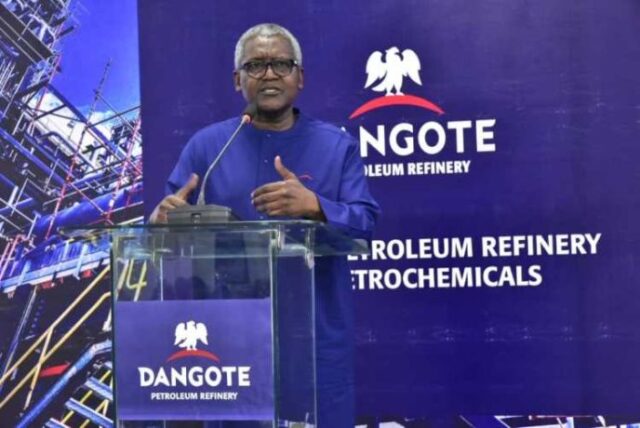
Aliko Dangote has revealed that he pledged all of his personal assets as collateral, alongside a personal guarantee, to secure the initial $3.7 billion loan used to finance the Dangote Petroleum Refinery and fertiliser projects. He described the move as the biggest risk of his business career, speaking in an interview on Arise News.
Asked to identify the single biggest risk he had taken across nearly five decades as an entrepreneur, Dangote pointed immediately to the refinery and fertiliser investments. “The biggest decision was the risk of the refinery and fertiliser,” he said, He explained that financing the projects required him to put everything he had built at the time on the line. “We gave all our assets as collateral. And apart from that, I gave a personal guarantee,” he said.
The Issues
The scale of the financial exposure Dangote describes underscores just how uncertain the refinery project was at its outset. The initial $3.7 billion loan came at a point when the eventual size, cost and completion timeline of the project were still far from settled, and the refinery would go on to cost roughly $20 billion in total, making it one of the largest private industrial investments ever undertaken on the continent. Committing personal assets and a personal guarantee against a project of that magnitude represented an extraordinary level of individual financial risk, even for one of Africa’s wealthiest businessmen.
Dangote’s broader comments also point to a structural problem he sees across African entrepreneurship: a widespread reluctance among wealthy Africans to make comparable industrial bets. He attributed this hesitancy largely to policy uncertainty, a factor that can make long horizon, capital intensive projects like refineries or large scale manufacturing feel too risky to pursue, even for investors with substantial capital, This raises a broader question about how much of Africa’s industrial development potential remains constrained not by capital availability, but by a risk appetite shaped by inconsistent or unpredictable policy environments.
What’s Being Said
Dangote was candid about the personal toll and mindset required to take on risk at that scale, describing his willingness to fight for these investments as something that has become intrinsic to who he is. “I fight every day, morning, day and night. It has become part of me now. I enjoy fighting,” he said, When asked directly why more wealthy Africans were not taking similar risks, he offered a pointed, almost self deprecating response, suggesting that his own appetite for sustained conflict and risk is not typical. “Everybody is not Aliko, who wants to fight every day,” he said.
What’s Next
With the refinery now operational and the broader Dangote Petroleum Refinery and Petrochemicals IPO recently opened on the Nigerian Exchange, attention is likely to shift toward how the business performs commercially and whether it validates the scale of risk Dangote took on to build it, His comments about policy uncertainty discouraging African industrial investment may also continue to shape conversations among investors and policymakers about what structural changes could encourage more entrepreneurs to pursue similarly ambitious projects.
Bottom Line
Dangote is framing personal risk tolerance, not just capital, as the defining factor behind Africa’s biggest industrial success stories, suggesting that the continent’s next wave of large scale investment may depend less on available wealth and more on entrepreneurs willing to stake everything the way he did.