






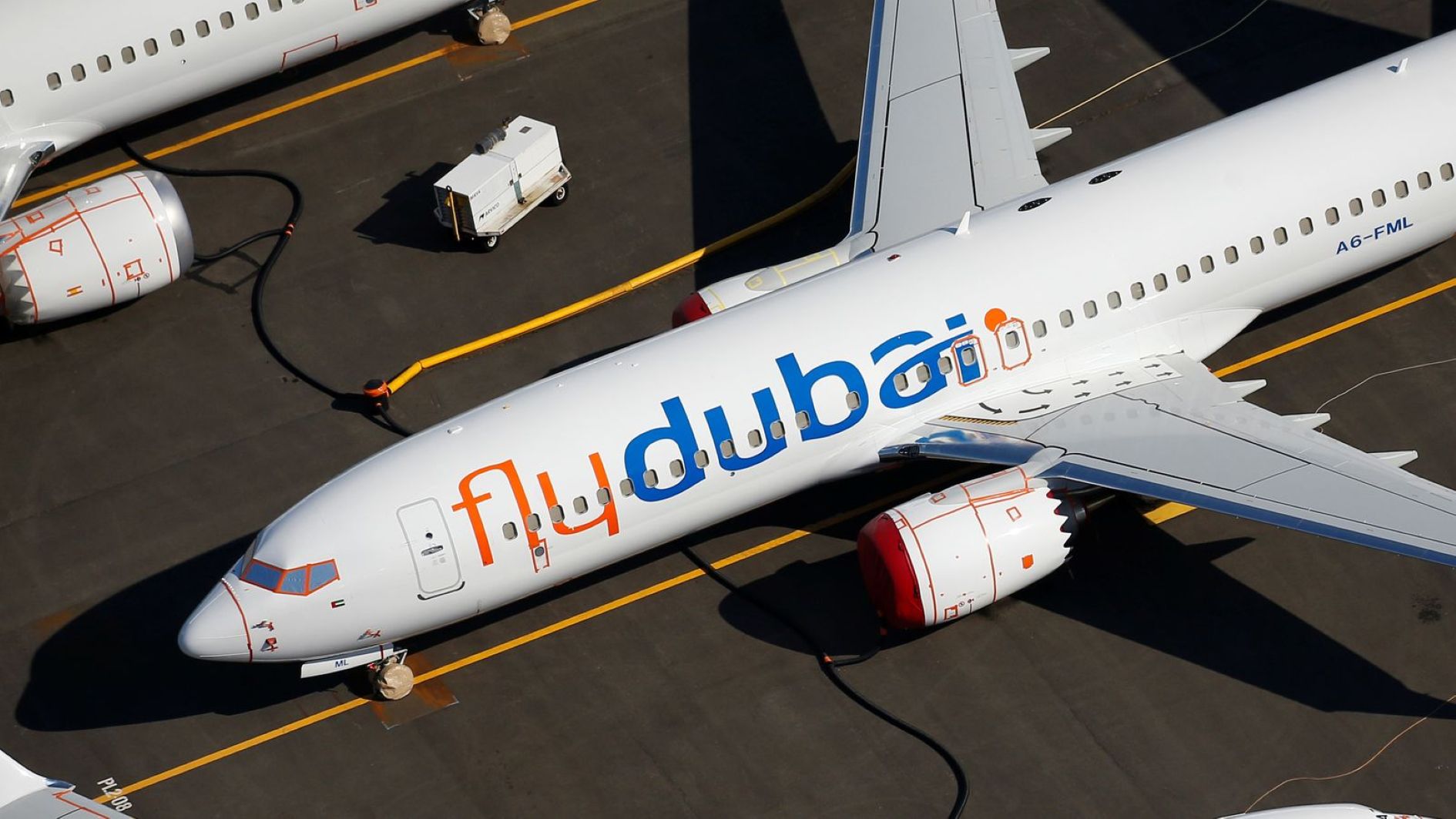
Flydubai flight FZ1073 was on its way from Dubai to Tel Aviv on September 30 when a violent confrontation in the cockpit sent the Boeing 737 MAX into a rapid descent, leaving 174 passengers and crew members facing what could have become one of the most serious aviation disasters in the region in years.
The aircraft was cruising at about 34,000 feet when the co pilot allegedly attacked the captain, stabbing him and attempting to interfere with the aircraft’s controls. Flight tracking data reviewed after the incident showed the aircraft losing more than 16,000 feet in a matter of seconds, while other accounts put the total descent at almost 17,000 feet in less than two minutes. The aircraft was subjected to severe forces during the manoeuvre and part of its tail rudder was reportedly damaged.
What happened inside the cockpit then became critical to whether the aircraft would remain airborne. Despite being injured, the captain was able to open the cockpit door, allowing cabin crew and passengers to enter the flight deck and restrain the co pilot. There were also additional Flydubai pilots travelling on the aircraft, and they were able to assist with flying the aircraft after the confrontation was brought under control. The flight was diverted to Tabuk in Saudi Arabia, where it landed safely.
None of the 174 passengers died, although the captain and two other crew members required medical treatment.
The incident is now the subject of investigations involving authorities in the United Arab Emirates, Saudi Arabia and Israel, with investigators examining not only how the attack happened but also why it happened, how the alleged attacker obtained a weapon and whether there was any wider connection behind the incident.
How the incident unfolded
The flight departed Dubai International Airport and was initially operating normally. The aircraft was later cruising over the region near the Saudi Arabian and Jordanian border when the situation changed inside the cockpit.
The co pilot allegedly attacked the captain and attempted to take control of the aircraft, after which the plane entered a steep descent. The aircraft transmitted the international emergency code 7700, which indicates a general emergency, and later transmitted 7500, the code used to indicate unlawful interference with an aircraft.
The descent was so rapid that the aircraft lost more than 16,000 feet in roughly 30 seconds at one point, according to flight tracking data cited by Reuters. The aircraft’s sudden movements were accompanied by damage to the tail rudder, although investigators will ultimately have to establish exactly how the damage occurred and how it affected the aircraft’s ability to manoeuvre.
Inside the aircraft, the immediate problem was not simply that the plane was losing altitude. The people responsible for controlling it were themselves dealing with a violent confrontation.
The captain, although injured, was able to get the cockpit door open. Cabin crew members and passengers then entered the cockpit and restrained the co pilot, while other pilots who were travelling on the flight assisted in taking control of the aircraft. The plane was subsequently diverted to Tabuk, where it made an emergency landing.
That sequence of events is important because the aircraft’s survival did not depend on one safety feature. The outcome depended on the captain being able to open the cockpit, people outside the cockpit being able to intervene, the attacker being restrained and other qualified pilots being available to operate the aircraft.
Why this is different from the type of hijacking aviation security was designed to prevent
To understand why the incident has attracted so much attention, it is necessary to look at how modern cockpit security developed.
The most significant turning point was the September 11, 2001 terrorist attacks in the United States, when hijackers took control of four commercial aircraft and used the planes as weapons. Before the attacks, cockpit access arrangements were less restrictive than they are today, but the events of 9/11 fundamentally changed the way airlines and aviation authorities approached the security of the flight deck.
Reinforced cockpit doors, strict access controls and procedures designed to prevent unauthorised people from entering the cockpit became central features of commercial aviation security. The basic idea was that if a person in the passenger cabin could not gain access to the pilots, that person could not seize control of the aircraft.
That system was designed primarily around an external threat.
FZ1073 presents a different problem because the alleged attacker was already inside the cockpit and was authorised to be there.
This is not an entirely new concern. Aviation authorities had already been forced to examine the possibility of an insider threat after the crash of Germanwings Flight 9525 in March 2015.
What Germanwings changed about aviation security
Germanwings Flight 9525 was flying from Barcelona to Düsseldorf when the co pilot deliberately prevented the captain from re entering the cockpit and initiated a descent into the French Alps. All 150 people on board died.
The investigation that followed exposed a limitation in the security thinking that had developed after 9/11. The cockpit door had worked as designed: it prevented the captain from getting back inside once the co pilot had locked him out. The problem was that the person controlling the aircraft was himself the threat.
A European task force established after the crash noted that aviation security measures introduced after 9/11 had concentrated heavily on protecting the cockpit from people outside the flight deck. The Germanwings crash demonstrated that protecting the aircraft also required consideration of risks posed by members of the flight crew themselves.
The response included greater attention to pilot mental health and medical oversight, psychological assessment before pilots entered airline service, pilot support programmes and additional drug and alcohol testing. European authorities also examined the principle that there should be two people in the cockpit so that one pilot would not be left alone if the other became incapacitated.
Those measures were not intended to predict every possible act by a pilot. Rather, they were designed to add another layer of protection after an incident demonstrated that cockpit security could not be considered solely in terms of keeping outsiders away from the controls.
FZ1073 now raises another variation of the same problem.
The difference between Germanwings 9525 and FZ1073
The two incidents should not be treated as identical.
In the Germanwings crash, the co pilot locked the captain out of the cockpit and deliberately flew the aircraft into the ground. In the Flydubai incident, according to the emerging account, the co pilot physically attacked the captain while both were inside the cockpit and allegedly attempted to force the aircraft into a dangerous descent.
The distinction matters because the response required in each situation is different.
Germanwings raised the question of how to prevent a pilot from deliberately locking another pilot out and taking control of an aircraft. FZ1073 raises the question of what happens when a pilot physically attacks the other pilot and attempts to manipulate the controls while the aircraft is in flight.
In both cases, however, the underlying security problem is similar: the person creating the danger has legitimate access to the cockpit.
That is considerably harder to address than simply keeping an unauthorised person away from it.
Why the presence of other pilots mattered
One of the unusual circumstances surrounding FZ1073 was the presence of additional Flydubai pilots aboard the aircraft. They were reportedly travelling for operational reasons and were not on board because the airline anticipated a security incident.
Their presence became important once the captain was injured and the co pilot had been restrained because there were still qualified pilots available to help operate the aircraft.
That does not mean commercial airlines normally carry spare pilots in case one member of the cockpit crew attacks another. Rather, it was a circumstance that happened to benefit FZ1073 when the normal cockpit crew became compromised.
The incident nonetheless demonstrates an important principle in aviation: when something goes seriously wrong, several layers of redundancy can determine whether a dangerous situation becomes a disaster.
What is known about the suspected attacker
The co pilot has been identified in reports as an Omani national and was taken into custody after the aircraft landed in Saudi Arabia before being transferred to the United Arab Emirates for further questioning.
Authorities are examining his background and the circumstances leading up to the attack, including whether the incident was planned and whether anyone else was involved.
Israeli officials have suggested that radicalisation may have played a role and have described the incident as a possible terrorist attack. The UAE has also opened an investigation into the circumstances and motive, including whether there was any connection to terrorist activity.
Those claims should remain separate from the established account of what happened aboard the aircraft. There is substantial evidence that a violent confrontation occurred in the cockpit and that the aircraft subsequently entered a dangerous descent, but the motive for the attack and any possible connection to a wider organisation remain matters for investigators to establish.
The investigation will therefore have to go beyond the events captured by flight data and passenger accounts. Authorities are likely to examine the co pilot’s employment and security history, his activities before the flight, his communications and any other evidence that could establish whether the attack was spontaneous or planned.
How could a weapon have reached the cockpit?
Another question concerns the weapon allegedly used in the attack.
Commercial aviation has extensive security procedures designed to prevent prohibited weapons from being carried onto aircraft, while flight crew members are subject to their own security arrangements because they need access to restricted areas of airports and aircraft.
If investigators establish that the co pilot brought the weapon onto the aircraft, they will need to determine how it passed through the relevant security controls. They will also need to establish whether the weapon was obtained elsewhere and, if so, where and when.
That question is particularly relevant because the alleged attack took place inside a highly restricted area of the aircraft rather than in the passenger cabin.
At present, publicly available reports do not provide a definitive explanation of how the weapon entered the cockpit.
What investigators will examine
The investigation will have several strands because no single piece of evidence is likely to explain the entire incident.
Flight data will help investigators reconstruct the aircraft’s altitude, speed and movements during the descent, while cockpit and aircraft system records may help establish what was happening with the flight controls. Statements from the captain, other pilots, cabin crew and passengers will be important in establishing the sequence of events inside the aircraft.
Investigators will also have to determine the extent of the aircraft’s structural and control system damage and whether the reported rudder damage was caused by the rapid manoeuvre or contributed to it.
The human side of the investigation will be equally important. Authorities will want to understand the co pilot’s background, identify any warning signs that may have existed before the flight and establish whether anybody else knew about or assisted the alleged plan.
The answers could determine whether the incident is treated primarily as an isolated act by one crew member or as evidence of a broader security vulnerability.
Could cockpit security rules change?
It is too early to know whether FZ1073 will lead to new international aviation rules.
Major changes to aviation security generally follow detailed investigations rather than the initial account of an incident. Authorities first have to establish what happened, identify the points at which existing safeguards were unable to prevent or contain the threat and determine whether a new measure would actually reduce the risk.
The areas likely to receive attention include pilot vetting, psychological and medical monitoring, access to the cockpit, procedures for dealing with an aggressive or incapacitated pilot and the arrangements for bringing another qualified pilot into the flight deck when one member of the crew becomes unable to operate the aircraft.
The challenge is that there is no single measure capable of eliminating this type of risk. A reinforced cockpit door can keep an intruder out, but it cannot prevent a person who is already authorised to enter the cockpit from becoming dangerous. Pilot screening can identify certain concerns, but it cannot guarantee that a person will never become a threat. Two person cockpit procedures provide redundancy, but the second person can, in an extreme case, be the source of the danger.
This is why the aviation industry has historically responded to serious incidents by adding layers of protection rather than relying on one safeguard.
Why the Flydubai incident matters
FZ1073 is significant not simply because an aircraft came close to disaster, but because it illustrates how aviation security has evolved in response to different threats.
The September 11 attacks transformed cockpit security by demonstrating the consequences of allowing hostile outsiders to gain control of commercial aircraft. Germanwings 9525 subsequently demonstrated that an aircraft could also be deliberately brought down by a person who already had legitimate access to the cockpit. The Flydubai incident presents another variation in which, according to the current account, a crew member allegedly attacked the other pilot and attempted to interfere directly with the aircraft’s controls.
The investigation will determine how the attack was possible, why it happened and whether existing safeguards were sufficient to contain it.
For the people aboard FZ1073, the immediate outcome was that the aircraft reached the ground safely and all 174 passengers survived. For aviation authorities, the more important question will be what can be established from the incident and whether those findings require another change in the way airlines protect the flight deck and manage the people entrusted with controlling commercial aircraft.