



KEY POINTS
- President Bola Ahmed Tinubu challenged Nigerian manufacturers to match federal industrialisation efforts with increased production capacity, local sourcing, and regional export expansion.
- Speaking at the 54th Annual General Meeting of the Manufacturers Association of Nigeria (MAN), Tinubu outlined five core government pillars while emphasizing that stability is merely a foundation.
- Former UNIDO Director-General Dr. Kandeh Kolleh Yumkella urged deliberate industrial action, targeted support for national champions, and integration into future-focused global supply chains.
MAIN STORY
President Bola Ahmed Tinubu has challenged Nigerian manufacturers to match the Federal Government’s renewed push for industrialisation with higher production capacity, deeper local sourcing, stronger skills development, and a more aggressive pursuit of African markets.
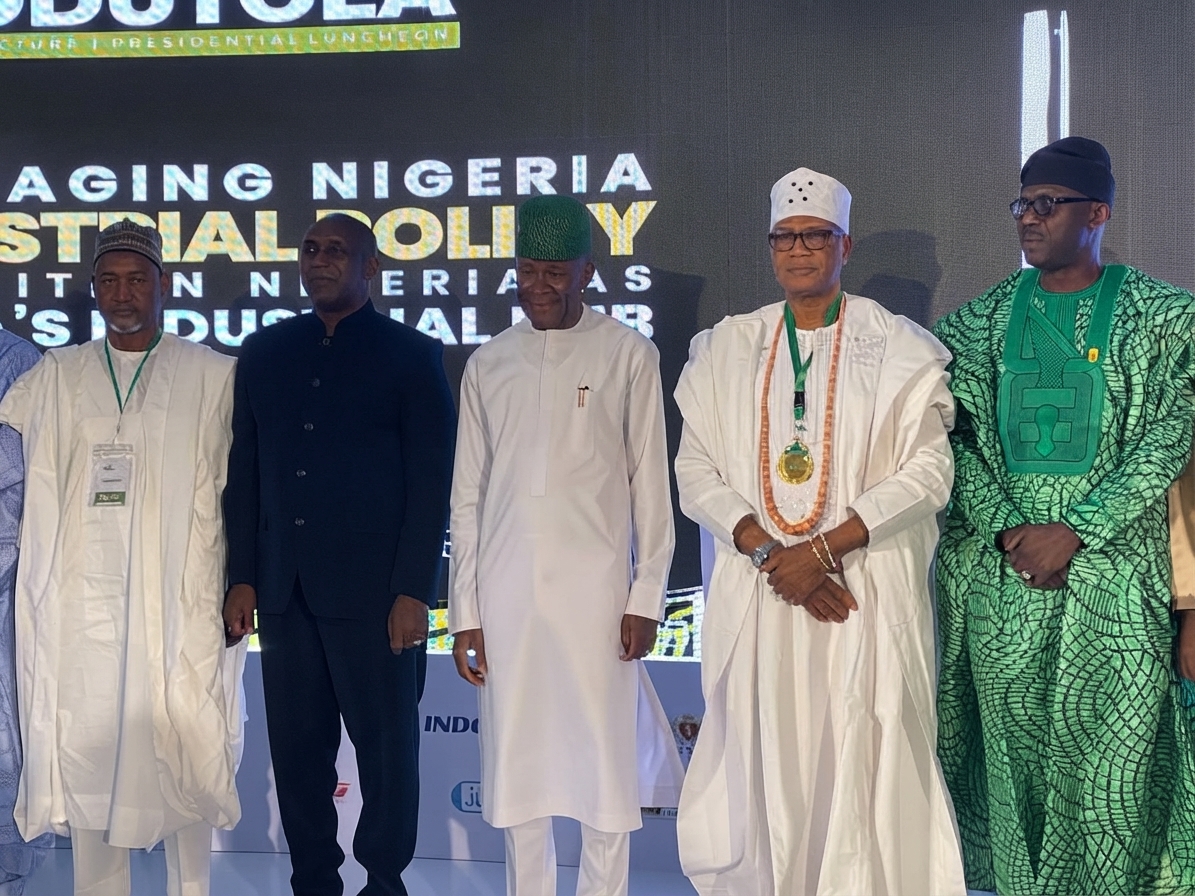
Tinubu, represented by the Minister of State for Industry, Senator John Owan Enoh, gave the charge at the 54th Annual General Meeting of the Manufacturers Association of Nigeria (MAN) in Lagos, where he acknowledged the difficult operating conditions facing manufacturers but said the government could not deliver Nigeria’s industrial ambitions alone.
The President’s message came as MAN’s annual gathering brought government officials, manufacturers, financiers, development partners, and industry stakeholders together around the theme, “Leveraging National Industrial Policy to Position Nigeria as Africa’s Industrial Hub.”
He said the Federal Government would work to provide the conditions required for manufacturers to compete, but challenged businesses to respond by expanding their productive capacity, increasing the use of Nigerian raw materials, and positioning themselves for markets beyond Nigeria.
“No nation has ever industrialized by government alone, and none has done it without government,” Tinubu said.
He outlined five areas where government would support industry: energy, capital, markets, security, and accountability. These include prioritising gas for industrial users and reliable power for industrial clusters, working with development finance institutions to provide patient and affordable financing, improving public procurement of Nigerian-made goods, protecting industrial corridors, and establishing a mechanism for publicly tracking the implementation of the Nigeria Industrial Policy.
But he also set out what government expected from manufacturers.
“Invest in capacity so that the plants you own run at the scale the market now demands,” he said. He also urged them to deepen backward integration, meet the standards of the markets they seek to enter, train and retain young Nigerians, and treat the African market as their home market.
“Government will clear the road; you must drive the trucks,” he said.
The challenge came against a manufacturing landscape that Tinubu described as showing both signs of improvement and significant weakness.
He noted that the sector recorded quarterly growth of 4.04 per cent in the first quarter of 2026, its strongest quarterly performance in four years, followed by 3.24 per cent growth in the second quarter. However, he also acknowledged that manufacturing’s share of real GDP fell from 9.57 per cent in the first quarter to 7.72 per cent in the second, while growth in the broader industrial sector declined from 7.46 per cent a year earlier to 3.96 per cent.
He further cited MAN’s estimate that unsold inventory in the sector stood at almost ₦1.2 trillion, with some manufacturers selling below production cost simply to keep their businesses operating.
“I say these things not to dampen the celebration, but to honour it,” Tinubu said. “A government that cannot face its numbers cannot change them.”
He said the Federal Government’s economic reforms were beginning to provide greater stability, pointing to lower inflation, the reduction in the Monetary Policy Rate, stronger external reserves, and economic growth.
But he stressed that stability was only a foundation for industrial expansion.
“Stability is not the destination. Stability is the runway,” he said.
The President said the Nigeria Industrial Policy, launched in February, aims to increase manufacturing’s contribution to GDP to between 20 and 25 per cent by 2030. He acknowledged that achieving that target would require far more than a policy document.
“Moving from under 10 per cent to over 20 per cent in a little more than four years is not a target for the faint-hearted,” he said. “It will not be reached by policy documents. It will be reached by power in your plants, by credit in your accounts, by raw materials at your gates, and markets for your goods.”
He said the Industrial Revolution Work Group, chaired by the Minister of State for Industry and co-chaired by the President of MAN, would provide a mechanism for tracking implementation through indicators including factories reopened, capacity utilisation, jobs created, exports, and new factories established.
The President also tied industrial expansion to Nigeria’s ambition to capture a larger share of the African market.
He said that although Nigeria recorded a record $6.1 billion in non-oil exports in 2025, only 3.4 per cent went to fellow ECOWAS countries, leaving the country’s closest regional market largely untapped.
With the African Continental Free Trade Area creating a single market of about 1.4 billion people, Tinubu said Nigerian manufacturers should regard Africa not as an export destination to be considered later, but as an extension of their domestic market.
“Nigeria will not be Africa’s warehouse, storing what others make; Nigeria will be Africa’s workshop, making what Africa needs, and sending it with pride across the continent and beyond,” he said.
The argument was reinforced by the guest speaker at the AGM, former Director-General of the United Nations Industrial Development Organization, Dr. Kandeh Kolleh Yumkella, who urged Nigeria to move from industrial policy to deliberate industrial action.
Yumkella said Nigeria had the resources, market, and emerging industrial champions needed to compete for the industries of the future, but warned that the country must deliberately create the conditions for those businesses to grow.
“Industrial policy must become industrial action,” he said.
He argued that government should not wait for successful Nigerian businesses to approach it for assistance. Instead, it should identify companies and sectors with the potential to become regional and global champions and deliberately support their expansion.
Using fertilizer, pharmaceuticals, automotive manufacturing, lithium processing, and digital transformation as examples, Yumkella said Nigeria could build stronger industrial ecosystems if government coordinated finance, infrastructure, skills, technology, and market access around strategic sectors.
He also stressed the importance of energy, recalling that power shortages had undermined Nigerian textile factories more than two decades ago when he visited manufacturing plants in Kaduna and Kano. The same problem, he said, remains a major constraint today.
For Yumkella, the opportunity is no longer limited to traditional manufacturing. Global supply chains are being reshaped, while artificial intelligence, renewable energy, battery storage, critical minerals, and digital technologies are creating new industrial opportunities.
“Nigeria has to think about the markets of tomorrow and the industries of tomorrow to build that base,” he said.
He also linked industrialisation directly to the employment challenge facing Africa. With West Africa’s population exceeding 450 million and a median age of about 18 to 20, he said the region needs to create millions of jobs every year.
“Manufacturing is the key,” Yumkella said, arguing that young people moving into cities need productive employment rather than repeated appeals for patience.
He called for stronger vocational and technical training designed around the actual skills required by factories, citing the German model of training factory-floor workers and the digital literacy evident in the operation of Togo’s port.
Yumkella also urged Nigeria to use its existing industrial champions as the foundation for further expansion.
“Don’t wait for them to ask for help. Ask them how you can help,” he said, urging government to identify strategic sectors and determine what support would allow Nigerian companies to expand across Africa.
His argument broadly aligned with the concerns raised by MAN President Otunba Francis Meshioye in his welcome address.
Meshioye said the success of the Nigeria Industrial Policy would depend on consistent implementation, institutional coordination, and measurable outcomes, rather than policy declarations alone.
He identified high electricity costs, weak infrastructure, expensive production inputs and logistics, unfair trade practices, policy uncertainty, skills and technology gaps, limited access to long-term finance, and dependence on imported inputs among the major constraints confronting manufacturers.
MAN consequently called for faster implementation of the industrial policy, affordable industrial electricity, stronger financing for manufacturers, improved infrastructure, greater foreign exchange support for productive businesses, stronger trade-defence measures, and deeper backward integration.
The association also proposed a Nigeria First Industrial Fund to provide long-term concessionary financing for technology upgrades and local value addition.
Meshioye said manufactured exports accounted for only ₦2.50 trillion, or 2.94 per cent, of Nigeria’s ₦85.13 trillion total exports in 2025, arguing that increasing industrial value addition must be central to Nigeria’s ambition of becoming Africa’s industrial hub.
The convergence between the three positions was clear: government has framed industrialisation as a shared responsibility, manufacturers are demanding that the operating environment be made more competitive, while Yumkella is urging both sides to focus on measurable industrial outcomes and the sectors that can create the next generation of African champions.
For Tinubu, the immediate test is whether the policy commitments translate into functioning factories, greater capacity utilisation, more Nigerian inputs, increased exports, and jobs.
For manufacturers, the challenge is to convert improved policy support into the productive capacity required to compete beyond Nigeria.
As Tinubu put it, the objective is not simply for Nigeria to consume what others produce, but to become a country capable of making what Africa needs.
THE ISSUES
- Bridging the gap between macro-level economic stabilization and micro-level factory-floor operational challenges, including high energy expenses and unsold inventories.
- Aligning public procurement frameworks and long-term financing strategies to support domestic manufacturing value addition and regional export competitiveness.
WHAT’S BEING SAID
“No nation has ever industrialized by government alone, and none has done it without government. Government will clear the road; you must drive the trucks.” – Bola Ahmed Tinubu, President of Nigeria
“Industrial policy must become industrial action. Don’t wait for them to ask for help. Ask them how you can help.” – Dr. Kandeh Kolleh Yumkella, Former Director-General, UNIDO
WHAT’S NEXT
The newly established Industrial Revolution Work Group will track policy execution indicators such as factory revivals, job creation, and export metrics under joint oversight by the Ministry of Industry and MAN.
BOTTOM LINE
President Tinubu challenged manufacturers to leverage the Nigeria Industrial Policy to scale up production and capture continental markets, even as industry leaders called for urgent action to resolve structural energy and financing constraints.