






By Boluwatife Oshadiya
Key Points
- 25 individuals convicted in a $215 million international email fraud scheme
- Scam targeted over 1,000 victims across 47 U.S. states and 19 countries
- Three defendants found guilty after trial; others pleaded guilty
- Fraudsters used hacked emails to execute business email compromise attacks
- Millions laundered through fake accounts and financial intermediaries
Main Story
A United States federal jury has convicted three individuals for their roles in a large-scale international fraud operation that defrauded more than 1,000 victims of approximately $215 million through sophisticated email hacking schemes.
On April 24, 2026, a jury sitting in Toledo, Ohio, found Oluwafemi Michael Awoyemi, Aruan Drake, and Peter Reed guilty of wire fraud conspiracy. Awoyemi and Drake were also convicted of money laundering conspiracy following a four-day trial presided over by U.S. District Judge James R. Knepp II.
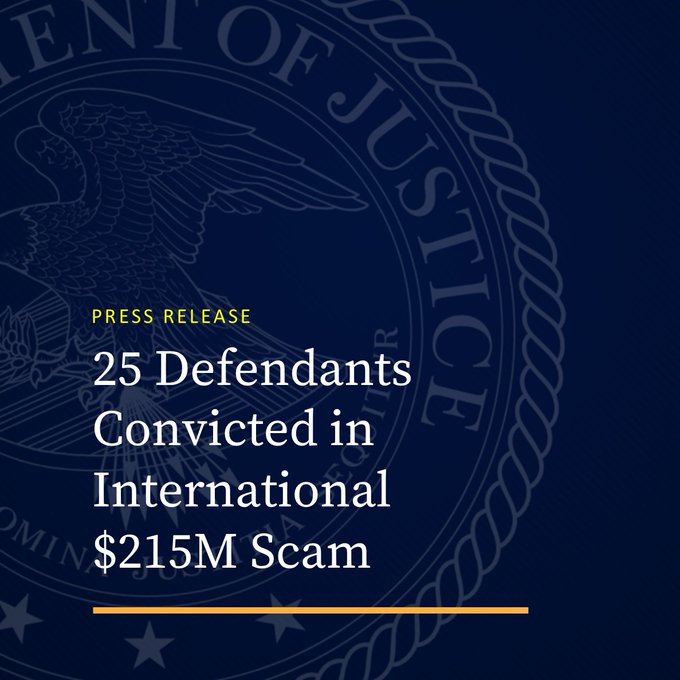
The convictions form part of a broader crackdown that has now seen a total of 25 defendants held accountable in what authorities described as a “business email compromise” (BEC) scheme—one of the fastest-growing cybercrime threats globally.
Court documents revealed that the fraud network, linked to transnational cybercrime groups, targeted individuals, companies, and organisations by hacking into their email systems. Once access was obtained, the perpetrators monitored communications to understand transaction patterns and business relationships.
Armed with this intelligence, the attackers sent carefully crafted fraudulent emails impersonating legitimate contacts, requesting payments under the guise of genuine business transactions. Victims, unaware of the breach, transferred funds to accounts controlled by the fraud syndicate.
The stolen funds were subsequently laundered through a complex network of bank accounts, shell companies, and money service businesses.
Investigators disclosed that approximately $50 million of the illicit proceeds was funnelled through cashier’s checks processed by a Chicago-area currency exchange operated by a co-defendant. The operator allegedly ignored multiple red flags, including fraudulent identification and warnings from financial institutions about suspicious transactions.
Victims of the scheme were spread across several U.S. states, including Ohio, New York, California, Texas, and Florida, as well as internationally in countries such as the United Kingdom, Germany, Canada, Australia, and the United Arab Emirates.
In one notable case, a business victim transferred $2.7 million to a fraudulent account controlled by members of the conspiracy.
Authorities also seized assets linked to the fraud operation, including nearly $1.2 million in cash and cryptocurrency, luxury watches valued at over $200,000, and a residential property in Georgia.
In addition to the three convictions secured at trial, 22 other defendants had earlier pleaded guilty to charges including wire fraud conspiracy and money laundering.
What’s Being Said
U.S. prosecutors described the case as a major victory against organised cybercrime, highlighting the growing sophistication of business email compromise schemes.
Law enforcement agencies involved in the investigation—including the FBI, the U.S. Postal Inspection Service, and the U.S. Border Patrol’s Sandusky Bay Intelligence Unit—emphasised the importance of international cooperation in tackling cross-border financial crimes.
What’s Next
Sentencing for all 25 defendants will be determined by the court at a later date. Judges are expected to consider factors such as individual roles in the scheme, prior criminal history, and the scale of financial losses caused.
Authorities have also indicated that efforts are ongoing to trace additional assets and dismantle remaining elements of the fraud network.