








Home Blog Page 15

The Dark Side Of Christmas Charity: Inside Nigeria’s Fatal Aid Rush And The Reforms Experts Demand In 2025

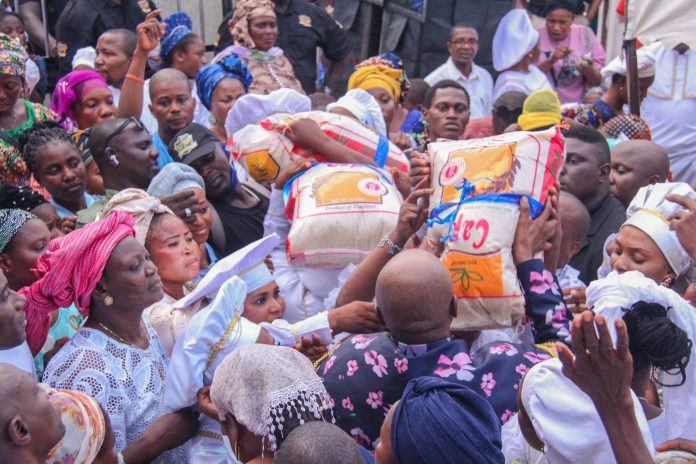
As Christmas approaches and Nigerians prepare for the season of giving, fresh concerns are emerging about the safety of charity-driven aid distributions. The warnings stem from the tragedies that unfolded last December, when poorly coordinated festive events resulted in dozens of deaths across the country, turning moments of goodwill into scenes of chaos and grief.

Nigeria has witnessed a sharp rise in the number of registered non-profits over the past four years. According to statistics from the Corporate Affairs Commission (CAC), the country recorded 191,278 registered Incorporated Trustees as of November 2023, covering NGOs, foundations, faith institutions, and charitable trusts. This represents an increase of more than 174,000 organisations since 2019.

However, experts caution that the growing numbers do not necessarily translate to increased impact. Independent assessments show that many registered organisations are inactive or lack the capacity to conduct large-scale community interventions. Crucially, no national database tracks how many NGOs actually distribute food or gifts during festive periods, leaving the true scale of Christmas charity in Nigeria largely undocumented.

This gap becomes more troubling in the face of Nigeria’s economic climate. According to the National Bureau of Statistics (NBS), headline inflation rose to 34.6% in November 2024 — the highest in nearly three decades and climbed further to 34.8% in December 2024. The result is a dramatic spike in the number of families struggling to afford essentials.

With food inflation at record highs, charity distribution has increasingly become a lifeline. This desperation, combined with poor planning and inadequate safety measures, set the stage for the tragic events of last Christmas.

When Goodwill Turned Deadly: The Stampedes of December 2024

December 2024 recorded some of the worst crowd-related tragedies Nigeria has witnessed in recent years, all linked to Christmas gifts, food distributions, or children’s charity programmes.

On 18 December 2024, a Christmas funfair for children at Basorun (Bashorun) in Ibadan, Oyo State ended in disaster. The event, which promised scholarship opportunities, food items and Christmas gifts to 5,000 children, attracted far more attendees than organisers anticipated.
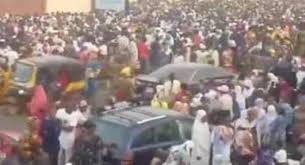
A sudden crowd surge led to the deaths of at least 35 children and left several others injured. The incident, widely reported across national and international media, became one of Nigeria’s deadliest child-focused charity events.

Just three days later, on 21 December 2024, another catastrophic stampede occurred in Okija, Ihiala Local Government Area of Anambra State. A charity event offering free rice and relief materials drew large crowds. Confusion at the distribution point led to a violent crush, killing at least 17 people, according to reports.

In the Federal Capital Territory, another frantic early-morning crowd formed at Holy Trinity Catholic Church, Maitama, during a festive charity distribution. By the time the gates opened at dawn, the surge had turned deadly. Ten people, including children, were confirmed dead.

Combined, these incidents claimed over 60 lives within four days, making December 2024 one of the darkest Christmas seasons in Nigeria’s recent history.

Why These Tragedies Happened

Interviews with security analysts, humanitarian experts and emergency responders point to several recurring factors:

Desperation driven by economic hardship makes large crowds inevitable.

Poor crowd-control measures, with many organisers lacking trained security personnel.

Overestimation of capacity, as small foundations and community groups attempted large events without professional support.

Lack of regulatory oversight, since many charitable events proceed without coordination with local authorities.

Experts warn that unless structural changes are implemented, such tragedies could continue during future festive seasons.

How Nigeria Can Prevent A Repeat In 2025

With the Christmas countdown now in days, humanitarian groups, religious bodies and private foundations are already planning outreach programmes. Stakeholders say the following steps are urgent:

1. Mandatory Safety Protocols for Charity Events: Organisers should be required to register large distributions with local councils, deploy trained security personnel and adopt controlled, ticket-based systems.

2. Government Oversight: Authorities must vet events likely to attract large crowds, enforce compliance, and penalise groups acting without permits.

3. Professionalisation of Non-Profits: The rapid proliferation of NGOs calls for clearer standards. Experts argue for annual audits, proper classification of active vs inactive organisations, and stricter documentation requirements.

4. Public Awareness and Responsible Beneficiary Behaviour: Residents should be sensitised to avoid dangerous rushes, with clear communication on distribution times and methods.

A Cautionary Christmas: For thousands of families who lost loved ones in December 2024, the festive season now carries a painful memory. Their tragedy serves as a warning that charity, while noble must be conducted with responsibility, structure and safety at its core.

As Nigerians prepare for Christmas 2025, the hope is simple: that generosity will no longer cost lives. With proper planning and oversight, the nation can ensure that the season of giving restores joy not grief to those who need it most.
SSANU Threatens Nationwide Strike In 2026 Over Marginalisation, Unpaid Allowances

The Senior Staff Association of Nigerian Universities (SSANU) has threatened to embark on a total and comprehensive industrial action in 2026 if the Federal Government fails to conclude renegotiations and present what it described as a “credible and realistic” offer to non-teaching staff before 31 December 2025.

The warning was contained in a communiqué issued after the association’s 53rd National Executive Council (NEC) meeting held at the University of Jos, Plateau State. The meeting reviewed the state of the nation, security concerns, and the welfare of non-academic staff across Nigerian universities.

Signed by SSANU’s National President, Mohammed Ibrahim, the communiqué accused the Federal Government of persistently sidelining non-teaching staff in the payment of Earned Allowances and in ongoing renegotiation processes.

Ibrahim reaffirmed that the ₦50 billion agreed upon in the 2022 Memorandum of Understanding must be released without delay. He further emphasised that Inter-University Centres and research institutes, previously excluded from disbursements, must be included in subsequent payments.

“NEC expressed strong dissatisfaction with the longstanding marginalisation of non-teaching staff. The continued denial of their financial entitlements is unacceptable and will attract firm, coordinated action,” the communiqué stated.

The union also criticised the government for failing to demonstrate meaningful commitment to SSANU during renegotiation meetings, while allegedly giving preferential treatment to other groups.

According to the NEC, the trend reflects “a deliberate and persistent exclusion” of non-academic workers. It warned that failure to conclude renegotiations and present a realistic offer by the end of 2025 would trigger a system-wide strike in 2026.

SSANU also raised alarm over the worsening security situation in educational institutions, citing recent abductions in Niger and Kebbi States.

The union urged governments at all levels to prioritise security on school campuses by deploying modern surveillance technology, strengthening perimeter fencing and intelligence systems, and enhancing campus security units. It also called for university staff to be covered by comprehensive health and life insurance.

Opposition to PPP in university services

The NEC rejected the Federal Government’s proposed public-private partnership model for managing municipal services in universities, warning that such initiatives could lead to job losses, casualisation, and unstable service delivery.

It insisted that no university staff should lose their job or suffer downgraded employment conditions under any reform.

“Any attempt to impose PPP measures without safeguarding staff welfare will be met with decisive resistance,” the union warned.

Beyond university concerns, SSANU assessed the broader national landscape and highlighted the collapse of key sectors including healthcare, agriculture, and infrastructure.

The union cited rising food insecurity—affecting more than 27 million Nigerians—as well as devastating floods that have displaced thousands and destroyed farmlands.

The NEC called for urgent, coordinated government action to rebuild public health systems, support farmers with inputs and secure access to land, improve water and sanitation infrastructure, and invest in climate-resilient facilities.

According to the union, without decisive intervention, these compounding national crises will continue to worsen hardship and undermine Nigeria’s long-term development.

Revenue Probe: Reps Reject NNPCL’s 60-Day Extension Request, Fix December 15 For Appearance

NNPC Denies Plans To Increase Fuel Price

The House of Representatives Committee on Public Accounts has rejected a request by the Nigerian National Petroleum Company Limited (NNPCL) for a 60-day extension to respond to queries on alleged revenue leakages. The committee has instead set 15 December as the final date for the company to appear before it.

The committee chairman, Bamidele Salam, issued the directive during a hearing on Monday in Abuja, following NNPCL’s failure to honour multiple invitations.

Salam read a letter from the NNPCL management explaining that its officials were unable to attend the session due to a scheduled meeting with the President. The company requested two months to prepare for the engagement.

However, the chairman noted that the committee had written to NNPCL more than seven times, adding that the company had repeatedly failed to appear, often citing similar reasons.

Describing NNPCL’s conduct as unacceptable, Salam said the committee viewed the repeated absences as a disregard for parliamentary oversight.

He disclosed that the Auditor-General for the Federation had raised significant concerns involving trillions of naira in alleged revenue leakages from NNPCL operations—funds that should have been remitted to the Federation Account.

“The only way we will accept that this is a ‘new NNPCL’ is to see clear improvements in your conduct and corporate governance,” Salam said.

“We do not think NNPCL should continue in this seeming contempt of the parliament. You are, therefore, directed to appear unfailingly on Monday, December 15.”

He further urged the company to ensure that all outstanding documents requested by the committee are submitted ahead of the session.

Hassan Bappa (PDP–Taraba) reiterated that the committee’s mandate is to ensure accountability across public institutions, stressing that NNPCL is not exempt from legislative oversight.

Abia, NDPHC Begin Construction Of 7.5MVA Power Substation In Umuahia

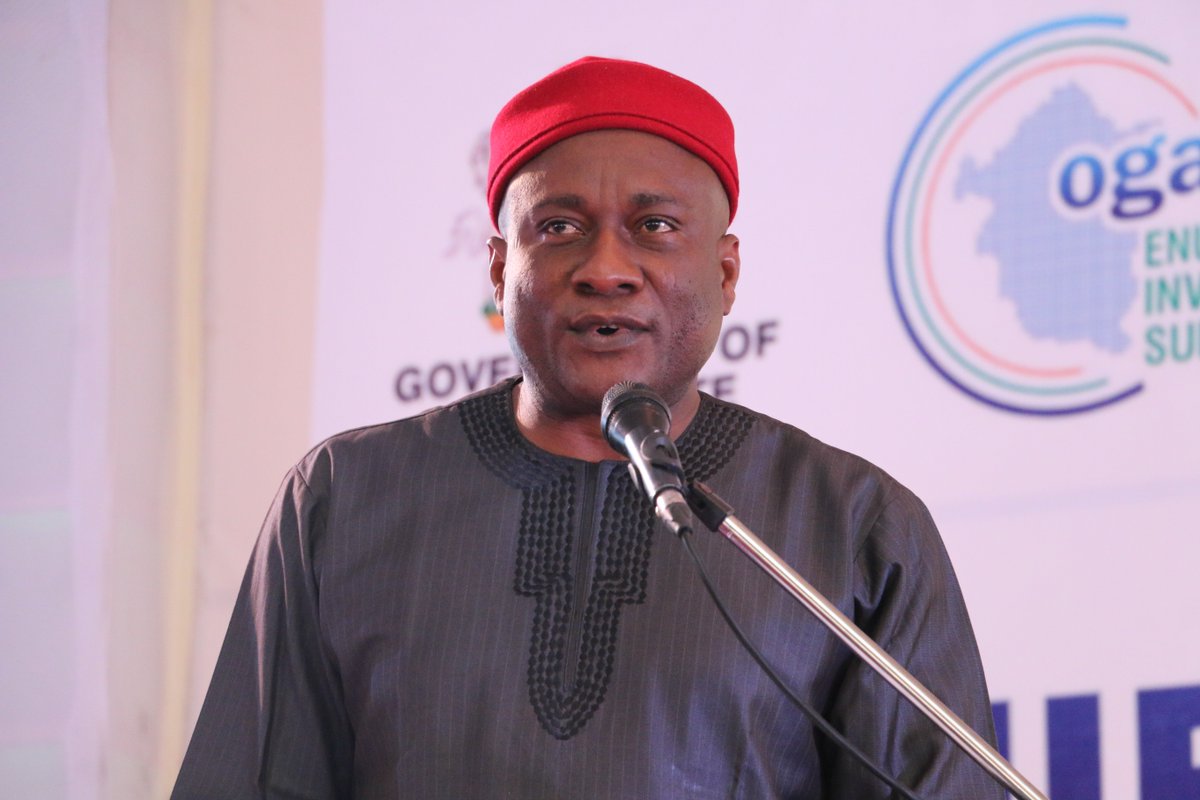
The Abia State Government and the Niger Delta Power Holding Company have commenced the construction of a 7.5 MVA, 33/11 kV injection substation in Umuahia in a move expected to strengthen electricity supply in the state capital.

According to a statement issued by the NDPHC, the construction works began last Thursday, following a groundbreaking ceremony performed by Governor Alex Otti.

The governor described the project as a major step in the state’s effort to modernise its power distribution network and deliver more reliable electricity to households, businesses, and public institutions. He said the facility marked the beginning of a broader strategy to expand and upgrade critical power infrastructure across Abia State.

Otti commended the Federal Government and the NDPHC for prioritising Abia in the implementation of the National Integrated Power Project. He also praised President Bola Tinubu’s ongoing reforms in the electricity sector, noting that the liberalised market framework had created room for stronger state participation, increased private sector investment, and new global partnerships.

The project, which is being executed under the National Integrated Power Project, will comprise a one kilometre 33kV line, 1.2 kilometres of 11kV line, two 300kVA distribution substations, and two kilometres of low tension line.

The Managing Director and Chief Executive Officer of NDPHC, Jennifer Adighije, represented at the event by the Executive Director, Networks, Bello Babayo Bello, said the company remained committed to expanding access to stable and sustainable electricity infrastructure across the country. She stated that the project reflected the organisation’s mandate to support communities and deepen economic development through reliable power supply.

Governor Otti disclosed that the state had already made budgetary provision for an additional 7.5 MVA injection substation in the 2026 fiscal year. He said the project, when completed alongside the new facility, would give the Ogurube Layout axis of Umuahia a combined capacity of 15 MVA.

Stakeholders at the event said the partnership between the Federal Government, NDPHC, and the Abia State Government demonstrated the importance of coordinated efforts in delivering critical public infrastructure.

When completed, the facility is expected to improve electricity supply to Umuahia, support small and medium sized businesses, stimulate industrial activities, and improve the quality of life for residents of the state capital and surrounding communities.

Trump Raises Concerns Over Netflix Warner Bros Deal

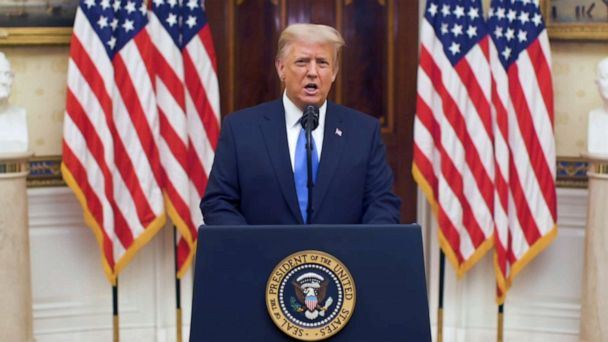
Trump Pardons Lil Wayne, Kodak Black, Others (See Full Statement)

US President Donald Trump has raised concerns about Netflix’s planned 72 billion dollar deal to buy Warner Bros Discovery’s movie studio and HBO networks.

Speaking at an event in Washington DC, Trump said Netflix already has a large market share and the combined company could be too powerful.

Netflix and Warner Bros announced last week that they had agreed to bring major franchises such as Harry Potter and Game of Thrones to Netflix. The deal would create one of the biggest media companies in the world and is still waiting for approval from competition authorities.

Netflix started in 1997 as a DVD rental company and later grew into the world’s largest streaming service. If approved, the deal would strengthen its position at the top of the global streaming market.

Under the agreement, popular titles such as Looney Tunes, The Matrix and Lord of the Rings would move to Netflix. The deal is expected to be completed after Warner Bros completes a business split in the second half of 2026.

US competition regulators are expected to examine whether the merger gives too much market power to the combined company.

Trump said he would be personally involved in deciding whether the deal should be approved. He also said Netflix co CEO Ted Sarandos recently visited the Oval Office and praised him for his leadership.

Media experts say the main concern for regulators is the combination of Netflix with HBO, Warner Bros’ streaming business. Some analysts believe the deal could still be approved if regulators treat cable TV, broadcast TV and YouTube as competing platforms.

Industry groups have raised concerns. The Writers Guild of America said the merger could lead to job losses, lower wages and higher prices for viewers if approved.

AXA Mansard, IEI Project N5.53bn Profit In Q1 2026

Only 2.9m Vehicles In Nigeria Have Insurance Policies
credit: Pakwheels

Two insurance companies, AXA Mansard and International Energy Insurance Plc, have projected a combined profit before tax of N5.53 billion for the first quarter of 2026.

The companies disclosed this in their financial forecasts filed with the Nigerian Exchange Group as part of their statutory disclosure requirements.

AXA Mansard Insurance projected a profit before tax of N4.24 billion and a profit after tax of N3.6 billion for the period. The company also expects to generate N47.18 billion in insurance revenue in the first quarter of 2026.

According to the forecast signed by the company secretary, Omowunmi Adewusi, insurance service expenses are expected at N32.19 billion, while net expenses from reinsurance contracts are projected at N9.78 billion. This is expected to result in an insurance service result of N5.20 billion.

The company also anticipates N5.42 billion in net investment and other income, with operating expenses forecast at N6.18 billion. Taxes are expected to amount to N635.32 million, leading to the projected profit after tax of N3.6 billion.

AXA Mansard’s cash flow outlook shows N4.33 billion expected from operating activities and no cash flows from financing activities. Investing activities are projected at a negative N7.02 billion, resulting in a net cash decrease of N2.70 billion for the quarter. The company expects to start the period with N11.90 billion in cash and end with N9.20 billion.

International Energy Insurance Plc projected a profit before tax of N1.29 billion and a profit after tax of N868.5 million for the same period.

Figures signed by the company’s Chief Financial Officer, Uyi Osagie, and Acting Managing Director, Joyce Odiachi, show the insurer expects to generate N3.76 billion in gross premium written, with an insurance service result of N2.71 billion.

Operating profit is projected at N809.38 million, while interest and similar income are estimated at N486.35 million. Taxation is projected at N427.26 million.

The company said its projections are based on stable government policies, strong management, and the absence of major uninsured risks or catastrophic claims.

It also expects continued customer loyalty and increased industry revenue from the mandatory enforcement of building under construction and public building insurance policies, as well as compliance with the “No Premium, No Cover” guideline.

Dollar To Naira Exchange Rate For 8th December 2025

Dollar To Naira Exchange Rate For 8th Dec 2023

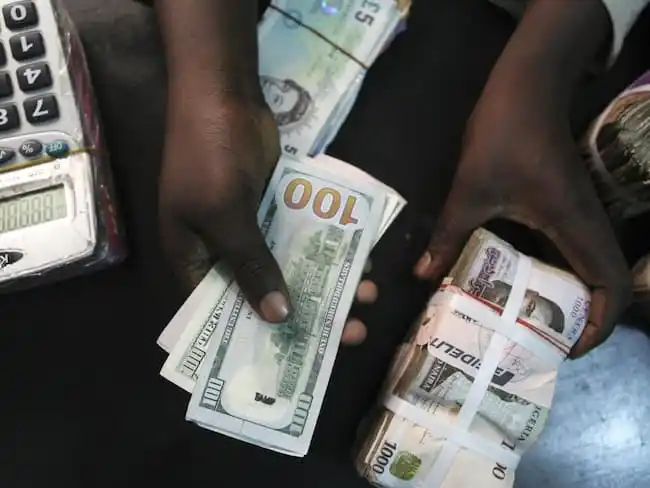
The exchange rate between the Naira and the US dollar, according to the data released on the FMDQ Security Exchange, the official forex trading portal, showed that the naira closed at 1465.00 per $1 on Monday, December 8th , 2025. The naira traded as high as 1446.00 to the dollar at the investors and exporters (I&E) window on Sunday.

How much is a dollar to naira today in the black market?

Dollar to naira exchange rate today black market (Aboki dollar rate):

The exchange rate for a dollar to naira at Lagos Parallel Market (Black Market) players sell a dollar for ₦1490 and buy at ₦1475 on Sunday 7th December, 2025, according to sources at Bureau De Change (BDC).

Please note that the Central Bank of Nigeria (CBN) does not recognize the parallel market (black market), as it has directed individuals who want to engage in Forex to approach their respective banks.

Dollar to Naira Black Market Rate Today

Dollar to Naira (USD to NGN)Black Market Exchange Rate Today
Selling Rate₦1490
Buying Rate₦1475

Dollar to Naira CBN Rate Today

Dollar to Naira (USD to NGN)CBN Rate Today
Highest Rate₦1456
Lowest Rate₦1448

Please note that the rates you buy or sell forex may be different from what is captured in this article because prices vary.

NiMet Predicts Dust Haze In North, Thunderstorms In South From Monday To Wednesday

NiMet, Earth Networks Sign Pact On Early Warning Of Severe Weather

The Nigerian Meteorological Agency (NiMet) has forecast a mix of dust haze and thunderstorms across the country between Monday, 8 December, and Wednesday, 10 December 2025.

The agency disclosed this in its three-day weather outlook issued on Sunday by the Central Forecast Office, warning of reduced visibility in some northern states where horizontal visibility may drop to between 2km and 5km.

Monday

NiMet projects moderate dust haze over parts of Katsina, Kano, Jigawa, Gombe, Bauchi, Adamawa, Taraba, Borno and Yobe on Monday. Other northern areas are expected to remain under slight haze for most of the day.

The central states will also experience slight dust haze.

In the South, the morning is expected to be cloudy with intervals of sunshine. Isolated thunderstorms are likely over Cross River and Akwa Ibom early in the day. Later, light rain and scattered thunderstorms are anticipated across Rivers, Delta, Ondo, Lagos, Edo, Ogun, Bayelsa, Cross River and Akwa Ibom.

Tuesday

Moderate dust haze is expected to persist across the North on Tuesday, with visibility still ranging between 2km and 5km. Slight dust haze will continue over the central region.

Southern states will remain partly cloudy with sunshine intervals. Isolated thunderstorms are likely over Bayelsa, Rivers, Delta, Cross River and Akwa Ibom in the afternoon and evening.

Wednesday

By Wednesday, moderate dust haze is forecast to continue across the North and central states.

The South is expected to begin the day cloudy, with isolated thunderstorms and light rainfall expected later over Akwa Ibom, Cross River, Lagos, Edo, Ogun and Ondo.

Safety Advisory

NiMet advised motorists to exercise caution due to reduced visibility and slippery roads during rain or thunderstorms, noting the increased risk of road accidents under such conditions.

Airline operators were urged to obtain airport-specific weather information and monitor updates ahead of flight planning and operations.

Residents were encouraged to stay updated through NiMet’s official channels and adhere to guidance from local authorities.

The agency further advised individuals with asthma and other respiratory challenges to minimise exposure to dust, use protective masks when necessary, and keep inhalers or prescribed medications close at hand.

NITDA Raises Alarm Over Chatgpt Security Flaws Enabling Data-Leakage Attacks

The National Information Technology Development Agency (NITDA) has issued a critical cybersecurity advisory alerting Nigerians to newly discovered vulnerabilities in ChatGPT that could expose users to data leakage and targeted cyberattacks.

The advisory, released through the agency’s Computer Emergency Readiness and Response Team (CERRT.NG), comes amid growing reliance on AI systems for business operations, academic research, and government processes.

According to NITDA, cybersecurity researchers have uncovered seven security flaws affecting the GPT-4o and GPT-5 models, enabling cybercriminals to manipulate ChatGPT using indirect prompt injection techniques.

The agency explained that attackers can plant hidden instructions inside webpages, comment sections, or URLs—commands which ChatGPT may unknowingly execute when users browse, summarise, or interact with such content.

“By embedding hidden instructions in webpages, comments, or crafted URLs, attackers can cause ChatGPT to execute unintended commands simply through normal browsing, summarisation, or search actions,” the advisory noted.

The agency added that: Some vulnerabilities allow malicious prompts to bypass safety controls when disguised under trusted domains.

Others exploit markdown rendering weaknesses, enabling embedded harmful instructions to slip through undetected.

In more severe cases, attackers may poison ChatGPT’s memory—causing the system to retain harmful instructions that could influence future responses.

While OpenAI has addressed parts of the issue, NITDA warned that large language models still struggle to fully distinguish legitimate user prompts from embedded malicious data.

Potential Risks to Users

If exploited, these vulnerabilities could expose individuals and organisations to:

Data leakage

Unauthorised command execution

Manipulated responses and misinformation

Compromised enterprise workflows

Long-term conversational manipulation through memory poisoning

NITDA’s Safety Recommendations

The agency advised Nigerians, businesses, and government bodies to adopt strict safety measures when using AI systems. These include:

Limiting or disabling browsing and summarisation features, especially when interacting with untrusted websites.

Enabling browsing and memory features only when absolutely necessary.

Ensuring that deployed GPT-4o and GPT-5 models are regularly updated to patch known vulnerabilities.

This advisory follows a similar warning issued by NITDA earlier in the year concerning a major security flaw found in embedded SIM (eSIM) technology. The vulnerability—linked to the GSMA TS 48 Generic Test Profile (version 6.0 and earlier)—placed over two billion devices at risk of SIM-level attacks, including malicious applet installation, cryptographic key theft, message interception, and covert device control.

NITDA reiterated its commitment to safeguarding Nigeria’s digital ecosystem and urged users to remain vigilant as cyberthreats evolve alongside emerging technologies.

NAF, Allied Forces Foil Coup Attempt In Benin Republic, Heightening Regional Anxiety

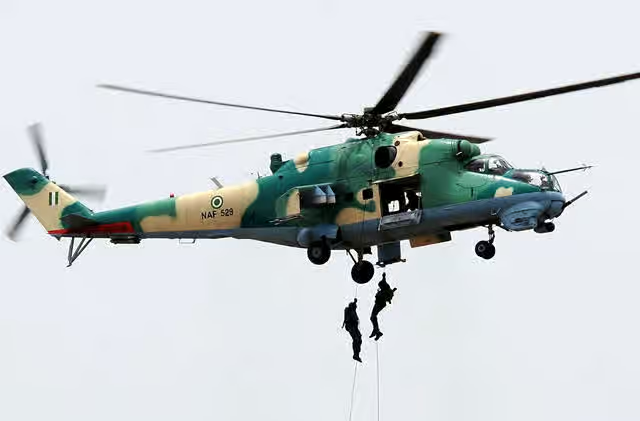
A coordinated military operation involving the Nigerian Air Force (NAF), the Beninese Armed Forces and French troops yesterday thwarted an attempted coup in the Republic of Benin, restoring a fragile calm to Cotonou after hours of tension and sporadic gunfire near the presidential residence.

The failed takeover;  the latest in a region increasingly rattled by democratic backsliding, marks ECOWAS’ sixth major assault on civilian rule since 2020.

The Guardian gathered that two NAF fighter jets were deployed from Lagos at dawn after renegade soldiers broadcast an announcement claiming to have overthrown President Patrice Talon. French military aircraft were also observed circling over Cotonou during the operation.

Benin’s Interior Minister, Alassane Seidou, confirmed in a televised address that a “small group of soldiers” had launched a mutiny aimed at destabilising state institutions, but said loyal forces “retained control of the situation and foiled the attempt.” He further disclosed that President Talon was safe at a secure location.

Residents reported loud explosions in the late afternoon, believed to have come from airstrikes conducted as forces moved against the rebels. Flight-tracking reports showed three aircraft entering Beninese airspace from Nigeria; two later returned to Lagos, while the third headed toward the NAF base in Kainji.

French diplomats dismissed rumours that Talon sought refuge in their embassy.

The coup plotters, led by Lt Col Pascal Tigri, accused Talon of presiding over worsening insecurity in northern Benin, where troops have faced deadly attacks from insurgents linked to the Islamic State and al-Qaeda. They also cited alleged neglect of fallen soldiers’ families, cuts to healthcare services, tax hikes and restrictions on political activities.

Talon, 67, a close ally of Western governments, is due to leave office next year after completing his second term, with presidential elections scheduled for April.

Security sources told The Guardian that the airstrikes lasted about 30 minutes and formed part of a carefully coordinated suppression operation.

“Our objectives were clear — neutralise fleeing hostile elements, prevent regrouping and restore stability,” a senior Nigerian military officer stated, describing the mission as “precise, intelligence-driven and consistent with regional security mandates.”

Air Commodore Ehimen Ejodame stressed that NAF’s involvement was in line with ECOWAS protocols and the ECOWAS Standby Force mandate. “The operation underscores Nigeria’s commitment to regional security and was conducted in full coordination with host-nation authorities,” he said.

Although the plot was foiled, the incident has intensified concerns about democratic fragility across West Africa, where military juntas now dominate several states surrounding Nigeria.

The Nigerian government described the attempted takeover as “unacceptable and retrogressive,” warning that unconstitutional seizures of power undermine regional peace and socio-economic progress. ECOWAS also condemned the “subversion of the people’s will,” praising Benin’s security forces and pledging support, including potential deployment of the regional standby force.

Since 2020, the region has witnessed coups or attempted coups in Mali, Guinea, Burkina Faso, Niger, Guinea-Bissau, and now Benin. Across Africa, at least 10 successful coups have been recorded in the last five years.

Analysts note that while frustration with governance failures — insecurity, weak institutions, economic hardship, and poor delivery of social services — has emboldened coup supporters, military takeovers have only worsened instability in many cases, creating power vacuums exploited by jihadist groups such as ISWAP and emerging militant outfits like Lakurawa.

Stakeholders Warn: Only Good Governance Can Prevent Coups

Legal and security experts say the resurgence of coups reflects deep structural deficiencies that must be addressed urgently.

Constitutional lawyer Mike Ozekhome (SAN) argued that military regimes lack the competence to manage modern states and that the “euphoria” that greets coups quickly evaporates.

“Coups are no longer fashionable. Soldiers are not cut out for governance; the best antidote is good governance — responding to citizens’ needs, making life comfortable for them, and upholding democratic freedoms.” He said.

He warned against shrinking the political space, stressing that pluralism, strong institutions, and an active opposition are essential safeguards.

Security analyst Sadeeq Abubakar blamed persistent governance failures for fuelling discontent that emboldens soldiers. He cautioned that unless governments restore citizens’ faith in democracy, “the military will continue to return.”

Another analyst, Alli Hakeem, said the region must adapt governance models to its unique realities, arguing that Western-style democracy “has not worked effectively in Africa.”

Dr Bello Ishaq, Executive Director of the Impacthive Centre for Accountability, Democracy and Rights (ICADAR), described the coup attempt as part of a disturbing trend across Africa.

“These unconstitutional interventions arise from bad governance, corruption, economic hardship, and erosion of institutions,” he said. “We must strengthen accountability, promote rule of law, and confront external actors who sponsor instability for their interests.”

He reaffirmed that sustainable peace and stability will remain elusive until African states commit fully to democratic values, transparency and inclusive governance.

Niger CAN Awaits Official Confirmation Of Reported Release Of 100 Abducted Students

The Christian Association of Nigeria (CAN) in Niger State says it is yet to receive official confirmation on the reported release of 100 abducted pupils from Agwara Local Government Area, though it described the news as a potential answer to the prayers of many Nigerians.

The State CAN Chairman, Bishop Bulus Yohanne—who also owns St. Mary Private Catholic Primary and Secondary Schools, Papiri—made this known on Sunday in a statement issued by his media aide, Daniel Atori.

The school was attacked by bandits on 21 November 2025, during which at least 303 pupils, students, and teachers were abducted. Fifty pupils managed to escape two days later.

Last week, the National Security Adviser, Nuhu Ribadu, visited the school community and assured parents and school authorities that the abducted students were safe and would soon be reunited with their families.

Reacting to unconfirmed reports of the release of 100 students, Bishop Yohanne expressed cautious optimism.

“It will be a thing of joy if some of our children have been released. We have been praying and waiting for their return. If it is true, then it is cheering news,” he said. “However, we are not officially aware and have not been duly notified. We hope and pray it’s true, and we look forward to the release of the remaining children.”

The development follows reports by Channels Television that the Federal Government had secured the release of 100 abducted pupils—a claim applauded by Nasarawa State Governor, Abdullahi Sule, and retired Major General John Enenche. Speaking during a live interview on Channels Television’s Politics Today, Governor Sule described the reported breakthrough as “cheering news,” commending the coordinated efforts of security agencies.

Across Niger State, Christians concluded a three-day fasting and prayer session on Sunday, seeking divine intervention for the release of the remaining 265 children and teachers still in captivity. The programme, organised by the state chapter of CAN, was held simultaneously across all 25 local government areas and ended with a service at the 1st ECWA Church, Minna.

Guest preacher, Pastor Peter Ojo, urged continued prayer, declaring that “prayer still works.”

Representing Bishop Yohanne at the event, Rev. Ezekiel Ibrahim called for unity, saying, “Let us worship passionately and pray boldly. This is a time to set aside all differences and seek God’s intervention together.”

The Organisation of African Instituted Churches (OAIC) also expressed solidarity with the Bishop of Kontagora Diocese, affected families, and the school community.

OAIC Secretary, Sunday Ojimi, said, “No words can express the shock and pain this incident has caused, but we find strength and hope in our faith. Our hearts remain full of hope, and we are optimistic that the children and teachers will return safely to their families soon.”

He added that the organisation stands with the Niger Christian community during this period of uncertainty and continues to pray for the safe return of all abductees.

Insurance Recapitalisation Lifts Sector GDP Growth To 20.78%

Ongoing recapitalisation in Nigeria’s insurance industry has pushed the sector to one of its strongest growth performances in recent years, according to new national economic data.

Figures from the National Bureau of Statistics show that the insurance subsector recorded real GDP growth of 20.78 per cent in the third quarter, up from 15.70 per cent in the previous quarter and higher than growth recorded over the last six quarters.

A research note by Credit Direct described the performance as a strong rebound, linking the growth to capital strengthening efforts across the insurance industry.

Data at current basic prices showed that insurance contributed N398.17 billion to GDP in the third quarter. This was lower than the N554.07 billion recorded in the previous quarter but higher than the N267.30 billion posted in the first quarter of 2025.

The subsector has already exceeded its full year performance for 2024, contributing N1.22 trillion so far, compared with N1.18 trillion recorded in the entire 2024 financial year.

The combined finance and insurance sector also showed strong momentum, growing by 40.55 per cent in nominal terms year on year. Insurance alone recorded a nominal growth rate of 32.44 per cent.

In real terms, the finance and insurance sector grew by 19.63 per cent, with its contribution to real GDP rising to 2.65 per cent.

Industry leaders say the growth is being driven by increased economic activity across construction, trade, real estate, and oil and gas.

The Managing Director of Rex Insurance, Ebelechukwu Nwachukwu, said more infrastructure projects and rising business transactions have increased demand for insurance services.

She also said improved claims payment, greater use of digital platforms, and increased public awareness campaigns have helped to rebuild trust and attract more customers.

Meanwhile, the Managing Director of Cornerstone Insurance Plc, Stephen Alangbo, said recapitalisation expectations boosted investor confidence, strengthened company balance sheets, and improved share price performance across the sector.

PENGASSAN–Dangote Dispute Deepens As Refinery Halts Salaries Of Sacked Engineers

The rift between the Dangote Petroleum Refinery and the Petroleum and Natural Gas Senior Staff Association of Nigeria (PENGASSAN) has widened following the suspension of monthly salaries for engineers laid off in September amid a labour dispute.

The refinery reportedly stopped paying the affected workers after many of them declined redeployment to alternative Dangote projects located in Zamfara, Benue, Borno, Sokoto, and other states.

Investigations by The PUNCH indicate that the wage suspension followed weeks of tension, during which the engineers—who were reassigned to coal mines, concrete road construction sites, and rice processing plants—rejected the postings while awaiting the outcome of ongoing union negotiations.

Several of the workers, who spoke anonymously due to the sensitivity of the dispute, said the assignments included coal projects in Benue, concrete road sites in Borno and Ebonyi, and rice factories in Kebbi, Niger, Sokoto, and Zamfara.

Although a few accepted the postings, most relied on assurances from PENGASSAN that the matter would be resolved through dialogue.

It was further learnt that the Dangote Group first issued a warning in October by reducing the affected workers’ salaries before withholding their November pay entirely.

A senior Dangote official confirmed the development, insisting the company could not continue paying workers who rejected alternative employment. The official, who requested anonymity, argued that the company had offered redeployment in good faith.

“Those whose services were terminated were given opportunities to work on other projects, including rice mills, concrete road construction, and coal mines. All who accepted have since resumed,” the official said. “If an organisation provides alternative employment and the individual declines, will it keep paying salaries?”

In September, PENGASSAN shut down oil and gas facilities across the country, alleging that about 800 refinery workers were dismissed for joining the union. The refinery denied the claim, maintaining it only disengaged staff accused of sabotage as part of a reorganisation exercise.

The shutdown led to production losses and contributed to reduced power supply nationwide before the Federal Government intervened, directing the redeployment of the dismissed workers.

In October, the affected engineers were invited to pick up new placement letters from the Dangote Group’s Ikeja office. One such letter, titled Offer of Trainee Engagement, detailed a two-year training programme for mechanical engineering trainees at a coal project in Benue State.

However, many engineers expressed concerns about the postings, citing security risks and the absence of clear reporting locations.

“There was no office address to report to. These are security-prone zones. The letter said we must report within 14 days, but there’s no office to report to. That alone amounts to self-termination. PENGASSAN advised us not to accept until dialogue is concluded,” one worker said.

Speaking during a recent briefing, PENGASSAN President Festus Osifo said the union was actively engaging the Dangote Group to resolve outstanding issues without returning to industrial action.

“Though there are still unresolved matters, the NEC decided to continue pushing through dialogue. We hope that these issues will be resolved at the negotiation table,” Osifo said.

But the Dangote Group maintains it has the right to make business decisions. A senior official remarked, “PENGASSAN can ask for anything, but we also reserve the right to determine what aligns with our operations.”

Some affected engineers said they believed the salary suspension breached previous agreements.

“An agreement was reached that we would be deployed within Dangote’s oil and gas companies and that salaries would be paid until the issue was resolved, but our October salaries were slashed, and now November has not been paid. That is victimisation.” They said.

As the impasse persists, the engineers fear being forced into roles they consider unsafe or irregular, while PENGASSAN continues efforts to prevent a repeat of the September shutdown.

With both sides refusing to back down, the eventual resolution of the dispute now depends on the success of ongoing negotiations between PENGASSAN and the Dangote Group.

Industry Leaders Push Tech To Expand Insurance Coverage In Nigeria

Insurance

Stakeholders in Nigeria’s insurance sector have called for stronger use of technology to deepen insurance coverage and strengthen the industry’s ability to withstand economic and social shocks.

The call was made at the 25th Adetunji Ogunkanmi Memorial Lecture themed “Beyond Insurance: Building Resilience, Health, and Legacy”, where industry experts discussed the future of insurance in the country.

The Managing Director of Nigeria Liability Insurance Pool, Adeyinka Adekoya, said the industry relies too heavily on corporate clients and has failed to penetrate the retail market.

She noted that most ordinary Nigerians are not covered because insurance products are not designed to meet their everyday needs.

Adekoya said technology must be central to any plan to grow the sector, adding that digital platforms are needed to reach rural and underserved communities.

She said Nigeria’s insurance penetration remains very low when compared with other African countries and stressed that the industry should be moving towards a 10 to 15 per cent penetration rate.

She urged insurers to move beyond traditional agents and create multiple digital access points that allow people to buy insurance easily from their homes and mobile devices.

The Managing Director and Chief Executive Officer of Cornerstone Insurance Plc, Stephen Alangbo, also called for resilience in the face of risks such as climate change and political instability.

He said insurance plays a key role in protecting health, wealth and long term security, and urged Nigerians to think about the legacy they leave behind.

Alangbo said ongoing reforms, including the new Nigerian Insurance Act, are helping to improve the industry and make insurance more attractive to consumers.

He expressed optimism that Nigeria’s insurance sector could grow to rival global markets if technology and consumer focused innovation are fully embraced.

Doctors Demand Improved Working Conditions, Urgent Reforms In Nigeria’s Health Sector

The National Executive Council (NEC) of the National Association of Government General Medical and Dental Practitioners has called for sweeping reforms in Nigeria’s health sector, warning that deteriorating working conditions are undermining service delivery and threatening the stability of the medical workforce.

Speaking at the association’s 2025 Annual General Meeting (AGM) in Abeokuta, the National President, Dr Anas Alhaji Idris, said Nigeria’s healthcare system is struggling under the burden of insecurity, burnout, inadequate compensation, and worsening brain drain.

He stressed that a motivated and protected medical workforce is indispensable to national development, adding that “a healthy nation is a wealthy nation.”

Idris commended President Bola Ahmed Tinubu’s efforts to address insecurity but urged governments at all levels to intensify the actions necessary to create an environment where healthcare professionals can thrive.

The association outlined several urgent interventions required to restore confidence in the system and retain skilled professionals:

Immediate implementation of a revised salary structure and retention allowances to boost morale and stem migration of doctors.

Swift conclusion of the long-pending Collective Bargaining Agreement (CBA) to rebuild trust and restore industrial harmony.

Comprehensive insurance coverage for all doctors, given rising occupational hazards including insecurity, workplace violence, and exposure to infectious diseases.

Idris noted that many doctors continue to work under conditions that leave their families unprotected, describing this as “unacceptable for a country that aspires to a robust and sustainable healthcare system.”

“We call on the Federal Government, the Ministry of Health and Social Welfare, and the Ministry of Labour to urgently reconvene and finalise the Collective Bargaining Agreement without further delay,” he said. “Resolving the CBA is a critical step toward stabilising the sector.”

He further appealed to state governments to prioritise the welfare of doctors as part of a broader retention strategy.

Insecurity and Brain Drain

The NEC also identified insecurity as a major driver of medical migration, stating that restoring safety across the country is essential to stabilising healthcare delivery.

“The restoration of security remains central to reversing the medical brain drain,” Idris said. “Doctors must be able to work in an environment where their lives and the lives of their patients are protected.”

The association reaffirmed its willingness to engage with government and stakeholders to build a sustainable and resilient health system. Idris pledged continued advocacy for improved welfare, better working conditions, and enhanced professional development for government-employed doctors.

Other NEC members present at the meeting included the Chief Protocol, Dr Aina Oluwafemi; Secretary-General, Dr Ezekiel Ibrahim Ladan; Vice President 1, Dr Abiodun Ajayi; and several senior officials.

PenCom Warns Employers, Recovers N32.27bn From Pension Defaulters

The National Pension Commission has announced that it will intensify enforcement of the pension law and impose sanctions on employers who fail to remit workers’ pension contributions.

The Director General of PenCom, Omolola Oloworaran, made this known at a training workshop for accredited recovery agents held in Lagos.

She was represented at the event by the Commissioner of Inspectorate, Samuel Chigozie Uwandu, who said the commission is committed to clamping down on pension defaulters across the country.

PenCom disclosed that it recovered a total of N32.27 billion from defaulting employers between June 2012 and September 2025. The amount includes N15.87 billion in unremitted pension contributions and N16.4 billion in penalties.

The commission also recovered N2.06 billion from 49 employers in the third quarter of 2025 alone, reflecting what industry operators described as stronger enforcement action in recent years.

Oloworaran said persistent failure to remit contributions undermines the contributory pension scheme and stressed that the commission has shifted from persuasion to strict enforcement.

She described every unremitted contribution as a broken promise to Nigerian workers and said recovery agents are central to achieving compliance.

PenCom revealed that it is strengthening collaboration with the Corporate Affairs Commission, the Federal Inland Revenue Service and other regulatory agencies to improve compliance.

The commission also said it signed a memorandum of understanding with the Independent Corrupt Practices and Other Related Offences Commission to hold directors and managers of defaulting companies personally accountable, including possible criminal consequences.

The training sessions focused on employer audits, liability computation, negotiation, documentation, evidence management and the use of digital compliance tools.

Oloworaran urged recovery agents to maintain high ethical and professional standards while carrying out their duties and assured them of the commission’s support.

Air Peace Wins Airline Of The Year As Onyema Bags Aviation Executive Award

Allen Onyema: Aviation Fuel Price Increment Is Counter-productive

Nigeria’s largest airline, Air Peace, has won the Airline of the Year award for its performance and contribution to reshaping Nigeria’s aviation sector and restoring confidence in local carriers.

The award was presented by the Minister of Aviation and Aerospace Development, Festus Keyamo, at the maiden edition of the Nigeria International Air Show organised by Bria Williams in Abuja.

In a statement issued by the airline’s spokesperson, Efe Osifo-Whiskey, the Chairman and Chief Executive Officer of Air Peace, Allen Onyema, was also named Aviation Executive of the Year.

The statement said Air Peace has grown significantly since it was founded in 2014. It noted that the airline expanded from a small fleet of Dornier 328 and Boeing 737 aircraft to a large mixed fleet that now includes Boeing 777 wide-body aircraft, Embraer 195-E2 jets, and other narrow-body and regional aircraft. The airline said this growth reflects its strategic investments in fleet modernisation and increased operational capacity.

The airline also highlighted the expansion of its route network. In 2024, Air Peace launched its Lagos to London Gatwick service, marking its entry into the European market. In late 2025, the airline introduced a direct Abuja to London Heathrow flight, described as the first by a Nigerian airline and a major step in its international expansion.

The statement said these achievements in fleet development, network growth and long-haul operations were key reasons the airline stood out at the Nigeria International Air Show.

Global Crude Oil Prices Slide As U.S. Demand Weakens And Sanction Easing Signals Hit Market

Crude oil prices closed lower for the week as the global energy market reacted to fresh indicators of slowing fuel consumption in the United States, alongside Washington’s latest relaxation of restrictions on Lukoil’s international operations and ongoing uncertainty surrounding Russia–Ukraine peace efforts.

Brent crude ended the week at $62.99 per barrel, slipping 0.4% from the previous Friday’s price of $63.24, while the U.S. benchmark, West Texas Intermediate (WTI), settled at $59.30 per barrel, down 0.2% from last week’s $59.43.

Fresh data released by the U.S. Energy Information Administration (EIA) showed that commercial crude inventories increased by 600,000 barrels, bringing total stockpiles to 427.5 million barrels. Analysts had projected a drawdown of around 1.9 million barrels, and the unexpected rise contributed significantly to bearish positioning among traders.

The EIA further noted that U.S. strategic reserves added 300,000 barrels to reach 411.7 million barrels, while gasoline inventories jumped by 4.5 million barrels to 214.4 million barrels. Crude production also recorded a modest uptick, rising by 1,000 barrels per day to 13.815 million bpd, reinforcing widespread expectations of ample supply even as demand indicators soften.

Market analysts said the combination of rising inventories, steady production levels, and decreasing consumption patterns strengthened the downward pressure on global crude benchmarks throughout the week.

Sentiment was further weighed by Washington’s decision to temporarily permit Lukoil to continue operating its fuel stations outside Russia until April 29, 2026, easing fears of potential supply disruptions. The waiver, issued by the Office of Foreign Assets Control (OFAC), softened parts of earlier sanctions against Rosneft, Lukoil, and affiliated entities in response to concerns that the companies had not demonstrated meaningful support for Ukraine peace initiatives.

Political signals also contributed to the retreat in oil prices. Russian President Vladimir Putin told India Today that Moscow would bring the conflict to an end once its pre-war objectives had been achieved. He referenced a December 2 meeting with envoys of U.S. President Donald Trump as “very useful,” adding that all components of Washington’s proposed peace plan had been reviewed.

His remarks helped reduce the geopolitical risk premium that had previously offered support to crude markets.

However, new instability in Yemen added fresh complexities to supply risk forecasts. Forces aligned with the UAE-backed Southern Transitional Council (STC) reportedly seized key territories in the oil-rich Hadhramaut region, including strategic towns and vital oilfield locations. Officials from Yemen’s Second Military Region confirmed that STC special units had taken control of positions formerly held by the “Tribal Alliance,” along with several oil platforms on the Hadhramaut plateau.

Elsewhere in Latin America, U.S. President Donald Trump’s decision to shut U.S. airspace to Venezuelan aircraft — following earlier naval deployments near the country — raised concerns of tighter curbs on Venezuelan crude shipments. Analysts believe a full-scale confrontation remains unlikely, though additional U.S. pressure could constrain Venezuela’s already fragile oil output.

Expanded drone attacks targeting critical energy facilities in Russia and Ukraine also provided limited support to oil prices, underscoring ongoing risks of supply chain disruptions.

Despite these bullish geopolitical factors, the week ended with bearish momentum firmly in place, driven primarily by soft U.S. demand signals and Washington’s easing of sanctions affecting Russian-linked oil operations.

Nigeria’s Stock Market Rebounds Strongly As Industrial And Banking Stocks Boost Investor Wealth By N2.43tn

Stock Exchange Closes Trading Week With N30bn Gain

Investors on the Nigerian Exchange (NGX) recorded strong gains as renewed interest in industrial and banking stocks drove a significant rally, lifting market capitalisation by N2.43 trillion after weeks of volatility.

The market regained positive momentum following an extended period of profit-taking, advancing for four consecutive sessions to deliver notable gains across key indices.

The NGX All-Share Index ended the week at 147,040.26 points, representing a 2.45% week-on-week increase, a development market analysts attributed to improving investor sentiment and bargain-hunting activities.

According to stockbrokers, the upbeat performance pushed the total market value to N93.72 trillion, up from N91.29 trillion recorded the previous week, marking a 2.67% expansion. The Nigerian Exchange’s year-to-date return also rose to 42.86%, well ahead of Nigeria’s headline inflation rate of 16.05%.

Trading data showed moderately positive market breadth, with 42 gainers against 38 losers. Activity levels improved noticeably, with total deals rising 7.26% and trading volume climbing 60.26%. Although the value of traded equities slipped slightly by 2.03%, the market remained highly active, with 6.62 billion units worth N113 billion exchanged across 109,680 deals.

Sectoral performance mirrored the broader bullish trend. Industrial stocks led the charge, posting a 7.38% weekly surge, while the Banking Index gained 3.20%. Consumer Goods equities rose 1.56%, and Insurance stocks advanced 1.48%.

In contrast, the Oil & Gas Index dipped 0.57%, reflecting pressure on both upstream and downstream operators. The Commodity sector also edged lower, slipping 0.30% week-on-week.

Several equities delivered standout returns, with NCR leading gainers after appreciating 33.0%. Others included GUINNESS (+18.6%), CHAMPION (+11.6%), UACN (+11.5%), and SUNUASSUR (+11.0%), driven by sustained accumulation and improved investor appetite.

On the flip side, RTBRISCOE emerged the worst performer, shedding 12.8%, followed by LEGENDINT (-10.7%), EUNISELL (-10.0%), TRANSCOHOT (-9.9%), and LIVINGTRUST (-9.8%).

Looking ahead, analysts at Cowry Asset Limited expect the equities market to maintain a cautiously optimistic trajectory in the near term. They highlighted that fundamentally strong stocks are likely to attract continued buying interest, even as selective volatility persists, especially in sectors influenced by external factors such as Commodities and Oil & Gas.

Market watchers also anticipate that year-end portfolio adjustments, macroeconomic news flows, and upcoming dividend declarations will shape trading dynamics. Investor activity is expected to tilt toward resilient, oversold, and value-driven stocks as traders position ahead of potential market-wide momentum shifts.

Interbank Rates Hold Steady As System Liquidity Surges To N3.2 Trillion

Interbank lending rates remained stable last week as Nigeria’s financial system recorded a substantial liquidity surplus exceeding N3.2 trillion, fuelled by massive inflows from maturing short-term instruments and increased placements at the Central Bank of Nigeria (CBN)’s deposit window.

Money market analysts reported that system liquidity closed the week at N3.20 trillion, reflecting an increase of N1.242 trillion following a combination of auction settlements and repayments.

The market witnessed significant inflows, including N772.93 billion from matured Open Market Operations (OMO) bills and N805.88 billion from treasury bill maturities, which outweighed the outgoing N709.62 billion used to settle the latest auction.

Banks also strengthened their placements at the CBN’s Standing Deposit Facility (SDF), helping to maintain comfortable liquidity conditions and keeping short-term benchmark rates within a tight range.

Both the Overnight Rate (OVN) and the Repo Rate remained largely stable, supported by the CBN’s adjusted monetary policy corridor introduced in November.

During the week, the CBN offered N700 billion worth of treasury bills but allotted N709.62 billion across the 91-day, 182-day, and 364-day maturities, indicating strong investor appetite.

For the week ahead, the money market expects liquidity to remain elevated due to anticipated inflows of N512 billion from treasury bills and N1.08 trillion from OMO repayments.

Despite the liquidity boost, average interbank funding rates held firm at 22.61%. The Open Repo rate (OPR) closed unchanged at 22.50%, while the Overnight Lending Rate inched up marginally by 1 basis point to 22.72%.

Financial analysts anticipate a slight decline in funding costs in the coming week—provided no unexpected funding pressures arise.

System liquidity remained robust throughout November, averaging N3.3 trillion, up from October’s average of N2.9 trillion. This stability was supported by consistent OMO and treasury bill maturities, recurring placements at the CBN’s SDF window, and periodic coupon inflows from government bonds.

BizWatchNigeria.Ng
Privacy Overview

This website uses cookies so that we can provide you with the best user experience possible. Cookie information is stored in your browser and performs functions such as recognising you when you return to our website and helping our team to understand which sections of the website you find most interesting and useful.