








KEY POINTS
- The Manufacturers Association of Nigeria (MAN) has called for robust implementation of national industrial frameworks to curtail heavy reliance on imported raw materials.
- Speaking at the 54th Annual General Meeting in Lagos, MAN President Otunba Francis Meshioye revealed that Nigeria imported N3.53 trillion worth of raw materials in the first half of 2025 alone.
- Industry leaders and policy experts emphasized that lowering energy costs, enforcing local procurement directives, and fostering academia-industry partnerships are critical to positioning Nigeria as Africa’s industrial hub.
MAIN STORY
The Manufacturers Association of Nigeria (MAN) has issued a stern call for the rigorous implementation of the country’s industrial policy, pointing to the unsustainable scale of foreign input dependence as local manufacturers grapple with systemic economic hurdles.
Addressing stakeholders in Lagos on Monday during the opening ceremony of the association’s 54th Annual General Meeting and the Made-in-Nigeria Product Exhibition, MAN President Otunba Francis Meshioye stressed that Nigeria’s ambition to emerge as Africa’s premier industrial hub hinges entirely on enhancing the competitiveness of domestic production. The high-profile three-day event, themed “Leveraging National Industrial Policy to Position Nigeria as Africa’s Industrial Hub,” brought together policymakers, investors, and industrial players to showcase local manufacturing capacity and evaluate strategic growth bottlenecks.
Meshioye drew sharp attention to official trade figures showing that Nigeria imported approximately N3.53 trillion worth of raw materials during the first half of 2025, with nearly N1.72 trillion originating from Asian markets alone. He argued that this massive outflow underscores an urgent national imperative to strengthen domestic supply chains and expand local manufacturing inputs. According to the MAN president, official industrial policies must transition beyond mere rhetoric to deliver measurable gains in manufacturing investments, plant capacity utilization, productivity, and job creation.
“For manufacturers, positioning Nigeria as an industrial hub requires more than expanding the volume of domestic production. It requires an operating environment that enables firms to produce competitively, deepen local value addition, develop domestic supply chains, invest in technology and capacity, and access markets within Africa and beyond,” Meshioye stated. He noted that structural barriers such as exorbitant energy costs, unreliable power supply, expensive financing, poor logistics networks, and unpredictable regulatory frameworks continue to cripple operational efficiency.
To counteract these headwinds, Meshioye demanded stronger state backing through the strict enforcement of public procurement laws. He urged President Bola Tinubu’s administration to mandate total compliance with Executive Orders 003 and 005, which prioritize local content and domestic goods, suggesting that government agencies failing to comply should face formal institutional sanctions.
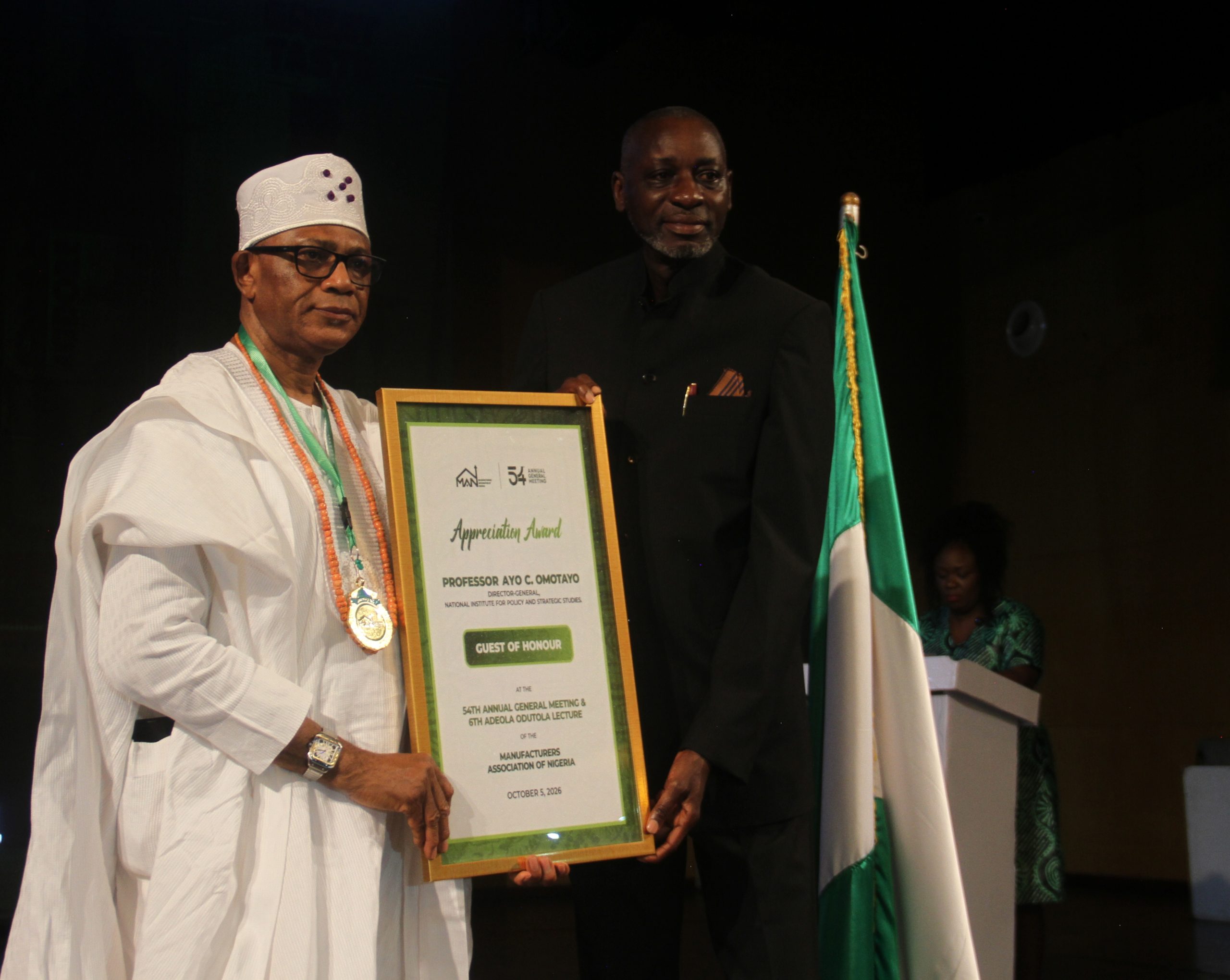
Echoing these positions, Professor Ayo Omotayo, Director-General of the National Institute for Policy and Strategic Studies (NIPSS), warned that sustainable economic development remains unattainable without a thriving manufacturing backbone. Referencing fast-developing global economies, Omotayo noted that Nigeria’s rapidly expanding population makes heavy import dependency an acute threat to foreign exchange reserves. He asserted that successful industrialization relies heavily on execution quality rather than policy formulation alone, challenging industry leaders to identify local substitutes for imported raw materials and production machinery.
Omotayo also advocated for deliberate cultural shifts, proposing the creation of manufacturing clubs in universities to foster early youth engagement with industrial processes and strengthen institutional linkages between academia and industrial developers.
Exhibitors at the three-day fair demonstrated diverse domestic capabilities across household goods, plastics, beauty products, and heavy industrial supplies, with several firms noting recent export milestones into regional markets like The Gambia.
In his closing vote of thanks, MAN Director-General Segun Ajayi-Kadir underscored that the exhibition serves as a physical testament to the resilience of Nigerian manufacturers. However, Ajayi-Kadir reiterated that realizing the true potential of the national industrial policy requires unyielding, collaborative action between the public and private sectors to dismantle crippling operational bottlenecks and secure long-term economic competitiveness.
THE ISSUES
- Heavy reliance on foreign raw material imports drains crucial foreign exchange reserves and exposes domestic production lines to external global shocks.
- Persistent infrastructure deficits, high energy expenses, and weak enforcement of local content policies continue to stunt domestic manufacturing growth.
WHAT’S BEING SAID
“For manufacturers, positioning Nigeria as an industrial hub requires more than expanding the volume of domestic production. It requires an operating environment that enables firms to produce competitively, deepen local value addition, develop domestic supply chains, invest in technology and capacity, and access markets within Africa and beyond.” – Otunba Francis Meshioye, President, MAN
“It is not policy that will make manufacturing work. Policy has its own role, but eventually, it is how we approach the implementation of the policies.” – Prof. Ayo Omotayo, Director-General, NIPSS
“Addressing these challenges requires sustained policy action and effective collaboration between the government and the private sector. Nations can only industrialise by consistent and conscientious implementation.” – Segun Ajayi-Kadir, Director-General, MAN
WHAT’S NEXT
The three-day Made-in-Nigeria Exhibition and AGM proceedings will continue with specialized stakeholder panels aimed at forging public-private strategies to ease production bottlenecks and expand export channels.
BOTTOM LINE
The Manufacturers Association of Nigeria has pressed the federal government for immediate, actionable policy execution and strict compliance with local procurement mandates following revelations of over N3.5 trillion spent on imported raw materials.








 has issued a stern call for the rigorous implementation of the country's ...)