



Keypoints
- US President Donald Trump and the Iranian government have agreed to a provisional two-week ceasefire, narrowly averting a “complete demolition” of Iranian infrastructure.
- The agreement, mediated by Pakistan, stipulates that Iran will immediately allow “safe passage” through the Strait of Hormuz under Iranian military management.
- Trump has accepted Iran’s 10-point peace plan as a “workable basis” for negotiations, which are scheduled to begin in Islamabad on Friday, April 10, 2026.
- Global oil prices, which had surged past $111 per barrel, fell sharply below $100 following the announcement as markets reacted to the potential resumption of energy flows.
Main Story
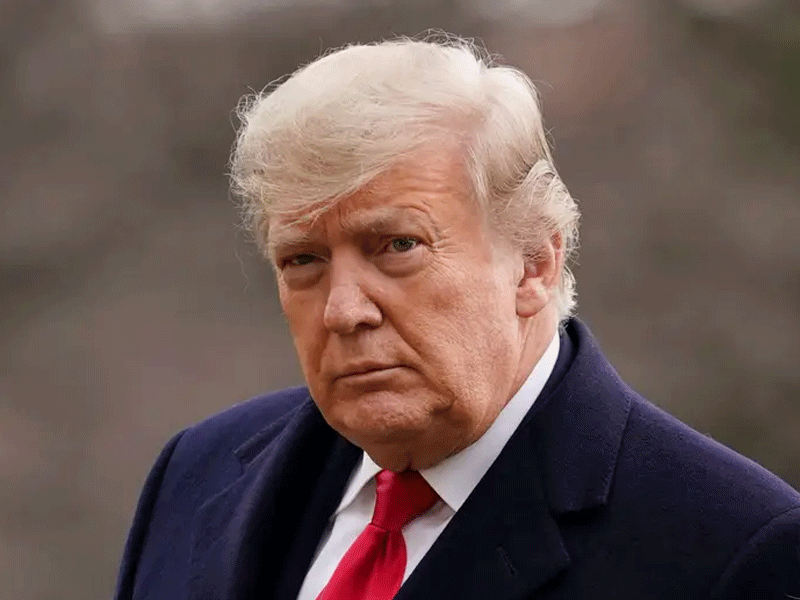
The world stepped back from the brink of a catastrophic escalation late Tuesday night as President Donald Trump and the Iranian Supreme National Security Council announced a two-week “double-sided” ceasefire.
The deal was struck less than two hours before a 0000 GMT deadline, during which the US had threatened to “decimate” Iran’s power plants and bridges.
The breakthrough followed an 11th-hour diplomatic intervention by Pakistani Prime Minister Shehbaz Sharif, who urged the US to “allow diplomacy to run its course” rather than initiate a campaign of “destructive force.”
As part of the truce, Iranian Foreign Minister Abbas Araghchi confirmed that safe passage through the Strait of Hormuz—the world’s most critical energy chokepoint—is now possible in coordination with Iran’s armed forces.
The ceasefire also covers regional fronts, including Lebanon, according to Pakistani mediators. While the US has halted its planned bombing of the Iranian mainland, both sides remain on high alert; reports indicate that limited strikes on military infrastructure, including Kharg Island and several railway segments, occurred in the final hours leading up to the agreement.
The Issues
The primary diplomatic hurdle remains the “10-point proposal” submitted by Tehran. While Trump described it as a “workable basis,” the plan contains highly contentious demands, including the full removal of US sanctions and the right for Iran and Oman to charge transit fees of up to $2 million per ship to fund reconstruction. A significant point of friction also exists between US and Iranian translations of the plan; the Farsi version reportedly includes “acceptance of enrichment” for Iran’s nuclear program, a clause absent from the English version. Furthermore, while the US views this as a path to a “definitive agreement,” Iran’s state media has characterized the ceasefire as a “great victory” aimed at “confirming battlefield achievements.”
What’s Being Said
- “Subject to the Islamic Republic of Iran agreeing to the COMPLETE, IMMEDIATE, and SAFE OPENING of the Strait of Hormuz, I agree to suspend the bombing… Tuesday was a big day for world peace!” President Donald Trump posted on Truth Social.
- “If attacks against Iran are halted, our powerful armed forces will cease their defensive operations,” stated Abbas Araghchi, Iran’s Foreign Minister.
- Prime Minister Shehbaz Sharif of Pakistan announced on X that both nations had agreed to an “immediate ceasefire everywhere,” inviting delegations to Islamabad to “settle all disputes.”
- Prime Minister Benjamin Netanyahu confirmed Israel’s adherence to the US-brokered ceasefire with Iran but clarified that it “does not cover fighting against Hezbollah in Lebanon.”
What’s Next
- High-level delegations from the US, Iran, and mediating nations will convene in Islamabad on Friday, April 10, to begin formal negotiations.
- Technical teams will work to clear the “traffic buildup” in the Strait of Hormuz, which has been effectively blocked since late February.
- Global markets will closely monitor the stability of the truce, particularly as Israel continues operations against Hezbollah, which could potentially trigger a collapse of the broader regional ceasefire.
Bottom Line
The two-week ceasefire provides a critical window for peace, yet the fundamental disagreements over nuclear enrichment, regional proxies, and economic sanctions mean the path to a “conclusive agreement” remains exceptionally fragile.