






Key points
- U.S. President Donald Trump accused Iranian leadership of repeatedly breaking an April ceasefire agreement.
- The U.S. military initiated a fresh wave of strikes against Iranian targets following direct orders from Trump.
- American forces fired 49 Tomahawk cruise missiles and deployed fighter jets as close as 65 kilometers to Tehran.
- Iran declared the total closure of the strategic Strait of Hormuz to all international shipping traffic.
- U.S. Central Command rejected Iran’s claims, stating that commercial ships are continuing to pass through the waterway.
Main Story
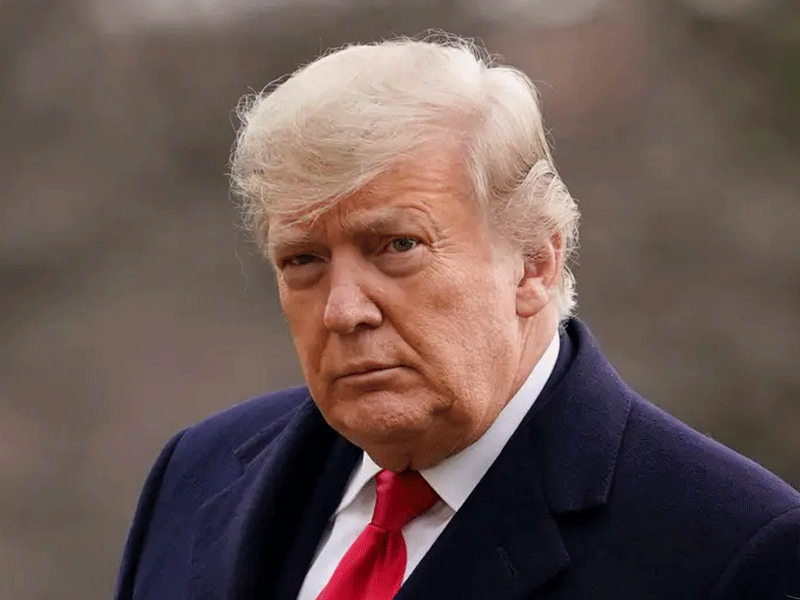
U.S. President Donald Trump has accused Tehran’s leadership of repeatedly violating an active April ceasefire, labeling it “the most violated ceasefire in the history of the world” following a fresh escalation in the region.
The statements come amid a renewed outbreak of hostilities that has shattered diplomatic quiet and triggered immediate military interventions.
According to a Fox News report by correspondent Trey Yingst late on Wednesday, Trump indicated that while the United States could potentially halt its active bombing campaign soon, the pause remains strictly conditional. The U.S. President warned that if Iran refuses to sign a formal framework agreement to permanently end the war, American forces would aggressively resume heavy air operations, stating, “we’ll bomb the shit out of them”.
Trump confirmed that the latest round of U.S. military actions involved firing 49 Tomahawk cruise missiles alongside the deployment of fighter jets, with the closest American target striking roughly 65 kilometers outside the Iranian capital of Tehran.
The U.S. military confirmed it launched the new wave of strikes on targets across Iran under direct orders from the president, while Iranian state media reported a series of explosions rocking several critical port cities along its southern coast. In a swift retaliatory move, Iran announced the full closure of the strategic Strait of Hormuz to all international shipping.
However, the U.S. military’s Central Command (CENTCOM) quickly dismissed Tehran’s declaration of a blockade, maintaining that commercial vessels were still actively transiting the vital energy waterway without interruption.
The Issues
- Securing a binding framework agreement to prevent further military escalations and permanently restore the broken April ceasefire.
- Maintaining the open and safe transit of commercial shipping through the Strait of Hormuz amid conflicting military reports.
- Protecting civilian populations in southern Iranian port cities experiencing heavy localized explosions.
What’s Being Said
- Confronting Tehran’s compliance, U.S. President Donald Trump criticized the current state of diplomacy, describing the April agreement as “the most violated ceasefire in the history of the world”.
- Reporting from the ground, Fox News correspondent Trey Yingst quoted Trump’s severe warnings to Iranian leadership, noting that the administration demands a signed framework agreement to definitively end the war.
What’s Next
- U.S. Central Command will continue monitoring commercial shipping corridors to ensure the Strait of Hormuz remains unblocked.
- International diplomats will analyze the impact of the latest air strikes to see if Tehran will come to the table for a framework agreement.
- Iranian state media is expected to provide updates on the extent of damage across its southern port infrastructure.
Bottom Line
A fresh breakdown of the April ceasefire has triggered new U.S. missile strikes across Iran, leaving the conflict balanced between a potential pause in bombing and a total blockade of the Strait of Hormuz if a final framework agreement cannot be reached.