






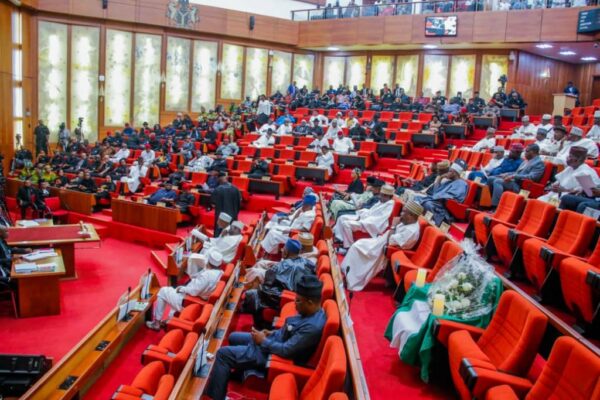
For decades, the call for state police has echoed through Nigeria’s political corridors, often raised, often shelved, and always returning whenever insecurity flares. On Thursday, that call moved closer to constitutional reality, as the House of Representatives passed a landmark bill to decentralise policing, while the Senate cleared its own version for second reading.
The House vote was decisive. Out of 290 members present, satisfying the required two-thirds quorum, 289 voted in favour of state police, with only one dissenting vote and no abstentions recorded. Speaker Tajudeen Abbas confirmed the outcome after a faulty electronic voting system forced lawmakers to register their presence manually.
The bill, sponsored by Orji Uzo Kalu and 14 other lawmakers, had passed second reading back in February 2024 before reaching this milestone. Its core proposal is to move policing from the Exclusive Legislative List, where only the federal government can legislate, to the Concurrent Legislative List, on which states can also act. To do this, the bill amends Sections 197, 214, and 215 of the 1999 Constitution, alongside Sections 84 and 216.
Not everyone was satisfied with the process. Bashir Zubairu Usman, representing Birnin Gwari/Giwa in Kaduna State, raised a Point of Order, protesting that the document had only been distributed to lawmakers that same day, leaving no time for proper review. Abbas overruled him, and the bill proceeded to third reading and passage amid scattered shouts of “Point of Order” from the floor.
In the Senate, Senate President, Godswill Akpabio, referred the bill to the Ad-hoc Committee on the Review of the 1999 Constitution after it cleared second reading with what was described as broad cross-party support.
The Architecture of a Two-Tier Police System
The proposed framework is detailed and layered. It replaces the Police Service Commission with a Federal Police Service Commission, and the Nigeria Police Council with a National Police Council. Wherever the Constitution currently says “Nigeria Police Force,” it would now read “Federal Police and State Police.”
Under the new Section 214, the National Assembly would legislate on the structure and powers of the Federal Police while setting the framework and minimum standards that states must meet before activating their own forces. Crucially, no state police can begin operations until the State House of Assembly passes an enabling law and the force is certified as meeting national minimum standards. Until that certification happens, the Federal Police continues policing that state.
Command structures mirror each other but report to different authorities. The Federal Police would be headed by an Inspector-General appointed by the President on the advice of the National Police Council, confirmed by the National Assembly. State Police would be headed by a Commissioner appointed by the Governor, also on the National Police Council’s advice, but confirmed by the State House of Assembly.
The bill builds in an appeal mechanism: if a state Commissioner of Police believes a Governor’s directive is unlawful or contradicts national policing standards, he can refer the matter to the National Police Council, whose decision is final.
On jurisdiction, the bill draws careful lines. Federal Police retain responsibility for public security nationwide, but state police govern matters within a state’s legislative competence. Federal Police “shall not interfere” with state police operations except where there is a complete breakdown of law and order that the state police cannot contain, where a Governor formally requests federal intervention, or where a state police force becomes inoperative due to administrative or financial collapse.
Removal procedures also differ in weight. An Inspector-General can only be removed by the President on the National Police Council’s recommendation, subject to a two-thirds majority resolution of the National Assembly, for grounds including grave misconduct, breach of the Police Act, fraud convictions, bankruptcy, or mental incapacity. A state Commissioner of Police faces similar grounds but is removed by the Governor, again on the Council’s recommendation, without the National Assembly hurdle.
The Federal Capital Territory remains under exclusive Federal Police jurisdiction, with the bill empowering the Federal Police to establish whatever commands and units it needs there.
The Case for State Police
Senate Leader Opeyemi Bamidele led the charge in the Red Chamber, framing the reform around intelligence superiority. He argued that local officers, fluent in community languages and familiar with social structures, are better positioned to gather actionable intelligence, and that modern policing depends more on intelligence than brute force.
He catalogued the threats driving the push: terrorism, banditry, mass abductions, farmer-herder conflicts, cultism, armed robbery, pipeline vandalism, communal clashes and cyber-enabled crimes, all compounded by their localised nature, which he said has fuelled public demand for decentralisation because many Nigerians feel the centralised structure can no longer cope.
On the perennial fear that governors would weaponise state police against political opponents, Bamidele insisted the bill answers that concern through several layers, including State Police Service Commissions, federal oversight via the Federal Police Service Commission, uniform national standards, and legislative confirmation of senior appointments.
He also framed the reform as relief for an overstretched federal force, arguing it would let the Federal Police concentrate on interstate crimes, terrorism, organised criminal networks, border security, cybercrime, and protection of federal assets and national security operations, while state forces handle local matters and build the community trust that effective policing requires.
Internationally, Bamidele pointed to federations that already run multi-layered policing. He noted that Australia’s states each maintain their own police forces alongside a national force, and Germany runs state police services alongside federal security agencies, arguing Nigeria has no reason to remain an outlier among federations.
Senate Chief Whip Tahir Monguno added a practical dimension, suggesting state police would help bring Nigeria’s sprawling vigilante groups under a proper legal and regulatory framework.
The Voices of Experience: Mixed Verdicts from Retired Officers
Reactions from those who have actually worn the uniform reveal the depth of the divide.
Retired Assistant Inspector General of police, Ali Amodu, offered unqualified support, framing this moment as the fulfilment of a decades-old idea. He recalled writing a decentralisation memo to the force as far back as 1981, after returning from the United Kingdom, and urged lawmakers not to hesitate: “My view is they should go ahead to vote in favour of the establishment of state police.”
Retired Commissioner of Police, Lawrence Alobi, supported the principle but issued a procedural warning, insisting the National Assembly must consult retired and experienced officers rather than treating the reform as purely political business, cautioning that “it should not be a political jamboree.”
Retired Commissioner of Police, Ladodo Rabiu, took the opposite view entirely, grounding his opposition in fiscal reality. His argument: if the federal government already struggles to fund the Nigeria Police, and some states cannot pay civil servant salaries, how will they fund police forces, especially since “police is not a revenue-generating organisation.” He also questioned the logistics of replicating training infrastructure, asking whether every state would now build its own police college, and warned of jurisdictional clashes whenever federal and state forces operate in the same space.
A Security Adviser’s Pragmatic Middle Ground
Col. Ahmed Usman (retd), Special Adviser to the Sokoto State Governor on Security Matters, offered a practical implementation path that sidesteps the recruitment-cost debate entirely. Rather than mass recruitment, he proposed redeploying serving federal police officers to their states of origin, arguing their existing familiarity with local terrain, language, and culture would make the transition smoother and policing more effective from day one.
The Money Behind the Moment
The reform debate unfolds against a backdrop of rising security spending. Nigeria’s arms importation bill hit N32.5bn in the first quarter of 2026, up from N22bn in the same period of 2025, a 48 percent year-on-year jump, according to National Bureau of Statistics data.
Security analyst Chidi Omeje described the increase as a logical, even insufficient, response to threats spreading across every geopolitical zone, arguing the country needs not just more weapons but more trained personnel, surveillance assets, and “boots on the ground.” He acknowledged Nigeria’s weak domestic arms manufacturing capacity but argued procurement cannot wait for the Defence Industries Corporation of Nigeria to scale up, even as both tracks should be pursued together.
What Nigeria Could Look Like If This Becomes Law
If both chambers complete this process and the required number of state assemblies ratify the amendments, Nigeria’s security landscape would shift fundamentally. Each state could establish its own police force once certified against national minimum standards, with command running through a Governor-appointed Commissioner rather than solely through Abuja’s chain of command.
In practice, this could mean officers posted closer to or within their states of origin, policing communities whose languages, customs, and terrain they already understand, a point raised by multiple stakeholders. Community policing, which proponents argue has suffered under a one-size-fits-all federal model, could gain traction as trust between local forces and residents rebuilds.
The Federal Police would not disappear. It would retain a clear core mandate covering terrorism, interstate and organised crime, border security, cybercrime, and protection of federal assets, while still serving as a backstop for any state whose police force collapses or proves unable to contain a serious breakdown of law and order.
But the success of this model would hinge on the very tensions raised by sceptics: whether cash-strapped states can genuinely fund, train, and equip a police force; whether the safeguards against gubernatorial abuse, commission oversight, certification requirements, and National Police Council review, hold up in practice; and whether the jurisdictional boundaries between federal and state forces can be managed without the operational clashes Rabiu warned of.
What is clear is that after years of being a perennial talking point in Nigeria’s federalism debates, often invoked in speeches about deepening democracy and devolving power, state policing has now moved from rhetoric into the machinery of constitutional amendment. Whether it becomes the security solution its advocates promise, or the governance headache its critics fear, will depend less on the text of the law and more on how faithfully its safeguards are implemented once states begin standing up their own forces.