







Key points
- President Tinubu announced that the country’s multi-layered approach to fixing the electricity crisis is finally showing signs of progress.
- Small-scale solar projects managed by the government are bringing electricity to remote communities for the first time.
- A federal task force has received green-light approval to issue a ₦4 trillion bond aimed at wiping out historical energy debts.
- Recent legislative changes have stripped the central government of its monopoly, allowing states to run their own power markets.
- More than 1,000 localized solar mini-grids are currently being deployed across the country to drive rural development.
Main Story
Nigeria’s long-standing electricity crisis is turning a corner due to an aggressive push into rural solar networks and sweeping legal updates, according to President Bola Ahmed Tinubu.
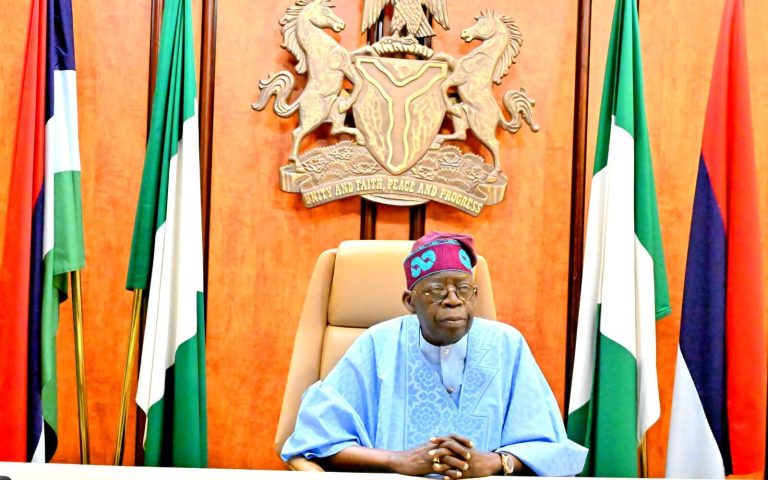
Delivering his nationwide Democracy Day address on Friday, the President explained that the government’s strategy to revamp the grid is successfully targeting areas that have spent decades without power. At the heart of this turnaround is a massive rural electrification campaign backed heavily by international lenders, including the World Bank and the African Development Bank.
According to the president, the current administration has shifted focus toward decentralized energy solutions, rather than relying entirely on the fragile national grid, He announced that the government is currently rolling out over 1,000 localized solar-powered mini-grids across the country, and that this infrastructure push is designed to give cut-off communities an immediate economic lifeline.
Referencing the recent implementtation of the Electricity Act, he revealed that the shift was made possible by the implementation of the piece of legislation,owning that it had permanently ended the federal government’s monopoly over power distribution and handed regulatory control to state governments and private investors.
Beyond setting up solar panels, President Tinubu disclosed that the government is also moving to clear the severe financial bottlenecks choking the energy market. He confirmed that the Presidential Power Sector Task Force has been authorized to raise a ₦4 trillion bond, noting that this major financial injection would be used exclusively to pay off verified, decades-old debts that had discouraged private investments in the sector.
He expalined that the task force was simultaneously executing plans to close the massive metering gap, ensuring that consumers were billed accurately and energy companies could reliably collect revenue.
The Issues
- Speeding up the installation of the remaining rural solar mini-grids to meet the 1,000-project target.
- Successfully managing the ₦4 trillion bond layout without worsening the nation’s broader debt burdens.
- Helping state governments quickly set up their own localized energy laws to replace the old centralized power model.
What’s Being Said
- Explaining how the new financial plans will help rural citizens pull their weight in the economy, President Bola Ahmed Tinubu noted: “The Presidential Power Sector Task Force is working hard to reduce the metering deficit and has been authorised to raise a N4 trillion bond to settle verified legacy debts. Alongside these reforms, the REA, supported by the World Bank and the African Development Bank, is successfully ensuring that underserved communities participate fully in the nation’s growth story,”.
What’s Next
- Financial managers will open up the bidding process for the ₦4 trillion bond to begin settling the power sector’s legacy debts.
- The Rural Electrification Agency will speed up field deployment to get the remaining solar mini-grids running in remote villages.
- State assemblies will continue passing localized electricity bills to officially take charge of their independent power grids.
Bottom Line
President Tinubu’s Democracy Day speech made it clear that the future of Nigerian power relies on two main pillars: using a ₦4 trillion bond to wipe out industry debts and setting up 1,000 independent solar stations to give rural communities their own reliable electricity supply.