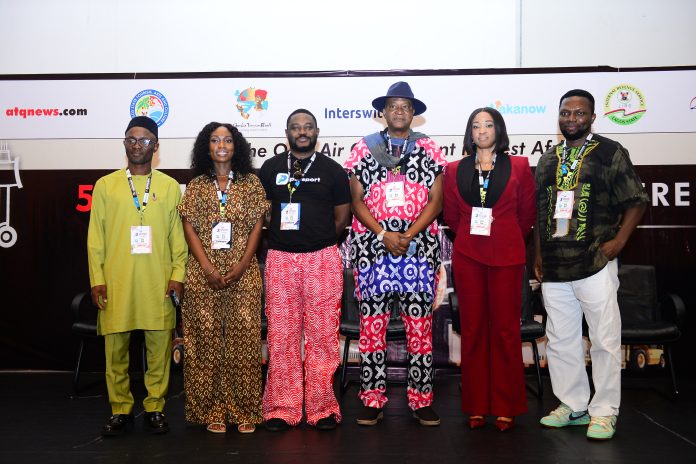
Interswitch, the leading African technology company focused on creating solutions that enable individuals and communities to prosper across Africa, has reaffirmed its leadership in powering the continent’s travel and mobility ecosystem. The technology giant showcased the new Quickteller Travel at the recently concluded 21st AKWAABA African Travel Market, held in Lagos from September 14 to 16, 2025.
Through its sponsorship and exhibition, Interswitch demonstrated how Quickteller Travel is redefining the travel experience for corporates, agencies, individuals, and operators, enabling seamless bookings for flights, hotels, tours, and corporate travel while ensuring secure, reliable payments across multiple channels.
Speaking during a panel session at the event, Nnenna Ajanwachuku, Vice President, Transport Ecosystem at Interswitch, emphasised the company’s role in transforming Africa’s travel economy.
“At Interswitch, we’re not just processing transactions; we’re creating the infrastructure that connects travellers, content creators, and operators across Africa. Quickteller Travel is making bookings smarter, payments safer, and travel more accessible for everyone,” said Ajanwachuku.
Throughout the three-day expo, Interswitch’s strategic exhibition and demo sessions drew the attention of stakeholders eager to explore how Quickteller Travel integrates with fintech APIs, supports interstate transport operators, and empowers travel agencies with tailored solutions.
By bridging critical gaps between travel services and payments, Interswitch is enabling greater collaboration across tourism, aviation, and mobility, reinforcing its mission to drive intra-African trade and prosperity.
“Our vision is clear. We are focused on simplifying travel, enabling growth for businesses, and giving travelers the convenience and confidence they deserve,” Ajanwachuku added.
With Quickteller Travel at the forefront, Interswitch is charting a path for a digitally connected and inclusive travel ecosystem across Africa.
The naira showed mixed performance at the foreign exchange markets despite increased liquidity from foreign inflows and CBN interventions.
At the official Nigerian Foreign Exchange Market (NFEM), the naira depreciated marginally by 0.05%, closing at N1,488.60/$1. Intraday trades ranged between N1,486 and N1,492.
This occurred even after the CBN injected $150 million into the market last week, with total inflows rising to $605 million from $550.9 million the week before.
At the parallel market, however, the naira gained 0.25% to close at N1,517/$1 due to subdued demand. Foreign portfolio investments dominated inflows at $251.7 million (41.6%), followed by exporters (19.72%), non-bank corporates (13.33%), FDI (8.94%), and the CBN (6.10%).
Meanwhile, external reserves hit $42.03 billion as of September 19, 2025 — the highest since 2019. Oil prices remained under pressure, with Brent crude falling 1.25% to $66.15/bbl amid oversupply concerns, weak demand, and US inventory builds. Year-to-date losses widened to 11.37%.
Analysts say Fed rate cuts may weaken the dollar and support commodities, but slowing global demand continues to weigh heavily on crude markets.
Verve, Africa’s leading domestic payments card scheme and a subsidiary of The Interswitch Group, is delighted to welcome Google Play as a strategic partner for the eighth (8.0) edition of VerveLife, which has progressively gained acclaim asAfrica’s largest and most celebrated fitness event series. This partnership from a lifestyle activation perspective further consolidates Verve’s evolving partnership with the Google Ecosystem, premised on a common goal of facilitating meaningful and rewarding consumer experiences that complement the aspirations of the Verve Life target audience towards healthier and more fulfilling lifestyles.
Launched eight (8) years ago, VerveLife has become Verve’s flagship lifestyle and active consumer engagement initiative, revolutionizing fitness and wellness in Nigeria and beyond, while promoting a healthy lifestyle among Verve’s cardholders and fitness enthusiasts.
Attracting over 14,000 participants annually across West and East Africa, The VerveLife movement has progressively grown into one of the continent’s most significant fitness platforms, featuring high-intensity workout sessions, dance routines, and fitness challenges led by expert instructors, culminating in a spectacular after party designed for fitness enthusiasts to unwind following the invigorating wellness sessions.
Cherry Eromosele, Executive Vice President, Marketing and Communications, Interswitch Group, expressed her optimism about the extension of Verve’s relationship with Google Pay into this strategic partnership to raise the bar on Verve Life in its 8t edition:
“We are thoroughly thrilled to take VerveLife to new heights this year, building on the success of our previous editions. Our latest collaboration on the lifestyle front with Google Play points to unwavering commitment to delivering exceptional experiences that resonate deeply with fitness enthusiasts across Africa.
This partnership not only enhances the quality of the events; it will also enrich the overall experience for our participants. With the value that Google brings on board, our Verve Life 8.0 participants should certainly look forward to exhilarating experiences, come November 1st, 2025, including exclusive complimentary merchandise and exciting rewards and incentives, courtesy Verve and Google Play. We are always excited to see our community come together annually, united by a shared passion for fitness and wellness.” Eromosele said.
Two years ago, in July 2023, Verve, the 1st and currently the largest domestic payment cards scheme out of Africa partnered with Google, to enable Nigerians to make purchases on key Google Platforms such as on the Google Playstore and YouTube with ease, thereby strengthening the digital ecosystem in Nigeria.
As a result, any Nigerian with an Android device and a Verve card now has a streamlined method for making purchases on the Google Play Store, as well as on YouTube.
Commenting on Google Play’s partnership with Verve, Anthea Crawford, head of retail and payment partnerships at Google Play, opined that the development simplifies the payment process for Google Play Store apps and services but also contributes significantly to a more inclusive digital environment for Nigerians.
For 2025, the VerveLife fitness train will travel across Nigeria stopping in cities such as Enugu, Ibadan and Abuja on August 30, September 13, and September 27, 2025, respectively before returning to Lagos for the highly anticipated grand finale in November. It will also make a stop at Uganda (Kampala) for the 2nd time and Kenya (Nairobi) for the 3rd time, before culminating in an exciting grand finale for the ultimate fitness extravaganza. The grand finale and after-party will be held on Saturday, November 1, 2025, at the prestigious and expansive Eko Convention Center in Victoria Island, Lagos.
As Verve continues to make good its commitment to championing fitness and wellness across Africa, fitness enthusiasts across Nigeria, Kenya and Uganda can look forward to yet another exciting edition of Africa’s biggest fitness party, VerveLife 8.0 themed ‘’Elev8’’.
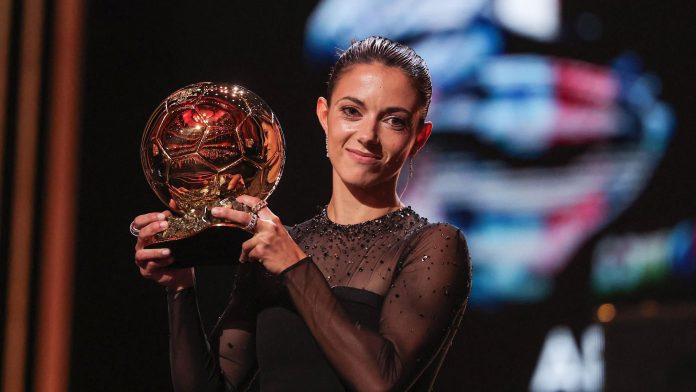
Barcelona midfielder Aitana Bonmatí has written her name deeper into football history after claiming the Women’s Ballon d’Or 2025, marking her third consecutive triumph in the award’s history.
The Spanish international, widely regarded as one of the finest midfielders of her generation, excelled once again for both club and country during the 2024/25 season. Her commanding displays helped Barcelona lift a remarkable treble consisting of the Liga F title, the UEFA Women’s Champions League, and the domestic cup.
Bonmatí’s individual statistics further underlined her dominance, as she contributed four goals and five assists during the Champions League campaign, proving instrumental in guiding her side to European glory.
The latest recognition confirms Bonmatí’s status as the heartbeat of Barcelona’s midfield and as a generational talent driving women’s football into a new era of visibility and influence.
Her third successive victory mirrors the sustained excellence she has demonstrated season after season, making her one of the most consistent players in world football.
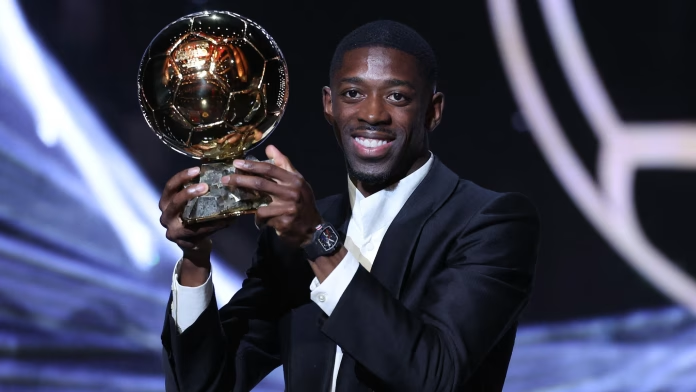
Paris Saint-Germain star Ousmane Dembélé has been named the 2025 Ballon d’Or winner, cementing his place among football’s elite at the prestigious ceremony held in Paris on Monday night.
The French international produced a phenomenal 2024/25 campaign, registering 35 goals and 16 assists across all competitions. His contributions were decisive in PSG’s most successful season in history, as the club secured a historic UEFA Champions League title—their first ever—alongside triumphs in Ligue 1 and the Coupe de France.
Dembélé, now 28, overcame strong competition from Barcelona’s teenage sensation Lamine Yamal and several other world-class players to capture the accolade.
This milestone is particularly significant for the forward, whose career was once plagued by persistent injuries and setbacks. His resurgence has now reached its peak, with the Ballon d’Or standing as a crowning moment after years of perseverance.
The award also highlights PSG’s rising dominance on the global stage, with the club not only winning major trophies in 2025 but also earning a place in the Ballon d’Or Team of the Season.
The Securities and Exchange Commission (SEC) has approved a two-year transition period for Nigerian fund managers to fully adopt mark-to-market valuation for fixed income securities, beginning September 22, 2025.
Under the new framework, bonds will no longer be valued primarily at amortised cost — their original purchase price adjusted over time — but at prevailing market prices, which more accurately reflect their current worth.
To ease the transition, the SEC has granted temporary forbearance on existing asset-allocation rules. Fund managers, who are normally required to maintain a 70:30 split between mark-to-market and amortised cost valuation, will now be allowed to operate a more flexible 50:50 balance during the two-year adjustment period. However, all new fixed-income purchases must immediately be marked to market.
The Commission has directed every fund manager to submit an implementation plan by October 2, 2025, outlining how they intend to achieve full compliance before the grace period expires.
In a bid to foster transparency and investor confidence, the SEC announced it will collaborate with the Fund Managers Association of Nigeria (FMAN) and other stakeholders to roll out investor education programmes on the valuation reform.
The regulator described the policy as a necessary step towards aligning Nigeria’s capital market practices with international standards, improving market efficiency, and strengthening investor protection.
The Ballon d’Or isn’t just another award—it’s football’s version of the Oscars. Golden lights, legendary names, emotional speeches, and that famous golden ball. And in 2025, the ceremony promises to be bigger than ever. With new categories, global rivalries, and young stars rising faster than ever, this year’s edition is shaping up as one of the most unpredictable in recent memory.
So, if you’re counting down to September 22 when Paris once again takes center stage, here are ten things you should know before the curtains rise at the Théâtre du Châtelet.
1. Paris Is Still the Stage Where Dreams Are Crowned
There’s something poetic about the Ballon d’Or staying rooted in Paris. The Théâtre du Châtelet has seen decades of football greatness pass through its doors—Messi, Ronaldo, Modrić, and more. On September 22, 2025, it’ll be the 69th time the ceremony unfolds in the French capital. Paris, a city of romance and history, doubles up as the football world’s cathedral for one night.
And you know what? For the players, walking up those steps is almost as nerve-wracking as scoring a penalty in a Champions League final.
2. It’s Not Just About the Ballon Anymore
When people hear “Ballon d’Or,” they often think of the one golden trophy for the best male player. But the event has grown into a full-blown football festival. This year, there are awards for:
Men’s and Women’s Ballon d’Or (best players)
Kopa Trophies (best young players)
Yashin Trophies (best goalkeepers)
Gerd Müller Trophies (top scorers)
Johan Cruyff Trophies (best coaches)
Club of the Year awards (men and women)
The Sócrates Award (humanitarian efforts)
And here’s the twist—2025 introduces three new awards for women: the Women’s Yashin, Women’s Gerd Müller, and Women’s Kopa. That’s a huge step for women’s football recognition. Honestly, it’s about time.
3. The Nominee Lists Read Like a Fantasy Football Squad
Take a peek at the men’s list—it’s stacked. Jude Bellingham, Haaland, Mbappé, Vinícius Júnior, and even rising talents like Lamine Yamal. On the women’s side, names like Aitana Bonmatí, Alexia Putellas, Barbra Banda, and Leah Williamson stand tall.
But what’s interesting is how many new faces pop up this year—players who’ve exploded onto the scene over just one season. Désiré Doué, Michael Olise, and Temwa Chawinga aren’t exactly household names yet, but a Ballon d’Or nomination can change that overnight.
4. How Do They Even Pick the Winners?
It’s not a random popularity contest. The voting process is meticulous. Journalists from the top 100 FIFA nations (for men) and top 50 (for women) cast their votes. Each juror ranks ten players, awarding points from 15 down to 1.
The criteria?
Individual brilliance—those “wow” moments we all replay on YouTube.
Team achievements—because medals still matter.
Class and fair play—football’s about respect, not just goals.
If there’s a tie, first-place votes break it. Still tied? Then second-place votes. It’s like extra time, penalties, and sudden death, but for votes.
5. Players Actually Keep Their Trophies (And Can Ask for Extras)
Yes, the winners get to keep their shiny Ballon d’Or forever. Some even request official replicas—imagine having one in your living room and another in your parents’ house. France Football itself keeps a couple of originals for display.
Fun fact: both Pelé and Diego Maradona received honorary Ballon d’Ors because they weren’t eligible back in their playing days. It’s football history correcting itself, late but deserved.
6. UEFA’s Partnership Changed the Game
Until recently, the Ballon d’Or was purely France Football’s baby. But since 2024, UEFA has stepped in as a co-organizer. Their aim? Expand its global influence, make it more accessible, and frankly, give it the glitz of the Champions League anthem.
But don’t worry—the voting system remains independent. UEFA’s role is more about marketing muscle and making the gala feel like a world-class event, not a niche magazine ceremony.
7. Coaches Finally Get Their Spotlight Too
The Johan Cruyff Trophy is now a fixture, and the names on the list are fascinating. Antonio Conte, Luis Enrique, Hansi Flick, Enzo Maresca, Arne Slot—each with a wildly different coaching philosophy. On the women’s side, Sarina Wiegman, Sonia Bompastor, and Nigeria’s own Justine Madugu are contenders.
This is big. For decades, coaches were background characters on Ballon d’Or night. Now they’re part of the main script.
8. Clubs Battle for Bragging Rights
It’s not just individuals—it’s entire institutions being honored. Men’s Club of the Year nominees include Barcelona, PSG, Liverpool, Chelsea, and Brazil’s Botafogo. On the women’s side, Arsenal, Barcelona, Chelsea, Lyon, and Orlando Pride made the shortlist.
This award matters because it reflects consistency across competitions. Clubs crave it. Imagine the bragging rights: “Not only do we win trophies on the pitch—we were the best in the world.”
9. Last Year’s Winners Set the Bar High
Let’s rewind. In 2024, Rodri (Manchester City) took home the men’s Ballon d’Or, while Aitana Bonmatí (Barcelona) cemented her status as the queen of midfield artistry.
Other winners?
Kopa: Lamine Yamal
Yashin: Emiliano Martínez
Men’s Coach: Carlo Ancelotti
Women’s Coach: Emma Hayes
Men’s Club: Real Madrid
Women’s Club: Barcelona
That list shows one thing—dominance by Spain-based talent. Will 2025 continue the Spanish flavor, or will England, Germany, or even Africa steal the show?
10. The Ceremony Is Entertainment in Its Own Right
Sure, it’s about football. But let’s not pretend it’s only about football. The Ballon d’Or is theater. Flashy red carpets, celebrity presenters, emotional speeches, and sometimes awkward translator moments.
This year, the hosts are Dutch legend Ruud Gullit and British journalist Kate Scott. Expect charisma, banter, and maybe a cheeky joke about VAR. And honestly, watching players out of their jerseys—suits, gowns, and all—is a refreshing reminder that even superstars are human.
The Bigger Picture: Why Fans Care So Much
Here’s the thing: fans argue endlessly about the Ballon d’Or. Who deserves it more? Who got robbed? Why didn’t my favorite make the cut? But that’s the magic—it fuels conversations in pubs, on Twitter, and in WhatsApp groups around the world.
Is it always “fair”? Maybe not. But does it capture the essence of football’s storytelling—heroes, villains, underdogs, legends in the making? Absolutely. And in 2025, with new women’s categories, rising stars like Yamal and Caicedo, and powerhouses like Haaland and Mbappé, we’re on the verge of another unforgettable night.
Final Whistle
The Ballon d’Or isn’t just about lifting a golden trophy; it’s about immortalizing a season, a career, a legacy. On September 22, the football world will pause, eyes locked on Paris.
Will Mbappé finally get his crown in Madrid colors? Could Bellingham follow in the footsteps of English greats? Will Aitana Bonmatí defend her throne or pass the torch? We’ll know soon enough. Until then, the debates, the predictions, and the anticipation are all part of the spectacle. Because in football, the story never ends when the whistle blows—it just takes another turn under the spotlight.
Nigeria’s new tax reforms—set to kick off on January 1, 2026—are a game-changer for individuals, entrepreneurs, and even crypto investors. The days of automatic tax reliefs are gone; instead, the government is nudging Nigerians toward structured investments like retirement accounts, housing funds, and insurance policies.
If you’re wondering how this affects your salary, your business, or that shiny Bitcoin in your wallet, let’s break it down—listicle style.
1. The Zero-Tax Threshold Just Got Clearer
If you earn below ₦800,000 annually, you won’t pay a kobo in personal income tax. That’s a relief for students, low-income earners, and freelancers still building their portfolios.
For businesses, it’s equally generous. Companies with an annual turnover of less than ₦50 million are exempt from corporate income tax. But hold on—don’t think that means you’re completely tax-free. VAT and electronic transfer levies still apply. It’s like getting a “welcome to the economy” pass, but you’ll still feel a few light taps from the taxman.
2. Tax Relief Is No Longer Automatic
Here’s the twist: under the current regime (till December 31, 2025), everyone gets an automatic relief—20% of gross income plus ₦200,000 (or 1%, whichever is higher). From January 2026, that cushion disappears unless you actively make qualifying investments.
So, instead of sitting back and waiting for relief, you’ll now have to show proof. The government wants you to invest in your future before cutting you a tax break
3. What Counts as Tax-Deductible Investments?
Not everything qualifies, but here’s where you can legally reduce your tax bill:
Retirement Savings Account (RSA): Contributions are tax-free, growth is tax-free, and withdrawals stay tax-free.
Life Insurance Premiums: For you and your spouse, these are deductible.
National Health Insurance Scheme (NHIS): Contributions qualify.
National Housing Fund (NHF): Also deductible.
Rent Payments: You get 20% relief on rent paid, capped at ₦500,000.
In short, the government is rewarding long-term financial planning.
4. Everyday Scenarios That Clarify the Law
Let’s walk through a few relatable examples:
Case 1: Your uncle sends you $100 (about ₦100,000). Do you pay income tax? No—because it’s under the ₦800,000 threshold. But VAT and transfer levies still bite.
Case 2: You buy Bitcoin with ₦100,000 and flip it for ₦200,000. Profit? ₦100,000. Tax? None—still below the ₦800,000 line.
Case 3: Same Bitcoin trade, but this time you sell for ₦2 million. Profit? ₦1.9 million. Tax? Yes—you crossed the threshold.
Case 4: Do the same trade through your registered company with turnover below ₦50m? No income tax. But VAT and levies remain due.
This makes the distinction between personal and business taxation clearer than ever.
5. Crypto Gets the Spotlight
Crypto investors—this reform speaks directly to you.
Holding assets? No tax.
Selling at a loss? No tax.
Selling at a profit? Taxable if your gain pushes you above ₦800,000.
Staking income? Taxable—since it counts as earnings.
In practice, if you’re casually trading small amounts, you’re safe. But serious traders with big profits? You’re firmly on the taxman’s radar.
6. Banking, Bonds, and Insurance—How They Fit In
The reforms also touch traditional finance:
Bank Deposits: No tax on balances. But if your savings account earns 10% interest on ₦1 million, that interest (₦100,000) is taxable.
Bonds: Federal Government bonds remain tax-exempt. A rare freebie.
Insurance Policies: Premiums you pay are deductible.
Inheritance or Gifts: Generally tax-free, unless they generate income later.
Think of it this way: the government isn’t chasing your assets; it’s chasing the money your assets make for you.
7. Practical Tips to Stay Ahead
Now the million-naira question: what should you actually do?
Get advice early: Pool funds with friends or colleagues and pay a tax professional to brief your group. Think of it as a “tax cooperative.”
Go digital: Keep receipts, scan documents, and prioritize card transactions over cash. An audit trail can save your skin.
Hire an accountant: Especially if you run a business. Compliance is cheaper than penalties.
Don’t mix transactions: Avoid dropping non-business checks into your business account. It can trigger unnecessary scrutiny.
Remember, the principle is simple: you’re taxed on what you earn, not what you own.
Final Thoughts
The 2026 reforms look less like punishment and more like persuasion. Nigeria is pushing citizens toward structured investments, savings, and accountability. For some, that feels like a burden. For others, it’s an opportunity to build financial discipline.
Whether you’re a crypto enthusiast, a small business owner, or just someone hustling to stay afloat, the new law will touch your wallet. The smart move? Start planning before January 2026.
Nigeria’s stock market has been pulling off something remarkable lately—it’s not just keeping up with inflation, it’s beating it. For investors who’ve been watching price levels climb relentlessly over the past two years, the latest inflation figures must feel like a breath of fresh air. In August 2025, inflation slowed to 20.13%, while the All-Share Index (ASI) powered ahead with a 36.1% year-to-date gain, climbing further to 38% by yesterday’s close.
But here’s the kicker: when inflation slows, real returns expand. That’s the story behind the numbers. And if you’re wondering what that really means for equities, let’s break it down.
1. Real Returns Are Finally Widening
When inflation drops, investors don’t just gain on paper—they gain in reality. As of August, 99 listed stocks had delivered returns above July’s inflation of 21.88%. With inflation sliding further, that number only expanded. Compare this with 2024, when just 65 companies managed to outpace the 34.8% inflation rate.
In simple terms, more investors are now walking away with actual purchasing power gains, not just nominal increases that get eaten up by rising prices.
2. Fixed Income Still Lags Behind
Here’s the thing—equities are shining, but not every asset class can say the same. Treasury bills are still clearing between 15.35% and 17.44%, and the 10-year FGN January 2026 bond yields around 17.74%. With inflation still over 20%, those returns remain negative in real terms.
So while bonds and bills may look safer on paper, equities are currently the ones offering shelter from inflation erosion. For conservative investors, that’s a bit of a dilemma: do you stick with low-risk, negative real returns or take on equities where the upside looks brighter?
3. Consumer Spending Power Is Making a Comeback
Declining inflation isn’t just an abstract number—it trickles down to wallets. When everyday Nigerians spend less on basics, they have more left for discretionary goods. That’s music to the ears of listed companies.
Take the Consumer Goods Index. By August 2025, it was up 91.3%, compared to just 40.46% a year earlier. Brands like Nestlé, Nigerian Breweries, Dangote Sugar, and BUA Foods swung from combined losses of nearly N418 billion in Q1 2024 to profits of N289.8 billion in Q1 2025. FX stability also played a part, but easing inflation gave consumers the breathing room to spend more, which fueled this rebound.
4. Banks Are Breathing Easier Too
The banking sector is another clear winner. Lower inflation translates to stronger corporate and household cash flows. That means fewer loan defaults, reduced impairment charges, and healthier balance sheets.
If disinflation continues, the Central Bank of Nigeria (CBN) might eventually soften its hawkish stance. Lower policy rates could bring down banks’ funding costs and even stimulate more borrowing—further improving profitability. For investors, this suggests banking stocks might still have room to run.
5. Dividends Could See a Boost
Let’s be honest—many Nigerian investors love dividends as much as capital gains. And with company profits bouncing back, dividend payouts are likely to rise. This matters for two reasons:
It improves total shareholder returns.
It attracts new investors who prefer steady income streams.
The broader implication? Stronger dividend yields could keep the equity rally going, especially if inflation continues its downward path.
6. The MPC’s Next Move Is Critical
Now, here’s a curveball. The Monetary Policy Committee (MPC) meets again on September 22, 2025. While analysts expect the Monetary Policy Rate (MPR) to hold at 27.5%, the language of the committee could shift market sentiment.
If the MPC sounds confident about sustaining disinflation, it’ll reinforce investor optimism. But if they hint at dovishness, equities might get an extra push. Either way, the meeting will be a temperature check for the market’s next leg.
7. Equities Remain the Lead Story
So what’s the big picture? Nigerian stocks are not just staying ahead of inflation—they’re comfortably outpacing it. The ASI’s 38% YtD gain is proof that easing inflation is fueling both confidence and profitability.
Of course, risks remain. If inflation were to spike again due to currency pressure or global shocks, the rosy outlook could dim. But for now, equities look like the strongest horse in the race, especially in consumer goods, banking, insurance, and industrials.
Final Thoughts
The easing inflation story is about more than percentages—it’s about confidence, purchasing power, and opportunity. For professionals, executives, or even retail investors trying to protect wealth, equities are offering something rare in Nigeria’s high-inflation history: consistent, positive real returns.
Sure, nothing in markets is ever guaranteed. But if inflation keeps sliding, investors could be looking at one of the most favorable windows for Nigerian equities in years. You know what? It’s not just about beating inflation. It’s about making your money actually work harder than the economy’s headwinds.
Nigeria’s crude oil and condensate production averaged 1.63 million barrels per day (mbpd) in August 2025, according to new figures released by the Nigerian Upstream Petroleum Regulatory Commission (NUPRC). The volume represents a 3.1 per cent increase from the 1.58mbpd recorded in August 2024.
The breakdown, published by the Commission over the weekend on its official X handle, showed crude oil output rose to 1.43mbpd in August, up 5.5 per cent from 1.36mbpd in the same month last year. However, condensate production declined by 10.6 per cent to 197,229 barrels per day (bpd), compared with 220,435bpd in August 2024.
On a month-on-month basis, combined crude oil and condensate volumes dropped by 4.7 per cent from July’s 1.71mbpd, while crude output slipped 4.8 per cent from 1.5mbpd, a development partly attributed to unscheduled facility maintenance.
Despite the marginal decline, Nigeria achieved 96 per cent compliance with its Organisation of the Petroleum Exporting Countries (OPEC) production quota of 1.5mbpd, underscoring improved alignment with cartel targets.
Terminal performance data showed Forcados led production in August with 8.99 million barrels, comprising 8.08 million barrels of crude and 915,200 barrels of condensates. It was followed by Bonny Terminal with 6.26 million barrels (5.84 million barrels of crude and 418,270 barrels of condensates), Qua Iboe with 4.99 million barrels (4.94 million barrels of crude and 50,500 barrels of condensates), and Escravos with 4.18 million barrels (4.08 million barrels of crude and 107,000 barrels of condensates).
NUPRC data further revealed that Nigeria’s combined crude and condensate output ranged between 1.59mbpd and 1.85mbpd during the review month, reflecting both resilience and short-term slippages in the upstream sector.
Overall, the figures highlight Nigeria’s continued recovery in crude oil production, even as falling condensate streams and occasional disruptions point to lingering structural challenges.
Billionaire businessman and philanthropist, Femi Otedola, has advised the Depot and Petroleum Products Marketers Association of Nigeria (DAPPMAN) to adapt to current realities in the downstream oil sector or risk obsolescence, declaring that the association has “outlived its usefulness.”
Otedola, in a statement on Sunday, weighed in on the ongoing disagreement between the Dangote Refinery and DAPPMAN over fuel supply terms. He commended Aliko Dangote for what he described as a “historic leap” towards Nigeria’s energy independence, insisting that entrenched interests can delay but cannot halt change.
Recalling that he founded DAPPMAN in 2002 to challenge the dominance of major marketers, Otedola said the association had served its purpose at the time by bridging supply gaps in an inefficient downstream market. However, he noted that today’s realities — including local refining capacity and idle storage facilities — render its traditional model outdated.
“Many of the original players have exited the scene, and those left are clinging to assets that no longer reflect today’s business realities,” Otedola stated. “Nigeria now has over four million metric tonnes of storage capacity, most of it idle. With the Dangote Refinery now supplying fuel locally, the old business model is crumbling.”
He argued that depots, once critical to an import-driven system, are increasingly redundant in a deregulated, locally supplied market. Otedola dismissed claims that depots generate significant employment, contrasting them with filling stations that provide far more jobs across the value chain.
Highlighting the Dangote Refinery’s 8,000 eco-friendly CNG trucks as an example of industry transformation, Otedola urged DAPPMAN members to reposition themselves by investing in retail outlets or exploring new value chains, rather than clinging to “outdated privileges.”
Drawing parallels with Nigeria’s cement industry, which rendered bulk carriers redundant after local production took off, he warned that fuel depots face the same fate. He suggested that DAPPMAN members consider selling, restructuring, or even acquiring and operating the Port Harcourt Refinery if they wish to prove their competitiveness.
Otedola also lauded President Bola Tinubu for implementing full deregulation of the downstream sector, crediting the reform with breaking entrenched interests and fostering transparency, competition, and accountability.
“The era of subsidy exploitation, rent-seeking, and arbitrage is over,” he said, recalling how fraudulent subsidy claims worth up to N2 trillion under the Goodluck Jonathan administration were tied to depot licences. “DAPPMAN had its place, but its relevance is fast fading. Aliko’s refinery is not the problem; it is the solution. We must move forward.”
Socio-Economic Rights and Accountability Project (SERAP) and Amnesty International have called on President Bola Tinubu to instruct the Attorney General of the Federation and Minister of Justice, Lateef Fagbemi, SAN, to withdraw charges filed against activist Omoyele Sowore, as well as the owners of social media platforms X (formerly Twitter) and Facebook.
The charges, reportedly linked to Sowore’s critical and allegedly ‘anti-Tinubu’ posts on social media, have drawn sharp criticism from rights advocates, who say they represent an attempt to stifle dissent.
In a joint letter signed by SERAP’s Deputy Director, Kolawole Oluwadare, and Amnesty International Nigeria’s Director, Isa Sanusi, the organisations urged the President to direct the Department of State Services (DSS) and other law enforcement agencies to desist from misusing judicial processes to silence public criticism. They warned against the increasing resort to Strategic Lawsuits Against Public Participation (SLAPPs) as a tool of harassment.
The groups further pressed Tinubu to mandate the preparation of an anti-SLAPP bill for the National Assembly, aimed at safeguarding Nigerians from the weaponisation of the justice system by security and law enforcement agencies.
According to the statement, “the weaponisation of the justice system to crack down on peaceful dissent is entirely inconsistent with the Nigerian Constitution 1999 (as amended) and the country’s international human rights obligations.”
They also noted that a case challenging the legality of the Cybercrime (Prohibition, Prevention, etc.) (Amendment) Act 2024, with regard to its compatibility with the right to freedom of expression, is currently before the ECOWAS Court.
The groups argued that the use of SLAPPs and criminal defamation suits to intimidate critics undermines democracy and the rule of law, stressing that such actions restrict public participation and erode fundamental freedoms.
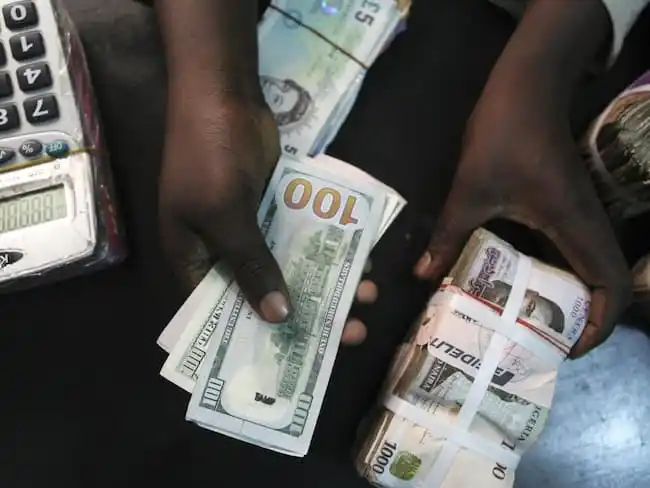
The exchange rate between the Naira and the US dollar, according to the data released on the FMDQ Security Exchange, the official forex trading portal, showed that the naira closed at 1516.00 per $1 on Monday, September 22nd , 2025. The naira traded as high as 1481.00 to the dollar at the investors and exporters (I&E) window on Sunday.
Dollar to naira exchange rate today black market (Aboki dollar rate):
The exchange rate for a dollar to naira at Lagos Parallel Market (Black Market) players buy a dollar for ₦1520 and sell at ₦1516 on Sunday 21st September, 2025, according to sources at Bureau De Change (BDC).
Please note that the Central Bank of Nigeria (CBN) does not recognize the parallel market (black market), as it has directed individuals who want to engage in Forex to approach their respective banks.
Dollar to Naira Black Market Rate Today
Dollar to Naira (USD to NGN)
Black Market Exchange Rate Today
Buying Rate
₦1520
Selling Rate
₦1516
Dollar to Naira CBN Rate Today
Dollar to Naira (USD to NGN)
CBN Rate Today
Highest Rate
₦1499
Lowest Rate
₦1481
Please note that the rates you buy or sell forex may be different from what is captured in this article because prices vary.
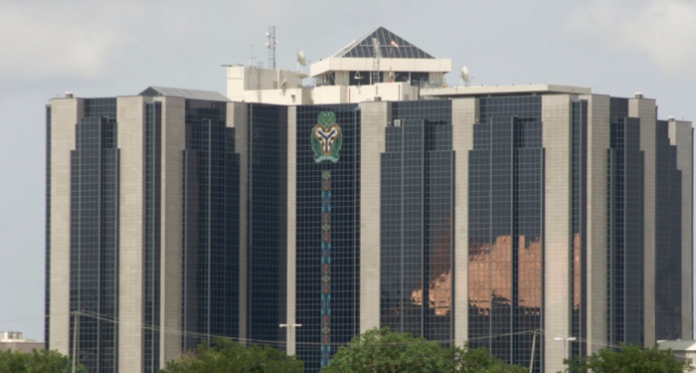
The Central Bank of Nigeria (CBN) has injected $150 million into the nation’s foreign exchange (FX) market, a move aimed at calming volatility and reinforcing the naira’s recent momentum.
The intervention, which saw the apex bank sell U.S. dollars directly to commercial banks, comes against the backdrop of fluctuating demand for foreign currencies—particularly the greenback.
According to TrustBanc Financial Group Limited, the move does not signal a return to a fixed exchange rate regime. Instead, it reflects a discretionary response to temporary market distortions, such as the recent turbulence triggered by global tariff concerns following U.S. President Donald Trump’s Liberation Day announcement.
Last week, trading activity on the Nigerian Foreign Exchange Market (NFEM) was dominated by selling pressure, forcing the exchange rate below ₦1500 per dollar. Data from AIICO Capital Limited showed weak bids coupled with stronger supply from offshore players and exporters dragged the official NAFEX rate to ₦1502.56 per dollar.
Although liquidity thinned midweek as supply slowed, demand surged later from corporates and portfolio investors, prompting the CBN’s intervention. The apex bank sold dollars within the ₦1491.50–₦1509.00 range.
The injection helped the naira close stronger on Friday at ₦1487.90 per dollar, gaining 0.9% week-on-week. In the parallel market, however, the currency ended at ₦1520 amid supply-demand imbalances.
TrustBanc noted that with foreign reserves climbing by $299.7 million to $41.99 billion, narrowing spreads, and growing investor confidence, conditions are stabilizing. However, the firm stressed that “sentiment, not just supply, will ultimately determine how long the floor holds.”
Analysts at Cordros Capital Limited projected short-term naira stability, supported by resilient FX liquidity, stronger non-oil export receipts, and reduced speculative activity. They added that dovish global monetary policies and lower treasury yields could boost portfolio inflows into naira assets.
Meanwhile, commodity markets remain volatile. Brent crude slipped 1.1% to $66.68 per barrel, while U.S. WTI fell 1.4% to $62.68 amid oversupply concerns. Gold prices, however, surged for a fifth consecutive week, with spot gold climbing to $3,672.08 per ounce.
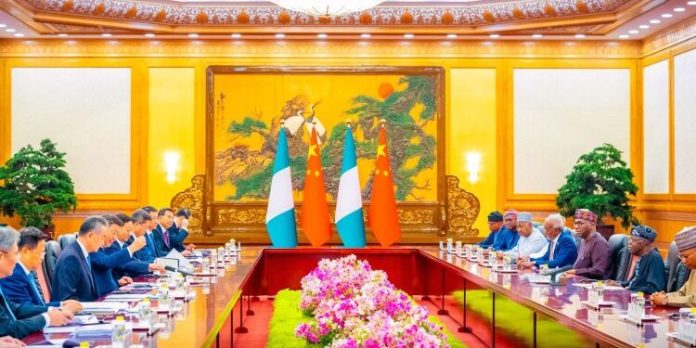
China’s Consul-General in Lagos, Ms Yan Yuqing, has disclosed that trade between China and Nigeria reached $15.48 billion between January and July 2025, representing a 34.7% increase compared with the same period in 2024.
Speaking at a reception marking the 76th anniversary of the founding of the People’s Republic of China, Nigeria’s 64th Independence Day, and the Mid-Autumn Festival, Yuqing hailed Nigeria as China’s second-largest trading partner in Africa.
She attributed the surge to the elevation of bilateral ties to a comprehensive strategic partnership during the 2024 Forum on China-Africa Cooperation (FOCAC) summit.
According to her, cooperation across infrastructure, energy, trade, culture, and education has continued to expand, yielding tangible benefits for both nations.
“Nigeria and China, guided by principles of mutual respect and mutual benefit, have achieved remarkable progress. Trade volume of $15.48 billion in seven months underscores this momentum,” she said.
The envoy also praised the Chinese community in Nigeria for strengthening cultural exchange, contributing to local development, and engaging in charity initiatives. She reassured that the consulate would continue to safeguard the welfare of Chinese nationals and promote bilateral cooperation.
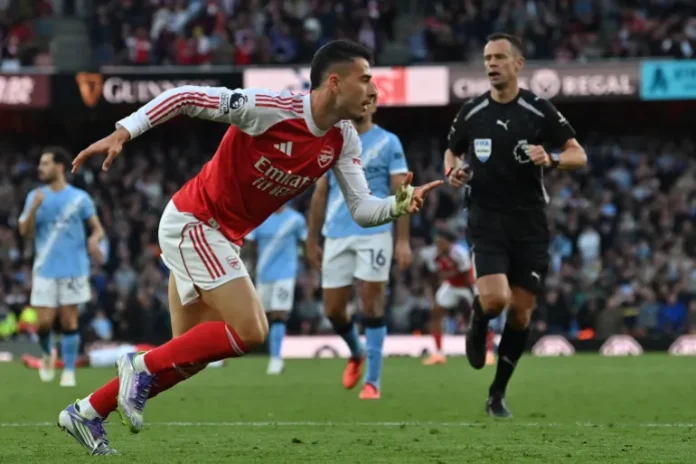
Arsenal and Manchester City played out a thrilling 1-1 draw in a Premier League clash that had significant title race implications, with Gabriel Martinelli rescuing a point for the Gunners deep into stoppage time.
City struck early when Erling Haaland linked up with Tijjani Reijnders before finishing past David Raya for his 11th goal in six matches. Arsenal pushed forward with intent, with William Saliba, Riccardo Calafiori, and Noni Madueke all testing the visitors, but City’s defence held firm.
Mikel Arteta’s side intensified after the break, introducing Bukayo Saka and Eberechi Eze. Their presence lifted Arsenal’s attacking threat, though Raya was called upon to deny Haaland at the other end.
Despite Arsenal’s dominance, Guardiola’s men appeared poised for victory until Martinelli latched onto Eze’s through ball in injury time, lifting his strike over Donnarumma to level the score and spark wild celebrations.
The result keeps Arsenal three points clear of Manchester City in the standings, extending their unbeaten run against the champions to five matches.
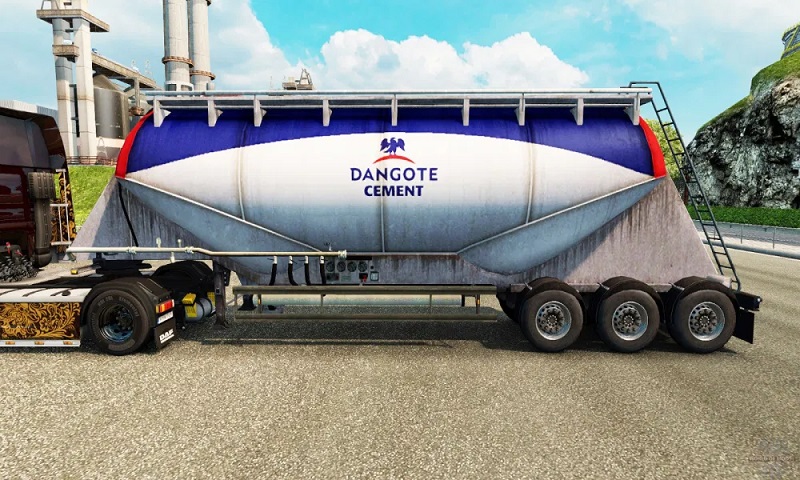
Dangote Cement Plc, the largest listed company on the Nigerian Exchange (NGX), has seen its market valuation fall to ₦8.71 trillion after sustained selling pressure dragged its stock lower.
At Friday’s close, the cement giant’s share price stood at ₦516.20 after 551,027 units worth ₦286.85 million exchanged hands. The drop translated into a ₦199.1 billion loss in market value week-on-week.
The NGX data revealed that Dangote Cement, with 16.873 billion shares outstanding, saw its market capitalisation slip below the ₦9 trillion threshold. Despite the decline, the company maintains a low free float of just 4.79%, which has historically helped dampen volatility.
Majority ownership remains concentrated with Dangote Industries Limited holding 87.28%, followed by Stanbic IBTC Nominees (5.43%), while directors collectively control the balance.
Despite the market setback, Dangote Cement posted a strong financial performance for the first half of 2025, recording ₦520.46 billion in profit—up from ₦189.90 billion in the same period of 2024.
Big Brother Naija Season 10 continues to keep fans on edge as housemates Thelma Lawson and Bright Morgan were evicted in a surprising Saturday night twist. The eviction, which followed the weekly party, was announced by the host, Ebuka Obi-Uchendu, during his visit to the house.
Thelma was the first to be shown the exit, shortly followed by Bright, marking a double eviction that left the housemates visibly emotional and unsettled.
Breaking away from the traditional Sunday night eviction format, organisers opted for a rare Saturday eviction to shake up the dynamics of the game. Such twists have historically been used to create tension, disrupt alliances, and push contestants to reassess their strategies.
While addressing the housemates, Ebuka reminded them of the stakes, stating that Big Brother Naija is a competitive reality show where only the strongest will survive. “This is a competition. You must always bring your best. Tonight’s eviction is proof that anything can happen at any time,” he said.
The double eviction has since ignited discussions across social media platforms, with fans speculating on how the departure of Thelma and Bright will impact alliances, rivalries, and gameplay in the coming weeks.
With fewer contestants left, the pressure is mounting, and the journey to the grand prize is expected to become even more unpredictable. Now in its 10th season, Big Brother Naija remains one of the most-watched reality shows in Africa, keeping millions of viewers glued to their screens with its drama, suspense, and unexpected twists.
The Minister of Mines and Steel Development, Olamilekan Adegbite, has disclosed that solid minerals exporters have failed to remit about N17bn in royalties to the coffers of the government.
The Federal Government has revoked 1,263 mineral licences due to default in payment of statutory annual service fees, in a sweeping move to sanitise Nigeria’s mining sector.
The Minister of Solid Minerals Development, Dr Dele Alake, announced the decision in Abuja, stating that the revocation covered 584 exploration licences, 65 mining leases, 144 quarry licences, and 470 small-scale mining leases.
Alake explained that the move was aimed at discouraging speculators who hold onto licences without developing them, thereby blocking serious investors. He stressed that the annual fee is the minimum proof of interest in mining activities.
The minister added that the affected licences would be deleted from the Mining Cadastre Office (MCO) electronic system, opening up opportunities for new investors. He warned that the revocation does not absolve debtors of their outstanding obligations, noting that the list would be forwarded to the Economic and Financial Crimes Commission (EFCC) for enforcement.
According to MCO’s Director-General, Simon Nkom, 1,957 licences were initially marked for revocation, with affected holders given 30 days to comply after publication in the government gazette on June 19, 2025.
Since the start of President Bola Tinubu’s administration, a total of 3,794 mineral titles have been cancelled, including 619 revoked for non-payment of fees and 912 for inactivity.
Alake emphasized that the administration is repositioning the solid minerals sector to drive industrial growth, create jobs, and enhance Nigeria’s economic prosperity.
The Big Brother Naija Season 10 house witnessed yet another dramatic twist on Sunday night as two housemates, Kuture and Joanna, were evicted from the show during the live eviction ceremony anchored by Ebuka Obi-Uchendu.
Joanna was the first to be evicted, followed later by Kuture, leaving viewers and fellow contestants in suspense as the night unfolded.
This latest development comes just hours after the shock eviction of Thelma Lawson and Bright Morgan, who were both evicted in a rare Saturday night episode. The unexpected twist stunned fans and intensified the competitive atmosphere within the house.
The Saturday eviction, which took place shortly after the weekly party, broke away from the traditional Sunday-only eviction routine. Ebuka, while addressing the housemates that night, reminded them that the game is unpredictable and that every moment counts.
With Sunday’s eviction added to the mix, four contestants were shown the exit within 24 hours—a move that has heightened tension among the remaining housemates and fueled debates among fans on social media.
During the Sunday show, Ebuka also posed some tough questions to the housemates about their conduct, strategies, and choices, further stirring drama in the house.
As the competition narrows, viewers are left wondering what other surprises the organisers might have in store for the weeks ahead.