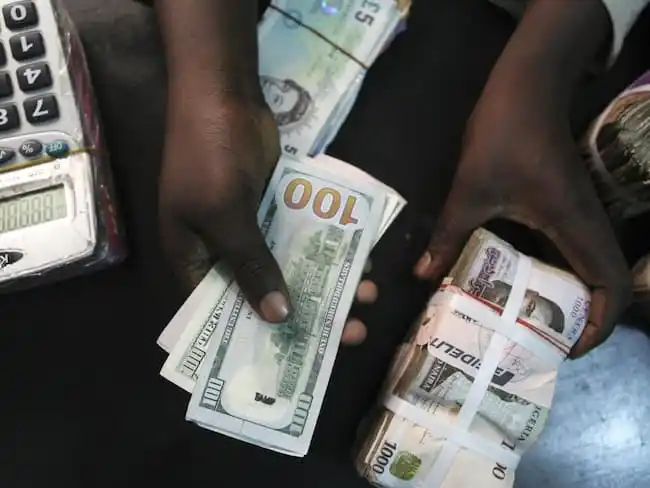
The exchange rate between the Naira and the US dollar, according to the data released on the FMDQ Security Exchange, the official forex trading portal, showed that the Naira closed at 1584.00 per $1 on Friday, June 13th, 2025. Naira traded as high as 1536.00 to the dollar at the investors and exporters (I&E) window on Thursday.
Dollar to naira exchange rate today black market (Aboki dollar rate):
The exchange rate for a dollar to naira at Lagos Parallel Market (Black Market) players buy a dollar for ₦1580 and sell at ₦1584 on Thursday 12th June, 2025, according to sources at Bureau De Change (BDC).
Please note that the Central Bank of Nigeria (CBN) does not recognize the parallel market (black market), as it has directed individuals who want to engage in Forex to approach their respective banks.
Dollar to Naira Black Market Rate Today
Dollar to Naira (USD to NGN)
Black Market Exchange Rate Today
Buying Rate
₦1580
Selling Rate
₦1584
Dollar to Naira CBN Rate Today
Dollar to Naira (USD to NGN)
CBN Rate Today
Highest Rate
₦1546
Lowest Rate
₦1538
Please note that the rates you buy or sell forex may be different from what is captured in this article because prices vary.
The Manufacturers Association of Nigeria (MAN) has attributed the sharp decline in manufacturing export earnings to high interest rates, warning that the sector’s viability is under pressure.
According to data from the National Bureau of Statistics (NBS), manufacturing exports fell from N1.04tn in Q3 2024 to N294.43bn in Q1 2025, marking a significant N746.38bn drop. Compared to the previous quarter (Q4 2024), export value declined by 40.43% from N494.22bn.
The Director-General of MAN, Segun Ajayi-Kadir, said the sustained high monetary policy rate of 27.5% has made access to financing difficult for manufacturers. He noted that while inflation and exchange rate fluctuations have shown signs of moderation, overall costs remain elevated, limiting sectoral growth.
Despite Nigeria’s trade surplus of N5.17tn in Q1 2025, the manufacturing sector continues to experience a downward trend. Though manufacturing exports grew year-on-year by 9.58% from N268.70bn in Q1 2024, they have steadily declined since a 52.48% drop recorded in Q4 2024.
Earlier in May, MAN described the manufacturing sector’s performance as sub-optimal, citing persistent challenges such as unstable exchange rates, poor power supply, high inflation, insecurity, multiple regulations, poor access to credit, infrastructure deficits, high logistics costs, unfavourable trade policies, and low patronage.
The association reported that 767 manufacturing companies closed operations in 2023, with over 18,000 job losses in 2024.
NBS data also showed that Nigeria’s total exports in Q1 2025 grew by 7.42% year-on-year to N20.59tn, and by 2.92% quarter-on-quarter from N20.01tn in Q4 2024. Non-oil exports stood at N3.17tn, accounting for 15.38% of total exports—up from 14.20% (N2.84tn) in the previous quarter.
The value of imported manufactured goods in Q1 2025 was N7.51tn, down 11.35% from N8.47tn in Q4 2024, but up 30.90% year-on-year from N5.74tn. Manufactured goods accounted for N7.80tn or 21.67% of total trade in Q1 2025, compared to N8.97tn or 24.50% in Q4 2024.
The top manufactured export in Q1 2025 was unwrought aluminium alloys, shipped to Japan and China with values of N33.73bn and N4.25bn respectively. Other major exports included dredgers to Spain (N37.23bn), and cathodes to Japan and South Korea (N11.34bn and N8.59bn).
Most manufactured exports went to Asia (N103.34bn), followed by Africa (N83.13bn) and Europe (N75.71bn).
On the import side, top manufactured goods included motorcycles from India (N146.11bn), communication equipment from China (N120.15bn) and the U.S. (N12.06bn), polypropylene from Saudi Arabia (N83.31bn), and herbicides from China and India (N132.81bn and N2.71bn respectively).
Parisians and football fans worldwide are abuzz as the full list of 2025 Ballon d’Or nominees is set to be unveiled next August. Paris Saint-Germain’s epic Champions League triumph has shifted the spotlight onto Ousmane Dembele, who now leads the charge in the race for football’s most prestigious individual award.
Ceremony: Slated for September 22 at Théâtre du Châtelet, Paris.
Award categories: Men’s and Women’s Ballon d’Or, Yashin Trophy (goalkeeper), Kopa Trophy (young player), and Gerd Müller Trophy (top scorer).
Voting panel: One journalist per nation—100 for men’s voting, 50 for women’s—each naming a top-10 list. The Ballon d’Or award goes to the player with the highest aggregate points.
Leading Men’s Ballon d’Or Candidates
1. Ousmane Dembele (PSG)
Dembele has enjoyed his most prolific season yet, scoring 35 goals and registering 15 assists, as he spearheaded PSG’s historic quadruple: Champions League, Ligue 1, Coupe de France, and Trophee des Champions. He earned Champions League Player of the Season honours and topped Ligue 1’s scoring charts, securing the league’s Player of the Year award. PSG’s first-ever European Cup win—a 5–0 demolition of Inter Milan—further cemented his candidacy.
2. Lamine Yamal (Barcelona)
At just 17, Yamal has already reshaped expectations: 19 La Liga goals, 26 assists, and starring roles as Barcelona clinched the La Liga, Copa del Rey, and Supercopa titles.
His electrifying performance in Spain’s victory over France in the Nations League semi-final drew high praise from national coach Luis de la Fuente, who said Yamal “made a big Ballon d’Or statement”.
3. Mohamed Salah (Liverpool)
Salah compiled an impressive 36 goals and 24 assists, leading Liverpool to a Premier League title. Though missing out on Champions League success dents his campaign, his sheer statistical influence keeps him in the upper tier.
4. Raphinha (Barcelona)
Raphinha’s outstanding year included 39 goals and 25 assists, contributing decisively to Barça’s domestic treble. As the club’s most consistent attacker, his numbers speak volumes .
5. Kylian Mbappé (Real Madrid)
With 45 goals and 7 assists, Mbappé delivered superb personal stats in his debut Real Madrid season, though Madrid failed to add silverware . This lack of trophies may diminish his Ballon d’Or prospects.
Broader Field & Observations
Other high-profile names expected among the top contenders include Jude Bellingham, Vinícius Júnior, and Lionel Messi. Players like Vitinha and Nuno Mendes have also earned acclaim—with Mendes earning particular praise for his defensive dominance in Portugal’s Nations League triumph.
Notably, UEFA and pundit rankings—such as TalkSport and Goal’s power lists—generally back Dembele, spotlighting Champions League success as the dominant factor in a year without World Cup or Euro influence. France coach Didier Deschamps has also publicly endorsed his national star, calling for Dembele to receive the Ballon d’Or “100%”.
Final Thoughts
In a season where European glory carries extra weight, Dembele’s combination of sheer productivity, narrative resurgence, and continental impact positions him as the clear frontrunner.
However, Yamal’s captivating breakthrough at 17 and his international performances have transformed him into a formidable challenger. Salah and Raphinha bring strong cases, albeit with less international glitter.
Ultimately, voters face a choice between experience and redemption (Dembele), youthful genius and consistency (Yamal), or raw productivity (Salah/Raphinha). All paths lead to Paris in September.
Let’s not sugarcoat it—flying has long been considered the safest way to travel. And for the most part, it still is. But every now and then, a tragedy like the Air India Flight AI‑171 crash shatters that comfort.
265 lives were lost—mothers, fathers, professionals, students—after the Dreamliner plunged into a residential hostel block barely 30 seconds after takeoff from Ahmedabad. The images were horrifying. The loss? Irreparable. But one man—Vishwash Kumar Ramesh, a British-Indian national seated near an emergency exit—walked away. Alive. Bruised, but breathing. And suddenly, all those safety briefings and “just-in-case” precautions feel a lot less silly.
So, what can we learn—really learn—from this catastrophe?
1. Your Seat Might Be the Dealbreaker
Ramesh, the sole survivor, was seated near an emergency exit. Coincidence? Maybe. But it’s not the first time proximity to an exit has meant the difference between life and death.
Experts—and crash statistics—have repeatedly shown that passengers seated within five rows of an exit have significantly higher survival rates. Why? Because in a high-speed evacuation, every second matters. And in something as chaotic as AI‑171, that split second can be everything.
Window seat or aisle? The aisle offers faster movement, especially in a dark, smoke-filled cabin. And while first class might sound glamorous, the middle-to-rear cabin area has historically shown better survival odds.
2. Always know the Exit points
Let’s be real. Most people treat the safety demo like background noise. But in a crash, muscle memory kicks in—not logic.
Count the rows to your nearest two exits. Vishwash didn’t freeze. He ran. He knew where to go. You might think you’ll have time to figure it out, but AI‑171 reminds us that everything can go sideways in under a minute. Thirty seconds. That’s all it took.
3. Dress For The Flight
In a fiery crash, that cute beach outfit or pair of Crocs won’t save you. Closed-toed shoes? Essential. Long pants and sleeves made of natural fibers like cotton? Highly recommended. Not only do they reduce burn injuries, but they also protect against sharp debris.
Flip-flops, heels, synthetic fabrics—these are dead weight in an emergency. The survivors of other accidents often recall crawling, climbing, or running through rubble and wreckage. AI‑171 tore through a hostel building. Imagine climbing down from a flaming tail section with your feet exposed.
4. Brace For Impact
There’s this grim joke that the brace position is designed to preserve dental records. But that couldn’t be further from the truth.
In real-world crashes—from the US Airways Hudson River landing to the horrifying AI‑171 disaster—the brace position reduces impact injuries to your legs, head, and internal organs. It helps your body absorb shock. Vishwash described being thrown forward before bolting from the wreckage. If he hadn’t instinctively curled forward, it might’ve ended differently.
So yes, awkward as it looks, tuck in. Your body will thank you—if you live to tell the story.
5. Forget All Your Luggages
One of the most heartbreaking reports from the Air India crash came from recovery teams: bodies found clutching handbags and backpacks. Some were still in their seats.
It’s human nature—we grab what’s familiar. But in an evacuation, seconds matter more than sentimental items. Luggage slows people down, clogs aisles, and causes deadly delays. Don’t be the reason someone else doesn’t make it out. The only thing you should be grabbing is your own life. Phone and passport? Fine, if they’re in your pocket. Otherwise—leave it.
6. Listen To The Crew.
AI‑171’s flight attendants were reportedly among the first to perish, seated at the front. But on countless other flights, the crew has been the deciding factor between panic and survival.
Flight attendants aren’t waiters in the sky. They’re trained professionals—emergency responders, really. They know how to open emergency doors, deploy slides, and direct evacuations under pressure. If they shout, listen. If they command, follow. That trust might just be your lifeline.
7. Mental Preparation
Let’s get something straight: being mentally prepared doesn’t mean you’re paranoid. It means you’re aware. In fact, fear often comes from feeling powerless. But knowledge? It gives you a kind of quiet courage.
Before takeoff, take 10 seconds to:
Locate exits.
Note the number of rows.
Remind yourself of the brace position.
Think: “What will I do if something goes wrong?”
Even Vishwash admitted, “It all happened so quickly.” But he reacted. That’s what matters.
Though the investigation is still underway, initial reports suggest the landing gear was still extended and the flaps remained deployed during takeoff. That’s unusual and could mean a mechanical or procedural failure occurred right at liftoff.
We’ll know more as flight data from the recovered black boxes is analyzed. But one thing’s already clear: preparedness can’t always prevent disaster, but it can absolutely increase the odds of surviving one.
Final Words from the Wreckage
The Air India tragedy wasn’t just a statistic. It was real. Messy. Heartbreaking. And yet—one man lived. One.
That’s not to glorify survival. It’s to underscore just how fine the line is between life and death in a plane crash. Your chances aren’t determined by luck alone. They’re shaped by what you wear, where you sit, what you do in those first 30 seconds. So no, don’t fly in fear. But fly aware. As AI‑171 painfully reminded us, preparedness is more than a formality—it’s a chance.
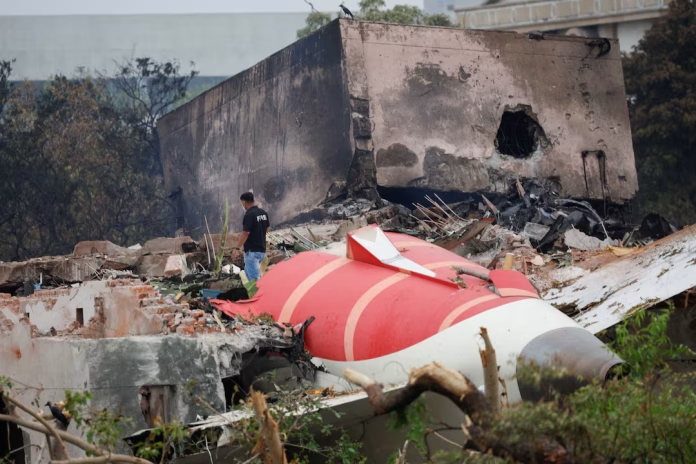
A routine international flight turned into a devastating tragedy yesterday when Air India Flight AI‑171, a Boeing 787‑8 Dreamliner departing from Ahmedabad, crashed into a residential block and medical college hostel just moments after taking off for London Gatwick, resulting in the loss of 265 lives—including those on board and civilians on the ground.
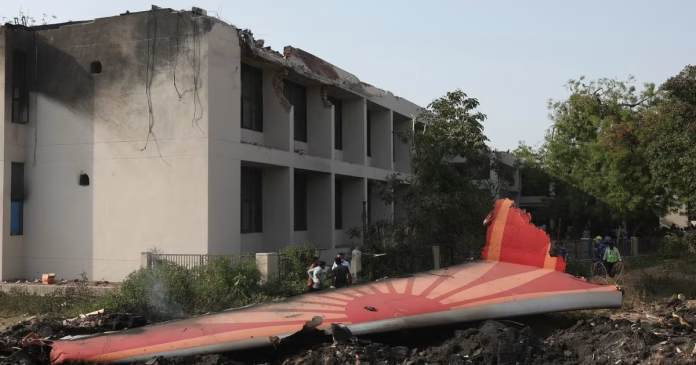
Eyewitnesses described a horrific scene as the aircraft, carrying 230 passengers and 12 crew members, rose to merely 30 seconds into its ascent before it suddenly plummeted into the hostel building associated with B.J. Medical College in Meghani Nagar. The impact ignited a fierce fire, scattering debris across the area and leaving bodies and wreckage strewn in its wake.
Deputy Commissioner of Police Kanan Desai confirmed that 265 bodies had been recovered; this includes 241 from the aircraft and at least 24 victims on the ground. He cautioned that the final count remains provisional, pending further DNA testing to verify identities.
Sole Survivor Identified
Remarkably, British-Indian national Vishwash Kumar Ramesh, seated near an emergency exit, walked away from the calamity—the only survivor. Hospital interviews relayed his harrowing account: “Thirty seconds after take‑off, there was a loud noise and then the plane crashed. It all happened so quickly… I got up, ran, bodies everywhere,” he told the Hindustan Times. His brother, Ajay, was also aboard but did not survive.
Victims and Ground Damage
The passenger manifest included individuals of at least four nationalities: 169 Indian citizens, 53 British, seven Portuguese, and one Canadian. Additionally, dozens of local residents and medical students housed in the hostel perished when the plane’s tail section embedded itself into the building’s upper floors. Victims remain unrecognizable, prompting an extensive DNA identification effort.
High-profile casualties included former Gujarat Chief Minister Vijay Rupani. National grief has simmered, mirroring the intensity of the disaster.
Search, Rescue, and Relief Operations
Within an hour, fire brigades and rescue units from the Indian Army, CRPF, NDRF, and local municipal forces had extinguished the flames and mobilized large-scale recovery operations. More than 290 body bags were deployed, with teams working at a rapid pace.
Federal and state authorities—led by Home Minister Amit Shah and Gujarat CM Bhupendra Patel—alongside PM Narendra Modi, who called the disaster “heartbreaking beyond words,” responded swiftly, visiting the site on June 13.
Crash Investigation Underway
A comprehensive investigation has been launched, with the Indian Aircraft Accident Investigation Bureau taking the lead, aided by experts from the UK’s AAIB, the US National Transportation Safety Board, and Boeing itself. The recovered black boxes will play a central role in determining the cause.
Global Response and Compensation Efforts
Global leaders and organizations have voiced condolences. The UK government activated crisis teams to assist victims’ families. Air India, alongside parent conglomerate Tata Group, pledged financial support and covered medical bills for survivors. Boeing’s CEO confirmed the company is cooperating fully with the inquiry. Preliminary reports indicate the aircraft’s landing gear remained extended and flaps deployed during takeoff—an uncommon configuration that may become a key focus of the probe.
What Comes Next
Identification continues via DNA analysis, expected to finalize the official death toll.
Technical analysis of flight data recorders will explore mechanical performance and aircraft behaviour.
Regulatory oversight is anticipated, with possible grounding of the entire 787 fleet in India until safety is assured.
Compensation and rehabilitation efforts for the injured and affected families remain underway.
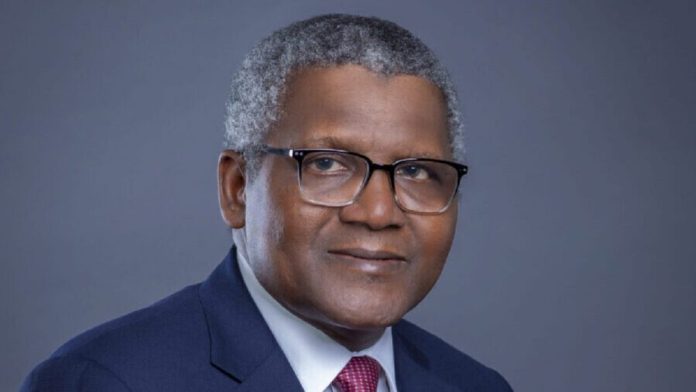
Aliko Dangote, Africa’s wealthiest businessman, has officially stepped down from his position as Chairman of Dangote Sugar Refinery Plc, drawing the curtain on a 20-year era of transformational leadership. His retirement will take effect on June 16, 2025, heralding a new chapter for the company he helped mould into an industry leader.
Throughout his two-decade tenure, Dangote spearheaded strategic initiatives that reshaped the sugar sector in Nigeria. Among these were Backward Integration Projects rolled out in Adamawa, Taraba, and Nasarawa States, which significantly enhanced the company’s production capacity and fortified its supply chain.
Dangote Sugar Refinery Plc acknowledged Dangote’s groundbreaking contributions in an official statement, describing his leadership as central to the company’s strategic development and enduring culture. Under his watch, the company achieved consistent growth, delivering long-term value to shareholders and reinforcing its position at the forefront of Nigeria’s agro-processing industry.
With his exit, the board has announced the appointment of Arnold Ekpe as the incoming Chairman. Ekpe, a veteran in the banking and finance sector, assumes the role as an Independent Non-Executive Director and is expected to bring a fresh perspective to the company’s governance and expansion strategies.
Ekpe’s appointment followed a rigorous selection process by the board and reflects a deliberate effort to position the company for its next growth phase. Known for his deep expertise in corporate leadership and regulatory affairs, Ekpe is tasked with guiding Dangote Sugar Refinery through an evolving macroeconomic and policy landscape.
His leadership is anticipated to build on Dangote’s legacy, with analysts expressing optimism that the company will maintain its upward trajectory under the new chairman. Stakeholders are expected to closely monitor how Ekpe navigates the challenges and opportunities in Nigeria’s competitive sugar market.
As Dangote Sugar transitions into this new era, the focus remains on sustaining its commitment to domestic sugar production and self-sufficiency, aligning with the Federal Government’s goal of reducing import dependency. The company’s ongoing projects and investment strategies are poised to benefit from Ekpe’s extensive experience and strategic acumen.
Nigeria’s external reserves dipped to $38.045 billion as the Central Bank of Nigeria (CBN) intensified efforts to stabilise the naira, deploying a total of $580 million in foreign exchange (FX) sales during May 2025. This robust intervention strengthened the local currency but has reignited concerns about the sustainability of such support and its implications for the country’s reserve buffers.
To contain the pressure on the naira amidst a surge in corporate demand for U.S. dollars to settle international transactions, the CBN continued to pump FX into the market via authorised dealer banks. These injections helped fortify the supply side, ensuring sufficient liquidity in the market. According to a recent macroeconomic note by AIICO Capital Limited, the naira maintained a relatively steady trajectory in May, supported by consistent FX inflows and monetary support.
Earlier in May, the weakening of global crude oil prices and heightened demand for dollars drove the USD/NGN exchange rate to intraday highs of ₦1,614. However, with over $580 million injected into the market by the CBN across multiple sessions, the currency found some footing. Additional inflows from exporters and renewed interest from foreign portfolio investors further bolstered FX availability, helping the naira recover periodically.
This trend was also underpinned by growing investor confidence, partly fuelled by a positive sovereign credit rating from Moody’s Investors Service. The agency upgraded Nigeria’s credit standing from Caa1 to B3, maintaining a stable outlook. This marked the second upgrade under President Bola Tinubu’s administration and reflected improved macroeconomic fundamentals.
Moody’s cited key reforms—such as the discontinuation of fuel subsidies, a more flexible FX regime, and enhanced revenue collection—as catalysts for the improved rating. It also elevated Nigeria’s local currency ceiling to Ba3 and its foreign currency ceiling to B2, noting progress in rebuilding FX reserves and reducing fiscal risks.
Throughout May, the naira traded within a range of ₦1,575 to ₦1,610 to the U.S. dollar, AIICO Capital reported. Fixing rates fluctuated within this bracket as market dynamics shifted. By the end of the month, the naira appreciated by 66 basis points on a monthly basis, settling at ₦1,586.15/USD. In contrast, the parallel market saw mild depreciation, with the exchange rate weakening by ₦11 to ₦1,617.50/USD due to persistent street-level demand for dollars.
Despite periodic surges in demand, analysts noted that overall confidence in the FX market has improved. Liquidity remains strong, and the naira has shown resilience, aided by improved capital flows and tighter monetary controls.
Another key development in Nigeria’s fiscal landscape was the full settlement of its debt to the International Monetary Fund (IMF). The debt, which stood at $3.54 billion in December 2020, was completely cleared by May 2025. This exit from the list of debtor nations is seen as a landmark achievement in fiscal management and a major step toward restoring international investor confidence.
Meanwhile, FX reserves saw modest growth, rising by $364 million between April 30 and May 14, 2025—marking the first two-week consecutive increase since the beginning of the year, according to AIICO Capital.
The country’s external sector also received a boost from remittance flows. Inflows from International Money Transfer Operators surged 44.5% year-on-year, climbing to $4.76 billion in 2024 from $3.30 billion in 2023. These remittance volumes continue to support FX liquidity and reflect a growing trust in the formal financial ecosystem.
This summer, luxury fashion house Banke Kuku invites women to take center stage with the launch of its vibrant new summer collection, the Summer Drop. Dubbed the Summer of Self, the collection is a bold declaration of individuality, sensuality, and style, made for women who aren’t just chasing the sun, they are the sun.
Fusing two of her most loved collections, Eden and Oceans, the Summer Drop introduces an array of summer-ready silhouettes designed for the modern woman. From flowing kaftans and sultry mesh dresses to playful shorts, mini dresses, and mini skirts, each piece embodies a sense of freedom and form. As part of the brand’s dedication to sustainable practices, each piece reflects not only style but substance, crafted with eco-conscious fabrics and mindful production that honors both the wearer and the world.
At the heart of the campaign are three Nollywood’s Leading Ladies who reflect the many shades of self.
Nancy Isime is The Trailblazer—cool, grounded, and full of light.
Idia Aisien is The Muse—seductive, stylish, and unforgettable.
Omowumi Dada is The Flame—bold, brilliant, and magnetic.
Together, they embody what this collection stands for: authenticity, range, and the power of owning your story.
More than a collection, The Summer Drop is a call to step into your light and live fully. This is your summer. Your story.
Alongside the launch of The Summer Drop, Banke Kuku continues to expand her global retail footprint. The brand will be hosting a curated showcase at The Bright Black Box, Bateman Street, Soho, London, where members and special guests will experience the brand through an intimate, immersive shopping event featuring exclusive pieces and personal storytelling from the designer.
These global brand moments reflect Banke Kuku’s larger vision to reframe African fashion on the global stage; not as a niche, but as a vibrant force in the luxury fashion conversation.
Another Thursday, another tale. But this one is special because it comes wrapped in a public holiday, Democracy Day. While some people are celebrating the day off with extra sleep and extra food, others are reflecting on the journey Nigeria has taken from military rule to civilian governance. And the rest? Well, they’re just stuck in traffic—because, yes, the roads are still bad.
So, let’s unpack Democracy Day and why it’s more than just a free day to binge-watch shows and complain about NEPA.
June 12 is not just a date; it’s a symbol of Nigeria’s struggle for real democratic governance. It commemorates the 1993 presidential election, widely regarded as the freest and fairest in Nigeria’s history, which was won by Chief Moshood Kashimawo Olawale (MKO) Abiola. Unfortunately, the military government at the time annulled the results, sparking national protests, political arrests, and international condemnation.
In 2018, President Muhammadu Buhari officially recognized June 12 as Nigeria’s new Democracy Day, replacing the previous May 29 observance. Why? Because June 12 represented the true democratic spirit Nigerians fought (and some died) for.
So, yes—it’s a public holiday. But it’s not just about eating fried rice and watching reruns. It’s a tribute to a moment in history when the people’s voice was silenced and the nation said, “Never again.”
Let’s be honest. Nigeria practices democracy, but in the same way a child “helps” in the kitchen. The intention is there, but the results can be messy.
We’ve had six democratic elections since 1999, a peaceful handover of power in 2015 (a major milestone in Africa), and an increasingly vocal youth population demanding better governance.
Yet, somehow:
The power supply is still unstable.
Fuel prices are a monthly mystery.
Public universities go on strike like it’s a sport.
Elections sometimes come with more drama than a Netflix series.
Corruption has more plot twists than a telenovela.
One might say our democracy is in progress, but it definitely needs better Wi-Fi and a solid update.
Despite the challenges, there’s been progress. Here are a few wins:
Youth Engagement: Movements like #EndSARS proved Nigerian youths are not just interested in social media trends, they care about social justice, too.
Civic Awareness: More Nigerians are asking tough questions, attending town hall meetings, and reading the fine print before elections.
Peaceful Transitions: Even with controversies, Nigeria has managed to transition from one government to another without military intervention since 1999. That’s no small feat in a continent where coups are still a thing.
Let’s get this straight—democracy is not limited to voting every four years. It’s also about:
Having access to basic amenities.
Freedom of expression (and not just on Twitter).
Holding leaders accountable.
Demanding transparency.
And yes, reminding the government that their job title literally includes “public servant.”
Democracy is a two-way street. If citizens are sleeping, leaders will party. But when citizens are awake, leaders start working overtime (or at least pretending to).
So, Where Do We Go From Here?
Simple. We do better. Here’s how:
Vote wisely—not for the highest bidder, but for the best candidate.
Participate in local governance—yes, those boring town halls matter.
Educate yourself and others. Knowledge is the new fuel.
Don’t lose hope. Change doesn’t happen overnight. (Except for power supply… that goes off instantly.)
As we mark this Democracy Day, let’s take a moment to appreciate how far we’ve come, from fear of military decrees to the freedom of disagreeing with our leaders (respectfully, of course).
But beyond the ceremonies and speeches, let’s remember that democracy is not a destination. It’s a journey. And Nigeria’s journey is still on the road, with a few detours, many speed bumps, and the occasional flat tire.
So, wear your national colors, eat your jollof in peace, but stay politically active. Because democracy is not a spectator sport, it’s a team game.
Till next week, Stay informed. Stay engaged. Stay hopeful. Stay woke. Stay safe. Stay stubborn for the right reasons.
Stanbic IBTC Capital, a subsidiary of Stanbic IBTC Holdings, has sponsored the 16th Honours Nite of the Nigerian Institution of Estate Surveyors and Valuers (NIESV), Lagos State Branch. The prestigious event held at the Lagos Continental Hotel featured the theme “Inspiring Excellence, Shaping the Future.”
This year’s Honours Nite served as a platform to recognise and celebrate exceptional achievements in the real estate and development ecosystem, bringing together industry leaders, corporate partners, and public sector decision-makers. Stanbic IBTC Capital’s commitment to fostering innovation and excellence was evident through the Stanbic IBTC Residential Development of the Period Award, which honoured projects demonstrating significant market influence and superior execution. Biufort Homes Limited’s Greenwich Gardens (Ketu) won the Silver Award, while UPDC Plc’s The Hampshire earned the Gold Award for its outstanding design, execution, and strategic contribution to the premium residential landscape.
In his opening remarks, Gbenga Ismail, Chairman of the NIESV Lagos State Branch, emphasised the importance of value-driven service: “Honours Nite gives us the chance to highlight the excellence and integrity inherent in our profession. While we celebrate today’s achievers, we set a precedent for a future that embraces innovation.”
The NIESV Lagos Branch plays a crucial role in promoting best practices and enhancing the real estate profession throughout Nigeria. The 16th Honours Nite not only acknowledged achievements but also reaffirmed NIESV’s mission to cultivate a built environment characterised by excellence, ethics, and service to society.
Commenting on the event, Oladele Sotubo, Chief Executive, Stanbic IBTC Capital, stated, “At Stanbic IBTC Capital, we believe that excellence in the real estate sector is necessary for sustainable growth and community development. By supporting events like the NIESV Honours Nite, we underscore our commitment to recognising and empowering the professionals who shape our built environment. Together, we can inspire innovation and uphold the highest standards, ensuring a future where quality housing and ethical practices thrive in Nigeria.”
Tola Akinhanmi, Head, Real Estate Finance, West Africa at Stanbic IBTC Capital, expressed pride in supporting professionals and developers dedicated to providing high-quality housing solutions. He said, “These awards recognise projects that meet significant market demands and symbolise the progressive vision for the future of real estate in Nigeria.”
The collaboration between Stanbic IBTC Capital and the Nigerian Institution of Estate Surveyors and Valuers highlights the importance of excellence in the real estate sector. It sets a foundation for future innovations and advancements especially in underweight asset classes such as the residential sector which will help to catalyse developments and further bridge the housing supply gap in Nigeria. This further underpins Stanbic IBTC’s value proposition and support to stimulate home ownership and acquisition via our end-to-end product offering including construction / development finance, insurance and various home loan packages which creates effective demand.
At the June 2025 Lagos Business School (LBS) Breakfast Session, renowned economist Bismarck Rewane delivered a robust mid-term economic review, highlighting Nigeria’s complex but cautiously improving economic landscape.
The session, themed “The Clairvoyant Economist Speaks”, employed three evaluative frameworks—Orthodox, Contemporary, and Dynamic models—to assess Nigeria’s performance in H1 2025 and offer projections for H2.
Under the orthodox model, which focuses on traditional macroeconomic indicators, Nigeria scored 51.5%, but dropped to 45.75% when Human Development Index (HDI) variables were included. This points to a disconnect between macroeconomic data and citizens’ welfare—a theme that recurred throughout the presentation.
The contemporary model, which includes investor sentiment and policy effectiveness, showed a better outcome with a 66.05% score, indicating momentum driven by policy reforms and market responsiveness. However, the “growth without welfare” dilemma persists, with households lagging behind market recovery.
The dynamic model revealed that Nigeria, with a comparative score of 36.96%, still trails regional peers such as Ghana and Kenya in competitiveness, particularly in power supply and digital inclusion. Notably, Nigeria’s power consumption per capita stands at just 200.92 kWh, significantly below global peers.
Despite inflationary pressures—projected to moderate to 20% by December—positive signs include a narrowing exchange rate gap, increasing oil production, and a more stable naira. The telecom sector, creative economy, and digital infrastructure were spotlighted as promising investment frontiers.
Rewane urged policymakers to sustain reform momentum while improving inclusivity and human development outcomes to ensure long-term competitiveness and citizen welfare.
In a significant step towards restoring public confidence and institutional transparency, the Nigerian National Petroleum Company Limited (NNPC) has, for the first time under its new leadership, publicly released its operational and financial performance data for April 2025.
The disclosure, made early Thursday by the Bayo Ojulari-led management, signals what many observers see as a renewed commitment to openness within Nigeria’s state-owned oil company—an entity long criticised for opaque practices and limited public accountability.
According to the report, NNPC recorded total revenue of ₦5.89 trillion in April, with Profit After Tax (PAT) standing at ₦748 billion. The company also disclosed that petrol availability across its retail outlets nationwide averaged 54 per cent during the period under review.
Ojulari, appointed by President Bola Ahmed Tinubu on April 2, 2025, is the first Chief Executive to assume office under the full implementation of the Petroleum Industry Act (PIA). His administration has been tasked with repositioning NNPC as a commercially viable and transparent entity, with aggressive targets including $60 billion in investments by 2030, and ambitious crude oil production goals of 2 million barrels per day by 2027 and 3 million by 2030.
For decades, NNPC has faced scrutiny over allegations of inefficiency, mismanagement, and lack of transparency, particularly in areas such as crude oil sales, subsidy administration, and contract awards. Public trust has remained fragile despite previous reforms and the company’s 2021 transition into a limited liability company.
Industry analysts view the latest disclosure as a possible turning point for the 48-year-old institution, and a signal that the new leadership may be serious about reversing the legacy of opacity that has defined the company’s public image.
While the data release has been welcomed in many quarters, stakeholders are expected to watch closely for consistency in future disclosures, third-party audits, and alignment with global best practices in corporate governance and reporting.
The Federal Government will host a landmark Public-Private Partnership (PPP) Summit in Abuja from June 17 to 18, aimed at mobilising private capital and expertise to accelerate Nigeria’s infrastructure development. Organised by the Infrastructure Concession Regulatory Commission (ICRC), the 2025 Nigeria PPP Summit is expected to draw high-level government officials, global investors, and private sector leaders for strategic conversations on infrastructure financing and delivery.
In a statement released Tuesday by Ifeanyi Nwoko, Acting Head of Media and Publicity at ICRC, the summit will hold under the theme: “Unlocking Nigeria’s Potential: The Role of Public-Private Partnerships in Delivering the Renewed Hope Agenda.” The agenda will focus on eliminating bureaucratic barriers and attracting investment in key sectors such as transport, power, broadband, agriculture, and healthcare.
The summit will open at the State House Banquet Hall with a keynote address by President Bola Ahmed Tinubu, alongside guests including Dr. Benedict Oramah, President of Afreximbank, and senior representatives from the African Development Bank (AfDB), International Finance Corporation (IFC), and other global institutions.
ICRC Director-General, Dr. Jobson Ewalefoh, said the summit represents a shift from talk to implementation. He explained that it is designed to dismantle bottlenecks, unlock capital, and deliver real infrastructure outcomes such as power lines, rail tracks, hospital facilities, and broadband access.
He added that PPPs serve as a bridge between Nigeria’s development vision and practical results, and that the summit will show Nigeria’s commitment to building and financing infrastructure in real time.
The second day of the summit will include technical sessions and panel discussions, focusing on identifying bankable PPP projects and scalable investment models for infrastructure corridors.
Some of the successful projects to be showcased include the Lekki Deep Sea Port in Lagos, as well as international examples like the Wind Power Project in Cape Verde and the Sene-Gambia Bridge in Senegal.
Participants will include representatives from investment firms such as Africa50, PAC Capital, Africa Finance Corporation (AFC), Norrenberger, Financial Derivatives, and KPMG, who will work alongside government officials to co-develop actionable solutions.
The ICRC noted that the summit aims to move beyond discussions and provide platforms for exclusive networking and closing viable infrastructure deals. The statement concluded that the time has come to shift from policy discussions to actual project delivery and visible transformation.
NiMet, Earth Networks Sign Pact On Early Warning Of Severe Weather
Staff of the Nigerian Meteorological Agency (NiMet) have finally received payment for the new minimum wage and salary adjustments, following weeks of industrial action and negotiations. The payments were implemented in May 2025 after sustained pressure from aviation unions and intervention by the Federal Ministry of Aviation.
An official of the Association of Nigeria Aviation Professionals (ANAP) confirmed the development, stating that arrears are expected to be paid by the end of July, following technical delays related to the government’s payment system.
“The implementation of the new minimum wage and salary increment was successfully carried out in May,” the official said. “However, arrears will come in by the end of July due to a system upgrade at IPPIS.”
The official noted that progress on workers’ demands had been communicated to the Director-General of NiMet, who was urged to follow up with relevant authorities on unresolved issues, including further wage-related adjustments.
“It was the minister that called the DG personally. After their meeting, the DG was directed to visit the Accountant General’s office and ensure that the funds were processed. Thankfully, it worked out and we received our payments in May,” the source explained.
The payment process began with the disbursement of subsistence allowances, followed by full implementation of the revised wage structure. Details of the increment included a new minimum wage of ₦70,000, along with a 25 to 35 percent salary increase applied on a tiered basis.
“The lower the level, the higher the percentage increase. For instance, some junior staff received up to 33 percent. Senior staff saw smaller increments, but every level received some adjustment,” the official said.
Meanwhile, other pending issues are still being addressed. According to the source, the agency’s new conditions of service have been signed by the Director-General and submitted to the Minister of Aviation. The document is now awaiting approval by the National Salaries, Incomes and Wages Commission.
“The DG has signed and forwarded the document. The Minister will now take it to the Salaries and Wages Commission for final approval,” the official noted. “Most of our requests are gradually being addressed.”
NiMet staff had embarked on a nationwide strike in May 2024 over unpaid salary arrears and poor working conditions. The industrial action followed a 14-day ultimatum issued by unions including the National Union of Air Transport Employees (NUATE), Amalgamated Union of Public Corporations, Civil Service Technical and Recreational Services Employees (AUPCTRE), and ANAP.
The unions demanded the payment of 45 months’ wage arrears dating back to 2019, as well as the implementation of other approved financial benefits. They also cited unresolved welfare concerns and deteriorating working conditions at the agency.
Despite several rounds of meetings, memos, and assurances, the payments had remained pending until the recent intervention led to the May disbursement.
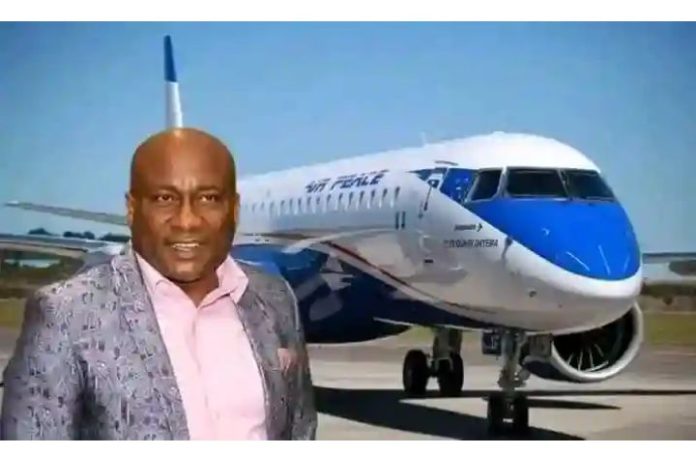
Nigeria’s leading carrier, Air Peace, has firmly denied recent allegations of extortion and overbooking levelled against it by Senator Adams Oshiomhole, describing his claims as “deliberate falsehoods” and calling for the release of CCTV footage to clarify the events in question.
The airline, in a strongly worded statement issued on Thursday via its official X (formerly Twitter) account, dismissed the senator’s accusations as baseless. “The Senator lied blatantly when he accused Air Peace of extorting its passengers. We challenge Senator Oshiomhole to produce a single evidence of a passenger who was extorted,” the airline stated.
According to the airline, the Lagos-Abuja flight referenced by the senator was not overbooked, and no tickets were sold after the check-in window had closed. It added that the flight eventually departed with more than 30 unoccupied seats, countering claims of capacity issues.
“None of our staff extorted any passenger. Every ticket was purchased prior to check-in closure. It would have been to our benefit to accommodate Senator Oshiomhole and other latecomers, but we are committed to upholding our on-time performance and will not compromise operational discipline for profit,” the statement read.
Air Peace also accused the former Edo State governor of disruptive conduct at the airport after arriving late for the flight. “He arrived late and, upon being informed, began causing a scene. He climbed onto the baggage conveyor belt, obstructing check-in for other passengers, and later barricaded the entrance to the terminal, hindering access,” the airline alleged.
In light of the controversy, Air Peace urged the Federal Airports Authority of Nigeria (FAAN) to release CCTV footage of the incident. “We call on FAAN to make public the video footage capturing Senator Oshiomhole’s actions from the moment he arrived at the airport. His accusations are defamatory, and his behaviour was aggressive, inappropriate, and regrettable,” the statement added.
Senator Oshiomhole had earlier expressed frustration over the airline’s operations, claiming he missed the early morning flight due to what he described as disorganisation and possible ticket racketeering. Speaking to reporters, he said the ordeal began a week earlier when his Air Peace flight was delayed for five hours before being cancelled.
He further recounted that a subsequent attempt to board an Ibom Air flight also failed despite his aide checking in their luggage. “I got there early, but was told boarding had closed. My assistant had checked in our luggage, but they insisted I had to be present. By the time I arrived, they refused to issue the boarding pass,” he said.
Oshiomhole said he incurred hotel bills of over ₦1.6 million as a result of the disruption, adding that he was later advised by an Air Peace staff to rebook for the 6:30 a.m. flight the following Wednesday. He claimed to have checked in online the night before, only to be told at the airport that the flight was full and that he could not board.
“As I speak to you, I’m still in yesterday’s clothes because my luggage had already been checked in with my assistant. They told me the flight was full despite my having a boarding pass. That suggests overbooking,” he alleged.
The senator also claimed that 20 to 30 other passengers were similarly denied boarding and accused the airline of engaging in ticket racketeering. “They offered me special treatment, but I declined. What about ordinary Nigerians? This practice of reselling seats at higher rates while ignoring earlier bookings is racketeering,” he said.
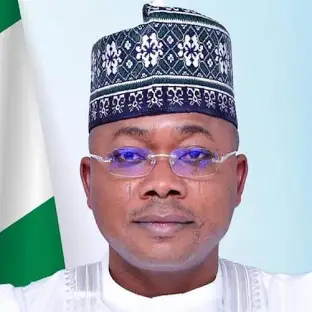
Kogi State Governor Usman Ododo reaffirmed his administration’s unwavering commitment to the principles of inclusion, justice, and accountability in governance on June 12, marking Democracy Day in Nigeria.
In a commemorative message on Thursday, Governor Ododo described the day as a pivotal point in Nigeria’s democratic evolution, noting that “democracy is not gifted, it is earned.” He emphasised that the ideals of democratic governance must be continually upheld through active participation, sacrifice, and service.
“Today, we celebrate as one people, united in history, hope, and purpose,” he said, paying glowing tribute to the heroes of the annulled 1993 presidential election, which is widely regarded as the freest and fairest in Nigeria’s political history.
Governor Ododo particularly acknowledged the role of President Bola Ahmed Tinubu, GCFR, whom he described as one of the leading figures in the fight for democracy. “The sacrifices made by pro-democracy heroes, including our father, President Bola Ahmed Tinubu, must never be forgotten,” he stated.
He stressed that Nigerians are not merely beneficiaries of the democratic dividends won through struggle and resilience, but custodians of its continued promise. “We are stewards of the democracy earned through the blood and sweat of our heroes,” he affirmed.
Reiterating his administration’s commitment to the delivery of good governance, Governor Ododo pledged to remain focused on infrastructure development, agricultural transformation, improved healthcare, and enhanced security across Kogi State.
He further emphasised the importance of building strong institutions, fostering transparency, and creating space for youth involvement in governance. “To our youth—you are not leaders of tomorrow. You are the true guardians of our democracy today. This democracy belongs to you,” he declared.
The governor also called on traditional rulers, religious leaders, civil society organisations, and public servants to embody democratic values through action rather than mere rhetoric. “Democracy is best measured not by titles or speeches, but by tangible outcomes that improve people’s lives,” he said.
Governor Ododo warned against threats to national unity, urging Nigerians to remain vigilant and united in defending the nation’s democratic foundations against forces of division and disruption.
He reaffirmed his support for President Tinubu’s Renewed Hope Agenda, assuring that Kogi State would align with the national vision for inclusive development.
“As Governor, I pledge to continue working day and night to protect the rights and freedoms of all Kogi residents, ensuring they live and work in safety, peace, and dignity,” he concluded.
Following criticism from passengers and industry stakeholders, the Federal Airport Authority of Nigeria (FAAN) has reiterated its commitment to removing obstacles preventing Nigeria’s aviation sector from operating at par with global benchmark countries.
Passengers and stakeholders have highlighted issues such as harassment, touting, and extortion—particularly by customs officers, airport staff, and security personnel—which undermine safety and dent international confidence in Nigerian aviation protocols.
The persistence of manual baggage search desks operated by Nigeria Customs Service (NCS) has come under particular scrutiny. Though FAAN attempted to dismantle these stations and replace them with automated scanners, NCS officers resisted, leading to tension that escalated into a physical confrontation over a faulty scanning unit.
The clash occurred between customs officers and FAAN’s Director of Aviation Security, Igbafe Afegbai, during efforts to install the machine at the Lagos cargo terminal. FAAN staff subsequently issued a 14-day ultimatum demanding the removal of the area customs controller and relevant redeployments by the federal government.
In an earlier incident, Skyway Aviation Handling Company dismissed a staff member for allegedly extorting N100,000 from a passenger, highlighting the scale of illicit behaviors FAAN aims to curb.
To address these issues, FAAN has acquired and begun installing advanced screening equipment, including six Orion 927DX X-ray scanners capable of high-resolution, four-color detection of explosives, narcotics, and other contraband. Each participating security agency—Customs, NDLEA, immigration, quarantine, and aviation security—will have dedicated monitors for transparent, automated baggage screening. Physical inspections will only occur in designated areas monitored by CCTV once alarms are raised.
FAAN plans to replace all manual luggage tables with these scanners and ensure proper operational training to eliminate opportunities for corruption.
Security training has also been ramped up following notable breaches, including an intruder found on an apron at Kano airport. The Nigeria Civil Aviation Authority (NCAA) has mandated the implementation of the Basic STP123 aviation security course as a standard for all aviation security personnel.
FAAN Managing Director Olubunmi Kuku has announced that airport staff are being enrolled in the Airport Management Professional Accreditation Programme, a multi-module certification aligned with international standards and delivered in partnership with ICAO, ACI, and the Nigerian College of Aviation Technology. The programme spans two to three years and focuses on areas such as operations management, passenger facilitation, crisis response, and technology integration.
FAAN’s Director of HR and Administration, Lukman Emiola, emphasized that the organisation is rewriting its internal operational framework to foster a culture of safety, precision, and global excellence across its workforce of more than 10,000 employees.
In a world where inflation is rising and salaries often fall short of covering living expenses, side hustles have become a lifeline for many. Yet, one major misconception holds back countless aspiring entrepreneurs: the belief that you need money to make money. The truth is, with the right mindset, skills, and tools, you can start a profitable side hustle with zero capital.
Everyone has a marketable skill — even if they don’t realize it yet. Can you write well? Are you a pro at editing videos, designing graphics, or teaching math? Can you speak or write fluently in another language? These are all valuable in today’s gig economy.
Action Step: List your top five skills. Then research platforms (like Upwork, Fiverr, or local WhatsApp and Facebook groups) where people are already monetizing similar abilities.
2. Use Free Online Tools
You don’t need to pay for fancy software. There are free alternatives for almost every digital need:
Canva for design
CapCut for video editing
Google Docs & Sheets for writing and organizing
LinkedIn and Twitter/X for networking
YouTube for learning how to use all of the above
Case Study: Michael, a 24-year-old student in Lagos, used Canva and free YouTube tutorials to launch a résumé design service. In under two months, he had paying clients across three countries.
3. Leverage Social Media
Your social media page can be your store, portfolio, and ad board all in one. You don’t need a website or a shop. Start by offering your service for free or discounted rates to a few people, collect testimonials, and showcase your results online. You’re already online every day — might as well make it work for you. Your WhatsApp status, TikTok, Instagram, or Twitter page can become your mini business hub.
Start by helping someone for free or at a discounted price. Take pictures. Ask for a review. Post the results. Let people see what you can do.
Tip: Use storytelling. Document your journey, share helpful tips, and let people see the human behind the hustle. Trust builds business.
4. Try Affiliate Marketing — No Products Needed
If you’re not into services, you can promote other people’s products and earn a commission. That’s called affiliate marketing. You don’t need to own a shop, make deliveries, or invest any money.
Just share your unique referral links on WhatsApp, in DMs, or even in casual conversations.
Jumia, Konga, and Amazon all have affiliate programs. So do many online course creators and tech products.
Golden Rule: Don’t promote nonsense. Only share things you genuinely believe in.
5. Offer Freelance Services
If you’re a fast learner or already have a basic skill, offer freelance services like:
Content writing
Social media management
Graphic design
Virtual assistance
Data entry
Start with free gigs or very low-cost jobs to build a portfolio. Once you get results and reviews, raise your price gradually.
6. Start a Knowledge-Based Hustle
Are you good at a particular subject, lifestyle hack, or career path? You can:
Start a blog (free on Medium)
Launch a YouTube channel (just a smartphone needed)
Teach online classes (using WhatsApp or Zoom)
Eventually, you can monetize through ads, sponsorships, or even paid courses — all without spending money upfront.
7. Join Local or Global Gig Platforms
Some platforms don’t require you to have a bank account or paid subscription:
Sweatcoin – Get rewarded for walking.
UserTesting – Earn for reviewing websites and apps.
TaskRabbit, Remotasks, and Clickworker – Microtasks you can do from anywhere.
Even local demand for WhatsApp marketing, errand running, or typing services is growing.
8. Barter and Collaborate
Don’t have money? Trade your skill. Need a logo for your writing business? Offer to write web content for a designer in exchange.
Collaboration can get you what money can’t — exposure, experience, and access.
9. Keep Learning, Keep Pivoting
Every side hustle starts somewhere, but many evolve. You might begin as a resume writer and grow into a full career coaching service. The key is to keep learning — and improving.
There are thousands of free courses on platforms like Coursera, Alison, and Google Digital Skills.
Starting with zero capital doesn’t mean starting with zero value. Your skills, time, and mindset are already assets. The side hustle economy is booming, and there’s room for everyone — especially the bold and resourceful.
So whether you’re a student, stay-at-home parent, or a 9-5 worker looking for extra income, the best time to start was yesterday. The second-best time? Right now.
NiMet, Earth Networks Sign Pact On Early Warning Of Severe Weather
The Nigerian Meteorological Agency (NiMet) has forecasted three days of thunderstorms and rainfall across various parts of the country, beginning Wednesday and continuing through Friday.
In its weather outlook released on Tuesday in Abuja, NiMet said early morning thunderstorms are expected on Wednesday in parts of Taraba, Kaduna, and Adamawa states in the northern region. Later in the day, storms with rainfall are likely to affect Kebbi, Taraba, Zamfara, Katsina, Kaduna, Kano, Sokoto, Gombe, and Bauchi.
In North Central Nigeria, morning thunderstorms are predicted in Benue, Kwara, Niger, the Federal Capital Territory, and Nasarawa, with later showers expected in Kwara, Kogi, Plateau, and the FCT.
For the South, NiMet forecasts a cloudy morning with chances of rain in Ondo, Ekiti, and Edo. By afternoon and evening, isolated thunderstorms with rainfall are expected across most southern states including Imo, Enugu, Abia, Ebonyi, Anambra, Oyo, Ogun, Delta, Cross River, Akwa Ibom, Bayelsa, and Rivers.
On Thursday, NiMet expects morning thunderstorms in parts of Kaduna, Kebbi, Zamfara, Adamawa, and Taraba. Later in the day, rainfall accompanied by thunderstorms is likely in Taraba, Adamawa, Kebbi, Kaduna, Zamfara, Kano, Gombe, and Bauchi.
In the North Central region, intervals of sunshine with cloud patches are forecast, along with early morning thunderstorms in Niger, Nasarawa, Benue, and the FCT. Later in the day, storms are expected in the same states as well as Kwara, Kogi, and Plateau.
Southern states such as Rivers, Bayelsa, Akwa Ibom, and Cross River may see morning storms, while widespread rain with thunderstorms is predicted later in the day across the entire region, including Lagos and Ogun.
For Friday, thunderstorms are anticipated in the morning over parts of Jigawa, Gombe, Bauchi, Adamawa, and Taraba, with more rainfall later in Taraba, Adamawa, Kano, Kaduna, and Bauchi.
North Central states like the FCT, Nasarawa, Kwara, and Niger are expected to experience scattered storms, with additional rainfall in Kogi and Benue during the evening hours.
Southern regions will continue to experience a mix of cloudy skies and rainfall, with morning showers in Oyo, Enugu, Imo, Ebonyi, Akwa Ibom, and Cross River, followed by isolated thunderstorms across most southern states later in the day.
NiMet cautioned that strong winds may precede the rainfall in many locations. The agency advised residents to secure loose items, avoid driving in heavy rain, disconnect electrical appliances, and steer clear of tall trees.
Airline operators were also urged to obtain airport-specific weather information for safe and efficient flight planning.
The public is encouraged to stay informed by checking daily weather updates via NiMet’s website: www.nimet.gov.ng.
Oil prices rose slightly following reports that the United States and China have reached an agreement in principle on a framework aimed at easing trade tensions between the world’s two largest oil consumers.
Brent crude, the international benchmark, climbed by 0.19% to $66.35 per barrel, up from $66.22 at the previous session’s close. Similarly, US West Texas Intermediate (WTI) increased by 0.15% to $63.95 per barrel, compared to $63.85 the day before.
The modest gains followed announcements from both governments indicating that progress had been made during two days of negotiations in London. The talks focused heavily on easing restrictions around the export of rare earth minerals—critical components in technologies ranging from electric vehicles to smartphones.
US Commerce Secretary Howard Lutnick confirmed that the two sides had agreed to a preliminary framework, which now awaits approval from Presidents Donald Trump and Xi Jinping. “We have reached a framework to implement the Geneva consensus,” Lutnick told reporters, referring to the outcome of recent discussions between the two leaders.
China’s Vice Commerce Minister Li Chenggang echoed this sentiment, noting that the framework aligns with the consensus reached during a phone call between the presidents on June 5.
Key sticking points included US complaints about China’s delayed release of rare earth exports, and Beijing’s concerns over Washington’s restrictions on Chinese access to critical technologies, such as semiconductors and artificial intelligence systems.
Although markets responded positively to the diplomatic breakthrough, analysts noted that price movements remained modest due to investor caution. “Traders are waiting for concrete details and final approval before fully pricing in the impact,” one analyst noted.
Meanwhile, supply data from the US added to market momentum. The American Petroleum Institute (API) reported an unexpected draw of 370,000 barrels in US crude stockpiles last week, compared to market expectations of a 700,000-barrel build. The official data from the Energy Information Administration (EIA) is expected later today. Should it confirm the drawdown, analysts believe oil prices could see further upward support.
Despite the cautious optimism, market sentiment remains sensitive to any shift in trade policy or geopolitical developments that could affect demand and supply balances globally.