Senate President Godswill Akpabio on Monday returned to Abuja from London, putting to rest speculations that he had been hospitalised abroad.
Akpabio had travelled to Geneva to attend the Sixth World Conference of Speakers of Parliament from July 29 to 31, after which he proceeded to London for what his office described as a brief vacation. His absence, however, fuelled rumours about his health and ability to continue leading the Senate.
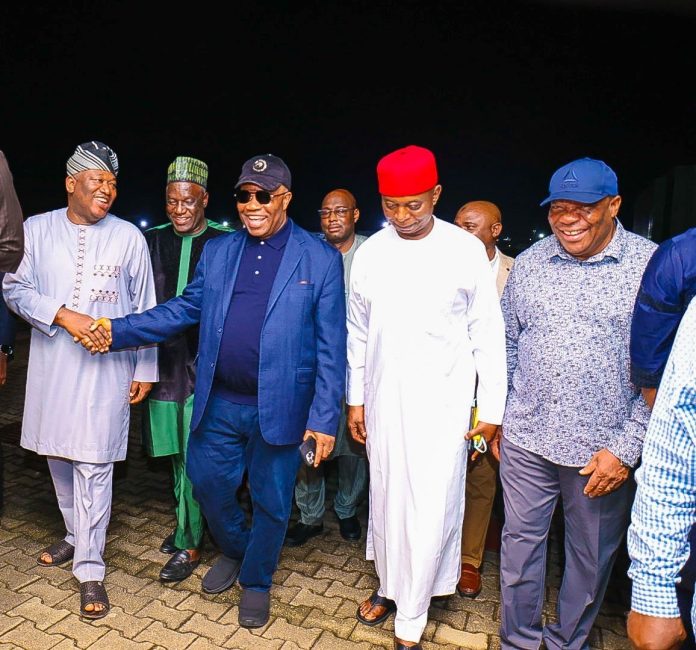
The Senate President arrived at the Nnamdi Azikiwe International Airport at about 4:00 a.m., where he was received at the Presidential Wing by senators, aides, and supporters in what many observers viewed as a show of political solidarity.
Speaking to reporters on arrival, Akpabio dismissed the speculations and assured Nigerians of “robust legislative engagements” when the National Assembly resumes. He also defended the size of Nigeria’s delegation to the Geneva conference, arguing that it was essential for strengthening democratic governance and deepening collaboration with other arms of government.
The Chief Executive Officer of Nature’s Renaissance International Limited (NRI), Prof. Clinton Brown Odiagbe, has called on Nigerians to adopt traditional medicine as a dependable alternative to synthetic products, stressing that Africa possesses the natural resources needed to address its health challenges.
Odiagbe made the call at the weekend during the unveiling of UATD Eyi Toothpastes in Lagos. He said the new products, which include a charcoal-based variant for adults and fruit-flavoured options for children, illustrate how indigenous remedies can be developed into world-class solutions that promote both wellness and economic empowerment.
Unlike conventional toothpaste, he explained, the charcoal-based Eyi toothpaste is fortified with herbal extracts such as turmeric and offers additional benefits beyond oral care. “This is nature made friendly. It is not just about whitening teeth, but supporting overall wellness by helping to relax nerves and improve sleep,” Odiagbe said.
The professor of natural medicine traced his passion for herbal solutions to a personal experience, recalling how a spinal injury sustained in his youth was successfully treated by a traditional bone doctor after conventional hospitals had failed. He added that subsequent exposure to Chinese and Indian herbal practices further reinforced his commitment to developing Africa-centred remedies.
Since its establishment in 2020, NRI has produced more than 16 certified herbal health products reportedly used by over three million Nigerians. Odiagbe emphasised that the company remains committed to advancing herbal healthcare in the country and beyond.
Plans by the Dangote Petroleum Refinery to commence direct fuel distribution across Nigeria with 4,000 Compressed Natural Gas (CNG)-powered trucks have suffered a setback following logistics challenges in China, forcing a delay in the rollout.
The $20bn refinery, located in Lekki, Lagos, had announced that the initiative would begin on August 15 with thousands of trucks specially ordered from China to ease petroleum product distribution nationwide. However, The PUNCH learnt that only 450 trucks had been delivered so far, representing about 11 per cent of the expected fleet.
A senior executive of the Dangote Group, who spoke on condition of anonymity, confirmed that shipping constraints from China were hampering deliveries. “There are not enough ships coming from China to handle 4,000 trucks and 4,000 tankers,” the official said.
According to the source, the first batch of 200 trucks had earlier arrived, followed by another 250, while 150 more are expected in the coming week. The refinery anticipates at least 60 shiploads of trucks over the next six weeks to meet its target.
Anthony Chiejina, Group Chief of Branding and Communication at Dangote Industries Limited, explained that the company was investing over N720bn in the deployment of the CNG-powered trucks. He said the scheme, when fully operational, would cut annual fuel distribution costs by more than N1.7tn, reduce inflationary pressures, and create over 15,000 jobs across the logistics chain.
“This strategic programme is part of Dangote’s broader commitment to eliminating logistics bottlenecks, enhancing energy efficiency, promoting environmental sustainability, and supporting Nigeria’s economic development,” Chiejina noted in a statement.
The refinery also projected that the plan would revitalise dormant filling stations, support micro, small, and medium enterprises, and curb cross-border smuggling of petroleum products.
When the scheme was unveiled in March, it was designed to bypass middlemen by distributing products directly to filling stations, telecom operators, and other bulk users. However, the announcement triggered resistance from members of the Natural Oil and Gas Suppliers Association of Nigeria (NOGASA) and tanker drivers, who feared job losses and supply disruptions.
NOGASA President, Bennett Korie, had earlier warned that Dangote’s direct distribution strategy could destabilise existing supply networks. The association appealed to President Bola Tinubu to intervene, stressing that no single operator could sustainably manage nationwide petroleum distribution.
Following negotiations, however, Dangote Group and stakeholders reached a compromise. NOGASA spokesman, Chinedu Ukadike, confirmed that the refinery had agreed to sell petroleum products to bulk buyers rather than distributing directly to end-users.
“I want to say that Dangote heeded our plea by agreeing with us that they will be sending these products to the bulk buyers, who are the suppliers. Based on that, we won’t have issues again,” Ukadike says.
Nigeria’s average daily crude oil production rose to 1.507 million barrels per day (mbpd) in July, exceeding its Organisation of the Petroleum Exporting Countries (OPEC) quota by about 7,000 barrels per day.
The latest OPEC Monthly Oil Market Report shows that production inched up by 2,000 bpd compared to June’s 1.505 mbpd, marking the second consecutive month the country maintained output above its approved quota.
So far in 2025, Nigeria has met or surpassed its OPEC quota in January, June, and July. January recorded the highest output of 1.54 mbpd, while production fell to 1.46 mbpd in February, 1.40 mbpd in March, and 1.45 mbpd in May. April saw a modest recovery to 1.48 mbpd before output climbed above quota in June and held steady in July.
The Nigerian Upstream Petroleum Regulatory Commission (NUPRC) has linked the sustained improvement to the Project One Million Barrels Initiative, launched in 2024. The initiative focuses on reactivating dormant oil fields, streamlining regulatory approvals, and improving operational efficiency across the upstream sector.
NUPRC Chief Executive, Gbenga Komolafe, recently noted that crude and condensate production has risen from 1.4 mbpd to between 1.7 and 1.83 mbpd. He stressed that the government remains committed to achieving an ambitious target of 2.5 mbpd by 2026, adding that the recent addition of about 300,000 bpd underscores ongoing momentum.
The Economic and Financial Crimes Commission (EFCC) has recovered over N5 billion and $10 million from contractors and government officials implicated in fraudulent activities linked to the turnaround maintenance of Nigeria’s refineries in Port Harcourt, Kaduna, and Warri. Investigators disclosed that an additional N10 billion and $13 million allegedly siphoned through inflated contracts are being targeted for recovery.
According to top sources, EFCC Chairman Ola Olukoyede is personally overseeing the probe, expressing concern over Nigeria’s long-dormant refineries despite huge public funds allocated for their rehabilitation. Nigeria’s four state-owned refineries have remained largely non-functional for decades, forcing the country to depend heavily on imported petroleum products.
The ongoing investigation is scrutinising allocations of $1.56 billion to the Port Harcourt refinery, $740.6 million to Kaduna, and $656.9 million to Warri. Findings point to widespread malpractices such as over-invoicing, contract inflation, and questionable payments as key reasons the facilities failed to deliver.
Sources confirmed that former management teams of the refineries have been repeatedly interrogated, while some serving and retired officials of the Nigerian National Petroleum Company Limited (NNPCL) are set to face charges.
“Investigations flagged former management teams of the three refineries who were arrested several times and grilled to uncover fraudulent dealings that prevented the refineries from functioning optimally,” one senior investigator said.
The official added that the EFCC has concluded investigations on certain NNPCL executives and is preparing charges against them.
“Both former and current officials of NNPCL and the refineries may be charged in court soon,” the source noted.
In addition to the sums already recovered, the anti-graft agency is probing fresh allegations of contract inflation worth about $40 million, allegedly involving NNPCL officials and contractors engaged to procure equipment for rehabilitation projects.
EFCC officials confirmed that the investigation remains ongoing, with more recoveries expected in the coming weeks.
Samsung Electronics has launched the Vision AI TV, a next-generation device that integrates artificial intelligence with privacy-focused features, positioning it as a hub for smart living rather than just an entertainment screen.
The television, equipped with Samsung Knox security technology, is designed to safeguard personal data while offering advanced capabilities such as instant on-screen search, live translations, digital art displays, enhanced gaming experiences, and seamless control of connected devices via SmartThings. The company also promised seven years of operating system updates, ensuring long-term relevance.
Speaking at the unveiling in Lagos, Tae Sun Lee, CEO of Samsung Electronics West Africa, said the innovation reflects the company’s forward-looking approach to home technology.
“With Vision AI, we’re not just offering a TV; we’re introducing a smarter, more connected way to live, building on almost two decades of global leadership,” he said.
Samsung, which has maintained its position as the world’s leading TV brand for 19 consecutive years, is expanding its 2025 lineup across OLED, Neo QLED, QLED, and lifestyle models.
Ajay David, Head of Consumer Electronics at Samsung West Africa, highlighted performance improvements in the new range, including glare-free OLED, brighter displays (up to 30%), high refresh rates of up to 240Hz, and AI-driven picture and sound enhancements. He added that the lineup introduces premium features such as Neo QLED Mini-LED with wireless One Connect and Nigeria’s first 100-inch Neo QLED TV.
According to Oge Maduagwu, Head of Marketing & Communications, the Vision AI TV marks a shift toward televisions as “intelligent lifestyle hubs,” delivering personalised and seamless experiences that merge entertainment with functionality.
Samsung reiterated its commitment to shaping the future of home viewing by blending innovation, design, and connectivity, while reinforcing customer trust built over nearly two decades of market leadership.
The Nigerian Communications Commission (NCC) has announced new measures to safeguard the country’s critical digital infrastructure, in line with a presidential directive to secure assets vital to Nigeria’s economy and national security.
The move comes amid a sharp rise in vandalism of telecom facilities since May 2025. Industry reports show that operators, including MTN, Airtel, Glo, and tower companies such as IHS Towers, have suffered an average of five vandalism incidents daily—up from two per day previously—amounting to 445 cases in just under three months.
NCC Executive Vice Chairman, Aminu Maida, said the initiative aims to ensure the resilience of telecommunications and other digital infrastructure against cyberattacks, vandalism, and natural disasters.
“Protecting our critical information infrastructure is not just a regulatory mandate but a national security priority,” Maida said after a stakeholders’ meeting in Abuja. “We are working closely with operators, security agencies, and other stakeholders to ensure proactive risk management, rapid incident response, and improved resilience.”
The commission identified telecom base stations, data centres, undersea cable landing stations, and other core network components as priority assets requiring enhanced protection. Operators have frequently reported fibre cuts, equipment theft, and sabotage disrupting services nationwide, with states such as Delta, Rivers, Cross River, Akwa Ibom, Lagos, Ogun, Ondo, and the FCT among the hardest hit.
The NCC’s initiative aligns with the National Cybersecurity Policy and Strategy, which places strong emphasis on securing critical information infrastructure.
The Association of Licensed Telecommunications Operators of Nigeria (ALTON) has repeatedly urged for urgent government intervention, including enforcement of the Critical National Infrastructure Act and deeper collaboration with security agencies to protect telecom sites.
Nigeria has maintained its position as the third-largest debtor to the World Bank’s International Development Association (IDA), with outstanding obligations rising to $18.2bn as of June 30, 2025. This represents a $1.7bn—or about 10.3 per cent—increase from $16.5bn in June 2024.
The IDA, the concessional lending arm of the World Bank, provides low-interest or interest-free loans and grants to the world’s poorest nations. While its loans come with long maturities and grace periods, Nigeria’s rising debt highlights the scale of its financing needs and growing dependence on concessional funding.
Nigeria first moved into the third position among IDA’s top borrowers in 2024, up from fourth place in 2023, and has retained this spot in 2025.
Globally, Bangladesh remains the largest IDA borrower, with its debt climbing from $20.5bn in June 2024 to $22.6bn in June 2025. Pakistan follows in second place, with obligations increasing from $17.9bn to $19.3bn over the same period. India, which previously ranked ahead of Nigeria, saw its exposure decline from $15.9bn to $14.2bn, largely due to repayments exceeding fresh disbursements. Ethiopia, with debt rising from $12.2bn to $14.0bn, completes the top five.
Other significant shifts in 2025 include Tanzania’s debt rising from $11.7bn to $13.7bn, overtaking Kenya at $13.0bn, while Vietnam’s exposure dropped to $11.6bn. Ghana’s debt grew modestly to $7.2bn, and Côte d’Ivoire entered the top ten with $6.2bn, displacing Uganda. Altogether, the top ten borrowers accounted for 61 per cent of IDA’s portfolio in 2025, down slightly from 63 per cent in 2024.
Recent data from Nigeria’s Debt Management Office also shows that the country’s total debt to the World Bank reached $18.23bn as of March 31, 2025, representing about 39.7 per cent of its total external debt stock of $45.98bn. The World Bank now accounts for over 81 per cent of Nigeria’s total multilateral debt.
Analysts note that while concessional loans offer more favourable terms than commercial borrowing, Nigeria’s reliance on them continues to raise concerns about debt sustainability. They stress the importance of ensuring that projects financed by these loans directly strengthen the country’s capacity to repay, particularly by expanding revenue sources.
Experts have further cautioned that excessive dependence on external debt could expose the country to exchange rate risks and fiscal vulnerability, underscoring the need for a disciplined borrowing strategy aligned with Nigeria’s economic priorities.
The Federal Government has pledged to reverse deductions from the Employees’ Compensation Scheme (ECS) managed by the Nigeria Social Insurance Trust Fund (NSITF), in a bid to ease tensions with the Nigeria Labour Congress (NLC) following threats of a nationwide strike.
Last week, the NLC accused the government of diverting 40 per cent of NSITF contributions into the federal treasury, describing the move as an attack on workers’ social protection. The union demanded an immediate refund and the full reconstitution of the National Pension Commission (PenCom) board, warning that non-compliance could trigger nationwide industrial action.
The Employees’ Compensation Scheme is designed to provide financial support to employees who suffer work-related injuries, illnesses, disabilities, or death. It is funded solely by employer contributions, typically one per cent of monthly payroll, with no deductions from workers.
In a letter dated August 16, 2025, NSITF Managing Director, Oluwaseun Faleye, confirmed that deductions had been made but argued they were not diversions. He explained that the deductions stemmed from a federal policy introduced in December 2023 requiring government-owned enterprises to remit 50 per cent of their internally generated revenue (IGR) to the treasury. The measure, introduced by the Ministry of Finance, was aimed at boosting revenue and narrowing the fiscal deficit.
Faleye said a directive from the Accountant-General of the Federation in March 2024 halted deductions from workers’ contributions, and partial refunds have since been processed. He noted, however, that deductions on investment income from contributions were still ongoing, though discussions with the Budget Office and Finance Ministry were underway to end the practice.
“We have been assured that no further deductions will be made from contributions or investment proceeds,” Faleye stated.
NLC’s Position
Responding, NLC Assistant General Secretary, Christopher Onyeka, said the union’s executive council would review NSITF’s letter before deciding on strike action. He insisted that NSITF funds were not government revenue but social protection contributions that should remain untouchable.
“These funds are meant to compensate workers in cases of injury. Classifying NSITF as a revenue-generating agency undermines workers’ rights,” Onyeka said.
The NLC also rejected claims that NSITF sought to amend the Employees’ Compensation Act in ways that could weaken protections. Faleye clarified that the agency’s proposals aimed at strengthening compliance and enforcement against defaulting employers, not undermining worker safeguards.
Pension Concerns
Beyond compensation funds, the NLC also raised alarm over the prolonged non-constitution of the PenCom Governing Board, describing it as a breach of the Pension Reform Act 2014. The union warned that the vacuum gives the federal government unilateral control over workers’ pension funds, exposing them to risks of mismanagement and political interference.
Section 19 of the Act provides for a 16-member board comprising government officials, labour representatives, and employers. While PenCom’s Director-General was appointed in 2024, the board remains incomplete more than a year after it was dissolved alongside other parastatal boards in June 2023.
Pension rights advocates have also backed labour’s call, stressing that the absence of a governing board undermines oversight and transparency.
Wider Labour Disputes
The latest dispute adds to a growing list of issues between the government and organised labour, including the removal of fuel subsidies, electricity tariff hikes, and minimum wage negotiations. The NLC has maintained that both pension and compensation funds represent workers’ deferred wages and cannot be treated as revenue for fiscal policy purposes.
Meanwhile, the Nigeria Employers’ Consultative Association (NECA) also urged the government to constitute the PenCom board, warning that failure to do so undermines regulatory credibility.
NSITF, however, assured that despite disruptions, workers’ funds remain secure.
“Every contribution is accounted for. The Employees’ Compensation Scheme is intact. The deductions arose from a general revenue policy not tailored to our operations,” Faleye reiterated.
PenCom also confirmed that contributors’ retirement savings accounts remain safe, with balances available in monthly or quarterly statements.
The Federal Government has appointed Mr. Opeyemi Agbaje as Chairman of the National Pension Commission (PenCom), following threats of industrial action by the Nigeria Labour Congress (NLC) over the failure to constitute the commission’s governing board.
The move comes after the NLC’s Central Working Committee, at its August 13 meeting, issued a seven-day ultimatum demanding the constitution of the PenCom board in line with the Pension Reform Act 2014. The union also called on the commission to submit a full status report of pension funds within the same timeframe.
Section 19 of the Pension Reform Act mandates a 16-member governing board for PenCom, including a Chairman, Director-General, four full-time Commissioners, and representatives of key stakeholders such as the NLC, the Trade Union Congress, the Nigeria Union of Pensioners, and the Nigeria Employers’ Consultative Association.
Agbaje, the newly appointed chairman, is the Chief Executive Officer of RTC Advisory Services Ltd, a strategy and business advisory firm with operations in consulting and policy analysis. He brings a wealth of experience from the banking sector and has served on the board of the Lagos State Security Trust Fund for two terms between 2011 and 2019.
He holds a Master’s degree in Law from the University of Lagos and an MBA from IESE Business School, Spain.
The Federal Government, through the Federation Accounts Allocation Committee (FAAC), deducted a total of N256.52 billion from revenue allocations in the first half of 2025 to finance gas infrastructure projects, official figures have shown. The deductions were made to fund the Midstream and Downstream Gas Infrastructure Fund (MDGIF), which was established to invest in projects that will enhance natural gas transportation, processing, and utilisation across the country.
Data reviewed from FAAC reports between January and June 2025 indicate wide fluctuations in monthly deductions. In January, N35.07bn was deducted, but this fell by 9.24 per cent to N31.83bn in February. March saw a sharp rise of 66.49 per cent to N52.99bn, before plunging to the lowest level of the period in April at N29.19bn. Deductions rose again in May to N41.27bn and further surged by 60.38 per cent in June to N66.18bn, the highest in the six-month period.
The June spike coincided with the Federal Government’s signing of over N165bn in equity investment agreements with 10 private companies for the development of gas processing plants, compressed natural gas (CNG) refuelling stations, and liquefied petroleum gas (LPG) storage facilities nationwide. These projects are central to the government’s “Decade of Gas” agenda, which seeks to boost domestic supply, reduce flaring, and expand access to cleaner energy.
In 2023, President Bola Tinubu inaugurated the governing council of the MDGIF, chaired by the Minister of State for Petroleum Resources (Gas), Ekperikpe Ekpo. The Nigerian Midstream and Downstream Petroleum Regulatory Authority manages the fund. The MDGIF’s objectives include attracting more than $575bn in investments to expand Nigeria’s midstream and downstream gas infrastructure and deepen private sector participation.
Speaking during the council’s inauguration, Ekpo stressed that the fund represents more than a financing tool. According to him, it is a catalyst for growth, energy security, and sustainable development.
“Our goals are ambitious, but so is our determination,” he said. “With the collective expertise of the governing council and support of stakeholders, we aim to drive innovation, create jobs, and unlock the vast potential of Nigeria’s gas resources.”
Ekpo added that the initiative is expected to translate into lower LPG and CNG prices, particularly benefiting low-income households, while also positioning gas as a central driver of Nigeria’s energy transition.
The planned fuel distribution scheme by the Dangote Petroleum Refinery using 4,000 Compressed Natural Gas (CNG)-powered trucks could not commence on Friday due to logistics challenges in China.
The $20 billion Lekki-based refinery had earlier announced plans to deploy the trucks for direct fuel distribution nationwide. However, only 450 units have so far arrived in Nigeria, with an additional 150 expected next week, bringing the total to 600.
A senior Dangote Group executive confirmed the development, explaining that global shipping constraints had hindered the movement of the trucks. “There are not enough vessels leaving China to transport 4,000 trucks and 4,000 tankers at once,” the official disclosed. According to him, 200 trucks arrived in the first shipment, 250 in the second, while another 150 are expected shortly.
With just about 11 per cent of the required trucks available, the refinery’s plan to commence direct fuel supply to customers from August 15 may face adjustments. The company had earlier indicated that at least 60 shiploads of trucks would be delivered within six weeks.
In June, the refinery revealed plans to invest over ₦720 billion in the initiative, projected to save Nigerians more than ₦1.7 trillion annually in fuel distribution costs. The refinery also pledged to absorb about ₦1.07 trillion each year in logistics expenses while supporting over 42 million micro, small, and medium enterprises by lowering energy costs and boosting profitability.
The scheme, according to Dangote Industries, is designed to eliminate distribution bottlenecks, enhance efficiency, curb smuggling, and create over 15,000 direct jobs in logistics and CNG filling stations nationwide.
The plan initially sparked resistance from the Natural Oil and Gas Suppliers Association of Nigeria (NOGASA), which warned that bypassing existing distributors could lead to disruption, job losses, and long-term product scarcity. The association later confirmed that it had reached an agreement with Dangote, under which the refinery would supply products to bulk buyers rather than directly to end users.
NOGASA’s National Publicity Secretary, Chinedu Ukadike, said the deal preserved the role of existing distributors. “Dangote has agreed to channel supply through bulk buyers, which safeguards our investments in the supply chain. With this, we no longer have issues,” he stated.
Nigerian singer and songwriter, Chike Ezekpeazu Osebuka, widely known by his stage name Chike, has stirred fresh conversations about marriage and personal fulfillment after describing the institution as “a stupid step.”
The 32-year-old music star made the statement during a candid conversation with media personality Chude Jideonwo on the WithChude podcast, where he opened up about his views on relationships, career, and personal happiness.
“In my personal opinion, I honestly think marriage is a stupid step. That’s just how I see it,” Chike remarked, stressing that he has no immediate plans of settling down.
Although celebrated for his love-inspired ballads and soulful lyrics, the Boo of the Booless crooner clarified that his happiness is not anchored on romance but on financial stability. According to him, wealth plays a more significant role in determining his peace of mind.
“For me to be genuinely happy, I need a lot of money. This isn’t even about being materialistic. I just really like money, and I want more of it,” he said.
Reflecting on his journey into music, Chike revealed that his decision to pursue a career in the industry only came after he completed his university education. Prior to that, music was simply a hobby.
“Maybe right after my university days, I realized music was what I wanted to do for a living. Before then, I didn’t take it that seriously; I just used to sing and disturb everyone around me,” he explained.
The singer also recounted the early stages of his career, noting how financial struggles pushed him into acting for about two years to sustain himself before music fully paid off.
“It was a difficult phase. I even had to take on acting jobs for a couple of years just to survive,” Chike disclosed.
This is not the first time Chike has shared unconventional views about love and relationships. In 2022, he admitted that he had never actually said the words “I love you” to anyone, explaining that the phrase makes him feel uncomfortably vulnerable.
“I always feel like if I say it, my balls would shrink and vanish. Thankfully, I get to sing it instead,” he joked at the time.
Despite his stance on marriage, Chike continues to be one of Nigeria’s most beloved voices in the Afropop and R&B scene, captivating fans with heartfelt lyrics—even if he personally remains skeptical about the very subject his music often celebrates.
Chelsea begin their 2025/26 Premier League journey on Sunday with aspirations of a serious title charge as Crystal Palace make the short trip across London. Fresh off their Club World Cup success and a summer of high-profile arrivals, Enzo Maresca’s men are eager to translate their international dominance into domestic glory.
The Blues fell away in the second half of last season, finishing fourth despite a bright start, but optimism has returned thanks to new additions such as João Pedro and Liam Delap. With an attacking line full of promise, expectations are high for Chelsea to establish themselves as early contenders for the title.
Meanwhile, it has been a mixed summer for Crystal Palace. Their euphoric FA Cup triumph was followed by the disappointment of missing out on the Europa League after a demotion ruling. Manager Oliver Glasner, however, has kept his side focused, guiding them to victory in the Community Shield against Liverpool on penalties.
The biggest talking point surrounds Eberechi Eze, who has been heavily linked with a big-money move to Tottenham Hotspur. Reports suggest the deal could exceed £50 million, but despite ongoing negotiations, the England international is expected to feature against Chelsea.
Yesterday’s Premier League Action The season’s opening Saturday delivered drama, even without goals at Villa Park. Newcastle United dominated Aston Villa despite Ezri Konsa’s second-half red card, but failed to convert chances in a 0-0 stalemate—highlighting the absence of injured striker Alexander Isak.
Chelsea Eyeing Title Tilt For Chelsea, this season feels like one where only a title challenge will suffice. With the Club World Cup in the trophy cabinet and millions invested in new talent, pressure is mounting on Maresca to deliver consistency across the campaign.
Crystal Palace Dealing with Disruption Palace, on the other hand, enter the campaign under a cloud of uncertainty. Eze’s potential exit and the off-field setback regarding European football could unsettle the squad. Nevertheless, Glasner has built a resilient team, and Palace’s ability to trouble elite opposition makes them dangerous opening-day opponents.
Kick-Off Details Chelsea vs Crystal Palace kicks off at 2pm BST at Stamford Bridge. All eyes will be on how Chelsea’s new stars settle into Premier League action—and whether Palace can once again prove their credentials against one of the division’s giants.
Chelsea fans are bracing themselves with excitement as the reigning world champions prepare to launch their 2025/26 Premier League campaign on Sunday afternoon. After a pre-season that featured victories over Bayer Leverkusen and AC Milan—momentum built off their Club World Cup triumph—there is growing belief that Enzo Maresca’s side could mount a serious title challenge this term after fading over Christmas last season.
Yet, the opening-day London derby against Crystal Palace has all the hallmarks of a potential upset. The Eagles, under Oliver Glasner, have made a habit of troubling England’s top sides, and Stamford Bridge will be no easy ground for complacency.
Maresca has spent the summer integrating several exciting new signings into his squad, and Sunday’s clash is expected to feature a mix of established stars and fresh talent. Here’s how Chelsea are likely to line up.
Chelsea Predicted XI (4-2-3-1 Formation)
GK: Robert Sánchez – With no new goalkeeper signed in the summer window, Sánchez retains the No.1 spot heading into the season.
RB: Reece James – The captain returns with hopes of finally putting persistent injury troubles behind him.
CB: Trevoh Chalobah – Declared fit just in time for the opener, Chalobah is set to feature in central defence.
CB: Jorrel Hato – The teenage sensation is primed for his full debut after impressing off the bench during pre-season. With Levi Colwill sidelined long-term, Hato’s versatility will be crucial.
LB: Marc Cucurella – With Colwill unavailable, Cucurella’s experience keeps him cemented in the starting role.
CM: Moisés Caicedo – A cornerstone of the squad, the Ecuadorian midfielder’s dynamism and defensive prowess remain vital.
CM: Enzo Fernández – Operating slightly higher up the pitch, Fernández will look to link up with Cole Palmer and exploit his box-to-box qualities.
RW: Pedro Neto – Despite personal tragedy this summer, Neto has established himself as Chelsea’s first-choice right winger heading into the campaign.
AM: Cole Palmer – After a subdued domestic season, Palmer rediscovered his spark at the Club World Cup and is tipped to be Chelsea’s creative heartbeat again.
LW: Jamie Gittens – The ex-Borussia Dortmund youngster has impressed during pre-season and could be handed a first Premier League start.
ST: João Pedro – The Brazilian forward has made a flying start at Chelsea, scoring in both friendlies, and is expected to spearhead the attack.
With fresh faces and growing chemistry under Maresca, Stamford Bridge awaits what could be the dawn of a new Chelsea era.
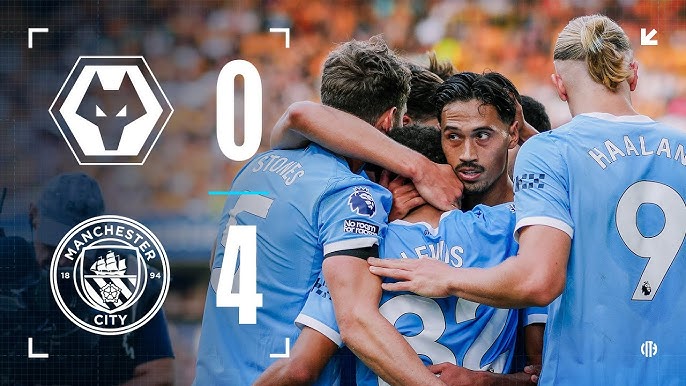
The new Premier League season began under the floodlights of Molineux with an evening that was as emotional as it was emphatic. Wolves paid tribute to their late former forward Diogo Jota before kick-off—a moment that quieted the ground and reminded fans of football’s power to connect generations. Yet, once the whistle blew, Manchester City shifted the tone entirely, dismantling Wolves 4-0 with a display that felt both clinical and ominous.
For Pep Guardiola’s men, this wasn’t just an opening-day victory. It was a statement: the champions aren’t slowing down. With Erling Haaland back to his ruthless self, Tijjani Reijnders making a dream debut, and a couple of fresh faces showing glimpses of promise, City’s campaign couldn’t have started on a brighter note.
The Opening
The match didn’t begin with City swarming Wolves the way many expected. In fact, the first 20 minutes carried a slight unease. Bernardo Silva floated in a teasing ball to Haaland, who stretched but couldn’t quite keep his header on target. Wolves, on the other hand, were prowling in the shadows, waiting for a turnover. Jørgen Strand Larsen forced John Stones into a sharp block, and Marshall Munetsi even thought he’d scored—only for VAR to quickly flag the offside.
But here’s the thing: when City need a goal to steady nerves, Haaland usually delivers. And that’s exactly what happened. A driving run from Reijnders sliced open Wolves’ midfield before he found Rico Lewis, who slipped in a smart ball for Haaland to tap home. The Norwegian didn’t even celebrate wildly—just a business-like acknowledgment, as if to say: “We’re back.”
Reijnders Announces Himself in Style
Barely had Wolves adjusted to being behind when City doubled their lead, and the architect was again their Dutch debutant. Oscar Bobb pounced on a loose Wolves pass, raced forward, and laid it off to Reijnders. With almost no backlift, the midfielder curled in a weak-footed finish that was anything but weak.
The away end erupted. A new signing scoring on his Premier League debut is always special, but this one carried an extra layer of promise. City fans have been spoiled in midfield over the years—from David Silva to Kevin De Bruyne—but there was something about Reijnders’ composure, movement, and confidence that felt like a glimpse into the club’s next chapter.
Wolves Threaten Again
To their credit, Wolves didn’t roll over. Early in the second half, Strand Larsen went close again, sliding just wide after Ki-Jana Hoever’s clever ball into the box. Molineux stirred, sensing a route back into the contest. But this is Manchester City. And against City, missed chances often carry a brutal price.
Moments later, Reijnders was at it again—linking beautifully with Bobb before cutting the ball back for Haaland, who rifled in his second. It was a pure City goal: patient, sharp, and devastating. The scoreboard read 0-3, and the Wolves faithful knew the evening had slipped beyond repair.
Cherki Joins the Party
James Trafford, City’s new No.1, had a quiet debut. His biggest test came from a low Strand Larsen drive, which he palmed away with minimal fuss. That was as close as Wolves got to spoiling City’s rhythm.
Then, just to rub salt in, City’s substitutes decided to add their names to the script. Nico O’Reilly teed up Rayan Cherki, who stepped into space outside the box and lashed in a precise, low drive. Another debut goal. Another young player stepping onto the big stage without blinking.
By the final whistle, the scoreboard read 0-4, but in truth, it could have been more. Wolves looked stretched, City looked relentless, and neutrals looked on thinking: is this the start of another title defense that feels inevitable?
Player Ratings: How the Stars Fared
James Trafford – 7.5
Handled what came his way calmly. A comfortable debut.
Rico Lewis – 8
Everywhere. Assisted Haaland’s opener and knitted City’s play together like a seasoned veteran.
John Stones – 7.5
Solid and composed. Just getting 82 minutes in the tank is a win for City.
Rúben Dias – 7
Shaky opening, but grew into the game with crucial blocks.
Rayan Aït-Nouri – 7
Faced his old side with a mixed start but steadied himself. Looked sharp in possession.
Nico González – 8
The so-called “mini Rodri” showed he can be more than a stopgap. Strong in duels, disciplined off the ball.
Tijjani Reijnders – 9 (Man of the Match)
Influenced three goals, scored one himself, and carried the swagger of a player who’s been here for years.
Bernardo Silva – 7.5
Worked tirelessly, played facilitator to perfection.
Oscar Bobb – 7.5
Energetic in the first half, clever assist for Reijnders.
Erling Haaland – 8.5
Two goals, same old Haaland. The machine never stops.
Jeremy Doku – 6.5
Struggled against Hoever, too hesitant at times.
Substitutes:
Matheus Nunes – 6 (shaky against his old team)
Nico O’Reilly – 6.5 (tidy on the ball, involved in fourth goal)
Omar Marmoush – 6 (lacked sharpness)
Rayan Cherki – 7 (brilliant goal, instant impact)
Abdukodir Khusanov – N/A
Guardiola’s Takeaway: A Perfect Start
If you listened closely to Guardiola post-match, you’d have noticed something. He wasn’t celebrating the 4-0 margin as much as others. Pep rarely does. Instead, he talked about “control,” “positioning,” and “still more to work on.” It’s classic Guardiola—always a perfectionist, never fully satisfied.
But deep down, he’ll know this was a near-ideal start. His new signings looked the part, his star striker looked sharp, and his squad depth already looks frightening.
What This Means for the Season Ahead
So, what can we take from this? City look ruthless, but we already knew that. Haaland’s sharpness is intact, which is bad news for defenders across England. Reijnders could be the signing of the season if this performance is anything to go by. And their younger players—Cherki, Bobb, O’Reilly—are showing that City’s pipeline of talent is as strong as ever.
For Wolves, this was always going to be a tough opener. They played with fight, but against City, fight isn’t always enough. Gary O’Neil will need to tighten his midfield and sharpen his attack if Wolves are to avoid getting dragged into trouble this season.
But let’s not overanalyze the numbers. Football is also about moments. The tribute to Diogo Jota. The roar of the away end for Reijnders’ goal. Haaland’s ruthless finishing. Cherki’s debut strike. These are the moments fans carry home, the ones they talk about over pints and in WhatsApp groups.
And as the new Premier League season kicks off, one thing already feels certain: Manchester City aren’t easing up. They’re revving the engine, and the road ahead looks daunting for anyone trying to keep up.
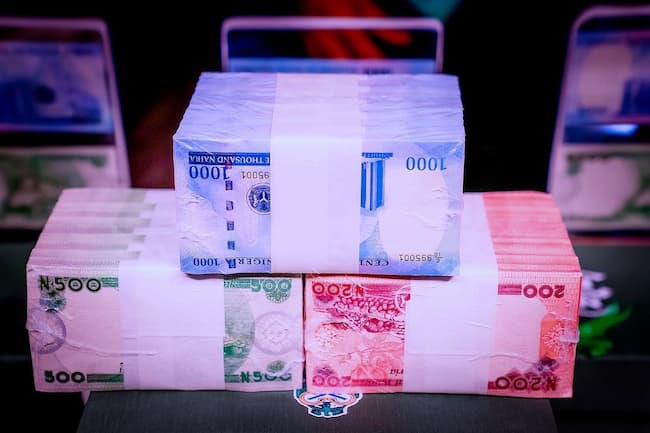
The naira extended its recovery streak against the US dollar, buoyed by fresh dollar injections from the Central Bank of Nigeria (CBN) aimed at easing pressure in the foreign exchange market.
At the official FX window on Friday, the local currency appreciated slightly, closing at ₦1,532.51 per dollar, compared to ₦1,534.52/$1 recorded the previous day. The appreciation was supported by a combination of foreign portfolio inflows, improved exporter supply, and corporate demand management measures.
Data from the CBN showed that during intraday trading, the naira touched a high of ₦1,535/$1 and a low of ₦1,529.75/$1, reflecting stronger liquidity conditions. The apex bank further injected USD 166 million into the market through authorized dealers to curb rising dollar demand.
Despite the official market’s stability, the parallel market reflected a different narrative. The naira closed at ₦1,550/$1 in the black-market segment, marking a modest week-on-week depreciation due to growing demand for business travel and personal travel allowances. This widened the exchange rate gap between the official and parallel markets to about ₦23 per dollar.
Meanwhile, Nigeria’s external reserves continued on an upward trajectory, climbing for the sixth consecutive week. The reserves rose by USD 431.86 million to reach USD 40.72 billion, according to updated CBN data.
Financial analysts project that the naira will maintain relative stability in the near term, supported by stronger forex inflows and deliberate policy actions. Experts at Cordros Capital noted that sustained foreign portfolio investor (FPI) interest, alongside higher non-oil export receipts, would reinforce the currency’s resilience.
“We expect steady capital inflows from FPIs given existing carry trade opportunities and improved investor confidence. Additionally, limited incentives for naira speculation and a pickup in non-oil exports should sustain FX stability,” Cordros Capital said in its weekly note.
With growing liquidity and reserves back on the rise, the naira is expected to remain range-bound, provided that dollar inflows continue to strengthen and demand-side pressures remain contained.
The Nigerian stock market ended the week on a bearish note as the Nigerian Exchange (NGX) All-Share Index declined by 0.46%, wiping off more than ₦425 billion in market value. This downturn was driven by persistent selling pressure, as cautious investors shifted focus towards fixed-income assets amid disinflationary signals in the economy.
Analysts observed that the equity market had shown signs of weakened risk appetite since the beginning of the week. Although bargain hunters initially targeted insurance stocks, profit-taking dominated trading sessions, sparking a broad-based sell-off across several sectoral indices.
By the close of Friday’s session, the NGX All-Share Index settled at 144,628.20 points, pulling the year-to-date return down to 40.52%. Insurance stocks were hit hardest, with NEM, CONAHLLPLC, ELLAHLAKES, MTNN, and 35 others recording losses.
Market turnover also reflected the downbeat sentiment, as trading activity slumped. The total volume of transactions dropped by 43.93%, while the total value of trades decreased by 36.80%, with stockbrokers reporting 1.37 billion units worth ₦13.76 billion exchanged across 31,717 deals.
UNIVINSURE dominated the activity chart in terms of volume, contributing 22.48% of the total market trades, followed by AIICO (8.59%), MBENEFIT (7.46%), VERITASKAP (5.13%), and SOVRENINS (4.52%).
On the losers’ list, NEM (-9.97%), STERLINGNG (-5.06%), INTBREW (-4.62%), MANSARD (-4.50%), and MTNN (-3.26%) were among the worst hit. Other major losers included FCMB (-1.35%), UCAP (-1.28%), UBA (-0.62%), OANDO (-0.48%), and FIDELITYBK (-0.24%).
Meanwhile, GTCO emerged as the most traded stock by value, accounting for 14.46% of the day’s total turnover. On the flip side, MBENEFIT led the advancers with a 10% gain, followed closely by IKEJAHOTEL (+9.95%), WEMABANK (+9.90%), DEAPCAP (+9.52%), TRIPPLEG (+8.32%), and DANGSUGAR (+6.57%).
In total, 39 equities declined while 30 posted gains, leaving market breadth in the negative territory. The heaviest losers of the day were LASACO, INTENEGINS, and LINKASSURE, which all slumped by 10%.
The market’s overall capitalization dropped by ₦425.05 billion, closing at ₦91.50 trillion. Sectoral performance was largely negative, with Insurance (-8.73%), Consumer Goods (-0.32%), Oil & Gas (-0.69%), Industrial (-1.32%), and Commodity (-0.57%) recording losses. Banking was the only sector that managed a modest gain of +0.56%.
Market experts note that the prevailing bearish trend reflects heightened investor caution and uncertainty over the market’s resilience, even as macroeconomic shifts continue to reshape asset allocation decisions.
Nigeria’s inflation rate eased by 34 basis points to 21.88% in July, according to the rebased Consumer Price Index (CPI) figures released by the National Bureau of Statistics (NBS) on Friday.
The moderation aligns with market expectations, driven by relative stability in the local exchange rate and the absence of fresh upward pressure from petroleum prices during the period.
Headline inflation slowed to 21.88% year-on-year from 22.22% in June. However, on a month-on-month basis, consumer prices rose by 1.99%, compared to 1.68% recorded in the previous month.
Food inflation accelerated by 77 basis points to 22.74% in July from 21.97% in June. Month-on-month, however, food inflation eased slightly to 3.12% from 3.25%, reflecting price declines in items such as vegetable oil, white beans, local rice, maize flour, guinea corn (sorghum), wheat flour, and millet.
Core inflation, which excludes volatile items like farm produce and energy, dropped by 143 basis points to 21.33% year-on-year from 22.76% in June. On a monthly basis, the core index fell sharply by 149 basis points to 0.97%.
The Nigerian Communications Commission (NCC) says its decision to return to market-driven pricing has attracted over $1 billion in telecom infrastructure investments in 2025.
Executive Vice-Chairman Aminu Maida disclosed this during a media session in Lagos on Friday, noting that the policy shift in January and February allowed mobile network operators to raise tariffs by up to 50% after nearly a decade of price stagnation.
“This act alone has allowed investments to flow in… we are talking about over a billion dollars in 2025 alone,” Maida said, adding that the change restored investor confidence and reversed years of underinvestment that had slowed network expansion and service quality.
He said the move aligns with the principles of the 2000 Telecom Policy and 2003 Communications Act, which promote fair pricing through market forces while safeguarding competition and consumer interests.
According to Maida, operators have begun receiving new equipment since June, with upgrades and site expansions already underway. The NCC tracks rollout progress through weekly calls with operators, intervening when they face regulatory bottlenecks.
Maida also highlighted operational challenges, including over 40 million litres of diesel consumed monthly to power base stations, total reliance on foreign exchange for importing all telecom equipment, and the need for better infrastructure protection.
He revealed that the NCC is working with the Office of the National Security Adviser to develop region-specific protection strategies, combining community engagement with stronger security presence in high-risk areas.