Key points
- The National Emergency Management Agency (NEMA) held a stakeholders’ engagement in Katsina to strengthen flood disaster risk governance ahead of the 2026 rainy season.
- NEMA Director-General Zubaida Umar noted that the campaign is designed to promote early, coordinated action to protect vulnerable lives and local livelihoods.
- The response strategy relies on the 2026 Seasonal Climate Prediction and Annual Flood Outlook to map highly flood-prone states and local government areas.
- Katsina State Emergency Management Agency (SEMA) has commenced sensitization exercises across the state’s vulnerable frontline communities.
- Emergency management officials conducted a high-risk assessment visit to Kwanar Are community, where the local dam is already at full capacity.
Main Story
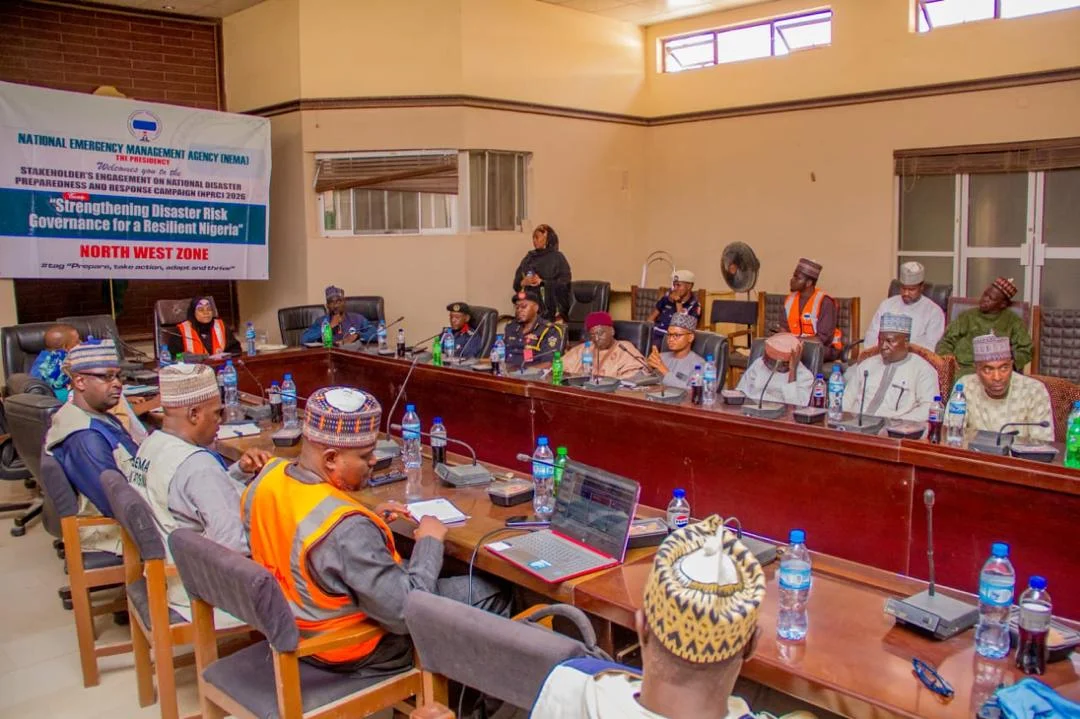
The National Emergency Management Agency on Monday held a stakeholders’ engagement and community outreach in Katsina as part of the 2026 National Preparedness and Response Campaign on flood and related hazards.
The exercise aimed to strengthen disaster risk governance and build resilience against flood-related disasters ahead of the 2026 rainy season.
Participants included officials of the Katsina State Emergency Management Agency, ministries, departments, agencies, security agencies, humanitarian organisations, traditional institutions, women and youth groups, community representatives, and the media.
The report indicated that NEMA has developed the 2026 Climate-Related Risk Management, Preparedness and Mitigation Framework to guide national efforts, focusing on capacity building, simulation exercises, and community evacuation planning.
NEMA Director-General Zubaida Umar expressed concern over the recurring impact of flooding nationwide, citing the 2026 Seasonal Climate Prediction by the Nigerian Meteorological Agency and the 2026 Annual Flood Outlook by the Nigeria Hydrological Services Agency.
SEMA Executive Secretary Binta Hussaini-Dangani commended the timely intervention, noting that the state has already begun direct community sensitization, particularly in areas near the Kwanar Are Dam which is currently operating at full capacity.
The Issues
- Critical water infrastructure, such as the Kwanar Are Dam in Rimi Local Government Area, is already at maximum containment capacity before the peak of the rainy season, threatening nearby agricultural communities.
- Translating scientific meteorological forecasts into actionable, localized evacuation plans for rural residents remains difficult due to limited rural communication channels.
- Local emergency management boards face recurring resource constraints when trying to preposition adequate relief materials across widely scattered flood-prone territories.
What’s Being Said
- NEMA Director-General Zubaida Umar noted that the campaign’s theme: “Strengthening Disaster Risk Governance for a Resilient Nigeria,” highlights the need for stronger institutions, proactive collaboration, and clear responsibilities in disaster management.
- “The framework focuses on reducing flood impact through capacity building, simulation exercises, infrastructure assessments, prepositioning of relief materials, and community evacuation planning,” Umar stated.
- SEMA Executive Secretary Binta Hussaini-Dangani commended NEMA for the timely engagement, stating that flooding remains “a recurring challenge in Katsina” while praising Governor Dikko Radda for supporting past containment efforts.
What’s Next
- NEMA and SEMA officials will establish emergency monitoring posts around high-risk dams to track daily water spill levels and provide early warnings to farmers.
- Humanitarian organizations will collaborate with local government councils to identify and secure safe high-ground centers for temporary community displacement.
- Technical teams will proceed with structural infrastructure assessments along vulnerable drainage channels to minimize urban flash flooding risks.
Bottom Line
NEMA’s activation of its 2026 flood mitigation framework in Katsina underscores an urgent push for institutional synchronization and proactive structural checks on full-capacity dams before seasonal rains trigger predictable humanitarian emergencies.