






Op-Ed By Angela Aminone
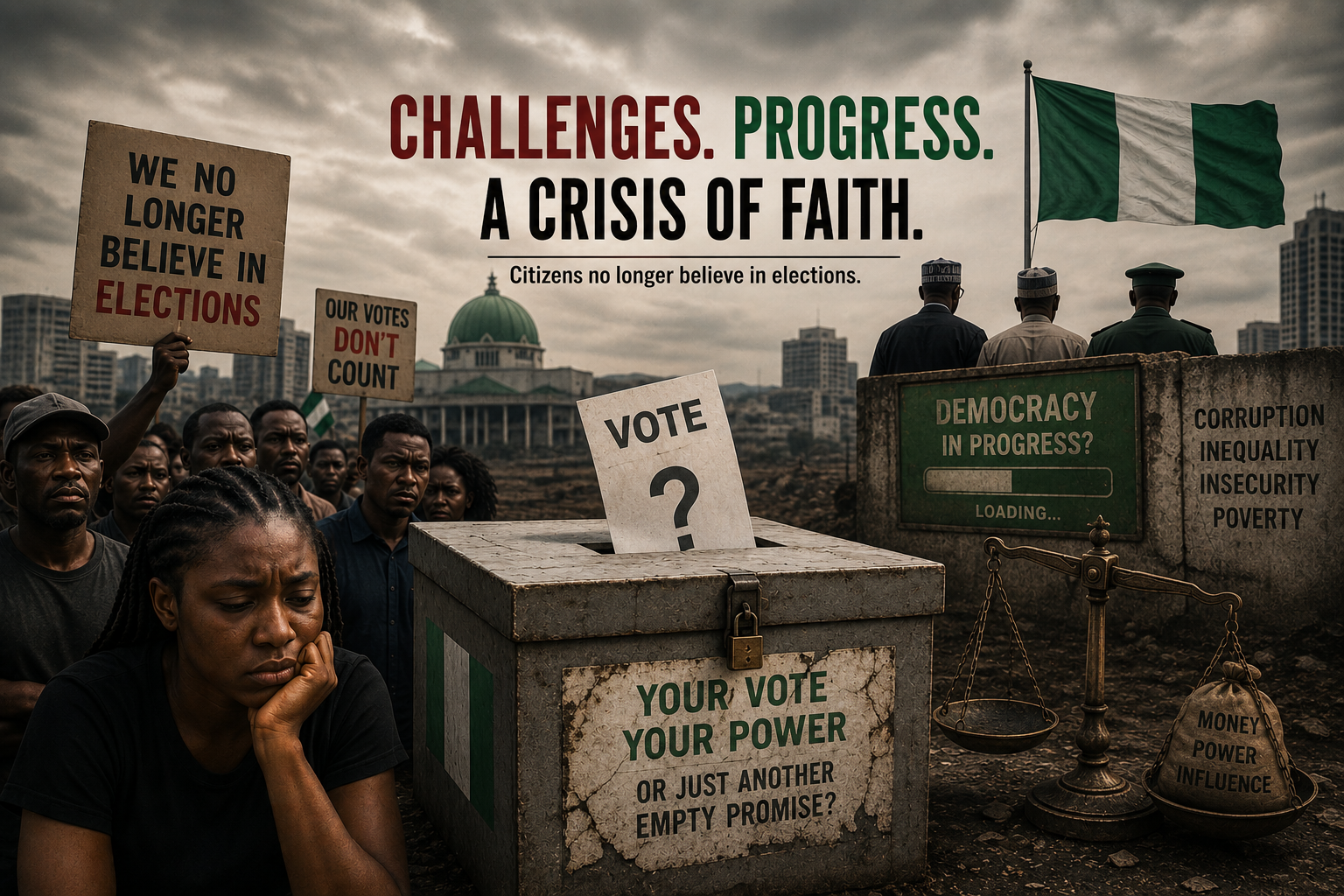
Can a country truly be called democratic if its citizens lose faith in elections?
A 21-year-old girl, when asked why she did not have a voter’s card, responded that it did not matter whether she voted or not, because “it doesn’t count, and whoever wants to be president will still become president.” This shows that a significant number of Nigerians do not process voter cards and participate in the electoral process.
Similarly In a recent statement, former President Goodluck Jonathan reportedly said people are begging him to contest for the 2027 election but they don’t have voters’ card. He said, “probably 50 percent of you don’t even have your voter’s card, and you’re asking me to go and contest the election.” He explicitly urged young Nigerians to obtain their voter cards and participate in elections process.
Additionally a significant number of Nigerians do not have faith in elections anymore because of electoral malpractice that has been going on in the country . Leaders are now giving the people fake manifestos and also bribing electoral officers to gain a specific position, leading to the low participation in the electoral process and the acquiring of voter’s card.
However, in a statement made by President bola Ahmed Tinubu during the APC presidential primary campaign in 2022, at Ogun State while seeking support for his presidential ambition, argued that he had played a major role in helping former President Muhammadu Buhari come to power, and now it was his turn to rule.
Certainly, this simply means that he has helped a lot of politicians in becoming who they are, and he even made the former president – Muhammadu Buhari become the president as at 2015 and now it’s his own turn to come to power.
Moreover, this statement sparked a wide reaction from the people up till date, people were stating that Nigeria is no longer a country for the people and that leaders are now chosen by selection not election, it’s no longer of the people neither by the people. In a video posted by a social media influencer online commenting on this issue he stated that leadership shouldn’t be about turn but competence, capacity and great results – leading to the question a lot of Nigerians have been asking “is Nigeria truly a Democratic country”?
Firstly, Nigeria can be described as a democratic state, but one that is still working to strengthen its democratic institutions and practices. Democracy is not just about holding elections; it is also about ensuring that elections are free and fair, the rule of law is respected, and the government remains accountable to citizens.
In addition, this system was adopted in Nigeria in order for citizens to choose their leaders through elections rather than making leaders take power by force, prevent the concentration of power in a single individual or institution, provide public service and development, maintain orders and also lead to a peaceful transfer of power without risk or political instability.
Nigeria’s current democratic system began on 29 May 1999, when military rule ended and Olusegun Obasanjo was sworn in as president. This period is known as the Fourth Republic, and Nigeria has remained under democratic rule since then, but the system has been undergoing different challenges such as electoral malpractice, corruption, vote buying, and weak accountability which have been affecting the quality of its democracy.
Conversely, the country has been facing these challenges since the year 2003 which was the first general election after Nigeria returned to civilian rule in 1999, the main presidential candidates were incumbent President Olusegun Obasanjo of the People’s Democratic Party (PDP) and Muhammadu Buhari of the All Nigeria Peoples Party (ANPP).
During the election, Human Rights Watch reported that violence, intimidation, and election fraud were recorded in some areas, and that dozens of people were killed during the election period.
Similar occurrences have been happening till date, corresponding with the 2023 election between the two main presidential candidates Peter Obi from the Labour Party (LP)and Bola Ahmed Tinubu of the All Progressives Congress (APC).
Nigerians are looking forward to the upcoming election of 2027, with a growing expectation for improvement in the democratic process. However, meaningful changes will depend on increased political participation, especially among young people, through voter registration and active engagement in elections.
The author is a 200 level journalism student from Delta State University Abraka.