







Key points
- A fresh IED attack kills a commanding officer and six soldiers in Borno.
- Presidency defends controversial airstrike amid claims of civilian casualties.
- Political leaders demand investigation, improved military capacity, and decisive action.
Main story
Nigeria’s fragile security landscape has come under renewed strain following fresh insurgent attacks on troops and mounting controversy over a recent airstrike in the North-East, intensifying pressure on the Federal Government.
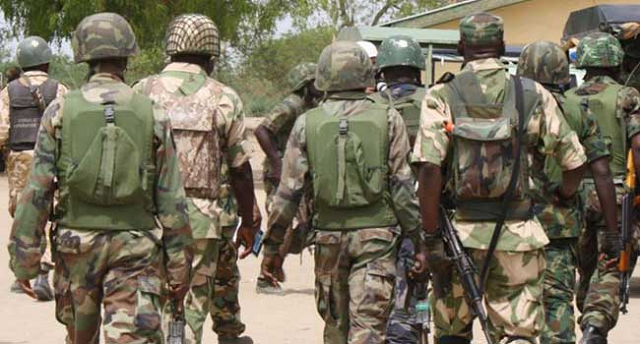
The situation escalated after a deadly improvised explosive device (IED) attack in Monguno, Borno State, claimed the lives of a Lieutenant Colonel, I.A. Mohammed, and six soldiers of the 242 Battalion.
The incident comes barely days after the killing of Brigadier-General Oseni Omoh Braimah on a military formation in Benisheikh on April 9.
Confirming the latest attack, Operation Hadin Kai spokesperson, Lt-Col Sani Uba, said troops came under heavy fire before an Army gun truck struck a planted IED. The commanding officer, who moved to assess the situation, was killed alongside six personnel after encountering another explosive device.
Uba described the officer’s actions as a demonstration of courage and commitment to duty, noting that the fallen soldiers’ sacrifices would remain etched in national memory.
Amid rising casualties, President Bola Ahmed Tinubu convened an emergency security meeting with service chiefs and heads of intelligence agencies at the State House, Abuja.
The high-level meeting brought together top security officials, including the Chief of Defence Staff, General Olufemi Oluyede, service chiefs, and intelligence heads, as concerns mount over the country’s deteriorating security environment.
The issues
The crisis has been compounded by international concern following a security advisory issued by the United States Department of State, warning of a worsening security situation in Nigeria.
The advisory placed several Nigerian states under its highest risk category, citing threats ranging from insurgency in the North-East to banditry and violent crimes across other regions.
Domestically, the fallout from a Nigerian Air Force airstrike in Jilli, along the Borno–Yobe axis, has triggered widespread concern, with reports suggesting significant civilian casualties, although military authorities have yet to confirm the figures.
What’s being said
The Presidency has defended the airstrike, insisting it targeted insurgent positions. Presidential aides argued that the location, widely referred to as Jilli Market, had been overtaken by Boko Haram and ISWAP elements and functioned as a logistics base.
They also criticised comments by Atiku Abubakar, accusing him of politicising a military operation and undermining troop morale.
However, former Senate President Ahmad Lawan called for an independent investigation into the incident, urging transparency, medical support for victims, and compensation for affected families.
Similarly, Peter Obi described the incident as a wake-up call, advocating increased investment in modern military equipment, improved coordination, and enhanced training.
Senator Ali Ndume also urged urgent intervention, describing the insurgency as an evolving crisis driven by both ideology and criminal enterprise.
The Federal Government, through the Minister of Information, Mohammed Idris, dismissed the U.S. advisory as routine, maintaining that most parts of the country remain stable despite isolated incidents.
What’s next
Security forces have vowed to sustain offensive operations against insurgents, with recent reports indicating that troops neutralised four fighters and rescued three abductees in Borno State.
Meanwhile, calls for an independent probe into the airstrike are expected to intensify, alongside growing demands for reforms in Nigeria’s security architecture.
The Federal Government is also under pressure to strengthen military capacity, improve intelligence coordination, and reassure both citizens and international partners of its ability to manage the crisis.
Bottom line
With rising troop casualties, contested military operations, and increasing political scrutiny, Nigeria’s security challenges are entering a critical phase, testing the Federal Government’s strategy and resolve to restore stability.