






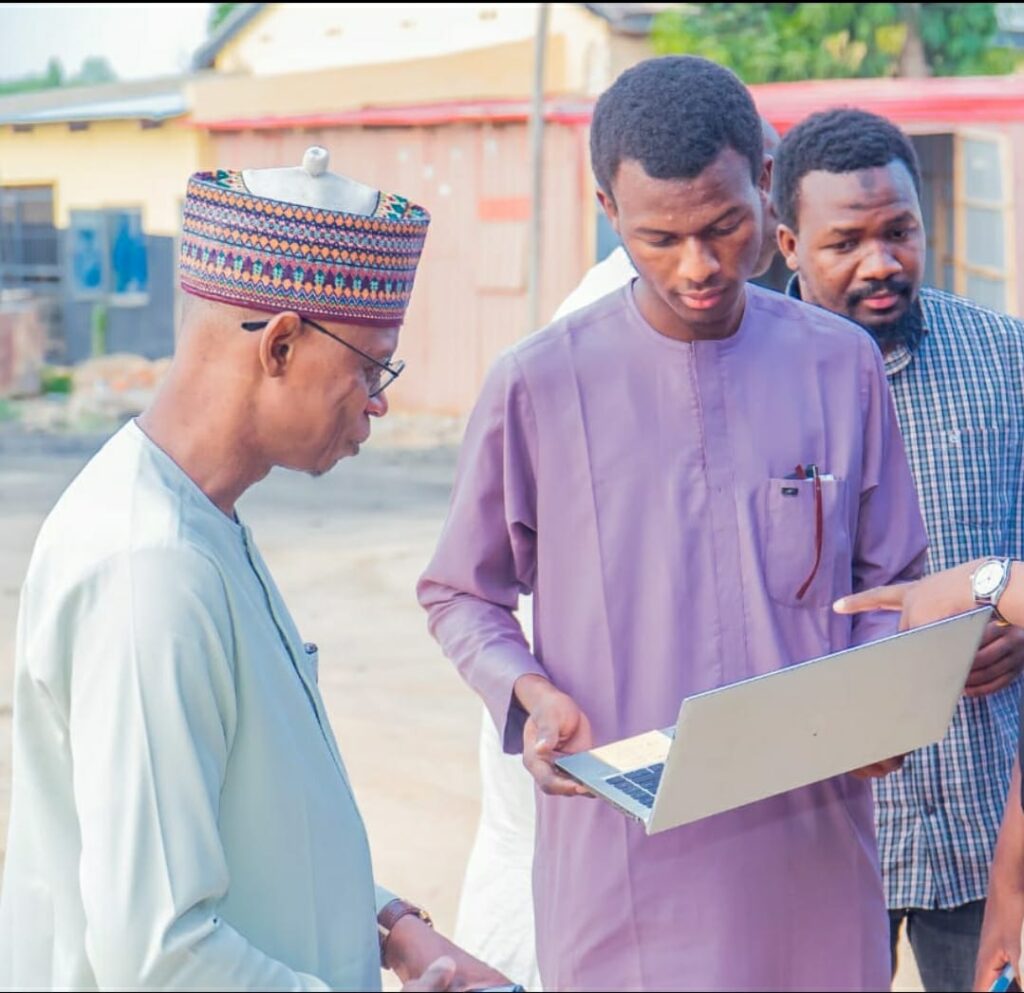
At 19, while many young Nigerians are still deciding what career path to follow, Ishaq Jamilu is already designing one of the technologies that could shape the future of transportation.
From Kusada Local Government Area of Katsina State, the young automotive enthusiast has attracted international attention with a self-developed electric vehicle concept designed around one central idea: electric mobility should not be a luxury reserved for the wealthy.
Jamilu’s design was recently recognised by the International Art Magazine Japan, which featured his project in an article titled “Revolutionising Affordable Electric Vehicles: Reducing Costs Without Sacrificing Performance.” For a teenager who acquired much of his knowledge through the internet, technical drawings and hands-on mechanical work, the recognition has become both a personal milestone and a statement about what young Nigerian innovators can achieve with limited resources.
An idea born from curiosity
Jamilu said his fascination with automobiles began at an early age. Rather than waiting for formal training before experimenting with vehicle design, he turned to the internet, where he studied automotive engineering concepts, vehicle structures and design techniques.
His learning process was largely practical.
He experimented with technical drawings, explored 3D modelling and gained experience working as a vehicle mechanic. That combination gave him an unusual advantage: he was not looking at vehicles only as objects to be drawn on a computer or paper, but also as machines that must function in the real world.
“I have always been passionate about automobiles. I started learning by myself through the internet, studying vehicle designs and practising through drawings and 3D modelling.”
His mechanical experience, he added, helped him understand the difference between an attractive design and one that could potentially become a functional vehicle.
Designing for affordability
The electric vehicle concept that brought him international attention is built around affordability.
Electric vehicles are increasingly being promoted globally as an alternative to conventional petrol and diesel-powered cars because of their potential to reduce emissions and dependence on fossil fuels. But in many developing economies, high acquisition costs, charging infrastructure limitations and battery expenses remain significant barriers to widespread adoption.
Jamilu’s approach attempts to address one of those barriers: cost.
His concept seeks to reduce production expenses without eliminating the features that make electric vehicles practical. The proposed design includes a compact body structure, efficient use of interior space, a user-friendly cabin and features intended to improve energy conservation.
“The recognition has encouraged me to work harder, improve my skills and pursue my dream in automotive design.”
The project remains a concept rather than a commercially manufactured electric vehicle. But its importance lies in the problem it is attempting to solve and in the young designer’s effort to develop a locally informed approach to future mobility.
When Katsina met Japan
The moment Jamilu discovered that his work had attracted attention outside Nigeria was, by his own account, unexpected.
He had shared his automotive designs on social media, using the platform to showcase his work and connect with other people interested in vehicle design. The attention eventually reached the International Art Magazine Japan.
For Jamilu, the recognition carried significance beyond the publication itself.
“I was very happy and surprised that a project I developed through self-learning in Katsina could attract the attention of an international art magazine in Japan.”
The journey from Kusada to an international publication also illustrates the changing geography of innovation. A young person working largely outside Nigeria’s traditional technology and automotive centres can now use digital platforms to display an idea to a global audience.
But recognition, Jamilu knows, is not the same as completion.
From concept to the workshop
His next challenge is turning his ideas into physical prototypes.
Jamilu said he wants to study automotive design formally and receive professional training that will deepen his understanding of engineering, manufacturing and vehicle development. He also needs access to specialised equipment and mentorship.
“I want to study automotive design professionally, gain more knowledge and acquire the skills and equipment required to turn my concepts into functional vehicles.”
That transition—from designing on paper and through digital models to engineering a roadworthy prototype—is where many promising ideas encounter their greatest obstacles.
A successful electric vehicle requires expertise across several fields, including battery systems, electric motors, electronics, vehicle dynamics, safety, materials, software and manufacturing. It also requires testing and resources that are often difficult for individual young innovators to access.
Jamilu’s ambition is therefore dependent not only on talent, but also on whether institutions and industry players can provide a pathway from innovation to practical development.
The Peugeot 406 experiment
His interest in redesigning vehicles did not begin with the electric vehicle concept.
One of his earlier projects involved modifying and redesigning a Peugeot 406 Sedan, an exercise that allowed him to combine his mechanical experience with his interest in automotive styling and engineering.
The project demonstrates the way his learning has evolved: from observing vehicles, to repairing them, to imagining how they could be redesigned.
That progression is particularly important because automotive design is both artistic and technical. A designer must consider appearance, ergonomics and user experience while understanding how the underlying vehicle systems constrain what can actually be built.
For Jamilu, the workshop has become part of his classroom.
A bigger message for Nigerian youths
Beyond the electric vehicle itself, Jamilu’s story raises a broader question about the country’s approach to youth innovation.
Nigeria has a large population of young people with access to smartphones, computers and online educational resources. Yet access to advanced laboratories, fabrication equipment, technical mentorship and structured innovation programmes remains uneven.
Jamilu believes the gap between ideas and execution can be narrowed if young innovators receive the right support.
“I believe many Nigerian youths have great ideas, but they need encouragement, mentorship, training and access to modern equipment.”
His appeal extends to government agencies, private organisations and individuals to invest in specialised training, mentorship and opportunities for young people to develop their ideas.
Beyond recognition
For now, the 19-year-old’s electric vehicle remains a concept.
But the recognition from Japan has given him something perhaps more valuable than publicity: validation that an idea developed in Katsina can enter an international conversation about the future of mobility.
His immediate goal is to acquire formal training, improve the design and eventually develop functional vehicles.
His longer-term ambition is bigger—to become a professional automotive designer and contribute to affordable and environmentally friendly transportation in Nigeria.
The significance of Jamilu’s story, ultimately, may not be that a teenager from Katsina has designed an electric car.
It is that he has demonstrated how curiosity, digital learning, mechanical skills and determination can turn a young person’s fascination with automobiles into an idea capable of crossing borders.
The journey from a sketch to a working electric vehicle is still a long one. But for Jamilu, the road has already begun—and it started not in a major automotive laboratory, but in Kusada, Katsina State.