





For several weeks, the contents of a 20-foot container at the Tin Can Island Port in Lagos remained hidden in plain sight.
The container had arrived aboard MV Velika on July 8, 2026, carrying what appeared to be ordinary cargo. But the Nigeria Customs Service’s risk-management system flagged it for examination. What followed was not merely another seizure at Nigeria’s busiest maritime gateway. It was the unravelling of a consignment containing hundreds of firearm components that, if successfully released into the country, could have added significantly to the arsenal available to criminal networks.
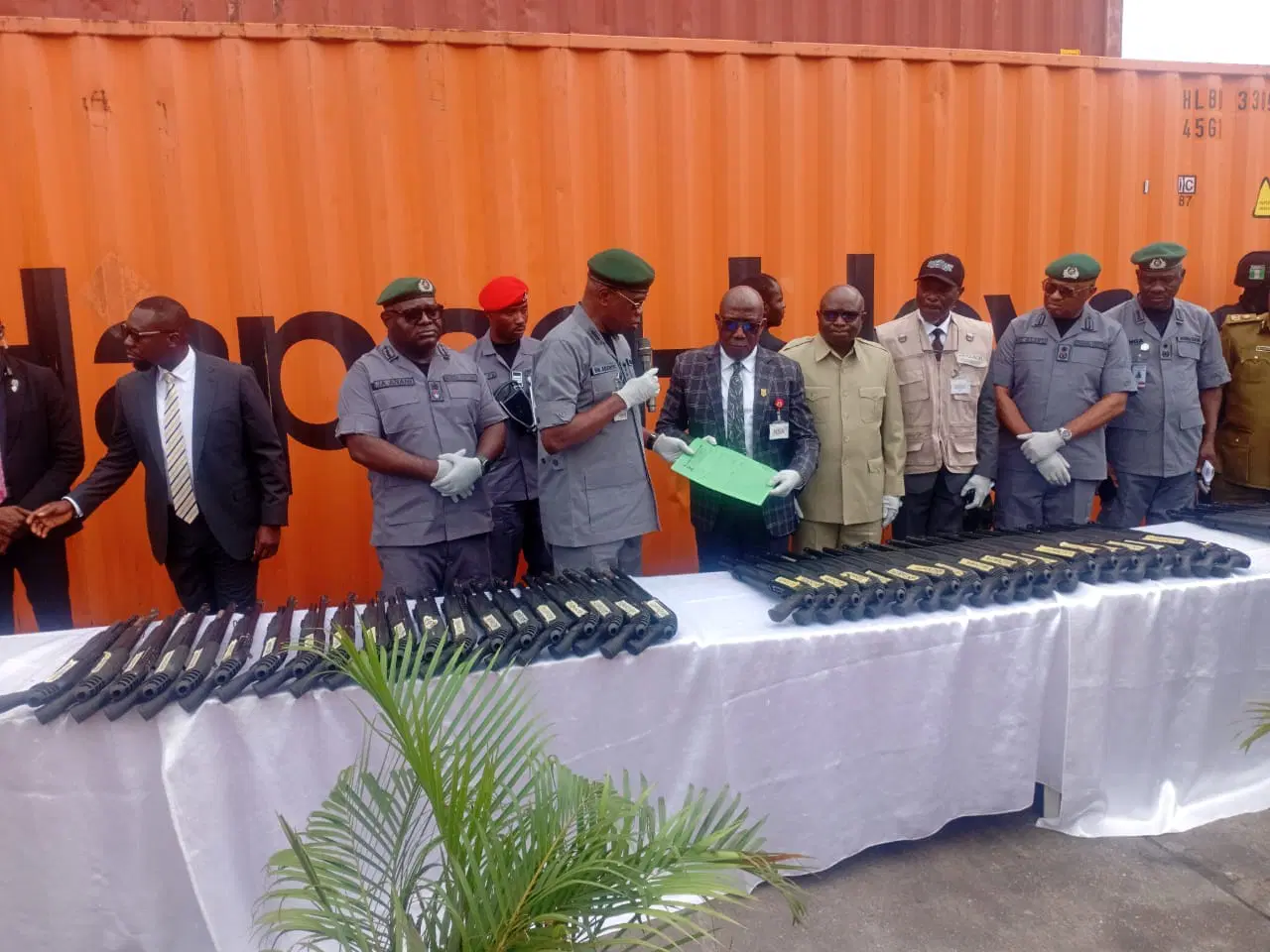
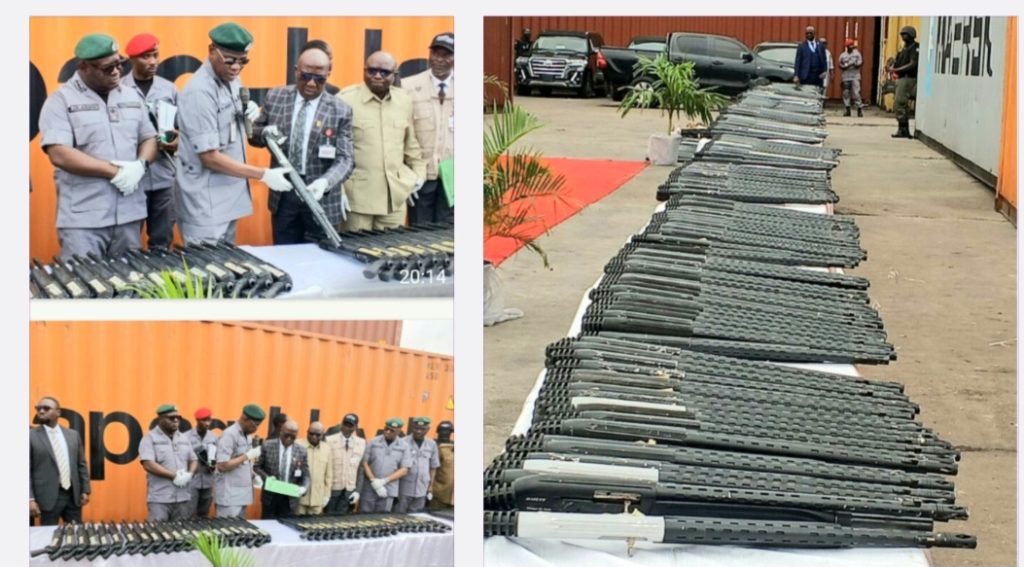
When Customs completed the physical examination and reassembled the components, the scale of the discovery became clearer: 399 fully assembled Jojef pump-action rifles and 535 assorted firearm components.
The seizure has since moved beyond the port’s walls. On August 17, the Nigeria Customs Service formally handed the weapons over to the National Centre for the Control of Small Arms and Light Weapons (NCCSALW), transforming what began as a Customs enforcement operation into another chapter in Nigeria’s wider battle against the circulation of illicit firearms.
According to the Comptroller-General of Customs, Bashir Adewale Adeniyi, MFR, the container was not opened due to a random suspicion or an officer’s chance observation. It was selected because the Service’s intelligence-driven risk-management system flagged it for inspection.
For Customs, the operation illustrates how the modernisation of cargo screening is changing the way the Service approaches enforcement. Rather than physically examining every container, risk-management systems allow officers to identify consignments considered more likely to contain prohibited or suspicious goods.
In this case, the firearms had allegedly been dismantled and concealed in knocked-down form, a method that could make them less immediately recognisable during cargo examination. It was only after detailed inspection and subsequent coupling of the components that the true scale of the shipment emerged.
The recovered components reportedly included 89 frames, 80 charging handles, 57 trigger groups and 25 locking lugs, alongside other parts.
The significance of those figures goes beyond the arithmetic. In a country confronting kidnapping, banditry, terrorism and other forms of armed violence, every firearm prevented from entering an illicit supply chain represents a potential threat removed before it can reach a criminal group.
The people behind the shipment
The investigation has also moved from the cargo to the people allegedly connected with it.
Customs identified Robert Eze and Ejiogu Godson as suspects arrested in connection with the consignment. One of them was reportedly arrested on July 31 at a bonded terminal while allegedly attempting to facilitate the release of the container. Both suspects were subsequently remanded by the Federal High Court in Lagos, with their arraignment scheduled for August 25, 2026. For investigators, the seizure therefore represents only the first layer of the case.
The larger questions are who financed the consignment, who arranged its shipment, who expected to receive the weapons, where they were ultimately intended to go, and whether the shipment forms part of a broader trafficking network.
Those questions are crucial because arms trafficking rarely ends with the person standing at the port. Behind a shipment can be a chain involving financiers, importers, intermediaries, clearing agents, transporters and final recipients.
The Customs investigation, therefore, has the potential to reveal much more than the contents of one container.
Why the timing matters
The seizure has also acquired a political and security dimension because of the approaching electioneering period.
Adeniyi warned that the country could not afford to allow ports and borders to become channels through which weapons enter the country, particularly at a time when political activity is expected to intensify.
“We will not allow the ports and the borders of this country to be used to bring in arms or anything else that threatens the safety of Nigerians,” the Customs chief said, promising stronger intelligence, risk-management systems and cooperation with sister security agencies.
His warning speaks to a longstanding Nigerian security problem: weapons that enter the country illegally can move far beyond the point of entry, eventually finding their way into communities where they can be used for kidnapping, banditry, communal violence, armed robbery and other crimes.
The European Union Agency for Asylum, in its January 2026 assessment of Nigeria’s security situation, described banditry as encompassing armed robbery, murder, kidnapping, cattle rustling and attacks on communities, with violence spreading from the North-West and North-Central regions to other parts of the country.
This makes the prevention of arms trafficking at ports and borders a critical part of the security response, rather than simply a Customs enforcement issue.
The bigger Nigerian arms problem
The 399 rifles are not an isolated discovery.
The NCCSALW, established in 2021 as Nigeria’s national authority for controlling small arms and light weapons, has repeatedly described illicit weapons proliferation as a significant driver of insecurity.
In April 2026, the Centre destroyed 2,800 illicit, obsolete, unserviceable and decommissioned small arms and light weapons, saying it had destroyed more than 16,000 weapons since its establishment. The exercise was presented as part of a broader effort to reduce the circulation and misuse of illicit firearms.
The Centre’s mandate is particularly important because confiscating a weapon is only one part of arms control. Seized firearms must be properly documented, profiled, secured and ultimately either authorised for legitimate security use or destroyed where they are illegal, obsolete or unserviceable. That is why the handover at Tin Can Port matters.
The weapons are no longer simply items seized by Customs. They have entered the custody of the national institution responsible for managing the country’s response to illicit small arms.
From Customs seizure to national security asset
Receiving the weapons, the Director-General of NCCSALW, DIG Johnson Babatunde Kokumo (Rtd.), commended Customs for what he described as its professionalism and continued collaboration with the Centre.
He said the firearms would be handled in accordance with Nigerian law and international best practices.
The Centre is expected to catalogue, profile and document the recovered weapons and components. Serviceable weapons required for authorised state security purposes will be properly accounted for, while obsolete, illegal and unserviceable weapons will be destroyed.
That process is more significant than it may initially appear.
The latest seizure also fits into a broader pattern of major arms interceptions by Customs.
In 2024, the Service intercepted a 40-foot container at Onne Port containing 844 firearms and 112,500 rounds of live ammunition, including hundreds of Jojef pump-action rifles. The NCCSALW subsequently took custody of the weapons.
More recently, Customs handed over another batch of prohibited firearms and ammunition to the NCCSALW, demonstrating that the two agencies are increasingly operating as complementary links in the national arms-control chain.
The NCCSALW has said it has received thousands of weapons from Customs since its establishment, while recent reports put the total at more than 21,000 firearms and weapons handed over by the Service.
The recurring appearance of firearms in maritime consignments raises a fundamental question: how many shipments are being attempted, and how many successfully evade detection?
There is no evidence from the present seizure alone to determine the answer. But the pattern demonstrates why intelligence, technology, cargo profiling and inter-agency cooperation remain essential.
The weapon that never reached its target
Adeniyi offered perhaps the simplest way to understand the significance of the seizure.
“Look carefully at what is laid out on these tables. 399 rifles. Somebody paid for them. Somebody arranged their shipment. Somebody was waiting at this end to collect them. And somebody, somewhere in this country, was going to be on the wrong end of them,” he said.
Those words shift the conversation from the spectacle of a weapons display to its human consequences. The rifles were not dangerous merely because they existed. Their danger lay in the possibility of where they would eventually end up and who might have used them.
For a country where armed criminality continues to threaten communities and livelihoods, stopping a firearm before it reaches its intended destination is arguably more valuable than recovering it after it has been used.
The 399 rifles therefore represent more than a successful Customs seizure. They are evidence of an increasingly sophisticated contest between criminal networks seeking to exploit Nigeria’s trade infrastructure and security agencies attempting to close those channels.
The immediate victory belongs to the agencies that stopped the shipment. For now, 399 rifles have been taken out of the equation.