





By Boluwatife Oshadiya│ October 27, 2026
Key Points
- Offers three trims, Performance, Thrust and Rocket, with deposits of $50,000 and $250,000 and an invite-only top tier
- Fires 10 cold-gas thrusters fed by 600 litres of compressed air to hop, flip and land rather than fly
- Targets 2028 production at Giga Texas, with final pricing, battery capacity and independent testing still outstanding
- Carries a “not approved for public road use” label on the Rocket trim, while the FAA says the car is not an aircraft
- Raises open questions on driver size, weight balance, public safety, crime and whether the world is ready for such cars
Main Story
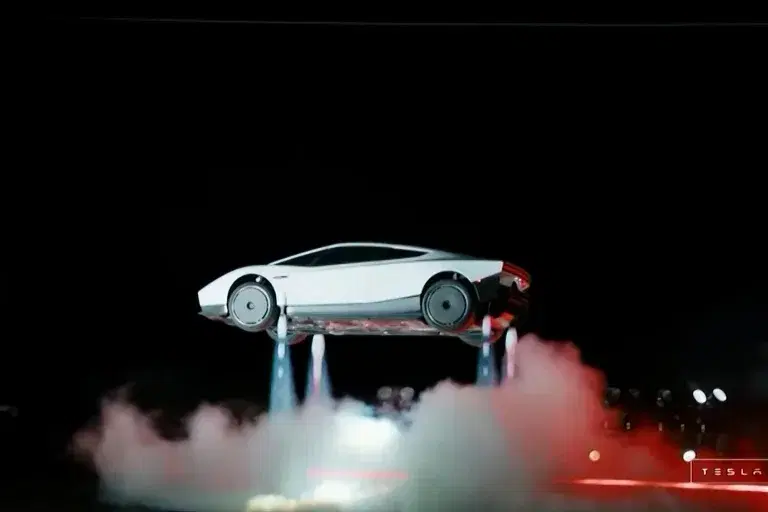
Tesla unveiled the production-intent second-generation Roadster on October 15, 2026, at a SpaceX facility near McGregor, Texas, using SpaceX cold-gas thrusters to make the electric hypercar hop, flip and land.
Elon Musk, Tesla’s chief executive, called it “the best of the last of the human-driven cars,” according to TechCrunch. Tesla says production will start in 2028 at Giga Texas, more than a decade after it first showed a next-generation Roadster, Reuters reported.
During the demonstration, a driverless Roadster with a mannequin in a SpaceX spacesuit in the driver’s seat drove up an inverted ramp using a suction system, rotated in the air and landed. It later jumped a line of Tesla vehicles, including a Cybercab, a Cybertruck, a Semi cab, a Model Y and a Model 3, TechCrunch reported.
Every figure below is a Tesla claim or an engineering target from the reveal and later interviews, including those with Lars Moravy, Tesla’s Vice President of Vehicle Engineering. No independent testing has taken place.
What has changed since the 2017 concept?
Tesla first showed the Roadster in 2017 with far more optimistic claims: 0–60 mph in 1.9 seconds, a top speed above 250 mph, 620 miles of range, 2+2 seating and a starting price of about $200,000. Range and seating have since been revised downward, while acceleration has been revised upward through the thruster system.
Musk first floated thrusters in 2018, writing on Twitter that a “SpaceX option package” would include about 10 small rocket thrusters arranged around the car, TechCrunch noted. The reveal itself was first set for October 1 and moved to October 15 after weather delays.
What are the three versions, and what do they cost?
What was once called the “SpaceX Package” is now split into three configurations. Some sources also mention a possible base variant below the Performance trim, but Tesla’s messaging centres on these three.
| Performance (“Road Ready”) | Thrust (“Race Ready”) | Rocket (“Air Ready”) | |
| 0–60 mph | Under 1.6 seconds | Under 0.9 seconds (0.81 shown) | Under 0.6 seconds (0.59 target) |
| Top speed | Over 200 mph (reports range from 210 to 230+) | Over 230 mph | Over 230 mph claimed; Musk targets about 380 mph (half the speed of sound) |
| Seats | Two | Two | One |
| Thrusters | None | Rear-mounted | 10, around the car |
| Road status | Primary road-legal version | Limited release; depends on local law | Not approved for public road use |
| Reservation | $50,000 deposit | $250,000 deposit | Invitation only |
All three target more than 300 miles of range, with real-world estimates often cited at 310 to 320 miles. Final pricing has not been announced. The deposits hold a place in line and are not the purchase price.
How does a reservation work?
- Performance: $5,000 is due immediately by credit card, and $45,000 by wire transfer within 10 days. The reservation is not final until the wire clears, and missing the window cancels it.
- Thrust: a $250,000 deposit, reportedly in the same two-step structure scaled up.
- Rocket: not open to the public; Tesla invites buyers.
According to the agreement terms reported after the reveal, deposits are fully refundable and non-transferable. Tesla cannot guarantee when, or if, a car will be delivered, any price shown is an estimate, and specifications can still change. How older 2017 deposit holders fit into the new trims has not been fully explained. Amounts vary by region, including in the UK and UAE. BizWatch Nigeria found no Tesla statement on reservations in Nigeria.
How do the “turbo” thrusters work?
There is no traditional turbocharger. Electric pumps compress up to 600 litres of air, about 250 kilograms, into composite-overwrapped pressure vessels (COPVs), Space.com reported. Tesla and Moravy have described pressures of up to about 10,000 psi. Cold-gas thrusters then release that air through aerospace-grade nozzles. Nothing burns, so there is no rocket fuel and no flame.
Tesla says the system can generate four to five times the force the tyres can transmit and more than 80 kilonewtons of thrust in launch mode. Capacity is roughly 200 litres for the Thrust trim’s rear thrusters, with the Rocket adding about 400 litres by replacing the passenger-seat area. Reports differ on whether the gas is air or nitrogen: Moravy has referred to nitrogen, while Musk has stressed air. A full charge gives only short bursts of about five to six seconds, InsideEVs reported.
Can it really fly?
Not in the way most people imagine. This is not a winged flying car. It is a vehicle capable of controlled, thrust-powered jumps and brief aerial manoeuvres.
The Rocket trim has 10 nozzles around the front, rear and sides. They work as attitude-control thrusters, as on a spacecraft, firing up, down or sideways to stabilise the car in the air, hop obstacles and perform flips or barrel rolls. Ultra-fast electric actuators adjust the gas release on a millisecond scale so the car lands on its wheels.
The limits are clear: short duration, low altitude and a stunt-oriented demonstration. Roger Connor, a curator at the Smithsonian’s National Air and Space Museum, told CNN the demonstration was not sustained flight, adding that it was “literally” hopping, according to International Business Times UK.
What is the 2g suction system?
The thrusters rely on a multi-mode floor suction fan system. Inspired by the 1970s “fan cars”, it vacuums air from beneath the chassis and can pull up to 2g of downforce, even at low speed or standstill in some modes. That is what let the car cling to an inverted ramp in the demonstration.
The electric motors produce more torque than the tyres can hold, so the suction presses the car into the road and lets it corner without sliding. Moravy said the active aerodynamics can generate downforce equal to twice the car’s weight above 200 mph, but the wings lose effectiveness below about 50 mph, according to a Deep News summary of his comments. Tesla’s peak-load figures reach about 5g with thrusters.
Does the self-recharging air tank really work?
Partly. Musk said at the reveal that the car can refill its own tanks with air, with no special propellant. Current prototypes fill from an external high-pressure supply, which takes two to six hours, with a target of under 30 minutes.
The production car appears to include an onboard system, likely a battery-powered compressor. Tesla has not disclosed its power draw, heat management, noise or real-world refill time. Refilling would draw energy from the main battery, and thrust empties the tanks far faster than any onboard compressor could refill them. The claim is real as a capability but is not a continuous process that keeps the thrusters ready for repeated use.
What powers it, and how fast does it charge?
- Drive: Rear-wheel drive only, a deliberate choice for what Moravy called a very direct, emotionally rich driving experience. Two motors, each with its own inverter, and no differential. Torque vectoring comes through roughly 8.4:1 planetary gearsets.
- Output: Over one megawatt (about 1,341 hp) and more than 1,400 Nm of torque. That is more power than a Model S Plaid’s three motors, at roughly half the drive-unit mass.
- Battery: Custom high-power 4680 cells in the 800–1,000 volt class. Capacity is not finalised, though estimates exceed 100 kWh.
- Charging: Tesla claims a peak of about 500 kW, or 15 to 80 percent in around 10 minutes on a V4 Supercharger. The charge port sits behind the active rear wing.
- Weight: Under 1,700 kilograms (about 3,700 lb), using magnesium, titanium, aluminium and carbon fibre to offset the weight of the air tanks.
How does steer-by-wire cope at extreme speed?
The Roadster is fully by-wire: steering through a yoke, plus brake-by-wire and throttle-by-wire, with no mechanical steering column. Computers command electric actuators at the wheels.
Steering ratio changes with speed, quicker at low speed and more damped at high speed, similar to systems already on the Cybertruck. It works with the suction fans, active aerodynamics, rear-motor torque vectoring and, on upper trims, the thrusters for yaw control. Above 200 mph the aerodynamics shift toward low-drag modes while software makes rapid micro-corrections. Redundant sensors and actuators are expected, but Tesla has released few Roadster-specific details and no technical papers on high-speed calibration.
What is inside the cabin?
The cockpit is stripped back to save weight. Seats are moulded into the structural tub, and the centre screen, slim displays, minimal manual controls and steer-by-wire yoke sit in front of the driver. Wireless phone charging and heated seats are listed, with cooled seats less certain. Roof panels are removable for open-air driving, and storage is minimal once thruster tanks are fitted. The doors are scissor or butterfly type.
Is the car suitable for everyone, whatever their shape and size?
That cannot yet be confirmed. Tesla has not published interior dimensions, headroom or occupant weight limits. What is known is that the seat base is fixed, according to Moravy’s comments as summarised by Deep News, with the driving position set by a movable pedal box and an adjustable backrest angle. The steering column also moves toward the driver, and the design is described as a fixed-seating-position “pilot’s car”.
The body is a low two-door coupe about 79 inches wide with a 111.2-inch wheelbase, per Wikipedia’s summary of Tesla’s figures. The Rocket trim has one seat, because the passenger-seat area holds extra gas tank. Tesla also has not said what loads of up to about 5g mean for occupants of different sizes or health. Until Tesla publishes dimensions and limits, tall, large or medically vulnerable buyers should not assume a fit.
Does weight distribution affect performance?
It almost certainly matters, but Tesla has not published a front-to-rear weight split. What it has said points to a rear-biased design: rear-wheel drive with torque placed behind the driver, thruster tanks packed into every usable void, and a Rocket trim that replaces the passenger area with about 400 extra litres of storage.
The 250 kilograms of compressed air is roughly 15 percent of the 1,700-kilogram weight target, though Tesla has not said whether the target includes full tanks. BizWatch Nigeria notes that because compressed air has mass, the car’s balance would shift as tanks empty during a thruster burst, an effect Tesla has not discussed. Tesla’s approach leans on suction downforce and thrust for grip, not on weight over the driven wheels, and on fast actuators to steady the car in the air.
Quick glossary
- Cold-gas thruster: a nozzle that releases stored compressed gas to push a vehicle, with no combustion
- COPV: composite-overwrapped pressure vessel, a lightweight high-pressure tank also used on SpaceX’s Falcon 9 and Falcon Heavy rockets
- Steer-by-wire: steering controlled electronically, with no mechanical link to the wheels
- Torque vectoring: sending different power to each wheel to help the car turn
- kN: kilonewton, a unit of force; 80 kN is roughly 8 tonnes of force
The Issues
Why is the flying version not road legal?
Tesla’s Roadster page says the Rocket is “not approved for public road use.” In the United States a car must meet the National Highway Traffic Safety Administration’s (NHTSA) Federal Motor Vehicle Safety Standards, which cover crash structure, occupant protection and lighting. Business Insider reported that high-pressure tanks, aerospace valves and protruding nozzles may conflict with those blueprints. InsideEVs also noted the Roadster appears to lack side-view mirrors, TopSpeed reported.
The FAA is no easier a fit. An FAA spokesperson told Business Insider the car does not meet the agency’s definition of an aircraft, which puts it outside normal aircraft certification. That is a jurisdictional point, not a safety approval. Musk answered the street-legal question from the crowd with “depends on your street,” according to Sacerdotus.
What hazards could it add to society?
TechRadar’s writer, who said he is not a road-safety expert, noted that Tesla’s rear thrusters produce more than 80 kN, comparable to being hit by a nine-ton weight, which could seriously injure a pedestrian or wreck a car behind it. Musk himself has described the Roadster as “not necessarily a safety-optimized car,” TechRadar reported. Other concerns raised include noise, collisions and privacy when vehicles hop over traffic or near airports and cities.
Will it add to crime?
No source reviewed links the Roadster to crime, and no crime data exists for thruster-equipped cars. Wider research on flying vehicles does flag misuse risks. A 2019 World Conference on Transport Research paper called for tracking systems, collision avoidance and law-enforcement tools to control misuse of flying cars. A Police Scotland update in 2022 said drones were already being used to commit traditional crimes. Those concerns cover drones and air taxis, not the Roadster, and access to its thruster trims is limited by price and invitation.
Is the world ready for flying and rocket-propelled cars?
The evidence says not yet. CBS News reported that technical and regulatory challenges have so far kept the flying-car sector from taking off. Connor said the hardest part for electric vertical take-off aircraft is the transition from vertical to forward flight, which the Roadster does not attempt. A 2018 Congressional Research Service note counted more than 50 flying-car concepts and listed unresolved questions on low-altitude air traffic, safety, noise, privacy and landowner rights. Autoakhbar reported that a rival flying car from Alef received an FAA special airworthiness certificate limited to exhibition and research, and still needed separate NHTSA approval for road use.
What’s Being Said
“the best of the last of the human-driven cars,” said Elon Musk, Chief Executive, Tesla.
“The Roadster will be Tesla’s new halo car,” said Seth Goldstein, Analyst, Morningstar, in a note ahead of the reveal.
“We are literally talking about hopping,” said Roger Connor, Curator of the Vertical-Flight Collection, Smithsonian National Air and Space Museum.
“The Tesla vehicle does not meet the FAA’s definition of an aircraft,” said a spokesperson for the Federal Aviation Administration, to Business Insider.
NHTSA told Business Insider that the manufacturer must ensure the car meets applicable federal safety standards and that drivers must obey local traffic laws. Analyst Dan Ives told CBS News the Roadster shows how Tesla and SpaceX can work as one engineering platform. Michael McCormick, a former FAA official, said certifying such a vehicle could take at least a year, according to a Ground News summary.
What’s Next
- 2028: Tesla’s production target at Giga Texas, with final pricing, options and hardware to be confirmed when configurators open
- Before delivery: Tesla must certify the Performance trim against federal safety standards and clear state registration; no FAA certification has been publicly reported for the Roadster
- Closer to 2028: independent testing, final battery capacity and real-world figures are still to come
- Now: reservations remain open in selected markets; BizWatch Nigeria found no Tesla statement on Nigerian availability
The Bottom Line: The road-legal Performance trim is the real product, and the thrusters are a showcase of what Tesla and SpaceX can build together. The headline feature, hopping, is the one that regulators, physics and everyday use are least likely to allow beyond a closed course. Until tests, pricing and regulatory rulings arrive, readers should treat the flying Roadster as a statement of engineering ambition, not something to expect in Lagos traffic.
Sources: Tesla reveal materials and interviews with Lars Moravy; Reuters/CBC; TechCrunch; CBS News; Space.com; Business Insider; TechRadar; CNN via International Business Times UK; InsideEVs via TopSpeed; Congressional Research Service; Police Scotland; World Conference on Transport Research (2019); Autoakhbar; Wikipedia.