




Sumsub’s latest report finds Nigeria’s lower fraud rate sitting alongside a sharp rise in deepfakes, as organised networks and AI agents widen the risks for African businesses heading into Black Friday.
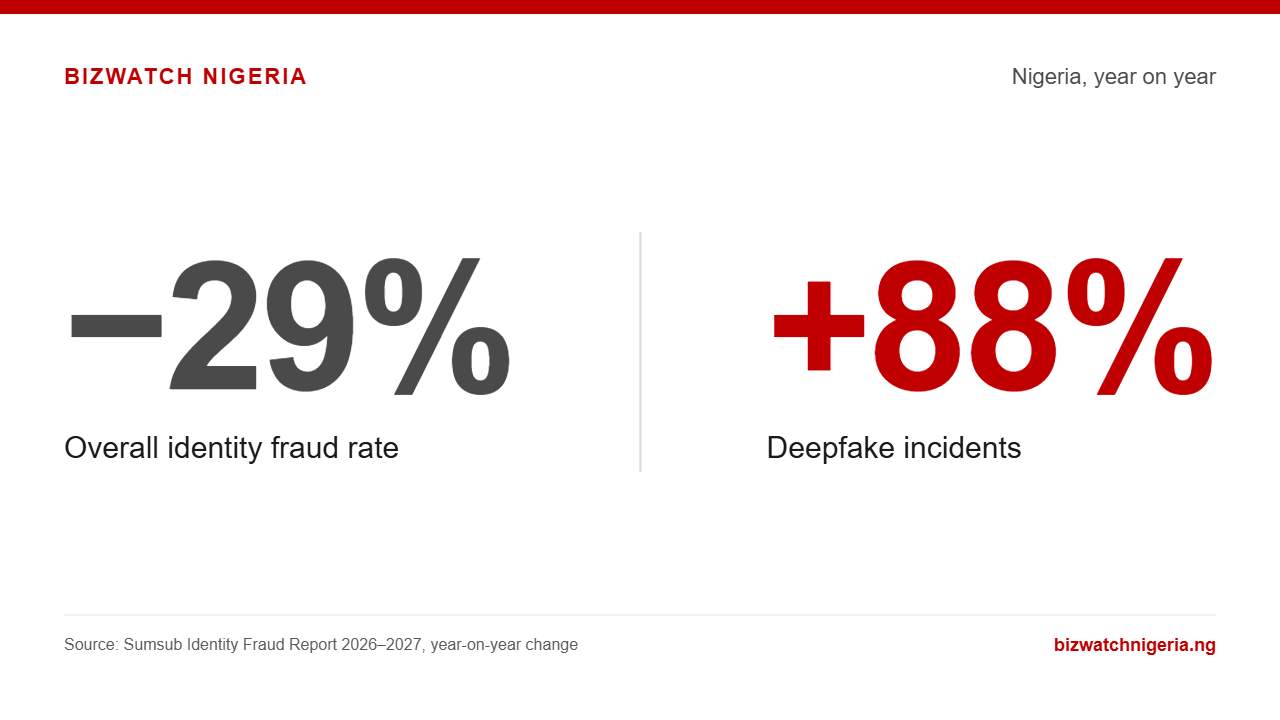
Nigeria’s identity fraud rate fell 29% over the past year, but deepfake incidents in the country rose 88%, according to Sumsub’s Identity Fraud Report 2026–2027. Nigeria also accounted for 35% of the fraud networks detected across Africa, the continent’s largest share, which suggests the lower rate tells only part of the story.
Across Africa, exposure is wide. Three in four businesses (75%) reported confirmed or suspected fraud over the past year, 83% of consumers say fraudsters targeted them, and 60% of victims who lost money recovered none of it. The report lands during International Fraud Awareness Week and ahead of Black Friday and festive trading, when banks, fintechs, retailers and payment platforms handle their heaviest volumes.
Deepfakes climb as overall fraud rates fall
Across Africa, the average identity fraud rate rose 10% over 2025–2026, while fraud complexity grew 15%. The headline rate hides sharp differences between countries. Sudan (+155%), Niger (+106%) and Botswana (+102%) recorded the steepest jumps in fraud, while South Africa (+37%), Côte d’Ivoire (+22%) and Uganda (+11%) also moved higher.
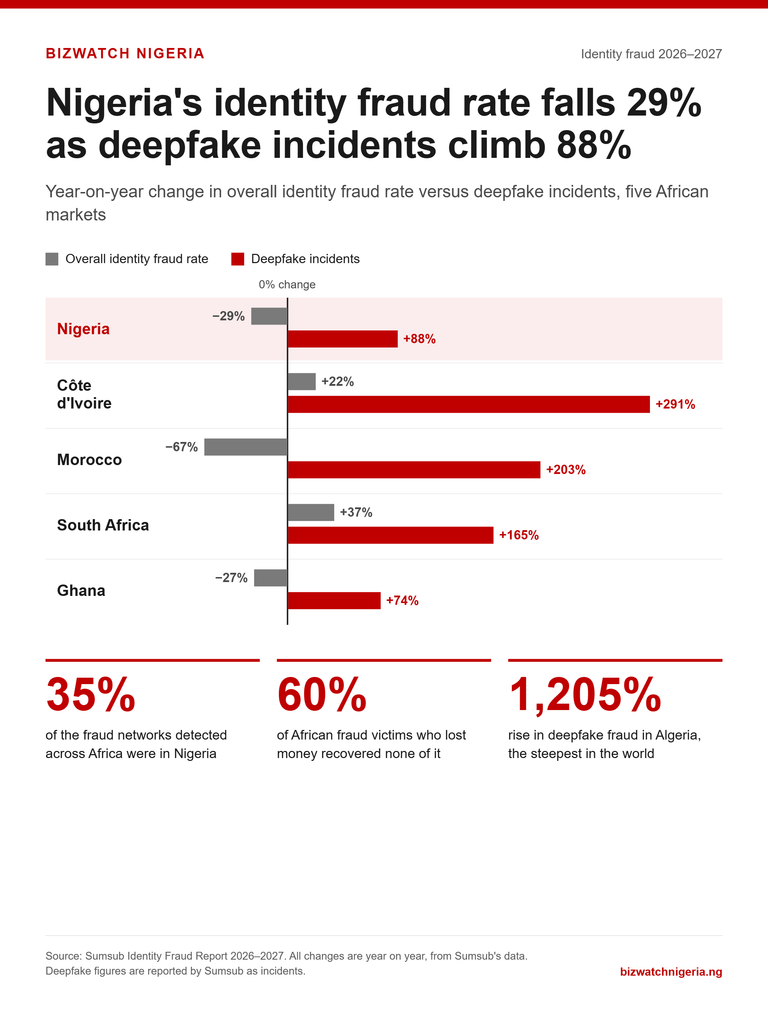
In several markets, the overall fraud rate fell while deepfake incidents surged. Nigeria’s identity fraud rate dropped 29%, yet deepfake incidents rose 88%. Ghana saw its rate fall 27% as deepfakes grew 74%. Morocco posted the starkest split: a 67% fall in the fraud rate against a 203% rise in deepfakes. Kenya (-42%) and Mauritius (-16%) also recorded lower fraud rates, though Sumsub says sophistication increased.
Côte d’Ivoire and South Africa went the other way, with both overall fraud and deepfakes rising. Côte d’Ivoire’s deepfake cases jumped 291% alongside a 22% rise in its fraud rate, while South Africa’s deepfake incidents grew 165% alongside a 37% rise in its rate. Algeria recorded the largest deepfake increase in the world, at 1,205%.
Other markets with significant deepfake growth include Zimbabwe (246%), Tunisia (219%), Ethiopia (126%) and Uganda (106%).
Africa against the world
Africa is moving against the global trend on fraud volumes. Sumsub says the global identity fraud rate fell 28% year on year to 1.6%, while Africa’s average rate rose 10%. The global rate stood at 2.2% in 2025 and peaked at 2.6% in 2024, making 2026 the second consecutive annual decline. North America cut its rate by 41% and Europe by 8%, according to the same report summary. Asia-Pacific has the highest regional rate, at 2.5%, while the U.S. and Canada have the lowest. Fraud complexity is rising everywhere: Sumsub’s new Fraud Complexity Index moved from 2.1 to 2.2 globally, and Africa’s complexity grew 15%. Digitally edited IDs now make up 17% of confirmed fraud worldwide, up from 5% in 2024.
On deepfakes, Nigeria is running well ahead of the pace. Worldwide, deepfake fraud rose 31%, and Europe recorded the sharpest regional increase at 41%, according to Sumsub. Nigeria’s 88% rise is nearly three times the global figure, though Sumsub reports the country numbers as incidents and the global one as a rate, so the comparison is indicative.
The fastest-moving markets sit at the extremes. Algeria’s 1,205% deepfake surge is the steepest in the world, ahead of Italy’s 251%, the sharpest rise Sumsub recorded in Europe. On overall fraud, Sudan (+155%), Niger (+106%) and Botswana (+102%) lead Africa, while Japan’s rate jumped 219% to 5.1%, the standout outside the continent.
Organised networks and AI agents show the same mix of gaps and bright spots. The biggest African ring, 3,038 connected users in Mauritius, is close in size to the largest in the United States, at 3,173. Africa’s 24% use of network analysis is slightly above the 21% global figure. On agents, 49% of African businesses detected or suspected fraud involving them, against 53% worldwide, and only 10% of African firms can suspend an agent, compared with 12% globally. Worldwide, only 37% of businesses verify who authorises an agent.
Organised networks slip past individual checks
Sumsub says criminals are increasingly operating as coordinated networks rather than lone actors, which lets them scale attacks across platforms, institutions and borders. Nigeria accounted for 35% of the fraud networks detected across Africa, the largest share on the continent. The biggest single network uncovered was in Mauritius, where investigators found a group of 3,038 connected users.
These rings exploit shared devices, interlinked accounts and coordinated identities, which can pass individual customer checks. An account that looks trustworthy today can be compromised later, turning a previously clean profile into a risk signal. Yet only 24% of African businesses use fraud network analysis tools, according to the Sumsub Fraud Exposure Survey 2026. The report argues that firms need to add network analysis and behavioural monitoring to traditional identity checks.
AI agents open a new front
Africa leads the world in business use of AI agents. Sumsub’s 2026 survey found that 39% of African companies already use them internally, the highest share of any region, and another 41% are preparing to. Governance has not kept pace: fewer than half of African businesses verify who authorises their AI agents, and only 10% can suspend them.
Nearly half of African businesses (49%) reported detecting or suspecting fraud involving AI agents, which Sumsub counts among the fastest-growing emerging threats in the report. The firm first flagged AI fraud agents as a global threat in 2025.
What’s being said
Hannes Bezuidenhout, VP Sales, Africa at Sumsub, says the continent’s digital growth cuts both ways. “Africa is one of the world’s most dynamic digital growth markets, with businesses rapidly adopting new technologies to drive financial inclusion and innovation. However, the same technologies creating opportunity are also creating new opportunities for fraudsters,” he says. He adds that companies need “a proactive, intelligence-led multi-layered approach to identity verification and fraud prevention.”
Mick Amelishko, AI Advocate at Sumsub, focuses on the agent risk. “AI agents are becoming the connective tissue between people and their data, and that convenience should not come at the cost of control,” he says.
Bottom line
A falling fraud rate is not the same as falling risk. In Nigeria and Ghana, fewer fraud cases are coinciding with far more deepfakes, and organised networks and unsupervised AI agents widen the gap. For banks, fintechs and retailers heading into peak trading, the findings point to network-level detection and tighter agent controls, not just stronger checks on individual customers. All figures come from Sumsub’s own data and surveys.
Methodology
The report analyses 5.8 million fraud cases detected between 2025 and 2026 and draws on a global survey of more than 1,400 fraud and risk professionals and 1,500 end-users across 21 markets.