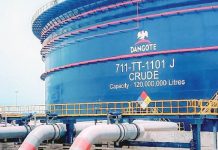






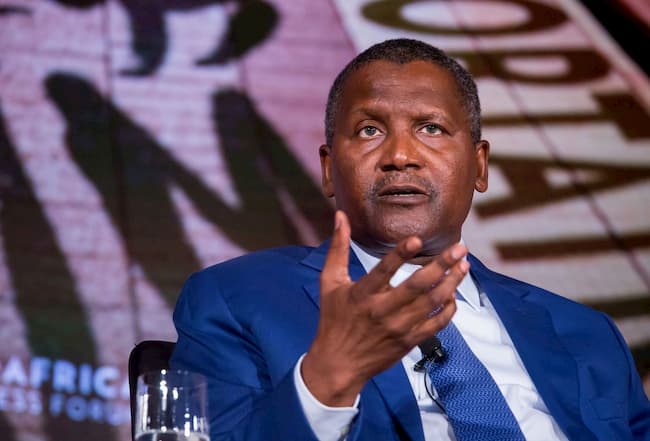
The Dangote Petroleum Refinery has entered into a major offtake agreement with 12 leading petroleum marketing firms to distribute up to 65 million litres of Premium Motor Spirit (PMS) daily across Nigeria, marking a significant development in the country’s downstream oil sector.
President of the Dangote Group, Aliko Dangote, disclosed that the structured distribution arrangement is designed to guarantee consistent domestic supply while enabling the export of surplus volumes.
Under the framework, between 60 million and 65 million litres of petrol will be supplied daily to the Nigerian market. Any excess production—estimated at between 15 million and 20 million litres per day—will be exported.
Nigeria’s current daily petrol consumption ranges between 50 million and 60 million litres, meaning the refinery’s projected output will comfortably meet local demand. On a monthly basis, the refinery is expected to supply between 1.8 billion and over 2 billion litres, depending on operational throughput.
This latest development builds on an earlier supply arrangement reached in October 2025 between the refinery and downstream operators aimed at stabilising fuel distribution and moderating pump price volatility.
Independent petroleum marketers had previously disclosed that the refinery targeted monthly domestic releases of up to 600 million litres to address persistent supply bottlenecks and rising costs nationwide.
The new structured distribution model has been endorsed by the Nigerian Midstream and Downstream Petroleum Regulatory Authority (NMDPRA). Selected marketers will oversee nationwide logistics to minimise disruptions, curb speculative practices, and ensure price stability.
Participating companies include:
- MRS Oil Nigeria Plc
- Nigerian National Petroleum Company Limited Retail
- 11 Plc
- TotalEnergies Marketing Nigeria
- Rainoil Limited
- Northwest Petroleum & Gas Company Limited
- Ardova Plc
- Bovas & Company Limited
- AA Rano Nigeria Limited
- AYM Shafa Limited
- Conoil Plc
- Masters Energy
The refinery indicated that once domestic obligations are fulfilled, surplus volumes earmarked for export will contribute to foreign exchange conservation, strengthen Nigeria’s trade balance, and bolster external reserves.
For decades, Nigeria—Africa’s largest crude oil producer—relied heavily on imported refined petroleum products, exposing the economy to exchange rate shocks, global supply chain disruptions, and recurring fuel shortages.
The Group Chief Executive Officer of the Nigerian National Petroleum Company Limited, Bayo Bashir Ojulari, recently described the refinery as a transformative asset capable of reshaping Nigeria’s energy security framework. He revealed that the plant, originally designed for 650,000 barrels per day, has achieved operational output of 661,000 barrels per day, surpassing expectations.
The refinery’s expansion comes amid broader reforms in Nigeria’s oil and gas sector following downstream deregulation and the removal of fuel subsidies under President Bola Tinubu.
As Africa’s largest refinery, the Dangote facility is expected to play a decisive role in ending Nigeria’s dependence on imported petrol, stabilising domestic supply, and positioning the country as a net exporter of refined petroleum products to West and Central Africa.
Industry observers believe that the structured offtake arrangement could significantly reduce the risk of supply shortages that have plagued the country for years while fostering a more efficient and transparent fuel distribution chain.