Imagine a surgeon preparing for an operation and reaching for an implant that was created specifically for the patient sitting on the operating table. Not manufactured for thousands of people. Not chosen from a standard size. Designed around one person’s body.
That future is already beginning to take shape.
3D printing has moved far beyond plastic prototypes and engineering workshops. In medicine, researchers and doctors are exploring how the technology can create customized implants, surgical models, prosthetics, and, eventually, living tissues. It may not receive the same attention as artificial intelligence or futuristic robots, but 3D printing could quietly transform some of the most difficult problems in modern healthcare.
And perhaps the most fascinating possibility is this: one day, we could print replacement body parts using a patient’s own cells.
From Plastic to Living Tissue
Traditional 3D printing works by building an object layer by layer from materials such as plastic, metal, or resin.
Bioprinting takes the concept much further.
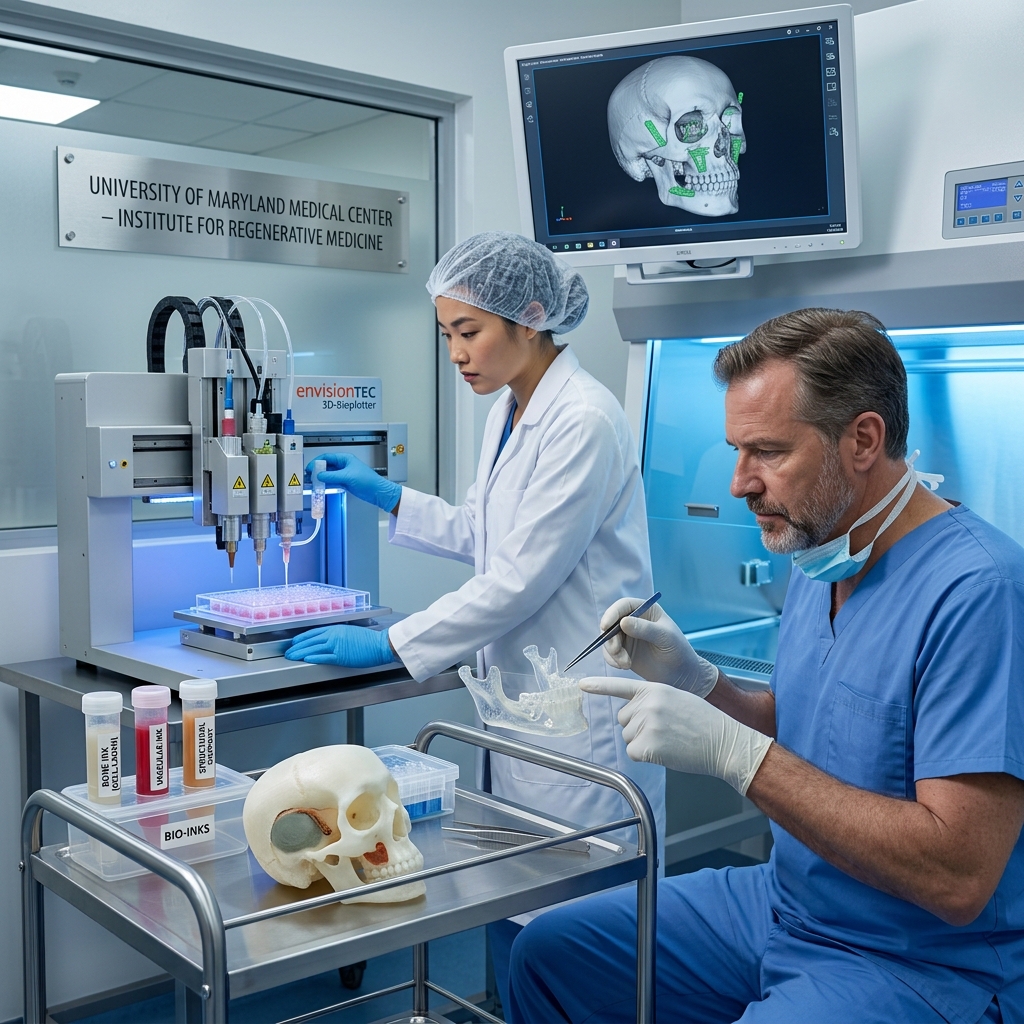
Instead of ordinary printing materials, researchers can use special mixtures containing living cells and biomaterials. These can be deposited in carefully controlled patterns to create structures that resemble natural tissues.
The goal isn’t simply to make something that looks like an organ.
It needs to behave like one.
A kidney, for example, contains incredibly complicated networks of blood vessels, filtering structures and specialized cells. Recreating that architecture is an enormous scientific challenge.
That’s why fully functional 3D-printed organs are not yet routine replacements for donated organs. But researchers are making progress toward simpler tissues and structures, while engineers continue developing better ways to organize living cells.
The Revolution Is Already Happening in the Operating Room
You don’t have to wait for fully printed hearts or kidneys to see the impact of 3D printing.
Doctors are already using 3D-printed implants and models in various areas of medicine.
A patient’s medical scans can be converted into a three-dimensional model, allowing surgeons to study complicated anatomy before an operation. In some cases, customized implants can also be produced to match a patient’s individual anatomy.
That level of personalization can be particularly valuable when a standard implant simply doesn’t fit the problem.
Instead of asking, “Which existing part fits this patient?”, medicine can increasingly ask, “Can we create the right part for this patient?”
That’s a major shift.
Imagine an Implant Made Just for You
Human bodies aren’t standardized.
Two patients with the same condition can have very different anatomy. A customized implant can potentially account for those differences.
This is one of the biggest attractions of 3D printing in healthcare.
A surgeon could use detailed imaging data to design an implant that matches a patient’s bone structure or other anatomical requirements. The result could potentially improve fit and make complicated procedures more personalized.
The possibilities extend to areas such as bone reconstruction, dental implants, prosthetics and other medical devices.
For patients, personalization could mean something very simple but powerful: a medical solution designed around them rather than adapted from something designed for everyone.
The Transplant Problem
Perhaps the biggest dream behind bioprinting is solving one of medicine’s most painful problems: the shortage of donor organs.
Thousands of people around the world need organ transplants, but there are never enough suitable donated organs to meet demand.
That creates difficult choices and long waiting periods.
Imagine a future where a patient’s cells could be collected, transformed into the appropriate tissue and used to create a replacement organ.
It sounds almost unbelievable.
But researchers are investigating exactly this idea.
Using a patient’s own cells could also potentially reduce the risk of immune rejection, although making this approach safe, reliable, and practical remains a major scientific challenge.
Why Printing an Organ Isn’t Like Printing a Shoe
The phrase “3D-printed organ” can make the technology sound easier than it really is.
An organ isn’t simply a three-dimensional shape.
It is a living system.
It needs blood vessels. It needs nerves. It needs different types of cells working together. It needs to receive oxygen and nutrients, remove waste, and respond to the body’s changing environment.
Getting all of those systems to function together is incredibly difficult.
Researchers therefore have to solve several problems at once: keeping cells alive during printing, creating complex biological structures, and ensuring that printed tissue continues functioning after implantation.
This is why fully functional, transplantable 3D-printed organs remain a major research goal rather than an everyday medical procedure.
A Future Built Around the Patient
Despite the challenges, the direction is exciting.
The most important change may not be that hospitals suddenly start printing complete organs overnight. It could happen gradually.
First, better customized implants.
Then more advanced tissues.
Then increasingly complex biological structures.
Eventually, perhaps, complete replacement organs.
The journey will likely take years, and there will be failures, ethical questions, expensive experiments, and discoveries nobody can predict yet.
But the underlying idea is powerful.
Medicine has traditionally worked with what nature gives us: donated organs, available implants, and treatments designed for broad groups of patients. 3D printing offers another possibility: building something specifically for the individual who needs it.
Conclusion
3D-printed medicine may still be in its early chapters, but the story is already changing surgery. From customized implants to experimental living tissues, the technology is bringing medicine closer to a future where replacement parts aren’t simply found; they’re made.
The day doctors routinely print fully functioning human organs may still be ahead of us. But when that day finally arrives, it could change one of the oldest realities of medicine: waiting for someone else to give you a body part you need to survive.