






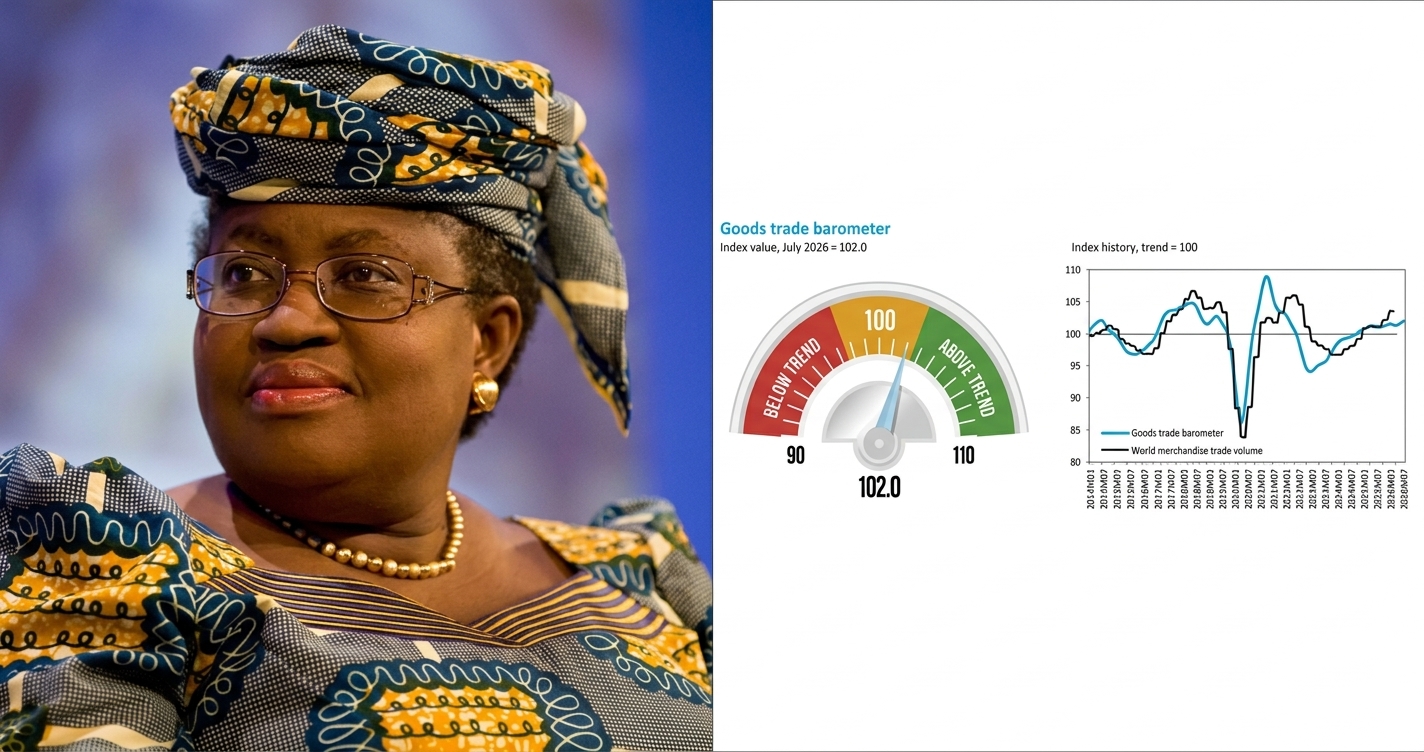
GENEVA — The World Trade Organization’s Goods Trade Barometer rose to 102.0 in its latest reading, up from 101.7 in June, as strong demand for artificial intelligence-linked electronics continues to outweigh the drag from the Middle East conflict on global merchandise trade. The reading comes as the WTO’s newly released Annual Report shows 2025 trade held up under some of the heaviest pressure the multilateral system has faced in its 80-year history.
The barometer is a composite leading indicator that tracks merchandise trade against its long-term trend. A baseline reading of 100 marks trend-level trade; anything above signals momentum is building, anything below signals a slowdown. The latest figure puts world trade firmly in growth territory for a second consecutive reading.
By the numbers
- Electronic components index: 104.9 — the barometer’s strongest component, driven by AI-related demand
- Export orders index: 103.5 — the most predictive of the sub-indices, pointing to further growth ahead
- International air freight index: 102.8
- Agricultural raw materials index: 102.6
- Automotive products index: 101.5
- Container shipping index: 99.6 — the only component below trend
- World merchandise trade volume growth, 2025: 4.6%
- Services trade volume growth, 2025: 5.3%
- Global goods and services trade value, 2025: $34.65 trillion, up 7% year-on-year
- Share of global goods trade flowing on core MFN tariff terms: 72%
Context
The WTO Secretariat’s Global Trade Outlook and Statistics report, released March 19, projects 2026 merchandise trade volume growth of 1.9% under its baseline scenario, falling to 1.4% if elevated energy prices tied to the Middle East conflict persist. The Secretariat estimates sustained AI investment could add 0.5 percentage points to trade growth this year. Trade volumes stayed positive year-on-year in the first quarter, though the WTO said disruptions from the Strait of Hormuz will show up more fully once second-quarter data is available. An updated outlook is due in October.
The WTO’s Annual Report, covering activities through 2025, frames the barometer’s resilience as consistent with the broader pattern of the past year: AI-driven demand offsetting tariff increases and policy uncertainty. Director-General Ngozi Okonjo-Iweala’s report also points to how governments handled the Strait of Hormuz disruption specifically — opting to lift trade restrictions and ease the flow of oil and gas rather than impose new barriers, a departure from responses to earlier crises.
What’s being said
Director-General Ngozi Okonjo-Iweala said the coordinated response to the Strait of Hormuz crisis shows how an interconnected trading system can help to bring about resilience when the world is tested by conflict.
Bottom line
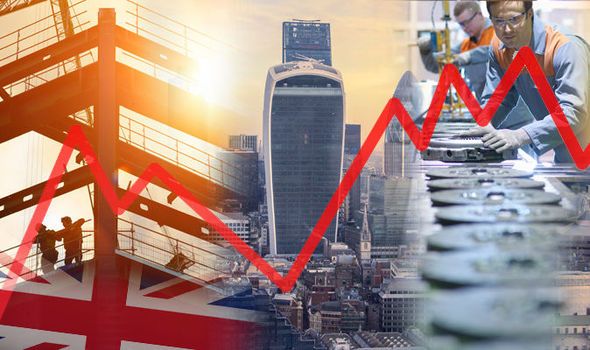
World merchandise trade is outrunning the headwinds facing it. AI-driven electronics demand is proving a stronger tailwind than Middle East disruption is a drag, 2025’s record trade figures back that pattern, and the WTO’s own forecasts suggest the balance holds through the rest of 2026.