






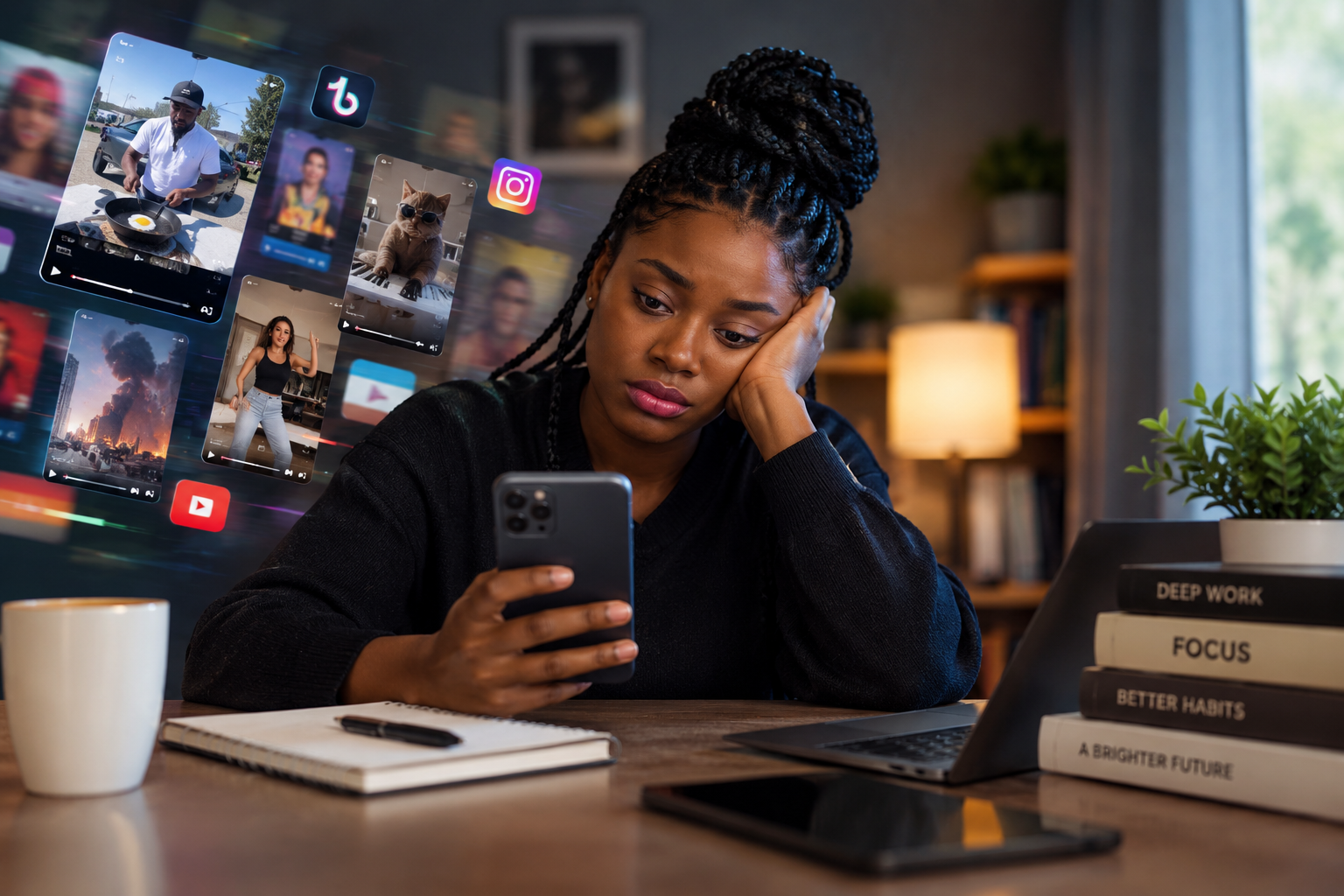
Hello, my fellow Boom-Scrollers, Notification-Binge Veterans, and Timeline Forensic Auditors. Welcome back to our weekly sanctuary! Today is Thursday, September 10, 2026. If you picked up your smartphone this morning to check a single text message and suddenly snapped out of a trance 45 minutes later—realizing you just watched twelve consecutive short-form videos of a man in Brazil frying an egg on a car hood while a robotic AI voice recited a story about a fictional billionaire—pull up an ergonomic plastic chair. You are in the safest room on the internet.
Forget traffic gridlocks, political party petitions, or utility billing math. Today, we are running an exclusive, deep-dive forensic audit on the single most pervasive, unhinged, and silent cognitive crisis sweeping across our homes, offices, and universities: The Collapse of the Human Attention Span and The Science of “Brain-Rot.”
Remember when you could sit down on a Sunday afternoon and watch a full 90-minute movie without checking your phone sixteen times? In late 2026, that feels like a fable told by elders around a fire.
Recent cognitive neuroscience and behavioral studies reveal that the average digital consumer’s screen-focus window has dropped from nearly 2.5 minutes a two decades ago to a staggering 47 seconds today. For short-form social media posts, Gen Z users average a microscopic 6.5 seconds of focused attention before deciding whether to keep watching or swipe up.
Our brains have been re-engineered by short-form video algorithms to expect a high-potency dopamine release every 5 to 7 seconds. If a content creator takes longer than two seconds to clear their throat, say hello, or introduce a concept, our thumbs execute an involuntary, military-grade upward swipe.
The street comedy across offices and student hostels is pure gold. People are setting YouTube playback speeds to 1.5x while keeping a mobile game open on a second screen, and then complaining that the 3-minute video was “pacing too slowly!”
You haven’t truly experienced modern cognitive exhaustion until you open an app to check a baking recipe, get distracted by a video of a cat playing a keyboard, spend 35 minutes reading arguments in the comment section, and completely forget why you unlocked your phone in the first place!
Why is the short-form video loop so impossible to break? Because it isn’t just entertainment—it is a finely tuned neurochemical feedback system.
Every time you swipe up on an algorithmically curated feed, your brain plays a high-speed slot machine. You don’t know what the next video will be:
Video A: A hilarious comedy skit (Dopamine Spike!).
Video B: A boring advertisement (Swipe!).
Video C: A shocking breaking news clip (Dopamine Spike!).
This unpredictable reward structure triggers a 47% dopamine surge during short-form video viewing. Neuroimaging studies show that heavy consumption of short-form media leads to hyperactivation in reward-processing regions while temporarily dampening mid-frontal prefrontal cortex activity—the exact brain region responsible for impulse control, working memory, and long-term focus.
The phenomenon colloquially dubbed “TikTok Brain” or “Brain-Rot” isn’t just slang; it represents real cognitive fatigue. University eye-tracking research demonstrated that spending just five minutes scrolling through short-form video feeds right before reading a long-form document causes participants’ eyes to scan rapidly and erratically across the text, making sustained reading and deep comprehension significantly harder.
Behind the funny memes and viral trends lies a vital educational reality for 2026: Your attention is your most valuable asset, and it is currently being mined for profit.
You do not need to throw your smartphone into a river, but you do need tactical protocols to protect your focus:
1. Beware the “Task-Switching” Penalty: It takes the human brain approximately 23 minutes and 15 seconds to fully regain deep focus after being interrupted by a digital distraction. Every time you take a “1-minute TikTok break” while working, you reboot your brain’s focus timer!
2. Institute the “Digital Sunset”: Turn off short-form video apps at least 60 minutes before bedtime. Consuming hyper-stimulating visual clips right before sleep causes physiological arousal, disrupting deep REM sleep cycles and causing morning brain fog.
3. Practice “Friction-Based” Detoxes: Place social media apps inside deep folders on your phone rather than your home screen, or turn your phone screen to Grayscale mode. When screen colors look dull, algorithm feeds lose over 50% of their visual appeal!
Digital Wellness Protocols for the Week
Set App Friction Timers: Use built-in screen time limits to lock short-video platforms after 30 minutes of daily use.
Read Long-Form Content: Re-train your prefrontal cortex by reading physical books, long-form articles, or full research papers for 20 uninterrupted minutes daily.
Protect Your Morning Focus: Never open short-form video apps within the first 45 minutes of waking up. Give your brain a calm, unstructured environment to start the day.
See you next Thursday—hopefully with lower screen times, longer attention spans, calm feeds, and zero timeline drama!