





How a motorcycle import deal struck in 1987 by Innoson laid the foundation for Nigeria’s motorcycle and electric vehicle industry becoming the only sector to run the full arc of Chinese technology partnership in Nigerian industrial history till date.
BizWatch Research Desk | March 2026
| KEY POINTS • In 1995, Innoson’s Nnewi motorcycle plant built on a Chinese technology partnership, crashed the market price of a new motorcycle from ₦150,000 to ₦70,000, eliminating Nigeria’s second-hand import market. • Chinese brands dominate the commercial motorcycle segment: Qlink, Daylong, and Lifan are all Chinese-origin marques assembled locally. China’s Haojue has led global motorcycle production for 22 consecutive years. • The electric tricycle transition is being led by Chinese partnerships, with Nigeria signing MoUs with Mutual Commitment Company Limited and China Metallurgical Group in 2023 for local assembly. • Nigeria’s EV sector runs almost entirely on a Chinese technology spine, from JET Motor Company’s Chinese powertrain and battery suppliers to Innoson’s rebadged BAIC, Dongfeng, and Zhongxing models. • An estimated 15,000–20,000 EVs are now on Nigerian roads (2025), up from virtually zero five years ago. The market is projected to grow at 6.8% annually through 2031. • Nigeria recorded its first 100% made-in-Nigeria EV export to the United States, an early but landmark signal that local assembly capability is beginning to yield exportable product. |
| 1987 Year of first Chinese motorcycle import deal — the beginning of the technology transfer arc | ₦70k New motorcycle price post-Innoson entry, down from ₦150,000 — a 53% price collapse |
| 22 yrs Consecutive years China’s Haojue has led global motorcycle production and sales | 20,000 Estimated EVs on Nigerian roads as of 2025, up from virtually zero in 2020 |
| 6.8% Projected annual EV market growth rate in Nigeria through 2031 | $40m Ogun State’s planned EV assembly hub budget, targeting 60,000+ jobs |
Nigeria’s automotive story is, at its core, a story about China. It begins not with the electric vehicle or smart factories, but with a single motorcycle import deal in 1987 — and it arrives, nearly four decades later, at a made-in-Nigeria electric vehicle rolling off a local assembly line and onto a ship bound for the United States. Between those two points lies the most complete technology transfer arc in Nigerian industrial history.
No other sector captures the full range of what Chinese technology partnership can produce in Nigeria: genuine skills absorption, market disruption through price, the slow building of local assembly capacity, and the unresolved tension between dependency and capability. The motorcycle and electric vehicle sector is where that entire argument plays out in full.
Part 1: Motorcycles — where the transfer began
In 1987, Chief Innocent Chukwuma, founder of Innoson Nigeria Limited, struck what would become one of the most consequential industrial import deals in Nigerian commercial history. He brought in the first shipment of Jingcheng motorcycles from China — Jingcheng being the direct Chinese equivalent of Suzuki; Jiachi, the Chinese equivalent of Yamaha. It was a trade deal, but it opened an industry’s door.
Eight years later, in 1995, Innoson built on that relationship to establish a fully automated motorcycle assembly plant in Nnewi, Anambra State, the first fully indigenous motorcycle assembly facility in Nigeria. The market responded immediately and violently.
The price of a brand-new motorcycle fell from ₦150,000 to ₦70,000. The tokunbo motorcycle market — second-hand imports that had long supplied the mass market — effectively ceased to exist.
The mechanism behind that price collapse was not just cost arbitrage. It was the Chinese manufacturing model applied wholesale: technology access through partnership, local assembly to reduce import duties, and a supply chain discipline that legacy importers could not match.
What Nnewi demonstrated, and what the research record confirms unusually clearly for a Nigerian case study, is that genuine skills transfer did follow. Innoson management stated on record that Nigerian workers now run the production line without Chinese input — and that the number of Chinese technical partners has been progressively reduced as local capability grew. At Shacman Motors, a parallel case in the Nnewi cluster, Chinese partners trained former ANAMMCO staff to assemble Chinese trucks independently, after which the lines operated without continued expatriate involvement.
These are documented management statements and they matter, because across most Chinese infrastructure projects in Nigeria, equivalent evidence of skills absorption is far harder to find.
The commercial motorcycle market in Nigeria today reflects that foundation. Brands sold and marketed as ‘made-in-Nigeria’ — Qlink, Daylong, and Lifan are all Chinese-origin marques assembled locally. China’s Haojue, which has led China’s motorcycle industry in both production and sales for 22 consecutive years, is one of the most actively traded brands on the Nigerian secondary market. The relationship between Nigeria’s commercial motorcycle sector and Chinese manufacturing has moved beyond dependency into integration.
Part 2: Tricycles — the electric pivot
The keke Napep is one of the most visible economic assets in Nigerian urban life — three wheels, a canopy roof, and a driver navigating traffic in cities from Port Harcourt to Maiduguri. For years, the tricycle market was an Indian story: Bajaj, TVS, and Piaggio dominated the petrol segment, their brands synonymous with the format itself.
That is beginning to change. Not because Chinese brands have displaced Indian ones in petrol tricycles — they have not, to any significant degree. But because the next generation of keke is electric, and the electric transition is being built on Chinese technology.
2023 MoU — Mutual Commitment Company Limited: The Nigerian federal government signed a memorandum of cooperation with Chinese company Mutual Commitment Company Limited to assemble electric tricycles locally and establish a renewable energy training centre alongside the assembly facility. The Minister of Power tied the deal directly to national electrification targets.
2023 MoU — China Metallurgical Group: At the Forum on China-Africa Cooperation (FOCAC) summit, Nigeria signed a separate MoU with China Metallurgical Group, one of China’s largest state-owned engineering conglomerates — specifically targeting local manufacturing capacity for electric tricycles.
Neither deal has yet produced a factory at the scale originally announced. But the direction of travel is clear: as Nigeria’s urban transport fleet eventually electrifies, the technology enabling that transition will at least in its first generation, come primarily from China.
Part 3: Electric Vehicles — a Chinese technology spine
Nigeria’s electric vehicle sector is young, fragile, and still largely dependent on imported components. It is also moving faster than most observers expected five years ago. The critical context is this: virtually every significant EV assembly or deployment initiative in Nigeria, whether branded as locally built or not, runs on a Chinese technology spine.
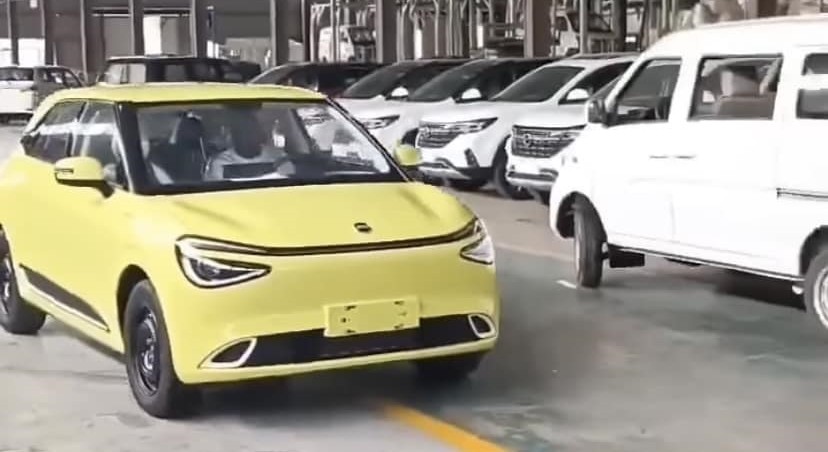
JET Motor Company: Nigeria’s most prominent commercial electric vehicle assembler imports its powertrain from China’s Jing-Jin Electric Technologies Co. and its battery pack from Chinese firm KeyPower. The company currently assembles three Jet Mover electric cargo vans per day at its Lagos plant — a small number, but with stated plans to scale to 50 per day as charging infrastructure is developed. The business model is Nigerian; the technology is Chinese.
Innoson Vehicle Manufacturing (IVM): Innoson’s EV range — the IVM Link, IVM EX02, and IVM EX01 — represent Nigeria’s highest-profile domestic EV brand. But the underlying vehicles are largely rebadged models from Chinese manufacturers BAIC, Dongfeng, and Zhongxing. Local content runs to an estimated 65% in areas like body panels, plastics, and upholstery. Core structural and powertrain elements remain pre-fabricated Chinese imports. The first batch of IVM EVs sold out immediately — buyers included federal and state governments and the Nigerian armed forces.
BYD, JAC, and Dongfeng: China’s largest automotive brands are not waiting to be invited. BYD, JAC, and Dongfeng are already present in Nigeria through assembly partnerships or dealership networks, offering financing packages, after-sales support, and models progressively adapted to local road conditions. In May 2025, the Chinese government announced plans to establish dedicated EV factories in Nigeria as part of a deepening bilateral economic agenda.
The market numbers are beginning to reflect this activity. Nigeria had an estimated 15,000 to 20,000 electric vehicles on its roads as of 2025 — up from virtually zero five years prior. The market is projected to grow at 6.8% annually through 2031. Against the scale of Nigeria’s vehicle population, those numbers are still small. Against the baseline of five years ago, the rate of change is significant.
Nigeria’s EV sector is not yet self-sustaining. But it exists — and it exists because of Chinese technology.
Ogun State’s EV hub: Ogun State has announced a $40 million assembly hub covering electric motorcycles, tricycles, cars, and buses — projected to create more than 60,000 jobs. Spiro, a fast-growing EV company with significant Chinese component sourcing, is already deploying battery-swapping stations in Abeokuta as part of the ecosystem being built around the hub.
What’s Being Said
“Our people can do the work without any input from our Chinese partners. Now they are able to run the production line by themselves. The number of our Chinese technical partners is depreciating because our people are being taught to use the technology.” — Innoson Nigeria management, on the Nnewi motorcycle assembly operation
“Chinese partners were brought in to train former ANAMMCO staff on how to assemble Chinese trucks — and once training was complete, Nigerians ran the lines independently.” — Shacman Motors management, Nnewi cluster
What’s Next
- The Ogun State $40 million EV assembly hub will be the largest near-term test of whether Nigeria can build a vertically integrated local EV ecosystem — or whether it remains primarily an assembly point for Chinese-manufactured components.
- The JET Motor Company’s scale-up from three to 50 vehicles per day hinges entirely on charging infrastructure development. If the federal government’s grid access and renewable energy programmes accelerate, this becomes viable. If not, the ceiling holds.
- The two 2023 electric tricycle MoUs — with Mutual Commitment Company Limited and China Metallurgical Group — have not yet yielded operating factories. Progress on ground-breaking will be the key status indicator to watch in 2026.
- BYD’s formal entry into Nigerian assembly (as opposed to dealership) would mark the arrival of a global EV tier-one manufacturer — transforming the competitive and capability landscape for the entire sector.
- Nigeria’s first made-in-Nigeria EV export to the United States is a milestone, but a fragile one. Sustaining and scaling that export capability will require both trade relationships and quality certification infrastructure that Nigeria is still building.
The Bottom Line
In 1987, a motorcycle importer in Nnewi struck a deal with a Chinese manufacturer and, almost accidentally, started Nigeria’s technology transfer story in the automotive sector. Nearly four decades on, that story has produced a functioning local motorcycle assembly industry, an electric tricycle sector in formation, and an EV market growing at nearly 7% per year on a Chinese technology foundation.
The depth of that foundation is both the sector’s strength and its most significant structural risk. Nigeria’s EV assemblers build on Chinese components, power Chinese-designed vehicles, and depend on Chinese battery technology. When the technology works, Nigeria benefits from cost, speed, and access. When Chinese supply chains are disrupted — by geopolitics, tariffs, or currency stress — Nigeria has limited ability to substitute.
The Nnewi motorcycle model — where Nigerians learned the technology, ran the lines, and eventually operated independently — remains the standard every subsequent Chinese partnership in this sector should be judged against. So far, few have matched it.