KEY POINTS
- The Federal Government has announced a $346 million (approx. ₦550bn) co-financing commitment in the 2026 budget to combat HIV, Tuberculosis, and Malaria.
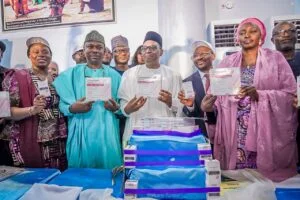
- Health Minister Prof. Muhammad Pate unveiled Lenacapavir, a breakthrough long-acting injectable that prevents HIV with just two doses per year.
- The funding marks a strategic shift toward domestic health financing as global aid remains constrained and international priorities shift.
- An initial rollout of 52,000 doses will begin in eight focal states, including the FCT, Anambra, and Kano.
MAIN STORY
Nigeria has taken a decisive step toward self-reliance in public health with the dual announcement of a major funding boost and the launch of a “game-changing” HIV prevention tool.
Coordinating Minister of Health and Social Welfare, Prof. Muhammad Pate, revealed on Tuesday that President Bola Tinubu has directed the Budget Office to capture $346 million in additional co-financing for the 2026 fiscal year. This capital is earmarked for essential commodities, laboratory reagents, and the expansion of primary healthcare services across the federation.
The centerpiece of the Abuja launch was Lenacapavir, a long-acting PrEP (Pre-Exposure Prophylaxis) injection. Unlike daily oral pills which often suffer from low adherence, Lenacapavir is administered once every six months.
Minister of State for Health, Dr. Iziaq Salako, noted that while Nigeria has achieved 95% viral suppression among those on treatment, prevention remains the final frontier. The new injectable is specifically designed for high-risk individuals who require a more discreet and convenient prevention option.
THE ISSUES
The primary challenge addressed by this move is the “Global Funding Cliff.” For decades, Nigeria’s HIV and Malaria responses were heavily subsidized by international partners like the Global Fund and PEPFAR. However, with global “headwinds” and changing donor landscapes, the Federal Government is pivoting toward “Domestic Ownership.”
The goal is for Nigeria to fully fund its priority disease programs by 2030. There is also the “Adherence Gap”; health officials admit that many at-risk Nigerians struggle with daily medication, making long-acting injectables like Lenacapavir a critical technical fix for the epidemic.
WHAT’S BEING SAID
- “The global space is changing… the headwinds force us to think differently,” stated Prof. Muhammad Pate.
- “By 2030, Nigeria should be able to put its own domestic resources toward priority diseases,” Pate added.
- “Lenacapavir offers high efficacy, convenience, and discretion for those facing adherence challenges,” noted Dr. Iziaq Salako.
WHAT’S NEXT
- Civil society groups are expected to monitor the 2026 budget cycle to ensure the $346 million is not just approved but released and utilized.
- Health workers in the eight pilot states will undergo specialized training this month on the administration and cold-chain storage of Lenacapavir.
- If the initial 52,000-dose rollout shows high safety and uptake, the government plans to expand the program to all 36 states by early 2027.
- Discussions are ongoing regarding the potential for local secondary packaging of these high-end injectables to further reduce costs.
BOTTOM LINE
The Bottom Line is that Nigeria is buying its way out of donor dependency. By committing over ₦500 billion in co-financing and adopting “space-age” medical tech like Lenacapavir, the government is signaling that it will no longer wait for international aid to solve domestic crises. The success of this 2030 “Ending AIDS” goal now rests on the transparency of the 2026 budget implementation.