





Key points
- NERC mandates region-based reporting to reduce electricity transmission losses to 6.5% by 2026.
- Power sector losses declining but still above regulatory benchmarks, costing billions monthly.
- New directive strengthens accountability amid ongoing grid instability and reform efforts.
Main story
Nigeria’s power sector regulator, the Nigerian Electricity Regulatory Commission, has issued a new directive compelling stricter monitoring of electricity transmission losses, with a target to reduce losses across all regions to no more than 6.5 per cent by the end of 2026.
The directive, contained in Order No. NERC/2026/026 issued on April 8 and effective Monday, introduces a framework for regional reporting of transmission loss factors by the Transmission Company of Nigeria.
Backed by the provisions of the Electricity Act 2023, the order aims to enhance transparency, accountability, and efficiency in the management of the national grid.
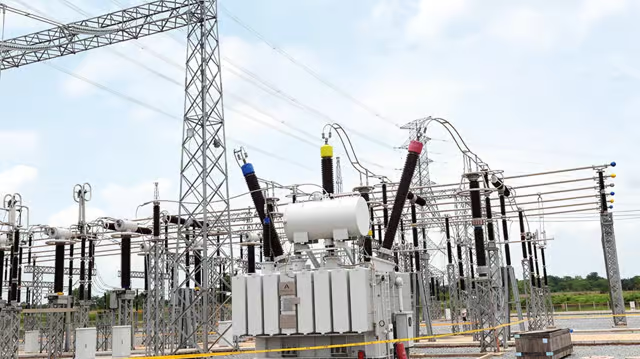
Under the directive, the Nigerian Independent System Operator is required to install smart meters at all regional interconnection points by December 2026 to ensure accurate measurement of electricity flows. It is also mandated to track power transmitted through transformers and submit quarterly reports to the regulator.
Data from NISO indicate that Nigeria’s national transmission loss factor stood at 8.71 per cent in 2024, declining to 7.24 per cent in 2025, and further improving to about 7.05 per cent following recent operational interventions. However, these figures remain above the seven per cent benchmark set under the Multi-Year Tariff Order.
NERC has directed TCN to submit, by July 2026, a comprehensive plan detailing how it intends to meet the new 6.5 per cent cap across all transmission regions.
The issues
Transmission losses continue to pose significant financial and operational challenges in Nigeria’s power sector, with inefficiencies previously costing between N5 billion and N8 billion monthly.
Despite incremental improvements, the sector remains constrained by infrastructure deficits, weak monitoring systems, and recurring grid collapses recorded in early 2026.
The shift from national averages to region-specific performance metrics underscores concerns about uneven performance and accountability gaps within the transmission network.
What’s being said
Managing Director of NISO, Abdu Mohammed Bello, acknowledged that losses were previously close to 10 per cent but noted that improved coordination and monitoring have begun to yield results.
He, however, stressed the need to further reduce losses to between five and six per cent to align with regulatory expectations.
Industry stakeholders have welcomed the directive, describing it as a decisive step toward enforcing discipline and improving operational efficiency across the grid.
They also emphasised the need for sustained investment in modern technologies such as supervisory control and data acquisition systems, alongside improved institutional coordination.
What’s next
TCN is expected to submit its compliance roadmap by July 2026, while NISO begins phased deployment of smart metering infrastructure across transmission regions.
By December 31, 2026, all regions are required to meet the 6.5 per cent transmission loss threshold, with quarterly performance reports submitted to NERC.
The directive is also expected to reinforce ongoing reforms following the unbundling of TCN and the establishment of NISO in 2025.
Bottom line
NERC’s latest directive signals a tougher regulatory stance on transmission inefficiencies, as Nigeria pushes to improve grid performance, reduce financial losses, and strengthen accountability within its evolving power sector.