







Key points
- ECOWAS Parliament begins a week-long joint committee meeting in Dakar to address renewable energy and rural electrification challenges across West Africa.
- Discussions will focus on scaling decentralised energy solutions, strengthening regional frameworks, and boosting investment in the power sector.
- Lawmakers are expected to adopt policy recommendations and conduct a field visit to a renewable energy facility in Senegal.
Main story
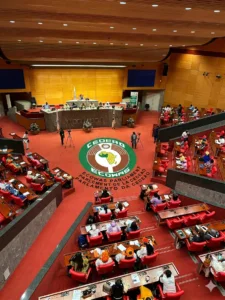
The ECOWAS Parliament has commenced a week-long delocalised joint committee meeting in Dakar, Senegal, aimed at addressing persistent renewable energy and electricity access challenges across West Africa.
A parliamentary statement issued on Sunday confirmed that the meeting, which began on Monday, is themed: “Harnessing Renewable Energy for Rural Electrification and Empowerment of Rural Economies in the ECOWAS Region: The Role of the ECOWAS Parliament.”
The gathering brings together regional lawmakers, officials from ECOWAS institutions, government representatives, development partners, private sector stakeholders, civil society organisations, and energy experts.
According to the parliament, the discussions will centre on strategies to accelerate rural electrification and expand renewable energy deployment across underserved communities in the region.
The meeting is being conducted by the Joint Committee on Energy and Mines; Agriculture, Environment and Natural Resources; and Infrastructure.
Participants will review decentralised energy solutions such as solar mini-grids, hybrid systems, and standalone solar installations, which are considered critical to bridging the electricity access gap in rural West Africa.
The parliament noted that despite gradual progress, millions of people in rural communities still lack reliable electricity, with significant implications for agriculture, education, healthcare delivery, digital inclusion, and economic productivity.
West Africa’s vast untapped solar and hydropower potential will also be assessed, alongside existing barriers to investment and implementation of energy projects.
Key regional frameworks under review include the ECOWAS Renewable Energy Policy (EREP), the Energy Efficiency Policy (EEEP), the updated ECOWAS Energy Policy, and the Regional Electricity Market (REM).
Institutions such as the ECOWAS Centre for Renewable Energy and Energy Efficiency (ECREEE), the West African Power Pool (WAPP), and the ECOWAS Regional Electricity Regulatory Authority (ERERA) are also expected to feature in the discussions.
A key highlight of the programme is a field visit to a renewable energy installation in Senegal, where lawmakers will interact with host communities, including women and youth, to assess the real-life impact of electrification projects.
The issues
Despite regional commitments, rural electrification remains uneven across West Africa, with many communities still off-grid or dependent on unreliable power sources. This continues to hinder socio-economic development and limits access to essential services.
What’s being said
The ECOWAS Parliament stressed that the meeting comes at a critical time, noting that parliamentary engagement is increasingly central to achieving the regional goal of universal access to affordable and sustainable energy by 2030.
It further emphasised that decentralised renewable energy systems are key to closing the electricity gap and unlocking rural economic potential.
What’s next
At the end of the session, lawmakers are expected to adopt recommendations aimed at strengthening rural electrification, attracting investment in renewable energy infrastructure, and improving parliamentary oversight of ECOWAS energy policies and programmes.
Bottom line
The Dakar meeting signals a renewed push by ECOWAS lawmakers to translate regional energy commitments into practical solutions, particularly for rural communities still lacking reliable electricity access across West Africa.