KEY POINTS
- China and India have raised concerns over new US legislation targeting Russia and countries that continue buying its energy.
- The measure allows tariffs of up to 100 per cent on imports from major buyers of Russian crude oil or natural gas.
- China objected to the extraterritorial application of US laws, while India highlighted possible effects on bilateral ties and global energy markets.
- India imported 2.08 million barrels of Russian crude per day in August, down 26.3 per cent from July.
MAIN STORY
China and India have expressed concern over new United States sanctions legislation aimed at restricting Russia’s ability to finance its war against Ukraine, with both countries warning of wider economic implications.
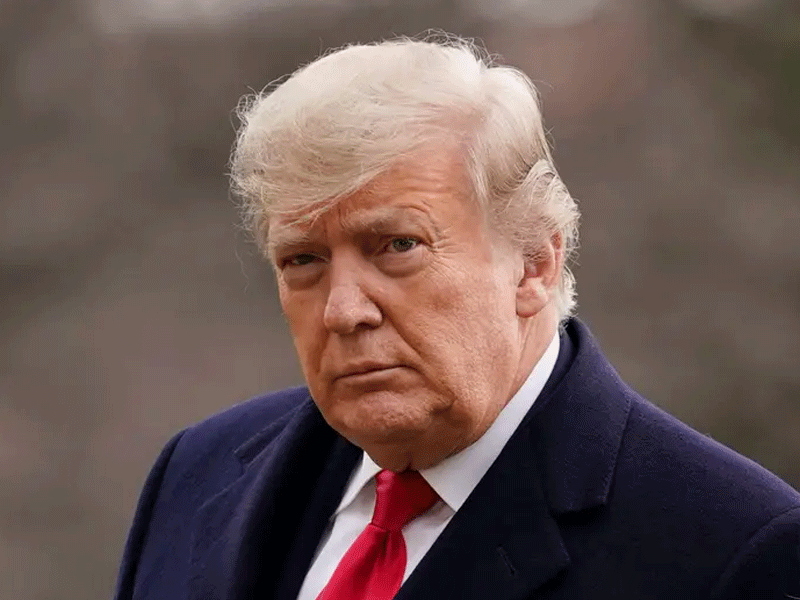
The legislation has passed both chambers of the US Congress and is awaiting President Donald Trump’s signature. Beyond sanctions against Russian officials and companies, it contains measures targeting the country’s oil and gas exports.
Under the legislation, Trump would have the authority to impose tariffs of up to 100 per cent on imports from countries that rank among the five largest buyers of Russian crude oil or natural gas and continue purchasing the supplies.
China criticised the measure, arguing that countries should be free to conduct economic and trade activities based on equality and mutual benefit.
Chinese Foreign Ministry spokesman Guo Jiakun said Beijing’s trade relations were not directed against third countries and warned against external pressure or interference.
He also opposed what he described as the extraterritorial application of national laws without a basis in international law or authorisation from the UN Security Council.
The issue comes as US China relations face another sensitive moment, with Chinese President Xi Jinping expected to travel to Washington next week.
India also raised concerns about the potential consequences of the legislation. Its Foreign Ministry said New Delhi had discussed the issue with senior US officials in recent months.
The government said the implications for both the India US relationship and the international energy market had been clearly communicated to Washington.
India also reaffirmed its focus on maintaining energy security for its 1.4 billion people while continuing to diversify its sources of supply.
The country remains a major buyer of Russian crude, although its purchases declined in August.
Data from commodity provider Kpler, cited by the Indian Express, showed that Indian imports of Russian crude fell 26.3 per cent from a record level in July to 2.08 million barrels per day in August.
Russia’s share of India’s crude oil imports also declined from nearly 60 per cent to 45 per cent during the period.
Kpler said the change appeared to reflect a normalisation of market conditions rather than a structural shift away from Russian crude.
THE ISSUES
- The legislation could extend the economic impact of US sanctions beyond Russia by allowing tariffs against countries that continue purchasing Russian energy, potentially affecting major trading partners.
- China and India are both significant participants in global energy trade, meaning restrictions affecting their purchases could have consequences beyond their bilateral relations with the United States.
- India’s lower Russian crude purchases in August show a change in import volumes, although Kpler’s assessment suggests the decline does not necessarily represent a long term shift away from Russian supplies.
- The dispute adds another issue to the broader US China relationship, particularly with a high level meeting involving the two countries expected next week.
WHAT’S BEING SAID
“China maintains ‘normal economic and trade relations with all countries in the world based on equality and mutual benefit.’” – Guo Jiakun, Chinese Foreign Ministry spokesman
“Its potential implications for not just the bilateral relationship but also the international energy market have been very clearly articulated by the Indian side.” – Indian Ministry of Foreign Affairs
WHAT’S NEXT
The legislation is awaiting Trump’s signature before it can take effect. India has indicated that discussions with US officials on its potential implications have already taken place, while China has reiterated its opposition to extraterritorial sanctions.
BOTTOM LINE
The proposed US measures could extend pressure on Russia to countries that continue buying its energy, putting China and India among the major economies with interests directly affected by the legislation. The potential impact will depend on how the measures are implemented and how affected countries respond.