Key points
- China has announced a ¥200 million (RMB 200 million) grant to Nigeria to support development projects jointly agreed by both governments.
- The grant is valued at approximately N40.32 billion, based on the exchange rate referenced in the report.
- The announcement was made during talks between Chinese Ambassador to Nigeria Yu Dunhai and Nigeria’s Permanent Secretary, Ministry of Foreign Affairs, Dr Dunoma Umar Ahmed.
- China has not yet disclosed the specific projects that will receive funding.
- Beijing said the grant forms part of efforts to deepen the China-Nigeria Comprehensive Strategic Partnership.
- Nigeria pledged to ensure that the grant is effectively utilised for the agreed projects.
- China remains Nigeria’s largest trading partner, with bilateral trade reaching N5.68 trillion in Q1 2026.
- Despite the strength of the relationship, Nigeria recorded a N4.51 trillion trade deficit with China during the quarter.
Main Story
China has announced a ¥200 million grant to Nigeria to support the implementation of development projects agreed upon by both countries, in another indication of the deepening economic and diplomatic relationship between Abuja and Beijing.
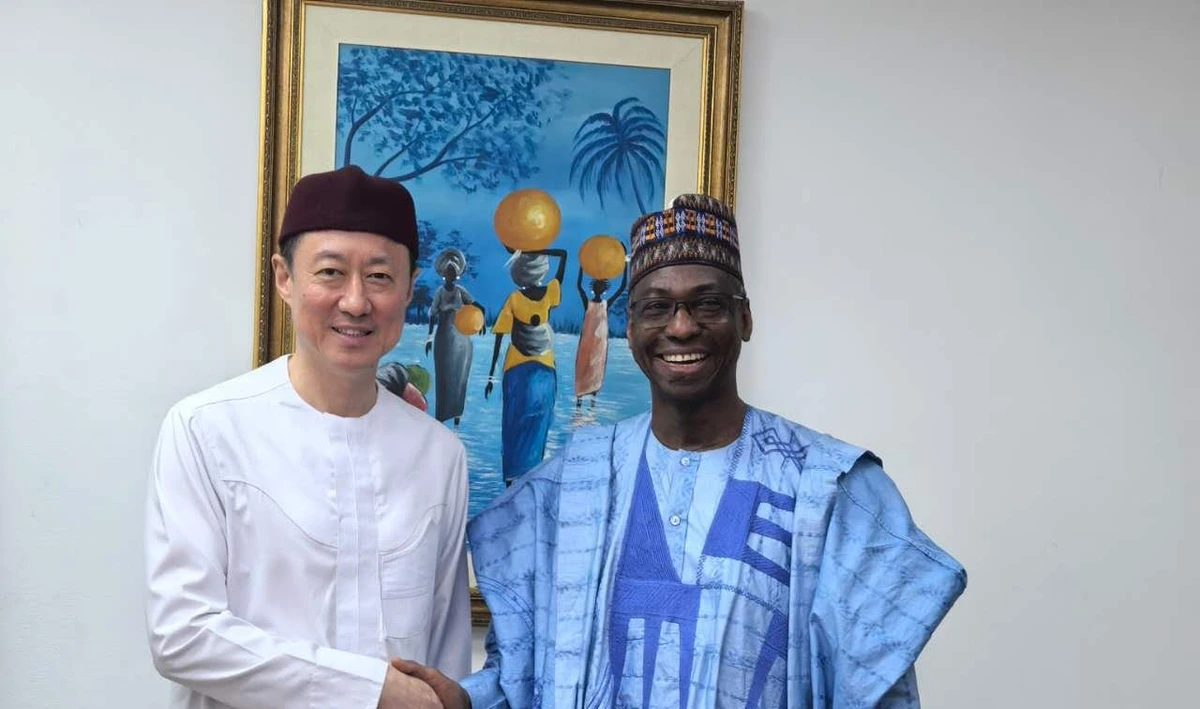
The announcement was made during a meeting between Chinese Ambassador to Nigeria, Yu Dunhai, and the Permanent Secretary of Nigeria’s Ministry of Foreign Affairs, Dr Dunoma Umar Ahmed, in Abuja.
According to the Chinese Embassy, the grant will be used to support projects jointly agreed by the two governments as part of broader efforts to promote Nigeria’s economic development and strengthen bilateral cooperation.
However, Beijing did not disclose the specific projects that will be financed with the grant or when disbursement and implementation will begin.
The announcement comes as Nigeria and China seek to translate their longstanding diplomatic relationship into increased infrastructure, investment and development cooperation.
What’s Being Said
Chinese Ambassador Yu Dunhai said China and Nigeria had maintained strong relations for more than five decades, describing the partnership as an important component of China-Africa relations.
He said the relationship had entered a new phase under the leadership of Chinese President Xi Jinping and Nigerian President Bola Ahmed Tinubu.
“China will provide RMB 200 million in grant assistance to Nigeria for the implementation of projects agreed upon by the two governments.”
The ambassador said both countries had maintained close communication while working to implement agreements reached by their respective leaders.
He added that Beijing and Abuja were also working to implement the outcomes of the 2024 Forum on China-Africa Cooperation (FOCAC) Beijing Summit, with the objective of ensuring that bilateral cooperation produces tangible benefits for citizens.
On Nigeria’s part, Dunoma thanked China for its support and pledged that the grant would be effectively utilised.
The Permanent Secretary said the assistance demonstrated China’s commitment to Nigeria’s economic and social development and reflected the longstanding friendship between both countries.
The Issues
While the grant represents additional development financing for Nigeria, the absence of details about the projects means the immediate economic impact cannot yet be fully assessed.
The effectiveness of the intervention will ultimately depend on project selection, transparency, implementation and monitoring.
There is also a broader question surrounding Nigeria’s economic relationship with China.
Although China provides significant infrastructure financing, investment and development support, Nigeria’s trade relationship with the Asian economic giant remains heavily tilted in China’s favour.
The challenge for Nigeria is therefore to ensure that development assistance and investment translate into stronger domestic production, technology transfer, employment and export capacity rather than deepen dependence on imported goods.
Nigeria-China Economic Relationship
China’s relationship with Nigeria extends well beyond diplomatic ties.
Chinese companies have become major participants in Nigeria’s infrastructure, manufacturing, energy and construction sectors, while Chinese goods account for a substantial share of Nigeria’s imports.
In Q1 2026, Nigeria-China trade stood at approximately N5.68 trillion, according to data from the National Bureau of Statistics.
Nigeria imported goods worth about N5.10 trillion from China during the period, while exports to China amounted to approximately N582.20 billion.
That produced a trade deficit of about N4.51 trillion in China’s favour.
The figures demonstrate the enormous scale of the relationship, but they also highlight one of its most persistent challenges: Nigeria buys significantly more from China than it sells to the country.
China as Nigeria’s Major Trading Partner
China retained its position as Nigeria’s largest trading partner in Q1 2026, having moved up from second place in the corresponding quarter of 2025.
Chinese products imported into Nigeria include machinery, electronics, industrial equipment, chemicals and a wide range of manufactured goods.
Nigeria’s exports to China, meanwhile, remain more concentrated around mineral and energy-related commodities.
This structure creates an opportunity for Nigeria to use its relationship with China to expand its productive capacity and diversify exports.
The latest grant could contribute to that objective if the funded projects are strategically targeted at infrastructure, industrial development, human capital and productive sectors.
The Wider Investment Picture
China’s engagement with Nigeria also includes major construction and energy projects.
A 2025 assessment by China energy expert Christoph Nedopil estimated Nigeria’s Belt and Road Initiative construction contracts at about $24.6 billion during the year.
The figure represented a significant increase from the previous year and placed Nigeria among the largest destinations for Chinese BRI construction activity.
A substantial portion of the estimated commitments was linked to the proposed Ogidigben Gas Revolution Industrial Park in Delta State.
The 2,700-hectare industrial park is designed to accommodate gas-based industries including fertiliser, methanol, petrochemicals and aluminium production.
If fully implemented, the project is expected to generate substantial employment and deepen Nigeria’s industrial capacity.
The Development Assistance Dimension
The latest ¥200 million grant adds another layer to China’s growing engagement with Nigeria.
Unlike commercial loans, grants do not ordinarily carry the same repayment obligation, making them potentially valuable for development projects where direct financial returns may be limited.
China has also previously provided humanitarian assistance to Nigeria. In August 2025, the Chinese government donated $1 million to support communities affected by severe flooding.
The new grant, however, appears to be more closely tied to bilateral development priorities agreed by the two governments.
What’s Next
The immediate next step will be for Nigeria and China to identify and implement the projects covered by the grant.
The Nigerian government will need to ensure transparent project selection, effective monitoring and proper utilisation of the funds.
For Nigeria, the larger strategic objective should be to use its relationship with China to secure technology transfer, local manufacturing, infrastructure development and export opportunities.
For China, the grant reinforces its broader strategy of strengthening economic and diplomatic partnerships across Africa.
Bottom Line
The ¥200 million Chinese grant provides Nigeria with additional resources for development while reinforcing the increasingly strategic relationship between Abuja and Beijing.
But the bigger opportunity lies beyond the value of the grant itself.
With China accounting for a substantial share of Nigeria’s imports and remaining its largest trading partner, Nigeria must increasingly seek to convert the relationship from one dominated by imports and infrastructure projects into a more balanced partnership built around production, technology, investment and exports.
The success of the latest grant will therefore depend not merely on how much money is provided, but on what it builds, who benefits and whether it helps Nigeria expand its productive capacity.