






What Nigerians would really be paying at the pump and beyond if Africa’s biggest refinery had never come on stream
Nigerians complain, with good reason, that petrol at over N1,000 a litre still stings. But run the counterfactual, an economy where the Dangote Petroleum Refinery never fired up its 650,000-barrel-per-day units and the picture gets considerably gloomier.
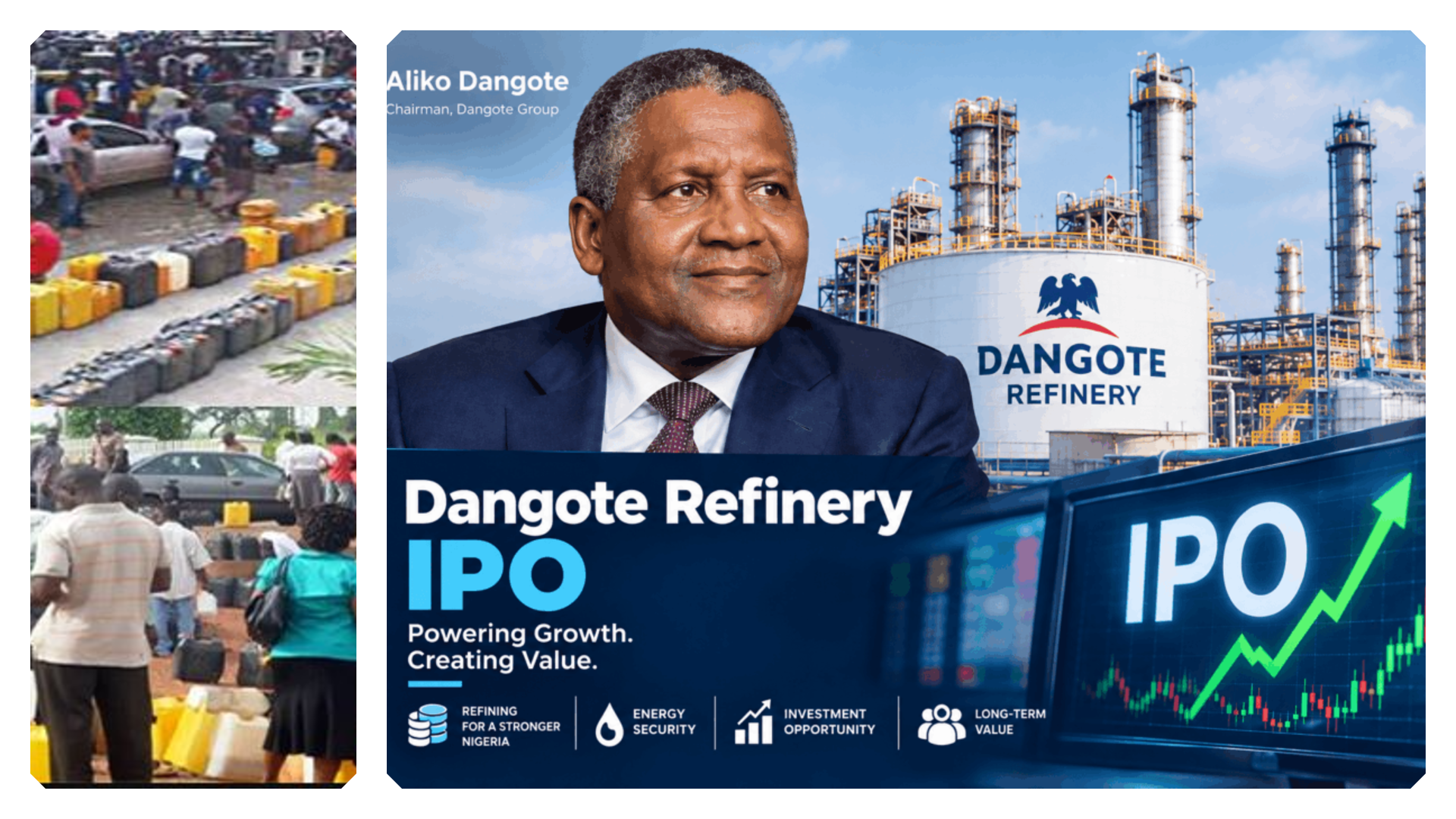
Since Premium Motor Spirit began flowing out of the Lekki Free Trade Zone in September 2024, the conversation around fuel pricing in Nigeria has shifted from “how do we survive scarcity” to “why isn’t domestic refining cheaper.” It’s a fair question. But it skips over what the refinery actually changed: not necessarily the sticker price at the pump, but the plumbing behind it such as how much dollar demand the country generates every month, how exposed it is to global shocks, and whether a queue at the filling station is a monthly event or a distant memory.
The Petrol Price Nigerians Almost Had
Petrol has travelled a brutal road since May 2023: from roughly N185–N195 a litre under the old subsidy regime, past N600, and above N1,030 in Lagos by October 2024 even with Dangote’s supply entering the market. Today, ex-depot prices sit in the N1,175–N1,215 range, among the more affordable in the region by some measures.
Strip Dangote out of that story and two things change. First, there is no domestic price anchor forcing imported fuel to compete as recently as this year, Dangote’s ex-gantry price has undercut the landing cost of petrol trucked in from Lomé, a discipline that simply doesn’t exist without a local refiner in the mix. Second, the roughly $4 billion a year in forex demand that import substitution has freed up would instead remain a permanent drain on the naira and a weaker naira raises the landed cost of every litre still being shipped in.
Put those two forces together and a defensible estimate lands petrol somewhere in the N1,700–N2,200-plus range today, with the added indignity of periodic scarcity, the queues and black-market premiums that defined the pre-2024 market rather than the merely expensive, but generally available, fuel Nigerians grumble about now.
Jet Fuel: The Scarcity Nigeria Barely Escaped
Aviation fuel is where the counterfactual bites hardest. Dangote’s refinery is now Nigeria’s dominant source of Jet A1, and the country’s jet fuel imports fell from roughly 13,000 barrels a day in 2023 to just 5,000 in 2024 as domestic output took over. Even so, this year’s global crude shock driven by Middle East tensions pushed Jet A1 from about N900 a litre in February to as high as N3,300 by April, before Dangote intervened with price cuts and interest-free credit facilities for marketers and airlines.
That is the performance of a market with a domestic buffer. Take the buffer away, and Nigeria faces the same global spike with none of the cushioning and with the physical scarcity problem restored on top of it. Industry veterans are blunt about the pre-2024 market: it combined a price problem and an availability problem at the same time. Import-only pricing addresses neither.
The Forex Arithmetic
Nigeria’s petrol import bill fell from about $14.06 billion in 2024 to roughly $10 billion in 2025 as Dangote’s output displaced imports, a drop of nearly 30%, and about $4 billion in foreign exchange that didn’t have to leave the country. That is money that, in the counterfactual, keeps draining reserves and keeps the naira under pressure, year after year, regardless of what any given barrel of crude costs.
It’s a slow-moving number, easy to lose in the noise of daily pump-price headlines. But it compounds. A naira that is structurally weaker because it’s still financing a full import bill for petrol, diesel and jet fuel is a naira that makes every other import like food, machinery, medicine more expensive too.
Inflation’s Missing Multiplier
Nigeria’s headline inflation eased to 15.39% in August 2026, down sharply from 28.32% a year earlier which is a genuine disinflation story, helped along by CPI rebasing and aggressive monetary tightening that took the policy rate from 18.5% to 26.5%. Fuel isn’t the whole explanation, but it’s a meaningful chapter: transport and logistics costs feed directly into the price of nearly everything else in a country where road haulage moves most food and goods.
Without Dangote’s moderating effect on fuel supply and forex demand, the honest expectation is that this disinflation would have been slower and shallower plausibly leaving headline inflation somewhere in the low-to-mid 20s% today rather than the mid-teens. Not because the refinery single-handedly tamed prices, but because it removed one of the recurring shocks which are fuel scarcity plus forex scarcity, hitting simultaneously and kept driving the cost of everything else.
At a Glance: Actual vs. Counterfactual
The estimates below are a modeled scenario, not a precise measurement. No analysis can cleanly separate the refinery’s effect from the subsidy removal, the naira float and global crude cycles that all landed around the same time. But they reflect the direction and rough scale the underlying data supports.
| Fuel / Metric | Actual (Sept 2026) | Without Dangote (modeled) | Why the Gap |
| Petrol (PMS) | ≈ N1,175–1,215/litre | ≈ N1,700–2,200+/litre | No domestic price anchor undercutting import parity; sustained forex drain weakens the naira further |
| Diesel (AGO) | Broadly stable, naira-priced | Higher, dollar-linked, more volatile | Trucking and logistics costs — a core driver of food inflation — stay elevated longer |
| Jet A1 (Aviation Fuel) | N1,650/litre, spiked to N3,300 in April | Higher peaks, plus physical scarcity | Pre-2024 Nigeria had a scarcity problem and a price problem together; imports alone don’t fix either |
| Petrol import bill | ≈ $10bn (2025) | ≈ $14bn+ annually, recurring | The ~$4bn/year saved by import substitution stays as permanent forex demand instead |
| Headline inflation | 15.39% (Aug 2026) | Plausibly low-to-mid 20s% | Weaker naira and costlier logistics feed straight back into food and transport prices |
What This Actually Means
The Dangote Refinery has not made petrol cheap in Nigeria, and it would be dishonest reporting to pretend otherwise. But strip it out of the picture entirely, and the counterfactual is not merely “more expensive fuel”, it is a return to a version of Nigeria many had hoped was behind them. This is a fair description of the Nigeria that still exists today, but an even starker one would exist without Dangote.
It is filling stations shuttered for days at a stretch, and the queues that once strectched for kilometres on highways and wrapped around city blocks becoming a fixture again rather than a memory. It is offices, factories and markets losing working hours to fuel runs, because economic activity in Nigeria still moves on the back of a jerrycan. It is airlines grounding routes and airfares climbing further out of reach, not because tickets got pricier in isolation, but because Jet A1 is simply not there to buy at any price on the worst days. And it is diesel-starved trucks sitting idle at depots while the cost of moving anything like food, cement, fabric, machinery being passed down the chain until it lands, inflated, on a market woman’s price tag and a household’s monthly budget.
That is the real cost of an import-only fuel market: not a smoothly higher price line, but scarcity that arrives without warning and radiates outward into lost workdays, grounded flights, stalled logistics, and the staggering, compounding cost of getting goods and services to the people who need them. The debate worth having isn’t “is fuel expensive” it plainly still is. It’s whether Nigeria is capturing the full value of no longer living that way, and whether the savings on forex and stability are being reinvested visibly enough for citizens paying over N1,000 a litre to feel like they’re part of the same story.
On the numbers, the counterfactual makes an unglamorous but important case: things are bad, but the plumbing changed and without it, they would plausibly be a great deal worse.
The Executive Mandate
For Nigeria’s corporate leadership and policymakers, the takeaway here is not to slip into complacency. The domestic refining buffer has granted us structural breathing room, but a buffer is only useful if you build behind it. Policymakers must treat this temporary stabilization of our forex drainage as a window to aggressively repair the broken transmission channels of our real economy and fix the logistics corridors, modernize rail networks, and drive agricultural self-sufficiency. Meanwhile, private sector executives across manufacturing and FMCG must stop waiting for a miraculous drop in nominal fuel prices. The ₦1,000 pump price is our new baseline reality. The winning strategy now is not surviving the shock, but aggressively re-engineering supply chains to optimize for predictable, domestic inputs. We have escaped the chokehold of absolute scarcity; our remaining task is to build out the productivity required to afford the new price of stability.