By Boluwatife Oshadiya | August 10, 2026
Key Points
- Cameroon’s 1-0 quarter-final win over Nigeria at WAFCON 2026 ended the Super Falcons’ title defence and automatic World Cup qualification
- Four WAFCON semi-finalists (Algeria, Cameroon, Malawi, Morocco) secure Africa’s direct tickets to the 32-team tournament in Brazil
- Nigeria joins South Africa, Ghana and Côte d’Ivoire in African play-offs for two intercontinental spots
- Super Falcons face South Africa on Thursday; winners advance to FIFA’s two-phase Play-Off Tournament
- Success requires winning the African play-off then navigating the intercontinental pathway in late 2026 and early 2027
Main Story
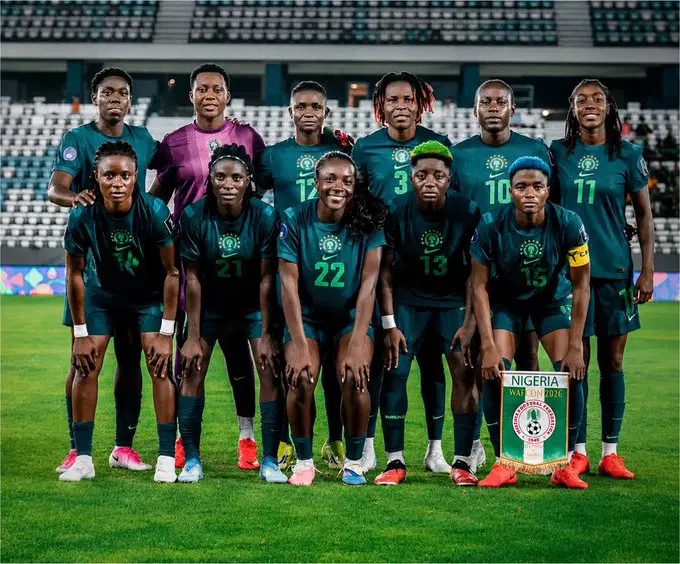
Nigeria’s Super Falcons suffered a 1-0 quarter-final defeat to Cameroon at the 2026 Women’s Africa Cup of Nations in Casablanca on 9 August, ending their bid to defend the continental title and missing automatic qualification for the 2027 FIFA Women’s World Cup.
Nineteen-year-old Myriam Nyadjou’s long-range free-kick in the 19th minute proved decisive. Cameroon goalkeeper Michaely Bihina produced a series of important saves as Nigeria created multiple chances but failed to convert. The result marked Nigeria’s earliest exit at a WAFCON finals and the first time the ten-time champions failed to reach the semi-finals.
The 2026 WAFCON doubles as Africa’s qualifying pathway for the expanded 32-team Women’s World Cup, which Brazil will host from 24 June to 25 July 2027. The four teams that reach the semi-finals — Algeria, Cameroon, Malawi and Morocco — earn Africa’s four direct places.
The four quarter-final losers still have a route. Nigeria, South Africa, Ghana and Côte d’Ivoire will contest African play-offs. Nigeria face South Africa on Thursday (13 August). The winners of the two ties (Nigeria–South Africa and Ghana–Côte d’Ivoire) advance as Africa’s two representatives to FIFA’s inter-confederation Play-Off Tournament.
Here is how the Super Falcons can still reach Brazil:
- Win the African play-off Nigeria must defeat South Africa to claim one of the two continental places allocated to the Play-Off Tournament. Defeat ends qualification hopes immediately.
- Advance through the intercontinental Play-Off Tournament The two African qualifiers join eight other nations (two each from AFC, Concacaf and CONMEBOL, plus one each from OFC and UEFA) in a ten-team competition.
- Win their assigned pathway FIFA’s format splits the tournament into two phases. The first phase (November–December 2026) features six teams ranked by the latest FIFA/Coca-Cola Women’s World Ranking: two from AFC, two from CAF, one from CONMEBOL and one from OFC. Two teams advance. The final phase (February 2027) brings those two together with two Concacaf sides, one CONMEBOL side and one UEFA side. The six teams are drawn into three pathways. A single knockout match in each pathway decides the three remaining World Cup places. Teams from the same confederation cannot be drawn against each other.
FIFA confirmed: “The six teams will be drawn into three paths, with a direct knockout match to determine the final three teams qualifying for the FIFA Women’s World Cup 2027. Teams from the same confederation will not be permitted to be drawn in the same pathway.”
The Issues
Nigeria has appeared at every FIFA Women’s World Cup since the inaugural 1991 edition — a unique unbroken record among African sides. Missing the 2027 tournament would end that streak and represent a significant setback for a programme that has long set the continental standard.
The expanded 32-team format and revised qualification structure give Africa a theoretical maximum of six teams at the finals (four direct plus two via play-offs). This is an improvement on previous cycles, yet the pathway for the quarter-final losers is longer, more complex and carries greater risk. Success requires two further knockout victories spaced months apart, against potentially stronger opposition from other confederations, with no home advantage guaranteed in the centralised play-off venues.
The Super Falcons’ recent form at WAFCON — an opening-group loss to Malawi followed by recovery wins over Zambia and Egypt — already signalled vulnerability. Failure to convert clear chances against Cameroon compounded the problem. Structural questions around clinical finishing, squad depth and preparation under pressure now sit alongside the immediate sporting challenge of the play-off route.
What’s Being Said
Super Falcons head coach Justin Madugu accepted responsibility after the Cameroon defeat and pointed to the second chance still available.
“The ladies did the best that they could do but that’s the way the game could go. We apologise and I take responsibility for that,” Madugu said. “But we still have a second chance and we will do our best to see what comes out of it.”
He added that Nigeria created more clear opportunities against Cameroon than in previous tournament matches yet lacked the required precision: “In all the games they played, they never created the type of chances they created today but it’s just that the conversion was not right and we were not precise and clinical with our finishing.”
FIFA’s official description of the Play-Off Tournament underscores the multi-stage nature of the remaining route and the protection against same-confederation match-ups in the final phase.
What’s Next
- Thursday 13 August: Nigeria vs South Africa in the African play-off (Casablanca). Winner progresses; loser is eliminated from World Cup contention.
- Parallel African play-off: Ghana vs Côte d’Ivoire. The two winners become Africa’s representatives in the inter-confederation tournament.
- November–December 2026: First phase of the FIFA Play-Off Tournament (centralised venue, six teams).
- February 2027: Final phase (centralised venue). Three pathway winners qualify for Brazil 2027.
- WAFCON semi-finals take place on 12–13 August, with the final scheduled for 16 August. Those matches determine the continental champion but no longer affect Nigeria’s World Cup path.
The Bottom Line: The Super Falcons’ earliest WAFCON exit in modern history has closed the direct door to Brazil but left a narrow, multi-stage corridor open. Qualification is still mathematically possible, yet it now demands two further high-stakes knockout wins across different competition windows and against broader international opposition. Nigeria’s unbroken World Cup record since 1991 hangs on their ability to regroup quickly, convert the chances that deserted them against Cameroon, and navigate a pathway designed to be unforgiving.