




By Boluwatife Oshadiya | July 20, 2026
Key Points
- Andy Burnham was sworn in as the UK’s 59th prime minister on July 20, 2026, succeeding Keir Starmer without a general election after winning Labour Party leadership support.
- The former Greater Manchester mayor, nicknamed the “King of the North,” has pledged immediate cost-of-living relief, action on homelessness, and a 10-year national plan to rewire Britain through devolution and regional rebalancing.
- Burnham brings over two decades of experience, including senior cabinet roles under Gordon Brown, but faces immediate challenges including economic pressures, public services strain, and restoring political trust.
Main Story
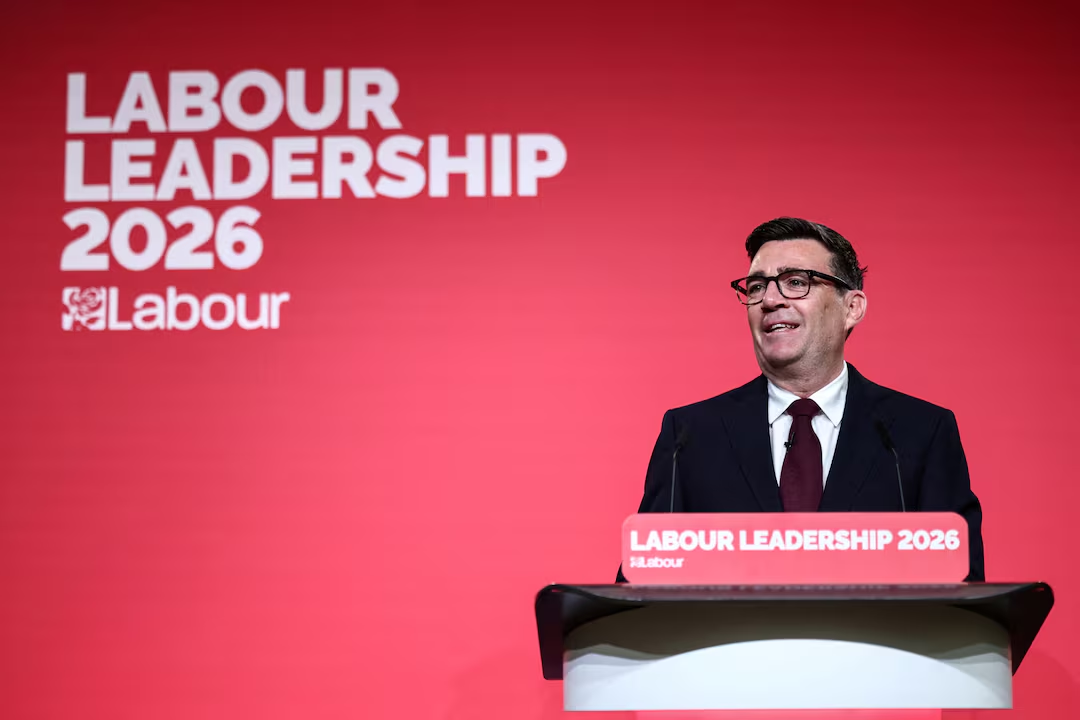
Andy Burnham officially became the United Kingdom’s new prime minister on Monday after succeeding Keir Starmer as leader of the governing Labour Party, making him the seventh British prime minister in a decade.
The former Greater Manchester mayor took office after Starmer resigned and formally handed over power following an audience with King Charles III at Buckingham Palace. Burnham, 56, was invited by the King to form a government.
Here are 10 key facts about Britain’s new leader, drawn from his long political journey and immediate priorities upon entering 10 Downing Street.
1. He is Britain’s 59th prime minister Burnham formally became prime minister after being invited by King Charles III to form a government following Keir Starmer’s resignation. He is the seventh person to occupy 10 Downing Street in the past decade, underlining a prolonged period of political instability.
2. He rose to prominence as Greater Manchester mayor Burnham has served as Mayor of Greater Manchester since 2017, winning three consecutive elections. His leadership in England’s largest city-region helped build his national profile, particularly through transport reforms such as the Bee Network, housing initiatives, and calls for greater regional autonomy.
3. He has spent more than two decades in frontline politics Elected to Parliament in 2001 (initially for Leigh, later Makerfield), Burnham held several senior cabinet positions under former Labour Prime Minister Gordon Brown, including Chief Secretary to the Treasury, Culture Secretary, and Health Secretary. He also served as Shadow Home Secretary while Labour was in opposition.
4. He survived political setbacks before reaching Downing Street Burnham unsuccessfully contested the Labour leadership in 2010 and again in 2015 before rebuilding his career in local government. His return to national politics has been widely viewed as one of Britain’s most notable political comebacks.
5. He is known as the ‘King of the North’ The nickname reflects his strong advocacy for northern England, where he has consistently argued that governments have concentrated too much power and investment in London and the south-east. As mayor, he campaigned for more furlough funding during COVID-19 and pushed for devolution. As prime minister, he has vowed to redistribute power across the UK.
6. He studied at Cambridge University Born in Aintree near Liverpool in 1970, Burnham studied English at Fitzwilliam College, University of Cambridge. He joined the Labour Party as a teenager before working as a political researcher and adviser ahead of entering Parliament.
7. He has made the cost of living his first priority In his inaugural speech outside 10 Downing Street, Burnham pledged to unveil measures to ease pressure on household finances. He promised that his government would begin announcing cost-of-living support immediately, including potential help with energy bills and bus fares.
8. He wants to tackle homelessness and expand social housing Burnham said his first instruction as prime minister would be to end rough sleeping across Britain. He has also pledged a major programme of council house construction and broader reforms aimed at improving housing affordability, stating that “Everything starts with a good home.”
9. He favours greater public control of key services Although he has stopped short of promising widespread nationalisation, Burnham has proposed stronger public oversight of essential services, while arguing for a new economic model that combines public investment with private enterprise. He supports public intervention where necessary to set higher ambitions for towns.
10. He promises a ‘rewired’ Britain Burnham says his government will pursue the biggest political and economic changes in four decades through a 10-year national plan focused on devolving power, rebuilding industry, improving living standards, and restoring confidence in government. He plans to establish a “No. 10 North” unit in Manchester to drive regional rebalancing.
The Issues
Burnham inherits a government facing mounting pressure over the economy, public services, and political trust. Key structural challenges include Britain’s high cost of living, pressure on the National Health Service (NHS), sluggish economic growth, housing shortages, and concerns over public finances. His rise highlights ongoing questions about regional inequalities, with northern England often feeling sidelined by Westminster-centric policies. The rapid turnover of prime ministers—seven in a decade—points to deeper instability in the UK’s political system.
Devolution remains a central tension. Burnham’s track record as mayor, including transport improvements and advocacy during the pandemic, underscores demands for more power and funding for regions outside London. Whether his 10-year plan can deliver tangible “equivalent living conditions” across Britain will test the limits of rebalancing in a unitary state.
What’s Being Said
“Later this year I will bring forward a new plan for Britain — a 10 year plan laying out a path from where we are now to where I believe we all want Britain to be… I can do something to give people some breathing space now.” — Andy Burnham, in his first statements as prime minister.
Supporters credit his northern roots and practical achievements, such as freezing bus fares, with delivering for ordinary people. Critics question the funding for ambitious pledges amid tight public finances.
What’s Next
Burnham is expected to set out initial cost-of-living measures as soon as tomorrow. A fuller 10-year national plan is slated for later in 2026. The next UK general election is not due until 2029 unless called earlier. His government will also need to navigate party unity, NHS pressures, and regional devolution talks.
The Bottom Line: Andy Burnham’s ascent marks another chapter in Britain’s turbulent politics, but his “King of the North” mandate offers a chance to address long-standing regional divides and economic pressures through devolution and targeted relief. Success will depend on translating ambitious pledges into deliverable outcomes amid constrained finances and high public expectations. For global markets and investors watching the UK, his focus on stability, housing, and public services signals a shift toward more interventionist regional policies.