







Home Blog Page 91

Health Minister Urges States, LGs To Step Up Healthcare Funding Amid Decline In Foreign Aid

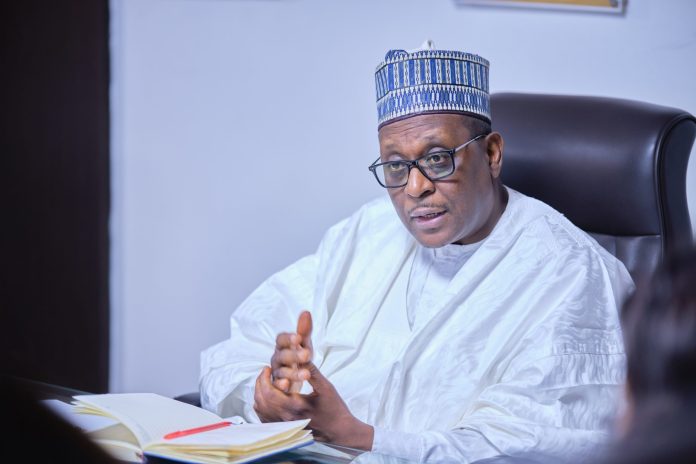
Minister of Health and Social Welfare, Prof. Muhammad Ali Pate, has called on federal, state, and local governments to take greater responsibility for financing and strengthening Nigeria’s healthcare system as foreign aid dwindles.

Speaking yesterday in Abuja at the National Health Financing Policy Dialogue organised by the National Health Insurance Authority (NHIA), Pate warned that households are bearing an unsustainable share of healthcare costs, with out-of-pocket expenditure exceeding 70 per cent.

He expressed concern that only about 10 per cent of Nigerians are covered by health insurance, with wide regional disparities, while counterpart funding for the Basic Healthcare Provision Fund (BHCPF) remains inconsistent, often delayed or unreleased.

Pate also highlighted accountability gaps in the system, noting challenges in tracking funds and linking them to measurable health outcomes. He stressed that high financing costs and regulatory bottlenecks continue to discourage private-sector investment in healthcare.

Despite these challenges, the minister said Nigeria’s fiscal position has improved significantly. He revealed that the country’s consolidated fiscal deficit shrank from 5.4 per cent of GDP in 2023 to 3.0 per cent in 2024, buoyed by a surge in government revenues—from N16.8 trillion in 2023 (7.2 per cent of GDP) to N31.9 trillion in 2024 (11.5 per cent of GDP). He noted that while the federal government recorded strong gains, state governments on aggregate achieved a fiscal surplus, though performance varied widely.

Also speaking, the Minister of Budget and Economic Planning, Senator Abubakar Atiku Bagudu, said the government has introduced mechanisms to attract more investment into the health sector. He acknowledged, however, that the combined resources from both public and private sectors remain far below what is needed to cater to Nigeria’s population of more than 220 million.
FG Issues Five-Day Flood Alert In 14 States

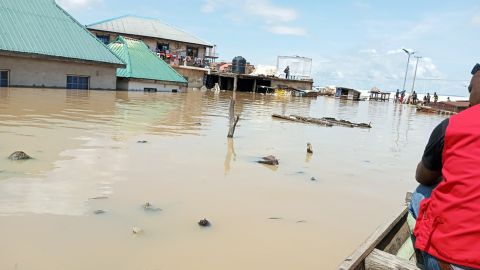
The Federal Government has warned that 14 states across Nigeria are at risk of flooding between Thursday, September 4, and Monday, September 8, 2025, following forecasts of heavy rainfall in 43 locations nationwide.

The alert was issued yesterday by the National Flood Early Warning Centre of the Federal Ministry of Environment and signed by the Director of the Erosion, Flood and Coastal Zone Management Department, Usman Abdullahi Bokani.

According to the statement, vulnerable areas include parts of Ebonyi (Afikpo), Cross River (Edor, Ikom, Itigidi, Akpap), Kano (Gwarzo, Karaye), Zamfara (Anka, Gummi, Kaura Namoda, Maradun, Shinkafi, Bukkuyum), Taraba (Dampar, Duchi, Garkowa, Gassol, Gembu, Kambari, Mayo Ranewo, Mutum Biyu, Bandawa, Ngaruwa), Abia (Eziama, Umuahia), Yobe (Geidam, Kanama, Potiskum) and Plateau (Langtang, Shendam, Wase).

Others are Borno (Ngala), Imo (Okigwe, Otoko), Niger (Sarki Pawa), Sokoto (Sokoto, Wamakko, Isa, Shagari, Makira), Kaduna (Kafanchan), and Akwa Ibom (Oron).

The ministry noted that climate change and poor drainage infrastructure have heightened the risks for many communities, urging state governments and residents to take precautionary measures.

In Lagos, Commissioner for Waterfront Infrastructure Development, Dayo Alebiosu, speaking ahead of the state’s maiden Waterfront Summit scheduled for September 11 on Victoria Island, warned of growing threats to the Lagoon. He said coastal erosion had already wiped out Idotun Village in Ibeju-Lekki, displacing residents and destroying livelihoods, while similar challenges were being recorded in other West African countries.

The summit, themed “Pressure on the Lagoon: The Lagos Experience,” will convene over 500 global experts to seek sustainable solutions to rising sea levels and erosion.

Meanwhile, in Abuja, the Minister of Budget and Economic Planning, Senator Abubakar Bagudu, signed exchange notes on financial assistance with the Chinese Ambassador to Nigeria, Yu Dunhai. The support, Bagudu said, would strengthen government’s relief and recovery efforts in flood-affected communities.

“We firmly believe that today’s signing ceremony will open new avenues for collaboration, strengthening our strategic partnership for the mutual benefit of our peoples,” Bagudu stated, adding that the funds would be managed transparently under a joint monitoring mechanism with the Chinese Embassy.

Ambassador Dunhai reaffirmed China’s solidarity with Nigeria, recalling recent flooding in both countries, and pledged continued cooperation in disaster response.

Report: 80 Million Nigerian Youths Jobless, 1,500 Schools Closed In Two Years

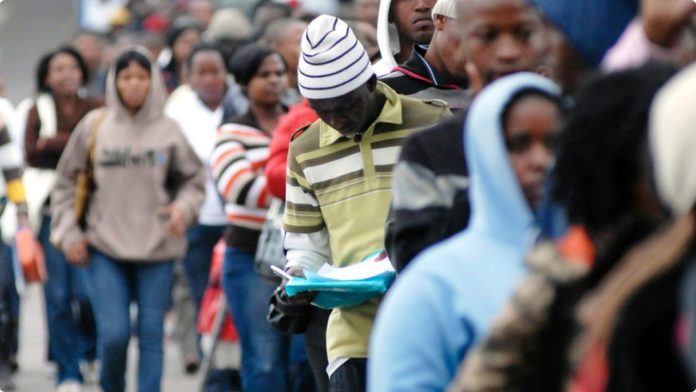
A new report by Plan International Nigeria has revealed that nearly 80 million Nigerian youths are unemployed, while more than 1,500 schools have been forced to shut down in the past two years due to worsening insecurity.

The findings, contained in the State of the Nigerian Youth Report 2025, were presented in Abuja on Wednesday by the organisation’s Advocacy and Youth Programme Officer, Jonathan Abakpa, during a youth dialogue convened by the House of Representatives Committee on Youth in Parliament to mark International Youth Day.

According to the report—produced in collaboration with ActionAid Nigeria and policy experts—the closures have left over one million children out of school, exacerbating Nigeria’s education crisis.

Despite being home to one of the world’s largest youth populations, with more than 60 per cent of its citizens under 30, Nigeria continues to grapple with unemployment, insecurity, poverty, and weak infrastructure. The report warned that without urgent reforms, the country risks squandering its greatest demographic advantage.

It noted that about 1.7 million graduates leave tertiary institutions annually, yet jobs remain scarce. In addition, violence in farming communities has claimed more than 77,000 lives over the past five years, displacing 2.6 million people and threatening food security.

Speaking at the event, Abakpa said: “Nigeria should be a powerhouse of innovation and growth, but systemic challenges are holding back its young people. Unless immediate action is taken, opportunities will continue to be wasted.”

Meanwhile, the Special Adviser to the President on Media and Public Communications, Sunday Dare, urged young Nigerians to seize opportunities provided by ongoing government programmes. Addressing over 24,000 youths at the Arise Congress 2.0 in Lagos, he cited initiatives such as the Nigerian Education Loan Fund (NELFUND), conditional cash transfers, and food security interventions as evidence of the administration’s commitment to youth empowerment.

Dare, who also chairs the Youth and Student Ministries Advisory Board of the Nigerian Baptist Convention, described youths as “champions” of the Tinubu administration, stressing that character, discipline, and determination remain vital to unlocking their potential.

The four-day congress, themed “The Emergence of Champions,” runs from September 3–6, 2025, and features religious and youth leaders, including the President of the Nigerian Baptist Convention, Rev. Israel Adelani Akanji.

WAEC Sets Strict ICT Standards for Schools Ahead of Full Computer-Based Exams in 2026

WASSCE: How To Check 2021 WAEC Result

The West African Examinations Council (WAEC) has announced stringent requirements for schools ahead of the full migration of the West African Senior School Certificate Examination (WASSCE) to computer-based testing (CBT) by 2026.

Head of Examinations, Mr. Lucky Njoagwuani, disclosed the guidelines on Thursday during a sensitisation programme in Port Harcourt, Rivers State.

According to him, schools intending to host the exams must provide at least 250 functional laptops with a 10 per cent backup, a robust server capable of supporting 250 systems simultaneously, and a Local Area Network (LAN) configuration.

Additional mandatory facilities include uninterrupted power supply, a backup generator of not less than 40kVA, functional air conditioning and lighting, closed-circuit television (CCTV) cameras, and a holding room or reception area for candidates.

Njoagwuani explained that the transition to CBT would significantly reduce logistics costs, enhance exam security, and improve accessibility.

“We started with the fourth series of our private candidate exam about two years ago, and it was successful. This year’s second series for private candidates is fully computer-based, with no option for pen and paper. By next year, the school candidate examination will also be fully computer-based,” he said.

Port Harcourt Zonal Coordinator of WAEC, Mr. Adeniran-Amusan Akim, urged schools to begin upgrading their ICT infrastructure in line with WAEC standards, stressing that the council would not compromise on requirements.

“Any school that cannot meet the stipulated facilities will be assigned to designated centres. WAEC will not lower the standards,” he stated.

The Rivers State Chairman of the National Association of Proprietors of Private Schools (NAPPS), Mr. Sunday Jaja, encouraged proprietors to take advantage of financial support from the Bank of Industry and the Federal Government’s MSME intervention fund to ease the cost of compliance.

“Technology is central to modern education. This initiative will keep schools in tune with global best practices and prepare students for the digital age,” Jaja noted.

The sensitisation event was organised by Teadro Systems Ltd in partnership with NAPPS, the Bank of Industry, HP, Lenovo, and Canon. The highlight was the donation of ICT devices, including laptops, printers, and tablets, to selected schools through a raffle draw.

INEC Confirms 2.8 Million Registered Voters For Anambra Governorship Election

The Independent National Electoral Commission (INEC) has announced that 2,802,790 voters are on the register for the forthcoming Anambra State governorship election slated for Saturday, November 8, 2025.

This was contained in a statement on Thursday by the National Commissioner and Chairman of INEC’s Information and Voter Education Committee, Sam Olumekun.

Olumekun explained that the commission conducted a voter registration exercise across all 326 wards of the state between July 8 and 20, 2025, during which 168,187 citizens applied as new registrants.

In line with Section 19(1) of the Electoral Act 2022, the register was displayed for one week to allow claims and objections. The entries were subsequently subjected to the Automated Biometric Identification System (ABIS), which flagged and eliminated 27,817 cases of multiple or duplicate registration.

INEC further approved 5,983 applications for voter transfers into the state, bringing the net addition to 146,353. With this, Anambra’s voter register has risen from 2,656,437 to 2,802,790.

A breakdown of the figures shows Idemili North with the highest voter population at 246,318 (8.79 percent), followed by Awka South with 216,611 (7.73 percent) and Ogbaru with 188,016 (6.71 percent). Dunokofia and Anambra West recorded the lowest figures with 83,580 (2.98 percent) and 71,332 (2.55 percent), respectively.

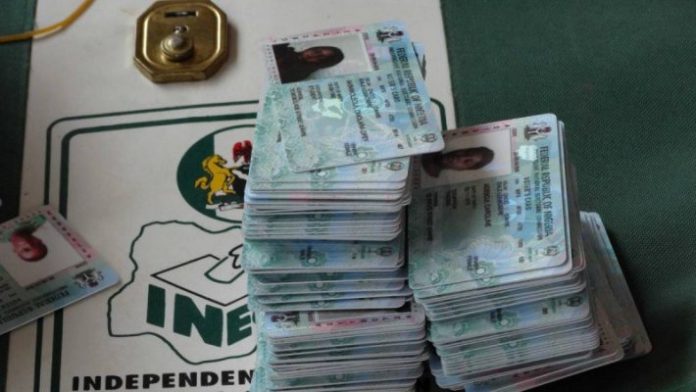
“The full distribution has been published on INEC’s website and official platforms,” Olumekun noted, assuring that Permanent Voter Cards (PVCs) for new registrants, transfers, and replacements would be ready for collection well ahead of the poll, now just 63 days away.

He stressed that the November 8 election forms part of off-cycle governorship polls resulting from judicial adjustments to Nigeria’s electoral calendar.

INEC has already released the final list of candidates and confirmed that political campaigns are underway. Sixteen political parties met the May 12 deadline for submission and will field candidates in the Anambra governorship contest.

IGP Appoints CSP Benjamin Hundeyin As New Force Public Relations Officer

The Inspector-General of Police (IGP), Kayode Adeolu Egbetokun, has approved the appointment of Chief Superintendent of Police (CSP) Benjamin Hundeyin as the new Force Public Relations Officer (FPRO).

This was contained in a press release signed by the outgoing force Public Relations Officer, DCP Olumuyiwa Adejobi, mnipr, on Thursday, 4th September 2025.

 CSP Hundeyin brings with him a wealth of academic and professional experience. He holds a Bachelor of Arts degree in English Language from Lagos State University and a Master’s degree in Legal Criminology and Security Psychology from the University of Ibadan.

In addition, he earned a Certificate in Civil-Military Coordination from the Martin Luther Agwai International Leadership and Peacekeeping Training Centre, Jaji, Kaduna State.

He is an Associate of the Nigerian Institute of Public Relations (NIPR), a member of the International Public Relations Association (IPRA), and an Associate of the Chartered Institute of Personnel Management of Nigeria (CIPM).

A seasoned communicator and public relations strategist, Hundeyin has served in various capacities, including Police Public Relations Officer at Zone 2 Command Headquarters, Onikan, Lagos. He was part of Nigeria’s contingent to the United Nations Peacekeeping Mission in Darfur, Sudan, in 2020, and also served as an Administration Officer at the Force Public Relations Department, Force Headquarters, Abuja. Until his current appointment, he was the spokesperson for the Lagos State Police Command.

While congratulating him on his new role, IGP Egbetokun urged CSP Hundeyin to leverage his extensive communication and security expertise to strengthen the Force’s public engagement and foster positive relations with Nigerians.

CSP Hundeyin can be reached via telephone on 07062606717 or by email at benjamin@hundeyin.com

The outgoing Force Public Relations Officer, Deputy Commissioner of Police (DCP) Olumuyiwa Adejobi, officially handed over the role on Thursday, 4th September 2025, at the Force Headquarters, Abuja.

Gold Prices Surge To Record High On Safe-Haven Demand

Gold Prices

Gold has climbed to a new record high, breaking through $3,575 per ounce, as investors increase their shift into safe-haven assets amid rising geopolitical and economic uncertainties.

The rally has been supported by expectations of imminent US interest rate cuts, a weaker dollar, and strong central bank demand. Analysts say bullion’s momentum highlights growing unease in global financial markets.

The Federal Reserve is widely expected to announce a rate cut this month, as the US labor market weakens and recession risks rise. Lower rates tend to reduce the appeal of cash deposits and government bonds while boosting demand for gold.

The dollar index has slipped to its lowest level in more than a month, further lifting gold’s appeal to overseas buyers. Silver has also gained, crossing $40 an ounce for the first time since 2011.

Central banks remain key drivers of demand. The People’s Bank of China has expanded its bullion reserves for 22 consecutive months, while several Middle Eastern and Asian countries are also accelerating purchases. At the same time, supply growth has stalled due to stagnant mine output, fewer discoveries, and higher environmental costs.

Private investors are also reshaping portfolios. Exchange-traded funds are recording strong inflows, sovereign mints report higher bullion sales, and institutions are increasingly treating gold as a core holding.

Upcoming US non-farm payrolls data is expected to show further deterioration in hiring, strengthening the case for monetary easing. Broader political and fiscal uncertainties, including concerns over rising deficits and trade frictions, are also contributing to gold’s appeal as a hedge against volatility.

Market analysts suggest that gold’s trajectory will remain upward as high debt levels, unstable currencies, and persistent inflation continue to drive demand for safe-haven assets.

FIRS Approves eTranzact As Nationwide E-Invoicing Provider

The Federal Inland Revenue Service (FIRS) has approved eTranzact International Plc as a certified provider for its nationwide e-invoicing programme, building on a collaboration that began with VAT automation under Tax Administration 2.0.

In a statement on Thursday, Adeyemi Opene, head of corporate communications at FIRS, said the approval reinforces eTranzact’s role in the digitisation of tax and business processes.

The e-invoicing platform, known as the Merchant Buyer Solution (MBS), introduces structured digital invoices for business-to-business, business-to-consumer and business-to-government transactions. It is designed to simplify tax processes, improve compliance and enhance transparency in Nigeria’s economy.

Mike Adoga, acting director of tax automation at FIRS, said providers were certified after meeting requirements including nationwide service capacity, proven security, neutrality and scalability. He noted that the National Information Technology Development Agency (NITDA) provided technical input to strengthen data protection and cybersecurity.

Tayo Koleoso, chief of staff to the executive chairman of FIRS, added that providers were carefully selected for their ability to deliver at scale.

Niyi Toluwalope, managing director and chief executive officer of eTranzact, described the certification as an opportunity to transform business–government interaction by creating transparency, efficiency and value for stakeholders.

He explained that the milestone builds on eTranzact’s earlier role in deploying an API system in 2017 with FIRS and banks for secure VAT and withholding tax reporting through TaxPro Max, which established a standard for digital transparency in tax administration.

Beyond tax automation, the company has delivered other government solutions, including a 2024 verification system for the Military Pensions Board that enabled pensioners at home and abroad to authenticate their identities.

Licensed by the Central Bank of Nigeria for switching, processing and mobile money operations, eTranzact has provided payment infrastructure across industries since 2003. Through the e-invoicing rollout, it will support FIRS in digitising invoicing nationwide in line with international standards.

MTN Nigeria Holds Steady At N9.13trn Market Value

PHOTOS: MTN MIP Fellows Visit University of Johannesburg

MTN Nigeria Plc shares traded flat at ₦435 on the Nigerian Exchange (NGX), with momentum stalling after weeks of steady movement.

The telecom giant’s market price remains 12.1% below its 52-week high of ₦495, according to NGX data. Over the past seven sessions, the stock has shown little movement, reflecting a lack of fresh catalysts to drive investor activity.

Despite no dividend payout in the past year, MTN Nigeria had previously rallied to ₦495 per share on the back of improved investor sentiment. Analysts, however, remain divided on the timeline for dividend resumption. The company’s earnings recovery has fueled optimism, but its shareholders’ funds remained negative in the first half of 2025.

Some projections suggest dividends could return by 2026 if earnings momentum is sustained.

At the close of trading on Thursday, NGX valued MTN Nigeria’s 20.99 billion outstanding shares at ₦9.13 trillion, representing a 12.12% discount to its peak valuation in the past year.

Oil Prices Slip On Weak Demand And Supply Concerns

Oil prices slipped on Thursday as expectations grew that the Organization of the Petroleum Exporting Countries (OPEC) and its allies may raise output at their meeting this weekend, while a surprise increase in US crude inventories added to oversupply concerns.

Brent crude traded at $66.75 per barrel, down 0.8% from the previous close of $67.27. US benchmark West Texas Intermediate (WTI) also fell 0.8% to $63.02 per barrel from $63.54 in the prior session.

Key OPEC+ members, including Saudi Arabia, Russia, Iraq, the UAE, Kuwait, Kazakhstan, Algeria, and Oman, are set to meet on Sunday to review October production levels. The group had already boosted output by 547,000 barrels per day in September, fueling expectations of further increases next month and weighing on market sentiment.

Adding to the bearish outlook, the American Petroleum Institute reported on Tuesday that US crude stockpiles rose by 622,000 barrels last week, against market forecasts of a 3.4-million-barrel draw. The build signaled weakening demand in the world’s top oil consumer. Official data from the US Energy Information Administration was expected later on Thursday.

Meanwhile, diplomatic developments surrounding the Russia-Ukraine conflict also influenced market dynamics. US President Donald Trump reaffirmed his commitment to brokering peace between Russian President Vladimir Putin and Ukrainian President Volodymyr Zelenskyy, though he noted both sides were “not ready yet” for a deal.

Analysts noted that easing geopolitical risks in Eastern Europe could temper supply fears, further contributing to price softness.

Trump also commented on global relations, referencing a ceremony in China marking the 80th anniversary of the end of World War II, which was attended by Putin and Indian Prime Minister Narendra Modi. He described the event as “impressive” but suggested the US was deliberately excluded, adding that his relationships with the leaders of China, India, and Russia remain strong.

Thursday Chronicles: How Nigerian Parents Say “I Love You” Without Saying It — A Survival Guide to Emotional Gymnastics

It’s another Thursday for our weekly Thursday Chronicles, where we turn trauma into tales and gbas gbos into giggles. Today, we’re unpacking a very Nigerian mystery: how our parents show love… without ever saying the word.

Let’s be honest, growing up in a Nigerian home is a unique experience. You may not have heard “I love you,” but you definitely heard:

“Did you eat today?”
“Come and take this ₦500, don’t tell your siblings.”
“Don’t disgrace me outside!”

Romantic? No.
Affectionate? Ehn… not really.
Love? 100%.

Let’s break down the top-tier Nigerian parental love languages:

  1. Feeding You Like You’re a Baby Goat

You might be 27 years old with a job and rent, but enter your parents’ house and they’ll ask, “Should I warm the rice?”
Before you even answer, you’re chewing turkey.

Food is their love language. If they fry extra dodo and hide it for you, congrats, you’re the chosen one.

  1. Insults That Are Actually Compliments

“I don’t know who you took after in this family, because it’s not me!”
Translation: You’re doing well, but I don’t know how to express it emotionally, so I’ll insult your whole lineage.

The sharper the tongue, the softer the heart. Nigerian parents will use tough words to cover soft feelings. It’s not abuse (most times). It’s just… coded affection.

  1. Threats That End in Gifts

“Better pass that exam or don’t come back to my house!”
You cry, read like your life depends on it, and then, boom, they buy you a new phone or cook your favorite soup.

That’s called “emotional budgeting”. They save up love and release it after maximum pressure.

  1. Random Acts of Service at Odd Hours

Ever had your mum quietly iron your clothes for Monday while grumbling about how you don’t fold your clothes properly?

Ever had your dad top up your data when you didn’t even ask?

They may never say “I’m proud of you,” but they’ll fix your broken slippers before you wake up.

It’s in their actions. You just need “emotional Bluetooth” to receive it.

  1. Using Your Full Government Name for No Reason

If your mum calls you by your full name — first, middle, and last — while handing you food, just know emotions are running high.

It’s her way of saying, “You’re mine. I suffered for you. Eat and be great.”

Love, Nigerian style, is dramatic.

  1. Their Prayers Are More Intense Than Your Goals

No one prays harder for you than your Nigerian parents, not even you.
They’ll wake up at 3 a.m. and bind and cast your village enemies, your boss, your haters, your crush, and your data plan in one prayer session.

They may not hug you, but they will cover you in the blood of Jesus like it’s spiritual sunscreen.

  1. Checking On You by Asking the Most Random Questions

“Have you been adding weight?”
“Are you eating?”
“Do you have gas in your cylinder?”
“Where are you now? I heard there’s traffic in that area.”

It’s never, “How are you really doing?” But deep down, they’re trying. They’re loving you the way they were taught — tough love, strong hands, soft heart.

Nigerian parents are not exactly romantic, but they are real. Their love may come with noise, threats, and unprovoked insults, but it’s love nonetheless. It’s love that “cooks, pays school fees, prays loud, and hides meat for you”.

So the next time your mum says, “Better go and marry before I leave this world”
Just know… she means “I want you to be happy and taken care of.”

Their methods may be different, but the love? It’s real, rooted, and (mostly) unconditional.

That’s it for this week’s Thursday Chronicles — where we turn family trauma into relatable content. See you next week, same time, same sass. Until then, may your parents hide meat for you and not your feelings.

Thursday Chronicles: The Silent Battle Of Growing Apart From Friends

Welcome to another chapter of Thursday Chronicles, where we open real-life files like meat pie, and taste the bittersweet stuff that nobody really wants to talk about. If you’ve ever stared at an old friend’s photo and quietly asked yourself, “How did we even stop talking?”, this one is for you. Grab emotional zobo and sit tight.

One of the most painful but underrated experiences in adulthood is growing apart from friends who once felt like family. You don’t fight. There’s no drama. No insult. Just a slow, quiet drift, like a radio slowly going out of frequency until all you hear is static.

It starts subtly. You stop talking every day. Then every week. Then suddenly it’s been three months since you last spoke, and you’re both posting birthday wishes on Instagram like strangers in each other’s lives. And the worst part? You’re not even angry. You just feel… weird.

How did you go from texting every day to “Hey, long time!” once in a blue moon?

Life happened. Growth happened. Circumstances changed. Maybe you moved cities, changed jobs, got into a relationship, or simply evolved into a different version of yourself. Your priorities shift. Your schedules clash. And somehow, even though you still care, you’re not in sync anymore.

You want to reach out. You even type the message sometimes. But then you remember the last 3 messages went unanswered. Or maybe you’re afraid that reconnecting will feel forced. So you delete it and scroll past. Again.

And it hurts. Because this person knew your secrets. They were your go-to for gossip, your safe space, your lunch break companion, your “call me when you get home” person. They were there through heartbreak, through campus stress, through bad decisions and bounce-backs. And now? You just watch them live their life through Insta stories and birthday captions from other people.

You want to blame them. But deep down, you know you also stopped trying. Adulting is exhausting. Between work, family pressure, romantic relationships, chasing money, and trying not to cry in public, sometimes friendships take the backseat, not intentionally, but by survival instinct.

You see their updates, maybe even miss them, but something holds you back from reaching out. Pride? Fear of awkwardness? Or just the weight of everything else going on? You tell yourself, “If they cared, they’d check in too,” forgetting they might be thinking the exact same thing about you.

Some friendships don’t end with a bang. They end with silence. Not out of hatred, but out of life pulling people in different directions. And that’s okay. Not every relationship is meant to last forever. Some are seasonal. Beautiful. Purposeful. But temporary.

Still, it’s okay to grieve them.

It’s okay to miss what you had and wish you could go back. It’s okay to smile at old photos and feel a sting of nostalgia. It’s okay to remember the laughs and wonder if they remember too. It means the friendship meant something. That it was real. That it mattered.

But it’s also okay to reach out. To send that message. To say “I miss you” without shame. Maybe the spark returns. Maybe it doesn’t. But at least you tried. Because some friendships don’t need fixing, they just need a little reminder.

And if the chapter has truly ended, let it end with love. No bitterness. No hard feelings. Just gratitude that it happened, and peace that it served its time.

Friendship isn’t always loud. Sometimes, it’s knowing when to hold on, and when to let go gently.

Thanks again for tuning into Thursday Chronicles, the only place where we gist about heartbreak that isn’t romantic.
Whether you’ve kept all your friends since nursery school or you’re currently recycling your WhatsApp contacts, know this: you’re not alone. The heart has many doors, and some friendships, even when they fade, leave the room warmer than they found it.

Catch you next Thursday, same feelings, same truth, same cruise in grown-up packaging. Until then, may your friendships be genuine, your bonds be soft, and your connections age like fine wine… or at least chilled Zobo.

Coalition Honours Udeh With 2025 Leadership And Peace Excellence Award

The Coalition of Nigerian Women Forum for Peace and Good Governance has conferred the 2025 Leadership and Peace Excellence Award on Pharm. Judith Ngozi Udeh, Principal Manager (Marketing) at Geneith Pharmaceuticals Limited, in recognition of her contributions to peace-building, healthcare development, and transformational leadership.

The award ceremony, held at Peace Media Hotel in Abuja, celebrated Udeh’s role in advancing healthcare marketing and institutional outreach, particularly through initiatives such as the Geneith Health Competition, which engages young people in health education and community development.

In her acceptance speech, Udeh expressed gratitude to the Coalition and dedicated the award to her team at Geneith Pharmaceuticals, describing the honour as a testament to the company’s collective commitment to social responsibility and innovation.

She reaffirmed her dedication to programmes that promote peace, equity, and sustainable development, while drawing attention to the challenges faced by the Nigerian girl child. “The struggles women face in early life often follow them into adulthood. We must create fair and supportive environments that allow women to thrive at every stage,” she said.

Udeh also acknowledged the support of Chief Emmanuel Umenwa, Chairman of Geneith Pharmaceuticals Limited, and Prince Cletus Ilobanafor, MD/Founder of CEOAFRICA, whom she credited as instrumental to her professional journey and the success of the Geneith Health Competition.

In its citation, the Coalition commended Udeh for her pioneering efforts in introducing new pharmaceutical products at the 97th Annual Pharmaceutical Society of Nigeria (PSN) Conference in Uyo. Her contributions, it noted, have strengthened Geneith’s reputation for integrity, affordability, and innovation in the healthcare sector.

The Forum described Udeh as a trailblazer and catalyst for positive change, stressing that the award not only recognises her past achievements but also serves as a call to deepen her impact in peace-building, good governance, and healthcare advancement in Nigeria.

CIoTA, UNILAG Groom Next Generation of Transport Leaders

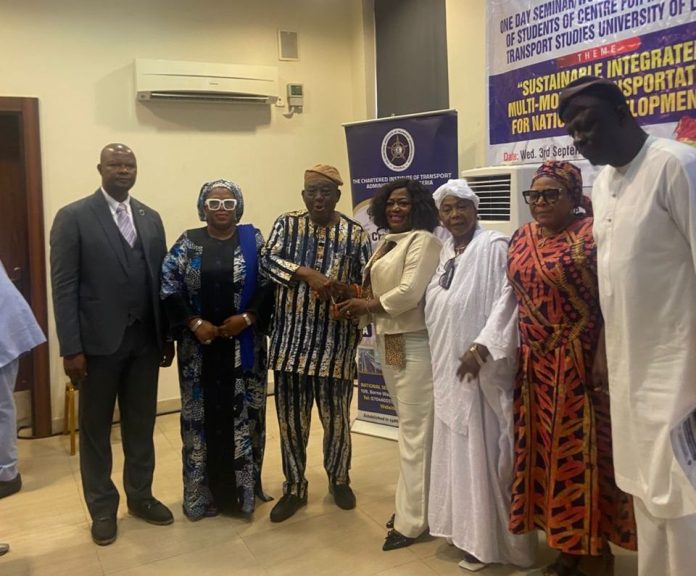
The Chartered Institute of Transport Administration of Nigeria (CIoTA), in partnership with the University of Lagos (UNILAG), has unveiled a new wave of transport professionals through a joint seminar, workshop, and student induction ceremony.

The event, held at the Arthur Mbanefo Digital Research Centre, was themed “Sustainable Integrated Multi-Modal Transportation for National Development.” It attracted academics, industry experts, and stakeholders from across the transport sector.

Speaking at the ceremony, CIoTA President, Prince Segun Obayendo—represented by the institute’s National Publicity Secretary, Dr. Chizoba Anyika—described the collaboration as a defining moment for Nigeria’s transport sector. He noted that the induction of students from the Centre for Multimodal Transport Studies into CIoTA marked an important step in preparing young professionals to drive innovation and reform.

“This partnership signals our shared belief that the future of transportation must rest on knowledge, innovation, and early professional preparation,” Obayendo said.

Delivering the keynote address, Professor Iyiola Oni stressed the need for academic excellence, ethical leadership, and practical professionalism as the foundation for sustainable sectoral growth.

The highlight of the programme was a lecture by Professor Bamidele Abiona Badejo, who described integrated multimodal transport—encompassing road, rail, and waterways—as a potential “game changer” for Nigeria. He underscored the value of data-driven strategies in improving operational efficiency and urged professionals to embrace continuous training and specialisation.

“The time has come for enhanced expertise among transport professionals. Equally, Nigerians must be encouraged to utilise infrastructure already provided by government to achieve maximum impact,” Badejo said.

The event blended ceremony with critical discourse, reinforcing the link between academia and industry while reaffirming CIoTA’s commitment to mentoring emerging professionals. The institute pledged continued support through targeted training, strategic growth opportunities, and sustained collaboration.

UN Raises Alarm As 1,364 Children Recruited By Terrorists, 14,000 Schools Shut In West Africa

The United Nations has warned of the worsening humanitarian toll of terrorism in West Africa and the Sahel, revealing that more than 1,300 children were recruited by armed groups in 2024, while over 14,000 schools were forced to close due to insecurity.

UN Under-Secretary-General and Special Representative for West Africa and the Sahel, Leonardo Simão, disclosed the figures on Wednesday at a regional conference on combating emerging terrorist groups, held in Abuja.

He described the figures as “stolen futures, fractured communities, and deepening fragility,” noting that extremist groups are increasingly exploiting ungoverned spaces, local grievances, and advanced technologies—including drones, encrypted communications, and cyber tools—to expand their operations.

According to the UN envoy, 1,364 children were recruited by armed groups across six countries in 2024, with 466 documented cases of sexual violence and 14,364 schools shut down. “The increase is not only in the number of attacks and victims but also in sophistication, as groups forge alliances and expand their reach,” he said.

Simão noted that five of the 10 countries most impacted by terrorism globally are in West Africa and the Sahel, warning that extremist violence has now spread into sensitive border areas such as the Tambacounda region—which straddles Mali, Senegal, Guinea, and Mauritania—as well as protected conservation zones like Park W, Arly, and Pendjari, spanning Benin, Burkina Faso, and Niger. He stressed that these incursions threaten livelihoods, eco-tourism, and biodiversity.

The envoy added that political disputes between neighbouring states and the impacts of climate change are fuelling recruitment and deepening fragility. “Climate change continues to act as a threat multiplier—driving displacement, intensifying resource conflicts, and forcing entire communities into precarious livelihoods that terrorist groups exploit,” he said. The Central Sahel, he added, is projected to spend $3.2 billion on defence in 2025, diverting vital resources from education, healthcare, and climate adaptation.

Simão urged West African states to adopt a holistic response that combines military measures with investment in political dialogue, improved social services, and sustainable development, with particular attention to youth and women. He also called for stronger action against organised crime—including drug trafficking, illegal mining, and arms smuggling—that finances terrorism.

Nigeria’s Minister of Defence, Mohammed Badaru, speaking at the same event, stressed the need for stronger regional cooperation, warning that fragmented national efforts cannot defeat a transnational threat. “Terrorism spreads whenever it finds weaknesses in our shared defences. Security in one country is inseparable from the security of its neighbours,” he said.

Badaru emphasised intelligence as the “primary force multiplier” in combating terrorism, calling for the institutionalisation of joint and multinational operations under clear command structures. He urged ECOWAS states to accelerate the operationalisation of the regional standby force and to harmonise legal frameworks to ensure extremist groups find no safe haven.

“Emerging technologies such as artificial intelligence must be deployed for regional early-warning systems. Yet as we innovate, we must uphold human rights and safeguard civil liberties. Security must strengthen legitimacy, not weaken it,” the minister said.

Non-Oil Revenue Surges 40% To N20.6tn, Says Presidency

The Presidency has announced that Nigeria’s non-oil revenue has grown by over 40 per cent, positioning the country on course to achieve its annual revenue target.

In a statement issued on Wednesday, the Special Adviser to the President on Information and Strategy, Bayo Onanuga, said recent fiscal reforms, improved tax compliance, and digitised revenue systems have significantly boosted collections.

According to data covering January to August 2025, non-oil revenue rose to N20.59 trillion, up from N14.6 trillion recorded in the same period of 2024. The Presidency described this as the strongest fiscal performance in Nigeria’s recent history.

“For the first time in decades, oil is no longer the dominant driver of government earnings. Nigeria’s fiscal foundations are being reshaped,” Onanuga said.

Of the total collections, non-oil sources accounted for N15.69 trillion—representing three out of every four naira. The Nigeria Customs Service alone contributed N3.68 trillion in the first half of 2025, exceeding its target by N390 billion, a development the Presidency attributed to “systemic reforms rather than one-off windfalls.”

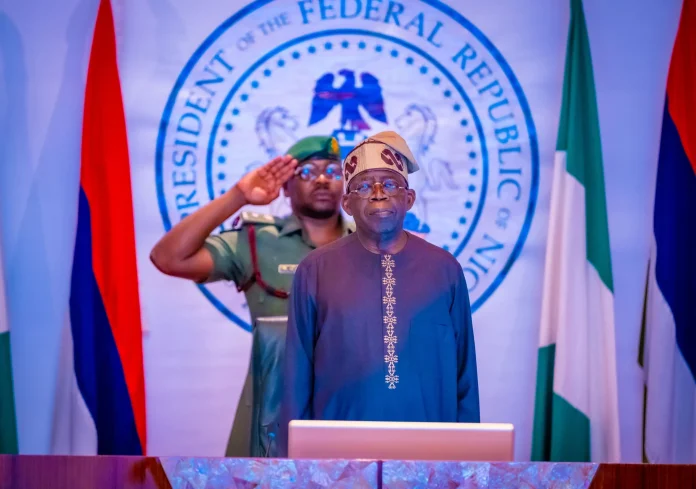
While acknowledging that inflation and exchange rate adjustments have influenced the revenue rise, the Presidency maintained that the primary driver was reform-led growth. President Bola Tinubu, speaking during a courtesy visit by members of the Buhari Organisation at the State House on Sunday, said the improved revenue performance has eased pressure on the domestic credit market as the Federal Government has stopped borrowing from local banks.

The Presidency also noted a positive spillover effect at the sub-national level, with monthly allocations to states and local governments surpassing N2 trillion for the first time in July. This, it said, enables states to increase spending on infrastructure, agriculture, and social services in line with the President’s inclusive growth agenda.

“Resources are being directed closer to the people,” the statement read, though it admitted that current revenues still fall short of the administration’s targets for expanded investments in education, healthcare, and infrastructure.

Despite the gains, the Presidency highlighted that oil revenues remain under pressure due to declining crude prices and production shortfalls. However, it stressed that this has not derailed the progress recorded in the non-oil sector.

Final year-end revenue figures will be validated by the Budget Office. “Revenues are rising, the base is broadening, and reforms are working. The priority now is to translate these gains into real relief for citizens by putting food on the table, creating jobs for young people, and investing in roads, schools, and hospitals,” the Presidency stated.

Interbank Market Liquidity Keeps Short-Term Rates Stable

Robust liquidity in the financial system kept short-term benchmark rates stable midweek, despite outflows from net Open Market Operation (OMO) bill settlements.

According to AIICO Capital Limited, system liquidity closed at ₦1.373 trillion on Wednesday, down ₦94.10 billion from the opening balance of ₦1.467 trillion. Analysts noted that banks’ use of the Central Bank of Nigeria’s (CBN) Standing Lending Facility has dropped significantly, with lenders now channelling excess funds into the deposit facility instead.

Despite a net OMO settlement of ₦160.40 billion, the interbank market maintained ample liquidity, holding rates steady at 26.5%. Both the Overnight Policy Rate (OPR) and Overnight (O/N) rate remained unchanged at 26.50% and 26.96%, respectively. Analysts expect rates to hover near current levels as no major funding pressures are anticipated, even with a Nigerian Treasury Bills settlement of ₦585.25 billion (net debit of ₦260.84 billion).

The Nigerian Interbank Offered Rate (NIBOR) fell across all tenors, with the Overnight rate dipping by 2 basis points to 26.99%. The 1-month, 3-month, and 6-month rates dropped by 27, 18, and 18 basis points, respectively. Cowry Asset Limited attributed the decline to improved system liquidity following OMO repayments by the CBN.

Meanwhile, yields in the Nigerian Treasury Bills (NT-Bills) market showed a mixed performance. Yields on the 1-month, 3-month, and 12-month tenors rose by 14, 16, and 11 basis points, respectively, while the 6-month tenor eased by 7 basis points. On average, NT-Bills yields fell by 23 basis points to 18.61%, reflecting strong investor sentiment in the secondary market.

CBN Adjusts Interest Rates On Treasury Bills

The Central Bank of Nigeria (CBN) has adjusted interest rates on Nigerian Treasury bills, lifting the stop rate on the one-year paper by 25 basis points at the midweek primary market auction.

According to auction results, the apex bank, through the Debt Management Office (DMO), offered ₦480 billion in Treasury bills across the standard tenors, attracting strong investor interest with total subscriptions exceeding ₦1 trillion. Out of this, ₦585.25 billion was allotted to investors.

Breakdown of the auction showed that the 91-day bill cleared at 15.32%, a decline of 3 basis points from the previous auction, while the 182-day tenor held steady at 15.50%. The 364-day paper, however, cleared at 17.69%, up 25 basis points from the prior level, reflecting higher pricing for longer-term instruments.

Market activity in the secondary segment closed on a muted note, with only marginal movements recorded in the 5-Mar and 20-Aug NTBs, alongside the 25-Nov OMO bill. Analysts noted that trading could turn mixed in the coming sessions, as some investors rebalance by offloading lower-yielding notes in favour of the newly adjusted one-year paper.

Dollar To Naira Exchange Rate For 4th September 2025

Dollar To Naira Exchange Rate For 8th Dec 2023

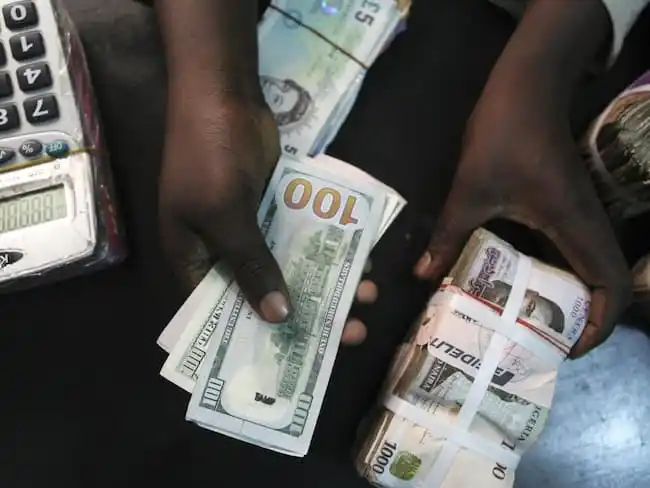
The exchange rate between the Naira and the US dollar, according to the data released on the FMDQ Security Exchange, the official forex trading portal, showed that the naira closed at 1518.00 per $1 on Thursday, September 4th , 2025. The naira traded as high as 1518.00 to the dollar at the investors and exporters (I&E) window on Wednesday.

How much is a dollar to naira today in the black market?

Dollar to naira exchange rate today black market (Aboki dollar rate):

The exchange rate for a dollar to naira at Lagos Parallel Market (Black Market) players buy a dollar for ₦1535 and sell at ₦1518 on Wednesday 3rd September, 2025, according to sources at Bureau De Change (BDC).

Please note that the Central Bank of Nigeria (CBN) does not recognize the parallel market (black market), as it has directed individuals who want to engage in Forex to approach their respective banks.

Dollar to Naira Black Market Rate Today

Dollar to Naira (USD to NGN)Black Market Exchange Rate Today
Buying Rate₦1535
Selling Rate₦1518

Dollar to Naira CBN Rate Today

Dollar to Naira (USD to NGN)CBN Rate Today
Highest Rate₦1520
Lowest Rate₦1518

Please note that the rates you buy or sell forex may be different from what is captured in this article because prices vary.

UN Suspends Air Service In Nigeria Over Poor Funding

The United Nations Humanitarian Air Service (UNHAS) has halted its fixed-wing operations in Nigeria due to a severe lack of funding, raising concerns about aid delivery to conflict-hit communities in the northeast. UN Spokesperson Stéphane Dujarric confirmed the development during a press briefing at the UN Headquarters in New York, noting that the service, operated by the World Food Programme (WFP), ended last week after nine years of operations.

“For nearly a decade, UNHAS has transported humanitarian staff, medical supplies, and critical cargo to and from the epicentre of the crisis in Borno and Yobe states,” Dujarric said. “In a country scarred by 16 years of conflict, where road travel remains dangerous, air transport has been essential.”

The WFP warned in July that dwindling resources could force it to suspend food and nutrition assistance for 1.3 million people in the northeast. WFP’s Regional Director for West and Central Africa, Margot van der Velden, said the agency urgently requires $130 million to sustain emergency operations for the next six months.

“Due to the severe funding cuts facing the World Food Programme, we have exhausted our food and nutrition resources,” Velden told UN correspondents in New York. “By early August, we will face the heartbreaking reality of suspending operations—not because there is no need, but because there are no resources.”

She cautioned that millions of vulnerable Nigerians could face worsening hunger, displacement, or exploitation by extremist groups if aid is cut off. Despite the challenges, Velden commended the Nigerian government, describing it as the largest financier of emergency response in the northeast.

UNHAS flights transported more than 9,000 passengers in 2024 and had already moved 4,500 humanitarian staff this year. According to Dujarric, $5.4 million is needed to keep the service running for the next six months.

“Without this funding, the humanitarian response in northeast Nigeria risks being cut off from the very people it is meant to serve,” he warned.

BizWatchNigeria.Ng
Privacy Overview

This website uses cookies so that we can provide you with the best user experience possible. Cookie information is stored in your browser and performs functions such as recognising you when you return to our website and helping our team to understand which sections of the website you find most interesting and useful.