German Interior Minister Thomas de Maiziere said he is planning a new law that would require refugees to learn German, integrate into the society risk losing their permanent right of residency.
The initiative comes after voters punished Chancellor Angela Merkel’s conservatives in regional elections earlier this month, giving a thumbs-down to her open-door refugee policy and turning in droves to the anti-immigrant party Alternative for Germany (AfD).
Around 1 million migrants arrived in Germany last year – many fleeing conflict and economic hardship in the Middle East and Africa – and de Maiziere said around 100,000 more had arrived so far this year.
Germany expected that in return for language lessons, social benefits and housing, the new arrivals made an effort to integrate, he told ARD television.
“For those who refuse to learn German, for those who refuse to allow their relatives to integrate – for instance women or girls – for those who reject job offers: for them, there cannot be an unlimited settlement permit after three years,” he said.
De Maiziere, who belongs to Merkel’s conservatives party, added that he wanted “a link between successful integration and the permission for how long one is allowed to stay in Germany.”
Vice Chancellor Sigmar Gabriel welcomed the draft law, which is planned for May.
“We must not only support integration but demand it,” Gabriel told mass-selling daily Bild.
Gabriel’s Social Democrats, the junior partner in Germany’s ruling coalition with Merkel’s conservatives, also suffered losses in this month’s elections in three German states.
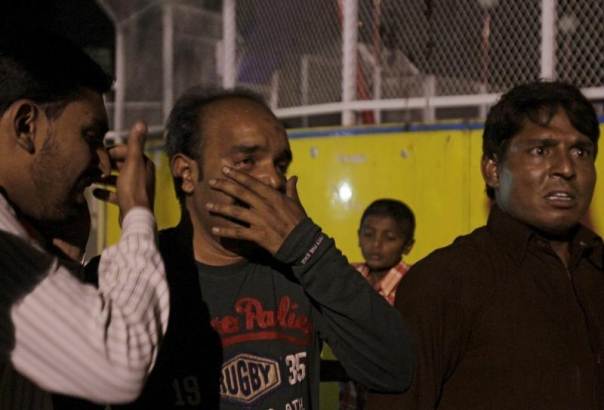
Pakistans stare in horror after easter bomb that l=killed over 70
Pakistani government will launch a paramilitary crackdown on Islamist militants in Punjab, the country’s richest and most populous province, after an Easter Day bombing that killed 70 people in the provincial capital Lahore, officials said on Monday.
The Sunday suicide bombing on a public park was claimed by the Pakistani Taliban’s Jamaat-ur-Ahrar faction, which once declared loyalty to Islamic State. The group said it was targeting Christians.
The brutality of the attack, Jamaat-ur-Ahrar’s fifth bombing since December, reflects the movement’s attempts to raise its profile among Pakistan’s increasingly fractured Islamist militants.
At least 29 children enjoying an Easter weekend outing were among those killed when the suicide bomber struck in a busy park in the eastern city of Lahore, the power base of Prime Minister Nawaz Sharif. Pakistan is a majority-Muslim state but has a Christian population of more than two million.
At the Vatican in Rome, Pope Francis condemned the attack as “hideous” and demanded that Pakistani authorities protect religious minorities.
It was Pakistan’s deadliest attack since the December 2014 massacre of 134 school children at a military-run academy in the city of Peshawar that prompted a government crackdown on Islamist militancy.
Security and government officials told Reuters that the decision had been made to launch a full-scale paramilitary Rangers operation, giving them powers to conduct raids and interrogate suspects in the same way as they have been in the southern city of Karachi for more than two years.
The move, which has not yet been formally announced, represents the civilian government once again granting special powers to the military in order to fight Islamist militants.
“The technicalities are yet to be worked out. There are some legal issues also with bringing in Rangers, but the military and government are on the same page,” said one senior security official, speaking on condition of anonymity as he was not authorised to share details of the plan.
One other military official and two government officials confirmed the decision on condition of anonymity.
Military spokesman Gen. Asim Bajwa said intelligence agencies, the army and Rangers had already launched several raids around Punjab following the attack, arresting an unspecified number of suspects and recovering arms caches.
Prime Minister Sharif toured hospitals full of victims, promising to bring justice.
“Our resolve as a nation and as a government is getting stronger and (the) coward enemy is trying for soft targets,” Sharif said, according to a statement from his office.
Jamaat-ur-Ahrar claimed responsibility for the attack late on Sunday night and issued a direct challenge to the government.
“The target was Christians,” a faction spokesman, Ehsanullah Ehsan, said. “We want to send this message to Prime Minister Nawaz Sharif that we have entered Lahore.”
Rescue services spokeswoman Deeba Shahnaz said at least 29 children, seven women and 34 men were killed and about 340 were wounded, with 25 in serious condition.
Jamaat-ur-Ahrar has claimed responsibility for several big attacks since it split from the main Pakistani Taliban in 2014.
While it mostly focuses attacks in its base of the northwestern Mohmand tribal area, it has previously carried out at least two major attacks in Lahore: one in 2015 that targeted two Christian churches and another at the Wagah border between India and Pakistan in late 2014.
Pakistan has been plagued by militant violence since it joined a U.S.-led campaign against Islamist militancy after the Sept. 11, 2001, al Qaeda attacks on the United States.
While the army, police, government and Western interests have been the prime targets of the Pakistani Taliban and their allies, Christians and other religious minorities have also been attacked.
Security forces have killed and arrested hundreds of suspected militants under an earlier crackdown launched after the 2014 Peshawar school massacre. Militant violence eased, but groups retain the ability to launch devastating attacks.
Most militants, like the Pakistani Taliban, are fighting to topple the government and introduce a strict interpretation of Islamic law.
As coordinator of a shelter for pregnant teenagers in central Uganda, Ritah Ssetumba has seen thousands of young girls struggling to cope with having a child but even she was shocked when an 11-year-old girl arrived pregnant and married.
The girl, identified as Aidah, was referred to the Wamukisa Youth Centre by a village hospital in Buikwe District, 60 km (37 miles) from the capital Kampala, where she gave birth to a boy with her 16-year-old husband by her side.
Aidah is one of about 300,000 girls each year to get pregnant in Uganda which has one of the world’s highest rates of pre-teen and teenage pregnancies as the east African nation struggles to enforce laws to clamp down on child marriages.
One in every four girls aged between 15 and 19 fall pregnant, according to the Uganda Bureau of Statistics, and nearly half of girls are married before 18.
“Aidah was the youngest pregnant child we have ever got in almost a decade of our operations,” Ssetumba said in an interview.
“But what shocked us even more was that the girl had been married off by her mother a year earlier and she also considered herself married.”
According to Ssetumba the mother agreed to let the then 10-year-old Aidah marry the 16-year-old to settle a debt with his family.
Aware of the dangers of child marriage, the Ministry of Internal Affairs, working with U.S. non-government organisation Vital Voices Global Partnership, is trying to raise awareness among girls about the dangers of early marriage and teenage pregnancy through theatrical drama and plays in schools.
This is the latest in a series of initiatives to back a campaign to reduce child marriages and teen pregnancies.
Ugandan authorities have struggled to enforce laws that set a minimum marriage age of 18, prompting the Ministry of Health to launch a partnership with the United Nations Population Fund (UNFPA) last year aiming to reduce the practice by at least 10 percent in five years.
Nakubulwa Mayi, a senior midwife at Mulago Referral Hospital the biggest hospital in the country, said pre-teen pregnancies posed serious physical and emotional risks to young girls.
“At this age a girl should be playing with dolls but not to have to handle a baby,” she said.
A study by the World Health Organisation (WHO) in 2013 indicated that early marriages and resultant pregnancies are the biggest cause of deaths among 15 to 19-year-old girls in Uganda, accounting for 20 percent of maternal deaths.
Others of those who survive the pregnancies can suffer lasting complications like fistula and disability.
But ignorance on risks of child marriage, limited access to education for girls, cultures dictating girls should marry young, and poverty, have all contributed to this growing trend of child marriage in Uganda, according to the 2015 National Strategy to End Child Marriage and Teenage Pregnancy report.
Agnes Igoye, assistant coordinator of the anti-trafficking task force at the Ministry of Internal Affairs, said early marriage is a form of sexual and gender-based violence with physical, social and economic effects.
“Once married, few girls return to school even if it becomes economically viable,” she told the Thomson Reuters Foundation.
Igoye said they were now visiting different schools asking the students to come up with stories related to child marriage and early pregnancy so her team could train the girls to perform such plays at schools and in community theatres.
“These plays show that children know what is happening to them in our society and they also know that it’s all wrong,” she said.
Federal government of Nigerian has sent two parents from the Chibok community, Borno State to go and verify the claim a suspected female suicide bomber arrested in Cameroun at the weekend if she is indeed one of the missing school girls that were abducted by Boko Haram about two years ago.
Spokesperson for the Nigeria’s President, Garba Shehu, said the country’s High Commissioner in Cameroon, Hadiza Mustapha, has been in contact with Cameroonian authorities who have shown a willingness to assist the government.
The abduction of about 270 school girls by Islamic militants from a school in Chibok town on April 14, 2014, sparked international outrage and a campaign #bringbackourgirls. While about 50 of the girls managed to escape, 219 of these girls remain missing.
One of the two female suicide bombers that were arrested in northern Cameroon at the weekend while attempting to detonate an explosive had claimed to be among the much talked missing Chibok school girls.
The girls were arrested after been stopped by local self-defense forces in Limani near a border town with Nigeria that has been the target of frequent suicide bombings in recent months.
“We hope that the Chibok parents would be able to identify the girl and determine whether she is indeed one of their missing students,” Shehu said.
He said the government was keen to ascertain the girl’s identity so she can be brought back to Nigeria and possibly assist the government in investigations regarding the fate and whereabouts of the other missing Chibok girls.
He disclosed that two parents from Chibok selected to embark on the trip to Cameroon are Yakubu Nkeki, chairman of the Chibok Abducted Girls Movement, and Yana Galang, the group’s women leader, whose 16-year-old daughter Rifkatu is among the missing girls.
The trip is being arranged by the government in partnership with the Murtala Muhammed Foundation in Nigeria, a non-government organisation which has been supporting the parents association and has offered to partly sponsor the trip to avoid any delays.
“If it is true, we are very happy about it. If we see her with our eyes, we will know where our girls are,” Galang said.
Shehu said the two girls would be brought by the Cameroonian government to Douala, the country’s largest city for the identification.
Former Nigerian president Goodluck Jonathan was criticized for his slow reaction to the Chibok abductions, seen by many as indicative of his response to Boko Haram, which at its strongest held large swathes of northeastern Nigeria.
Muhammadu Buhari, who defeated Jonathan in a 2015 election, ordered a new investigation into the kidnappings in January.
Joint operations between Nigeria and neighboring countries of Chad, Niger and Cameroun had succeeded in driving Boko Haram from many of its strongholds last year, but the terrorists have stepped up their cross-border attacks and suicide bombings, many of them carried out by young girls.
The Nigeria Army has promised a million naira reward for anyone with useful information that could lead to the rescue of Colonel Samaila Inusa who was kidnapped at the weekend in Kaduna.
It also promised to give adequate protection to anyone who provided the information, adding that such tip-off would be treated with utmost confidentiality.
Col. Inusa, was whisked away in his Mercedes-Benz car by gunmen around Kamazo, along Kaduna Refinery Road, in Chikun local government area of Kaduna State.
As part of efforts to successfully rescue the senior officer, the spokesperson for the First Division of the Nigerian Army, Usman Abdul, a colonel, announced the cash-for-information offer to journalists on Monday morning.
The Army had earlier promised a N500,000 cash reward for information, but on Monday raised the cash reward to N1million.
Mr. Abdul had said in a statement on Sunday that the senior officer was abducted on Saturday night.
According to the statement, “the abductors dropped off Colonel Inusa’s wife and left with him in his car. The car headed towards Abuja.”
The kidnapped senior military officer, until the incident, was serving in Nigerian Army School of Infantry Jaji Kaduna was abducted around Kamazo near NNPC junction, Kaduna.
The statement reads in part that, “Anybody with useful information or assistance should please assist in tracking these abductors.”
“They are in a Mercedes-Benz GLK Black colour with registration number Abuja, KUJ 154 TZ. This happened at about 7:30 pm on Saturday 26 March 2016.
The military authority released the following numbers on which it could be contacted:
a. 08033865572
b. 08030489203
c. 08023445961
d. 07038025282
e. 08058130703
The World Bank Group Analyst Program is a new and unique opportunity for exceptionally talented young people with a passion for international development to contribute to solving some of the world’s most pressing problems.
Applications are invited for the position of:
Job Title: World Bank Group Analyst Program 2016
Location: Nigeria
Description
Through this structured three-year program, you will work in an intellectually challenging and culturally diverse environment within a specific practice, region, or corporate unit in the World Bank Group, which includes the World Bank, the International Finance Corporation (IFC), and the Multilateral Investment Guarantee Agency (MIGA) and International Center for Settlement of Investment Disputes.
You will have the opportunity to contribute and grow your skills in areas ranging from analytics, research, data management, project management, communications, finance, management accounting, and information technology. In addition, the program offers various cohort activities aimed to broaden your exposure to the work of the World Bank Group and develop leadership skills.
Upon completion of the program, there may be opportunities for you to continue your career in the World Bank Group. Participants holding a Master’s degree who find the opportunity to continue their career at the WBG may also be eligible for advancement opportunities. Alternatively, you may leverage the experience you have gained to pursue further studies or other opportunities in international development.
Program Features
The WBG Analyst Program (WBG AP) offers a mix of challenging work program and a comprehensive development curriculum during the three-year of the program/contract.
Work Program
WBG Analysts are selected from recruitment streams that vary every year and range from Operations, Finance, Communication and International Affairs, Information Technology, Management Accounting.
The work program is therefore quite varied, too, and can take place in the World Bank, the International Finance Corporation, the Multilateral Investment Guarantee Agency, or the International Center for Settlement of Investment Disputes.
Typically, it involves research and analytical work, preparation of visually compelling presentations of data, drafting reports and overviews, coordinating specific programs. Because the WBG Analyst’s work program is very much business-driven, opportunities may come up for cross-support, stretch assignment or even full rotation to another area of the business during the course of their three-year term contract.
At the end of the three-year contract/program, WBG Analyst have several choices:
Apply competitively to an analyst position;
Apply to an officer’s position (for those meeting the eligibility criteria including holding a master’s degree);
Pursue academic studies or other job opportunities outside of the WBG.
Development Curriculum:
A three-year comprehensive development curriculum has been designed to ensure that WBG APs develop a WBG mindset, quickly gain the foundational learning needed to understand and contribute to the WBG, and build the competencies required at an analyst’s level – collaboration, leadership, integrative thinking, and innovation skills – while strengthening a culture of continuous learning.
The curriculum includes a blend of learning activities in a WBG cohort, small groups or individually, ranging from on-boarding activities, e-learning, cohort discussions with WBG leaders, leadership training, performance management support, career development workshops, and networking opportunities.
A technical Buddy is assigned in the hiring units in the WBG Analysts’ first week, as a “go-to person” to answer technical/process questions in their fields.
In their second year, a WBG Mentor, a technical senior colleague, are is offered to discuss career options, “stretch/exposure” assignment opportunities and gain insight into the organization’s culture.
Throughout the program, WBG Analysts meet in small groups to exchange, in a safe, intimate, and virtual format, some of the challenges they are facing. They receive mutual coaching from their peers, sometimes accompanied by an executive coach or an HR professional.
Finally, the Analysts Program team is dedicated to recruiting and helping integrate WBG Analysts into the WBG. It coordinates activities designed to support the cohort, including mentoring and guidance, helping formulate career strategies, and others.
Eligibility Criteria
Citizenship of a member country of the World Bank Group
Passion to contribute to the World Bank Group mission to end extreme poverty and boost shared prosperity
28 years of age or younger (i.e., born on or after January 1st, 1988)
Master’s or Bachelor’s degree in relevant field. Candidates who are currently pursuing a degree are eligible if the degree will be awarded by December 31, 2016
One to three years of relevant work experience in one or more specialty areas (see Application and Selection Process )
Analytical thinking, proven academic success, strong written and oral communication skills, and leadership potential
Experience working or studying in developing countries is preferred
Fluency in English is required. Fluency or proficiency in other languages, in particular Arabic, Chinese, French, Portuguese, Spanish or Russian, is preferred.
In addition, successful candidates must demonstrate the World Bank Group Core Competencies (Read more about the Selection Cycle):
Deliver results for clients
Lead and innovate
Collaborate within teams and across boundaries
Create, apply and share knowledge
Make smart decisions
Compensation & Benefits
Contract: a three-year local term contract is being offered.
Salary: WBG Analysts are offered a locally-competitive salary, based on their education and professional experience.
Health, Life, Accident and Other Insurance Programs: WBG Analyst and their families (including declared domestic partners) may choose from three comprehensive medical/dental benefit plans. The WBG also provides basic life and accident insurance to all staff at no cost, and staff can elect optional life and accident insurance plans. The WBG also provides disability and Workers’ Compensation coverage to staff at no cost.
Pension Plan: The WBG sponsors a comprehensive pension plan for eligible staff. Upon separation from the WBG, either a lump sum or a pension will become payable to the staff based on eligibility.
Relocation Benefits on Appointment: For WBG Analysts relocating to a new country, a cash allowance at the discretion of their hiring unit may be granted.
Tax Allowance: U.S. staff receive an additional quarterly payment to cover the U.S., state and local income tax liabilities on their World Bank Group income. Expatriates and U.S. permanent residents do not incur U.S. income tax liability and are thus not eligible for this benefit.
Financial Assistance: The World Bank Group offers financial assistance programs, including a two-year interest-free settling-in loan to those who relocate upon appointment.
Selection Cycle
WBG Analysts are chosen through an intensive and rigorous selection process. Competition is keen. We received thousands of applications last year for a limited number of positions.
Timeline
March 16-April 5, 2016: Application Process
April 2016:
Review of applications against eligibility criteria.
Status update to all candidates.
April 13-20, 2016: Online logical reasoning and behavioral assessment for candidates meeting the eligibility criteria (one week to complete, no extension possible. We recommend that you save the date already).
By April 30, 2016: Update to candidates on assessment results (passed or not passed, thus further considered or not).
May through December 31, 2016:
Depending on business needs in recruitment streams, candidates are contacted for interviews/further testing.
Candidates who are not selected by a particular business unit can be considered by another business unit in the same recruitment stream.
Decisions and offers communicated.
Status updates to all candidates.
Starting date on the job.
February 2017: New WBG AP cohort starts development curriculum.
Application Process
You may apply and be considered for up to two of the specialty areas listed below. To apply, click on the relevant link; you will be prompted to log into the Member Center or create a new account.
Please fill in all fields, answer the screening questions, attach your resume or CV and submit your Statement of Interest (no more than 700 words). Read more about our specific WBG Analyst instructions and details about the Selection cycle.
Following the screening of applications against the eligibility criteria, a select number of candidates will be contacted in April to take an online analytical reasoning and behavioral assessment. Other candidates will receive an email to inform them that they have not been selected.
The results of this assessment will determine further participation in the recruitment program.
Based on the business needs in a specific recruitment stream, a select number of candidates will be approached for further interviewing/testing between Mayand December 31, 2016. Offers will be made during that period.
Selected candidates will enter the World Bank Group between May 2016 andFebruary 2017 and will start their development curriculum in February 2017.
Application Closing Date
5th April, 2016.
Method of Application
Interested and qualified candidates should APPLY
Ericsson is a world-leading provider of telecommunications equipment and services to mobile and fixed network operators. Over 1,000 networks in more than 180 countries use Ericsson equipment, and more than 40 percent of the world’s mobile traffic passes through Ericsson networks. Using innovation to empower people, business and society, we are working towards the Networked Society, in which everything that can benefit from a connection will have one. At Ericsson, we apply our innovation to market-based solutions that empower people and society to help shape a more sustainable world.
We are truly a global company, working across borders in 175 countries, offering a diverse, performance-driven culture and an innovative and engaging environment where employees enhance their potential everyday. Our employees live our vision, core values and guiding principles. They share a passion to win and a high responsiveness to customer needs that in turn makes us a desirable partner to our clients. To ensure professional growth, Ericsson offers a stimulating work experience, continuous learning and growth opportunities that allow you to acquire the knowledge and skills necessary to reach your career goals.
We are recruiting to fill the following vacant positions below:
The British Council is the world’s leading cultural relations organization and creates opportunities for people in the UK and worldwide to understand each other, to work together and learn from one another. We see this as crucial to building secure, more prosperous and sustainable futures for us all. We build trust and understanding between different countries and cultures and develop strong international links that are of benefit to people in Britain and the rest of the world. We are recruiting to fill the following positions below:
The United Nations Children’s Fund (UNICEF) – In September 2014 UNICEF began implementing a joint programme with UN Women on Women, Peace and Security (WPS) funded by the European Union (EU). The programme will support the Nigerian Government (Federal level), three Northern Nigerian States namely Adamawa, Gombe and Plateau and selected Local Government Areas (LGAs) to strengthen women’s leadership, advance gender equality and improve protection for women and children in conflict settings.
UNICEF is responsible for implementation of Component 2 of the programme, namely ‘to increase access to reporting mechanisms and protective services for girls and women affected by human rights abuses, including gender based violence, in 3 states of northern Nigeria”. This will entail enhancing avenues for reporting of child rights violation and Gender Based Violence in Plateau and Gombe States, strengthening access to and quality of services for children and women who have experienced violence (including gender based violence (GBV), abuse, neglect and exploitation and strengthening the information management system for collecting data on violations.
We are recruiting to fill the following vacant positions:
The Nigerian Investment Promotion Commission, NIPC, has expressed its readiness to partner the Port Harcourt Chamber of Commerce, Industry, Mines & Agriculture, PHCCIMA, to woo foreign investors with viable investments into Nigeria.
The NIPC said it will facilitate submission of viable and bankable project profiles of PHCCIMA members for matchmaking with foreign investors.
To this end, the Commission has requested for database of credible businesses in Rivers State to ensure they benefit from its support and incentives.
The Commission made the promise when the President of PHCCIMA, Emi Membere-Otaji led a business delegation to the NIPC in Abuja recently, as part of the Chamber’s efforts to open new vistas and frontiers that will help realise set objectives and meet the needs and aspirations of its membership.
Speaking during the visit, Membere-Otaji said that the visit to NIPC by the PHCCIMA business delegation was in response to the call for diversification of the Nigeria’s economy following the current economic depression, occasioned by the sudden collapse of oil revenue. He said the plummeting oil prices was affecting not just PHCCIMA members but others doing business in Nigeria’s oil and gas sector.
He said: “The PHCCIMA has come to identify with the clarion call for diversification, hence we are here seeking collaborations with NIPC on how to harness opportunities to diversify members businesses and uplift them to the next level of increased business activity and volume.”
The Secretary to the Government of the Federation, Babachir David Lawal, has revealed that the reconstruction of schools and police stations destroyed by Boko Haram insurgents in the Northeast has commenced.
Lawal, disclosed this on Sunday, March 27, in Hong, Adamawa State, during the graduation of 500 students of Buba Industrial Village.
The skills acquisition programme was part of the youth empowerment scheme introduced by Yusuf Buba, the member representing Gombi/Hong federal constituency in the House of Representatives.
He said the reconstruction of the region was part of the election campaign promise made by President Muhammadu Buhari.
The SGF stressed that the aim was to bring lasting solutions to insurgency and rebuild destroyed infrastructure in the area.
“The federal government has begun the reconstruction of schools and police stations, among others, destroyed by Boko Haram insurgents in the Northeast region.
“The present APC-led government is determined to guarantee peaceful co-existence among Nigerians and ensure that Nigerians, irrespective of their locality or belief, benefit from the dividend of democracy,” Lawan said.
He criticised the opposition parties for what he called a campaign of calumny during the last general election, which linked the All Progressives Congress party with a particular religion and the insurgency.
Lawal said Buhari and the APC-led government would never discriminate against any Nigerian on the basis of religion or any other affiliation.
He commended Buba for initiating the skills acquisition programme for youths, describing the gesture as a “landmark achievement” worthy of emulation.
According to him, the programme was the first of its kind in the area since the inception of democracy in 1999.
The National Union of Air Transport Employees ,NUATE, has revealed that foreign airlines plan to sack about two thousand (2,000) Nigerian workers due to what they claimed is their inability to transfer their earnings to their respective home countries.
In a letter addressed to the Minister of State for Aviation, Senator Hadi Sirika and made available to newsmen, Acting General Secretary of NUATE, Comrade Olayinka Abioye said the plan has destabilize the affected workers, adding that the Federal Government should wade in and prevent the huge job loss.
According to Abioye , “ The reason being adduced for this danger is that their earnings in the past year is under lock with the Central Bank of Nigeria, CBN , as they are unable to transfer these earnings to their respective home countries to meet operational costs in accordance with international rules.”
“Following concerns raised recently by leaders of these workers and other stakeholders and in appreciation of the good intent of the government’s fiscal policy, we humbly make this clarion call for your (Minister) intervention to grant foreign airlines concession to repatriate their proceeds to their home countries,” he said.
He added that should the foreign airlines go ahead with the sacking of the workers it would not be in the interest of the aviation sector and Nigeria as a whole.
Giant Brewer, Nigerian Breweries Plc, has won the Nigerian Stock Exchange, NSE, Chief Executive Officer’s Distinguished Award for Compliance in 2015.
The award also known as the Most Complaint Listed Firm award is given by the NSE to a company that demonstrates the highest degree of compliance with the rules and regulations regarding disclosure obligations of listed companies to the exchange in a particular year.
According to the NSE, Nigerian Breweries Plc again demonstrated its recognition for the importance of corporate governance in 2015 to clinch the coveted award.
While presenting the award to the management of Nigerian Breweries Plc, the CEO of the NSE, Oscar Onyema, congratulated the company on its strict compliance to the rules and regulations of the exchange and said the company represents a sterling example of compliance to corporate governance in the country. The company had earlier won the award in 2012.
For According to a report on foreign portfolio investment, FPI, has revealed that for every dollar brought into Nigeria in 2016, more than $2 has been taken out.
A year-to-date report on FPI obtained at the weekend, indicated that Nigeria suffered a net deficit of 108 per cent in the first two months of the year.
The FPI outflow worsened in February, as uncertainties persisted over Nigeria’s foreign exchange management.
The report, coordinated by the Nigerian Stock Exchange (NSE), showed that FP outflow outpaced inflow by 108 per cent. The two-month report showed that foreign outflow totalled N58.20 billion as against foreign inflow of N27.95 billion.
Total foreign transactions of N86.15 billion represented 42.8 per cent.
Domestic investors, however, appeared to be stepping in to fill the gap left by the foreign investors. They invested N115.22 billion, representing 57.22 per cent of the total transactions, during the period.
Monthly analysis showed that FP outflow totaled N31.84 billion as against inflow of N10.94 billion. In the same period last year, foreign outflow was N81.60 billion while inflow was N52.35 billion.
In January, FPI report showed that foreign inflow stood at N17.01 billion as against outflow of N26.36 billion, representing a deficit of N9.35 billion.
Total foreign transactions thus were N43.37 billion. Nigerian investors accounted for N40.73 billion or 48.43 per cent of the total turnover of N84.10 billion recorded during the period.
In the comparable period of January last year, foreign investors appeared less edgy and there were more appetite for Nigerian equities, though the tinge of deficit was also evident then. Foreign inflow was N48.03 billion in January 2015 as against outflow of N51.08 billion.
Total foreign transactions stood at N99.11 billion or 52.24 per cent of total turnover of N189.72 billion during the period. Domestic investors accounted for N90.61 billion or 47.76 per cent of total transactions.
The FPI report further highlighted the downtrend that had marked foreign portfolio investments since 2014.
The FPI report uses two key indicators-inflows and outflow to gauge foreign investors’ mood and participation in the stock market as a barometer for the economy.
Indigenous oil firm, Seplat Petroleum Development Company Plc has reported a drop of N27 billion profit after tax in its full year 2015 financial results released to the Nigerian Stock Exchange in Lagos last week.
According to the results, profit after tax dipped from N40 billion it made in 2014 to end 2015 at N13 billion.
Also, its profit before tax went down by N23 billion represented 57.50 per cent to close the year with N17 billion from N40 billion in 2014,
Seplat Petroleum revenue slid by N11 billion in 2015, translated to 8.87 per cent from N124 billion it made in 2014 to end 2015 financial year with N113 billion.
Its gross profit went down from N74 billion to N49 billion in 2015, which is N25 billion or 33.78 per cent drop.
Earnings per share of oil and gas firm also dropped by 75 per cent from 0.08 kobo in 2014 to 0.02 at the end of December 31, 2015.
The Federal Airports Authority of Nigeria,FAAN, has stated that it would require at least N25 billion to construct perimeter and operational fences across all the 22 airports it manages.
The General Manager, Corporate Affairs of FAAN, Yakubu Dati told reporterd at the agency’s headquarters in Lagos that the figure was arrived at after a recent survey carried out by the authority.
Dati disclosed that each of the 22 airports is about 50 kilometre long and would require huge investments for them to be properly fenced to the standard recommended by the International Civil Aviation Organization,ICAO.
Dati who assured all the airports’ users of absolute security and safety of humans, cargo and equipment at all times said there are other safety measures FAAN has taken in line with international best practices to boost security and safety within the nation’s airports.
Among these measures, he said, were the introduction of the perimeter patrol and construction of perimeter towers which enables the Aviation Security, (AVSEC) personnel and other security agencies to have a full overview of the airport environment, adding that the authority had installed latest technologies in strategic locations to increase surveillance.
He added that the authority had been able to tackle inside threat, saying, “We profile anybody that works within the terminal or in the terminal in line with global standards. It is after passing that we issue them the On-Duty-Card (ODC). Even at that, the ODC also has some levels of restrictions such that it is not every holder that has access to every part of the terminal. We have different levels and colours based on the level of clearance you have received.”
New projections have shown that Nigeria will spend 24 per cent of its revenue in 2016 for debt servicing.
The Representative of Islamic Development Bank, IDB, in Nigeria, Abdallah Kiliaki said recently that the country pays about 75 of its debt for debt servicing.
Kiliaki was quoted to have stated during a visit to the Chairman, Senate Committee on Local and Foreign Debts, Shehu Sani.
He said: “When talking about unsustainable debt, it means that a country or a borrower is unable to pay. So, we take very that very seriously.”
“When you look at the debt GDP ratio of Nigeria, it is very low. It is 17 per cent compared to Italy and other countries which is about 150 per cent, while that of the United States is about 100 per cent.”
“But there is a caveat; it is true that debt to GDP ratio is low but when you look at the amount, the revenue to debt servicing ratio, the amount of money that the government is collecting, the revenue of the government vis-a-vis the ratio to the total debt, I think Nigeria pays about 75 to 80 per cent of its revenue to service debt,” Kiliaki had said.
Foreign investors who participated in the larger percentage of trading activities on the Nigerian Stock Exchange, NSE, have been withdrawing their investments from the market.
Foreign investors who used to dominate trading in the Nigerian stock market transacted 51.57 per cent of total market activities in January 2016, down to 36.48 per cent at the end of February trading.
According to market analysts, the foreign investors’ withdrawals can be attributed to unfavorable condition of foreign exchange currency.
According to the Nigerian Stock Exchange polls trading figures from major custodians and market operators on their Foreign Portfolio Investment (FPI) flows for the month of February, foreign investors withdrew N31.84 billion during the month against N10.94 billion invested in Nigeria market.
The percentage of transactions of foreign investors in February was 36.48 per cent compared to 74.49 per cent of domestic investors.
Total transaction on the bourse during the month stood at N117.27 billion as against N184.49 billion total transaction carried out in January.
However, domestic investors transacted N74.49 billion in February as institutional investors led with N38.25 billion while domestic investors transacted N36.24 billion. This is higher than N40.73 billion total transactions of domestic investors in January 2016 as retail investors transacted N18.88 billion as against N21.85 billion of institutional investors in January.
Meanwhile, total transactions at the nation’s bourse increased by 39.44 per cent from N84.10 billion recorded in January 2016 to N117.27 billion in February 2016.
In comparison to the same period in 2015, total transactions decreased by 36.44 per cent from the N184.49 billion recorded in February 2015.
Domestic investors significantly outperformed foreign investors by 27.04 per cent. Domestic transactions increased from 48.43 per cent in January 2016 to 63.52 per cent in February 2016 while FPI transactions decreased from 51.57 per cent to 36.48 per cent over the same period.
The Nigerian Railway Corporation, NRC document, has said that at least 405, 048 passengers travelled by trains in January and February, 2016.
The figure in the document indicates that while 207, 286 used the rail transportation in January; 197, 762 Nigerians travelled by trains in the second month of the year.
These comprise of passenger movement on all the NRC trains including the Lagos-Kano passenger train, Lagos-Ilorin intercity passenger train, Offa-Kano intercity passenger train, Minna-Kaduna Mass Transit Train (MTT), Kano-Portharcourt Intercity passenger train, Abba-Portharcourt MTT and the MTT operating between Lagos and Ogun states.
Already, the Ogun state government partnered with the NRC to provide free train ride for indigenes of the state from Lagos to Osun while the passenger traffic also rose during the season.
The corporation also expects a boost in the passenger movement with the planned commencement of standard gauge service from Kaduna to Abuja in May.
Automobile industry sources over the weekend have revealed that the importation of brand new cars into Nigeria plunged by 67 per cent in 2015.
Some stakeholders have attributed the massive plunge to the federal government’s re-launched automotive policy while others opine it was mainly due to the challenges with foreign exchange liquidity.
The National Automotive Design and Development Council, NADDC, estimates annual imports at about 400,000 vehicles with 50,000 units as new cars valued at N679.65 billion ($3.45 billion).
Meanwhile, data from the NADDC revealed that there are now over 40 auto assembly plants across the country.
The latest national accounts (Q4 2015) released by the National Bureau of Statistics (NBS) showed that the motor vehicles & assembly segment of the manufacturing sector contracted by 13.0 per cent year-on-year, compared with 24.3 per cent growth recorded in the corresponding period in 2014.