







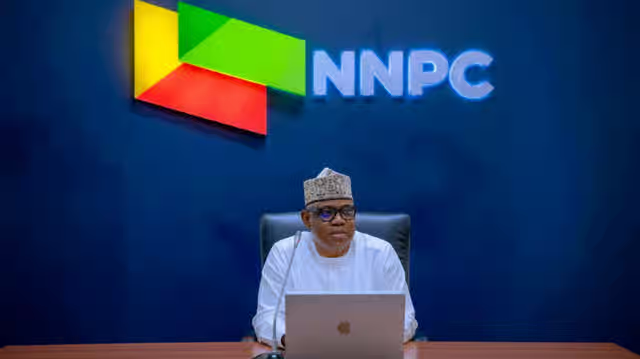
The CEO of Nigerian National Petroleum Company Limited (NNPC), Bayo Ojulari, has reassured Nigerians that ongoing reforms in the downstream petroleum sector will ultimately benefit consumers, even as the industry navigates short-term market adjustments.
Ojulari, speaking after a meeting with President Bola Tinubu, explained that the transition to a fully competitive, willing-buyer, willing-seller market framework may create temporary frictions, but it is designed to enhance efficiency and drive better outcomes for consumers. “In a competitive market, the ultimate winners are the buyers,” he said.
The NNPC boss highlighted key achievements in 2025, including an increase in oil production from 1.5 million barrels per day to over 1.7 million barrels, alongside a rise in gas output from 6.5 billion standard cubic feet per day to more than 7 billion. He also pointed to the completion of welding on the Ajaokuta–Kaduna–Kano (AKK) Gas Pipeline’s main line, which will enable early gas connections to northern states, supporting industrialisation, power generation, and fertiliser production.
Looking forward, Ojulari said NNPC is targeting 1.8 million barrels per day in oil production for 2026 while continuing to expand gas output. He stressed the importance of attracting strategic investment and leveraging the company’s asset portfolio to unlock value, in line with the president’s long-term vision of increasing crude production and attracting over $30 billion in new investment by 2030.
Regarding downstream petroleum supply and pricing, Ojulari noted that the Petroleum Industry Act (PIA) has separated regulatory functions from commercial operations, positioning NNPC as a fully competitive business entity. He acknowledged the current market pressures but described them as a transitional phase, pointing out that domestic refineries, such as Dangote Refinery, will strengthen supply stability and eventually improve consumer access.
Ojulari concluded that, with ongoing reforms and stakeholder collaboration, Nigerians should expect tangible benefits from increased competition in the sector in the months ahead.









, Bayo Ojulari, has reassured Nigerians that ongoing reforms in the downstream petroleum sector will ultimately benefit consumers, even as the industry navigates short-term market adjustments.)