By Boluwatife Oshadiya
Key Points
- NITDA issued a cybersecurity advisory on DeepLoad malware attacks
- Malware reportedly targets Nigerian agencies, businesses, banks, and individuals
- Attackers use fake browser update prompts and malicious commands
- Malware can steal banking credentials, passwords, and sensitive information
- NITDA urged organisations to strengthen cybersecurity measures immediately
Main Story
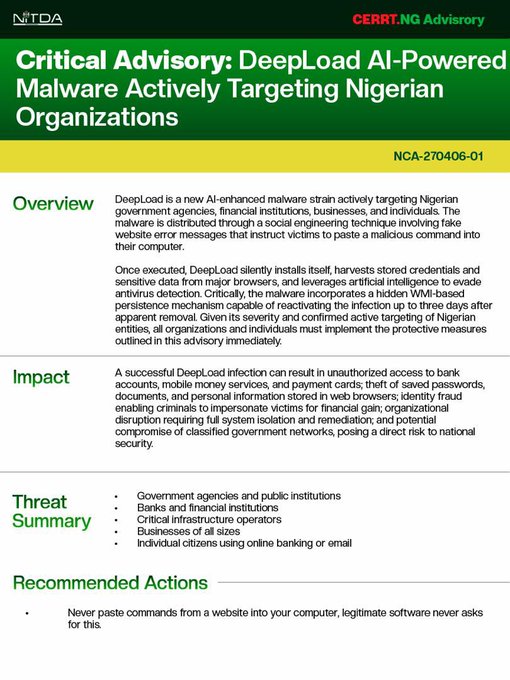
The National Information Technology Development Agency has issued a fresh cybersecurity alert warning Nigerians about a dangerous AI-powered malware known as DeepLoad, which is actively targeting organisations and individuals across the country.
In a critical advisory issued through the Computer Emergency Readiness and Response Team, the agency disclosed that DeepLoad is designed to harvest sensitive information, steal banking credentials, and evade traditional antivirus detection systems.
According to the advisory, cybercriminals are deploying the malware through fake website error messages and fraudulent browser update prompts that trick users into pasting malicious commands into their systems.
The agency warned that once activated, the malware silently installs itself, extracts saved passwords and confidential data from web browsers, and establishes persistence mechanisms capable of reactivating the infection even after apparent removal.
NITDA stated that the malware specifically targets government agencies, financial institutions, critical infrastructure operators, businesses, and individuals who rely on online banking and email services.
The agency added that DeepLoad leverages Windows Management Instrumentation (WMI)-based persistence and artificial intelligence-powered evasion techniques, making detection and remediation significantly more difficult.
The advisory noted that a successful attack could result in unauthorised access to bank accounts, identity theft, financial fraud, compromise of classified government systems, and large-scale operational disruptions for affected organisations.
Recommended Actions
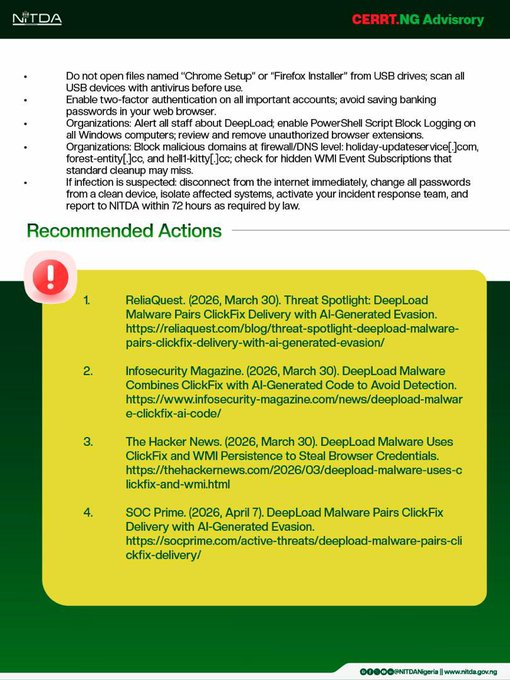
NITDA urged Nigerians never to paste commands from unknown websites into their computers, warning that legitimate software providers do not request such actions.
The agency also advised individuals to enable two-factor authentication across important accounts, avoid storing banking passwords in browsers, and scan all USB devices before use.
For organisations, NITDA recommended enabling PowerShell Script Block Logging, reviewing unauthorised browser extensions, blocking malicious domains at firewall and DNS levels, and conducting checks for hidden WMI event subscriptions.
The agency further directed organisations to disconnect infected systems from the internet immediately if compromise is suspected, activate incident response procedures, and report incidents to NITDA within 72 hours in compliance with Nigeria’s cybersecurity regulations.
What’s Being Said
Cybersecurity experts say the emergence of AI-assisted malware campaigns marks a growing shift in the sophistication of cyber threats targeting emerging markets, including Nigeria.
Analysts also warned that increased digital banking adoption and rapid online service expansion have made both businesses and individuals more vulnerable to social engineering attacks.
What’s Next
Industry stakeholders expect Nigerian regulators and cybersecurity agencies to intensify awareness campaigns and strengthen digital security frameworks as cyber threats become increasingly advanced and widespread.