



(Feature Article based on LBS Breakfast Session Presentation – “Gulf War III & Nigeria”, May 6, 2026)
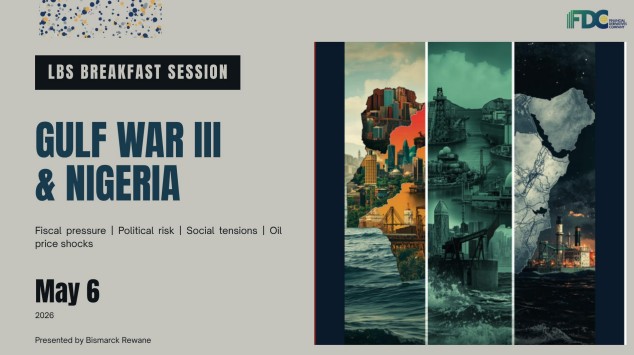
In the shadow of escalating geopolitical tensions in the Middle East, Nigeria finds itself once again at the mercy — and partial beneficiary — of global energy shocks. The LBS Breakfast Session presentation titled “Gulf War III & Nigeria,” delivered by economist Bismarck Rewane on May 6, 2026, paints a nuanced picture of an economy riding transitory oil price surges while grappling with deep-rooted structural vulnerabilities.
Fiscal pressures, political risks, social tensions, and oil price volatility dominate the narrative. Yet amid the turbulence, pockets of resilience and policy experimentation offer glimmers of cautious optimism.
The presentation opens with vivid imagery: a fractured map of Africa morphing from vibrant promise to industrial grit and fiery conflict. “Nigeria: From Hero to Zero” captures the national mood swing, contrasting superhero aspirations with the chains of debt, corruption, and economic strain. As global events unfold, Nigeria’s story is one of dualities — windfalls undermined by forward sales, growth without broad prosperity, and retail investors propping up markets even as fundamentals wobble.
Noteworthy Events Shaping the Moment
Several developments frame the current juncture. The UAE’s exit from OPEC+ after 59 years signals shifting alliances in energy geopolitics. The Strait of Hormuz has become a critical chokepoint, with supply chain logistics back in focus. Jet fuel prices have surged over 20%, yet Dangote Refinery’s decision to slash aviation fuel to ₦1,800 per litre provides some domestic relief.
Domestically, retail investors have driven the Nigerian Exchange (NGX) to new heights, growing their share from 7% to 35%. However, rising inflation and eroding per-capita income raise fears of a liquidity exit and potential bubble burst. Nigeria’s Purchasing Managers’ Index (PMI) has slipped into contraction after two years of expansion. Meanwhile, Nigerian banks have bolstered capital buffers, and the economy appears “more insulated than isolated” — though debt per head is rising faster than income per capita.
Globally, the Magnificent 7 tech giants pour billions into AI, while a leadership change at the U.S. Federal Reserve looms, with Jerome Powell’s term ending May 15, 2026, and Kevin Warsh nominated as successor. These shifts will influence monetary policy ripples worldwide.
The Oil Shock and Its Dual Impact
The U.S.-Iran conflict has injected volatility into oil markets. Brent crude has seen spikes, with scenarios from the Economist Intelligence Unit (EIU) ranging from prolonged war (prices averaging $144/b in Q2) to quick de-escalation (dropping to low $90s). As of the presentation, prices hover with temporary ceasefires and re-escalation fears.
For Nigeria, the war brings a dual effect: mostly transitory rather than structural. Oil windfalls are real but undermined by forward crude sales. Upstream investments in assets like Bonga and Agbami continue, and the refining sector — led by Dangote — is outperforming broader GDP and poised for rapid growth. GDP growth is likely to tick up, primarily petroleum-driven.
Yet challenges persist: slow rises in oil theft and vandalism, slowing foreign portfolio inflows, and higher interest rates in advanced markets. The external sector shows robust growth with minimal reserve depletion, and naira appreciation has helped dampen imported inflation. However, fiscal stimulus remains slow to impact, sectoral linkages are weak and not job-elastic, and unemployment/underemployment statistics invite skepticism.
Structural Constraints and Economic Composition
Nigeria’s economy reveals classic features of a resource-dependent state. Using the expenditure approach (Y = C + I + G + (X-M)), consumption dominates at 60% of GDP — second only to Kenya’s 76% — signaling limited investment and fiscal multipliers. Government spending is notably low at around 4-5%, painting Nigeria as less fiscally dominant than peers like South Africa, though federalism complicates the picture when state expenditures are included.
Analysts highlight structural growth constraints: inefficient payment systems compared to Kenya, varying money velocity, and currency dynamics near equilibrium in some peers. Nigeria experiences “growth without prosperity,” where aggregate GDP may rise but the average citizen feels poorer as living standards deteriorate amid rising debt burdens.
Inflation, Fuel Shocks, and Policy Responses
Fuel prices tell a painful story. Jet fuel sits at ₦3,300/litre (capped lower in some areas), diesel at ₦1,990, and PMS at ₦1,335 — with variations across states. These cost-push pressures immediately transmit to transport and food prices, especially perishables. Month-on-month inflation captures these shocks more acutely than headline figures, which lag.
Across Africa, fuel-importing nations have seen dramatic hikes (Nigeria +59% despite being a net exporter), with governments allowing varying pass-through. Policy remedies include import duty cuts on 127 items (effective April 1, 2026), public servant allowance hikes (effective October), monetary tightening pauses, and jet fuel caps. Intended to ease cost-of-living pressures and social tensions, these carry unintended risks: revenue losses, import competition hurting local producers, fiscal strain, and potential inflation from boosted demand.
External reserves have declined from a 13-year high despite oil revenues, due to naira interventions, weak inflows, forward sales, and fiscal outflows. Money supply growth continues but is contained by CBN tools like OMO and CRR. The naira shows relative stability, with PPP analysis suggesting undervaluation against the NFEM rate, though inflation risks could shift dynamics.
Markets: Retail Surge and Cautionary Tales
Retail investors (“orphans and widows”) now dominate, fueling rallies even as FPIs retreat. This democratisation brings volatility risks. The presentation warns of potential corrections but highlights opportunities, including the anticipated Dangote Refinery listing — valued at around ₦50 trillion, potentially 35% of market cap — expected to push total capitalization past ₦200 trillion.
Globally, Q1 2026 saw AI-driven tech gains reverse post-shock toward energy and defensives. Nigerian banks benefit from power sector forbearance and strong capital positions. Outlook remains guardedly positive for equities, provided oil prices stabilize.
Outlook and the Road Ahead
Q2 2026 projections see Brent in a $98–$105 range, supporting Nigerian production but with nuances around production sharing contracts (PSCs) and pricing pass-through. The Dangote effect, banking resilience, and potential creative/tech sector boosts (e.g., UK-Nigeria initiatives) offer upside. However, policymakers must navigate inflation (potentially 17-20% by December), naira pressures, and social strains.
John Kenneth Galbraith’s quote resonates: “Oligopoly is an imperfect monopoly… saved only by its incompetence.” Nigeria’s economy, with its concentrated oil reliance and policy experimentation, mirrors this. Adam Smith’s invisible hand struggles in monopoly/oligopoly conditions — a reminder that market forces alone won’t suffice without structural reforms.
Nigeria stands insulated by its resource base and domestic refining gains but not isolated from global shocks or internal frailties. The coming months — with Fed transitions, oil price trajectories, and domestic policy execution — will test whether transitory gains can seed lasting prosperity. As retail enthusiasm meets fiscal reality, the challenge is converting oil windfalls and market momentum into inclusive growth, jobs, and stability.
The hero’s journey from zero back to promise remains unfinished. With pragmatic policy, Dangote-scale industrial leaps, and global tailwinds, Nigeria could yet rewrite the narrative. But as the presentation underscores, the margin for error is slim in this new era of Gulf War III economics.
This feature draws directly from the economic analysis, data, charts, and scenarios in the May 2026 LBS presentation, balancing opportunities with persistent risks for a comprehensive view.