






Key points
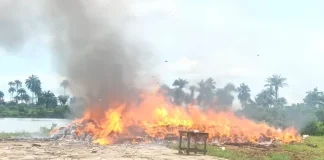
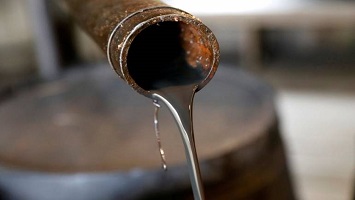
- The mastermind behind crude oil theft in Nigeria usually remains hidden from security agencies, leaving only low-level workers captured at illegal refining sites.
- Vice Admiral Idi Abbas stated that the delicate structure of oil theft syndicates complicates prosecution because arrested workers often do not know who employs them.
- Increased deployment of technology-driven surveillance, intelligence gathering, and monitoring systems has helped curb oil theft and secure national assets.
- The Nigerian Navy reported that the nation’s coastal and riverine communities are relatively safe, with sea robbery and pipeline vandalism largely contained.
- The Chief of the Naval Staff advocated for a specialized maritime court to accelerate justice and relieve the Navy of the high financial costs of maintaining seized vessels.
Main Story
The Chief of the Naval Staff, Vice Admiral Idi Abbas, says the masterminds behind crude oil theft in Nigeria often remain hidden from security agencies.
He stated that individuals arrested at illegal refining sites are usually low-level operatives with little knowledge of the larger criminal network.
Speaking on Channels Television’s Sunrise Daily on Friday, Abbas noted that many of those apprehended during operations are merely workers paid small sums.
He explained that the complex structure of oil theft syndicates makes it difficult to identify and prosecute the individuals who orchestrate the criminal enterprise. According to the Naval Chief, prosecution is often complicated because many arrested suspects have little or no information about the people directing the operations.
Despite these challenges, Abbas said the Nigerian Navy and other security agencies are continually refining their strategies to counter the evolving tactics of oil thieves. He stated that the adoption of technology-driven surveillance, intelligence gathering, and monitoring systems has significantly enhanced efforts to curb crude oil theft and protect critical national assets.
The Naval Chief reaffirmed the commitment of the Nigerian Navy to sustaining operations against oil theft, stressing that collaboration among security agencies, stakeholders, and host communities remains essential.
Meanwhile, Vice Admiral Abbas stated that Nigeria’s coastal and riverine communities are relatively safe. He said the Nigerian Navy has made significant progress in reducing threats along the coast, particularly illegal oil-related activities and sea robbery.
While crude oil theft and isolated cases of sea robbery remain areas of concern, he noted that the Navy has been largely successful in containing such activities through intensified surveillance and enforcement operations.
The Chief of the Naval Staff also called for the establishment of a special court dedicated to prosecuting maritime crimes. He said the proposed court would focus exclusively on cases involving crude oil theft and other maritime-related offences, helping to address delays associated with the conventional judicial process.
According to him, the establishment of such a court would significantly accelerate the dispensation of justice and reduce the substantial operational costs currently incurred by the Navy in maintaining seized vessels and other exhibits pending judgment.
The Issues
- Penetrating highly insulated, multi-layered criminal syndicates where low-level field workers have no direct knowledge of their employers.
- Sustaining high operational and maintenance costs for seized vessels held in naval custody during prolonged conventional court trials.
- Balancing ongoing tech upgrades in coastal surveillance with community-level collaboration to completely halt environmental pollution in the Niger Delta.
What’s Being Said
- Explaining the disparity between the low-level laborers caught at production sites and the actual financial beneficiaries of the illegal trade, Vice Admiral Idi Abbas stated: “Most of the faces behind these thefts are not really known or are not the ones we always catch. The ones we get at most of the illegal refinery sites are just being given some paltry sum, while the big masquerades are the ones that make the real money,”
- Outlining why the prosecution of field suspects rarely leads to the destruction of the broader criminal enterprise, Abbas added: “In trying to prosecute some of these people that we get, some of them don’t even know who they are working for. So, the network is a very delicate one,”
- Emphasizing the role of modern monitoring infrastructure in matching the adaptive tactics of oil bunkering networks, the Naval Chief noted: “As they are evolving strategies, we are also evolving new strategies. Like I keep saying, technology is the way forward. With that, we have been able to reduce the level of theft,”
- Summarizing the current security situation within the country’s deltaic and maritime borders, he declared: “As it stands today, I can say that our coastal areas and the riverine areas are relatively safe,”
- Identifying the specific maritime offenses that naval forces are actively suppressing along the waterways, he explained: “What we are contending with mostly there is the issue of crude oil theft and some pockets of sea robbery, which we are able to curtail,”
- Calling for institutional legal reforms to handle arrested sea criminals on Friday’s broadcast, Abbas urged: “What we are pushing for is that we should have a special court that will try these maritime criminals,”
- Explaining how a specialized fast-track judicial process would directly save the military from unnecessary asset management expenditures, he concluded: “If we have that in place, I believe the dispensation of justice will be done much faster and then ease the burden of keeping and maintaining some of the arrested vessels, which will be taken off from us because we spend a lot to maintain those vessels under our custody,”
What’s Next
- The Nigerian Navy will continue to deploy and refine technology-driven surveillance and monitoring systems along volatile channels.
- Maritime stakeholders and military leadership will look to advance advocacy for legislative action establishing a dedicated special maritime court.
- Joint security teams will maintain intensified enforcement and surveillance operations to clear out remaining pockets of sea robbery and illegal refining camps.
Bottom Line
The Navy has declared Nigeria’s coastal waters relatively safe but notes that the masterminds of crude oil theft remain shielded behind low-level operatives, prompting Vice Admiral Idi Abbas to call for a special maritime court to fast-track justice and eliminate the high cost of holding seized vessels.