








By Boluwatife Oshadiya | July 22, 2026
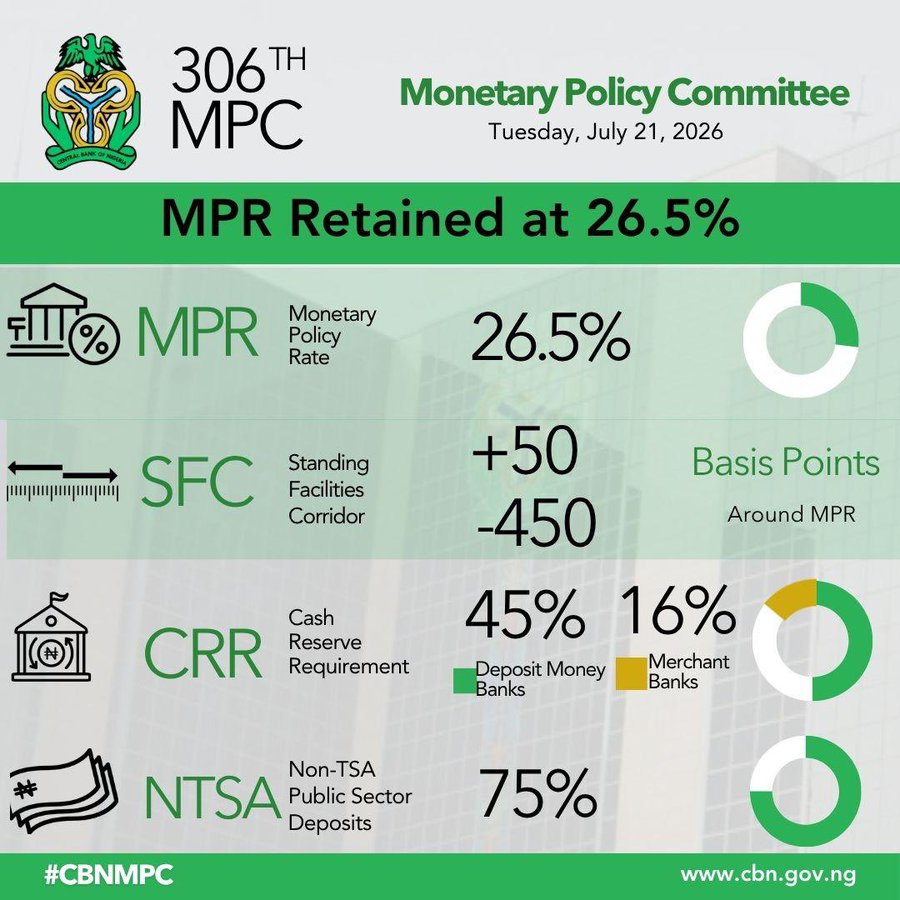
- MPC retains Monetary Policy Rate (MPR) at 26.5% and other key parameters
- Headline inflation eases marginally to 15.91% in June 2026
- Real GDP grows 3.89% in Q1 2026, driven by non-oil sector
- External reserves rise to US$52.52 billion, covering about 11 months of imports
- Committee cites resilience amid Middle East hostilities and global uncertainties
The Monetary Policy Committee (MPC) of the Central Bank of Nigeria (CBN) concluded its 306th meeting on July 21, 2026, and issued Communiqué No. 163, deciding to hold the benchmark Monetary Policy Rate steady at 26.5%. This marks the second consecutive meeting without a rate change, reflecting a cautious stance amid moderating domestic inflation, resilient growth, and external risks primarily from renewed hostilities in the Middle East.
The committee, with 11 members in attendance, reviewed global and domestic developments before opting to maintain the policy parameters to monitor incoming data closely.
Here are 10 key things to know about the communiqué and its implications for Nigeria’s economy.
1. No Change in the Benchmark Interest Rate
The MPC unanimously decided to retain the Monetary Policy Rate (MPR) at 26.5%. It also kept the asymmetric Standing Facilities Corridor at +50/-450 basis points around the MPR. This decision followed a thorough assessment of risks, with the committee noting that while headline inflation moderated slightly, global uncertainties—driven by Middle East developments—warranted a cautious approach.
2. Cash Reserve Requirements Unchanged
The Cash Reserve Requirement (CRR) remains at 45.00% for Deposit Money Banks, 16.00% for Merchant Banks, and 75.00% for non-TSA public sector deposits. These settings aim to sustain liquidity management and financial system stability following the successful banking sector recapitalisation exercise.
3. Marginal Easing in Headline Inflation
Headline inflation (year-on-year) declined to 15.91% in June 2026 from 15.93% in May, ending three months of increases. This was driven by a drop in the non-food component, even as food inflation rose to 17.52% from 16.96% due to supply constraints. Core inflation moderated more noticeably to 15.92% from 16.82%, aided by exchange rate stability. Month-on-month headline inflation also slowed to 1.66%. The 12-month average inflation continued its decline to 17.63%.
4. Resilient Economic Growth in Q1 2026
Real GDP expanded by 3.89% in the first quarter of 2026, compared to 4.07% in the previous quarter. The non-oil sector led with 3.94% growth, supported by telecommunications, financial services, trade, transportation, and other services. Oil sector growth slowed to 2.57% due to facility maintenance. The Composite Purchasing Managers’ Index (PMI) improved to 50.1 points in June from 49.6 in May, signaling expanding economic activity.
5. Strong Build-Up in External Reserves
Gross external reserves increased to US$52.52 billion as of July 17, 2026, from US$50.47 billion at end-May. This provides cover for approximately 11 months of imports of goods and services—well above the international benchmark of three months—bolstered by crude oil-related taxes and third-party inflows.
6. Global Headwinds from Middle East Tensions
The committee highlighted the resurgence of hostilities in the Middle East and their potential spillover on global energy prices and domestic inflation. Global growth is projected to slow to 3.0% in 2026 from 3.5% in 2025 due to geopolitical tensions, trade uncertainties, and tight fiscal conditions. Risks to global inflation remain elevated from commodity prices, supply disruptions, and climate shocks.
7. Praise for Policy Coordination and Reforms
The MPC welcomed improved fiscal-monetary alignment and commended the Federal Government’s commitment to reforms, including Executive Order 9, efforts to boost crude oil production, and diversification into solid minerals. It noted the positive outcomes of banking recapitalisation in enhancing sector resilience and urged continued surveillance.
8. Positive Outlook with Key Risks
Output growth is expected to remain resilient in 2026, supported by higher oil production, improving PMI, and policy reforms. Inflation is projected to moderate further due to forex stability, lagged effects of prior tightening, and upcoming harvests. However, a severe escalation in the Middle East conflict poses the primary downside risk.
9. Voices from Stakeholders and Analysts
Analysts largely anticipated the hold, with groups like the Chartered Institute of Bankers of Nigeria (CIBN), Cordros Research, and Capital Market Academics of Nigeria (CMAN) projecting retention of the 26.5% MPR. The Centre for the Promotion of Private Enterprise (CPPE) described the decision as “balanced and intelligent,” reflecting a measured response to transitory pressures. Public reactions have mixed relief at stability with concerns over sustained high borrowing costs for businesses and households.
“The outcome of the 305th MPC meeting reflects a balanced and intelligent policy…” (CPPE, as reported in coverage of similar recent holds; sentiment echoed in 306th reactions).
10. Next Steps and Forward Guidance
The next MPC meeting is scheduled for September 21–22, 2026. In the interim, the CBN will continue monitoring data, with emphasis on sustaining forex stability, improving food supply, and enhancing policy coordination. The communiqué underscores the committee’s readiness to adjust policy based on evolving conditions to preserve price and financial stability.
The Bottom Line: The MPC’s decision to hold rates steady signals confidence in the resilience built from prior reforms, even as it keeps a watchful eye on external shocks. While inflation shows tentative signs of easing and reserves strengthen, persistent food price pressures and geopolitical risks mean the tight policy stance remains a necessary anchor for stability. For businesses and policymakers, this communiqué reinforces the importance of domestic productivity gains and fiscal alignment to reduce reliance on high interest rates over time.








 of the Central Bank of Nigeria (CBN) concluded its 306th meeting on July 21, 2026, and issued....)