





By Emmanuella Opara | November 15th, 2026
KEY POINTS
- Energy experts say NNPC must balance commercial interests with Nigeria’s long-term economic priorities.
- About 35 per cent of NNPC’s revenue comes from oil and gas exports, while petroleum products account for 85 per cent of Nigeria’s exports.
- Researchers warn that different energy transition strategies could reduce government revenue and affect the wider economy.
- NNPC identifies natural gas as Nigeria’s transition fuel and is pursuing investments in renewable and low-carbon energy.
- The company is supporting efforts to eliminate gas flaring by 2030.
MAIN STORY
Energy experts and researchers have called on the Nigerian National Petroleum Company Limited to align its investment decisions with Nigeria’s long-term economic interests as the global shift towards cleaner energy threatens the viability of fossil fuel projects.
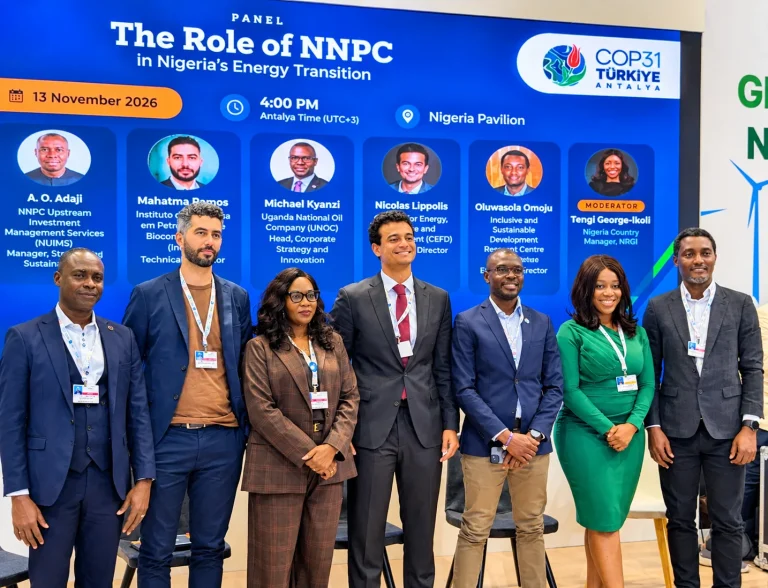
They made the call at a session titled ‘The Role of NNPC in Nigeria’s Energy Transition’ during the 31st United Nations Climate Change Conference (COP31) in Antalya, Türkiye, where participants examined the implications of changing global energy markets for Nigeria’s oil and gas industry.
The session was organised by the Centre for Petroleum, Energy Economics and Law, University of Ibadan; the Centre for Energy, Finance and Development; and the Inclusive and Sustainable Development Research Centre.
The Nigeria Country Manager of the Natural Resource Governance Institute, Tengi George-Ikoli, who moderated the session, said national oil companies would play a major role in determining how the global decline in fossil fuel production was managed.
She noted that as international oil companies reconsidered their investments, national oil companies could step in to fill the resulting investment gap, making their decisions critical to the energy transition.
George-Ikoli urged Nigeria to move beyond discussions and ensure that NNPC worked with the Federal Government to assess investment risks, prepare for declining fossil fuel demand and develop credible transition strategies.
In a presentation, the Executive Director of the Centre for Energy, Finance and Development, Nicolas Lippolis, said the Petroleum Industry Act 2021 had transformed NNPC into a commercially oriented company, requiring it to reconcile profitability with its public responsibilities.
He said the company had to generate government revenue, guarantee energy security and support domestic production while ensuring that its investments remained commercially viable as global energy markets changed.
Lippolis disclosed that approximately 35 per cent of NNPC’s revenue came from oil and gas exports, while petroleum products accounted for about 85 per cent of Nigeria’s exports, leaving the country exposed to changes in global demand.
His research identified gas-fired power, domestic midstream infrastructure and international pipelines as areas requiring closer examination because of their exposure to energy transition risks.
He also recommended independent market assessments for projects involving private and international partners to establish whether they had sustainable commercial demand.
Similarly, the Executive Director of the Inclusive and Sustainable Development Research Centre, Oluwasola Omoju, warned that NNPC’s transition decisions would have consequences beyond the petroleum sector, affecting the wider economy.
Presenting an economic modelling assessment, he examined three possible strategies: divestment from fossil fuel investments, increased investment in natural gas and the capture and commercialisation of gas currently being flared.
He said the findings indicated that the different pathways could produce negative macroeconomic effects, including declining government revenue as the economy adjusted to reduced dependence on oil and gas.
However, Omoju identified opportunities for employment growth in refining and industrial activities, which could absorb workers displaced by changes in the energy sector.
He added that the economic impact would depend on the strategy adopted by NNPC and the extent of government support through appropriate policies and financing arrangements.
Speaking during a panel discussion, the Manager of Strategy and Sustainability at NNPC Upstream Investment Management Services, A.O. Adaji, said the company was pursuing an energy mix rather than relying on a single approach to the transition.
He described natural gas as Nigeria’s transition fuel, explaining that NNPC was expanding its use for industrialisation, electricity generation and efforts to reduce energy poverty.
The company is also using blended investments and strategic partnerships to commercialise gas and supply power plants and industrial facilities.
Adaji disclosed that NNPC was supporting efforts to eliminate gas flaring by 2030 through the Nigerian Gas Flare Commercialisation Programme. He said flared gas accounted for approximately five per cent of Nigeria’s total gas production in 2025.
He also invited investors and businesses to participate in the commercialisation programme, adding that NNPC had established a new energy subsidiary to drive investments in renewable and low-carbon energy.
Other participants shared experiences from their respective countries.
The Technical Director of Brazil’s Instituto de Pesquisa em Petróleo, Gás e Biocombustíveis, Mahatma Ramos, said national oil companies should serve as instruments of sustainable development rather than focus exclusively on shareholder returns.
He cited Petrobras as an example, arguing that transition investments required clear government mandates, long-term financing and accountability to workers and communities.
The Director of Environmental and Social Performance and Safety at Senegal’s Réseau Gazier du Sénégal, Awa Diouf, explained how the country’s gas pipeline company combined public ownership with private-sector flexibility to coordinate producers, power plants and industrial consumers.
Meanwhile, the Head of Corporate Strategy and Innovation at Uganda National Oil Company, Michael Kyanzi, said Uganda had elevated energy security to the level of national security.
He called for greater collaboration among African countries, domestic value addition and regional infrastructure development to reduce dependence on imported refined petroleum products.
Kyanzi cited Uganda’s engagement with Kenya on petroleum pipeline infrastructure and the East African Crude Oil Pipeline involving Uganda and Tanzania as examples of regional cooperation that could reduce financing costs and improve energy security.
The panellists agreed that cooperation among national oil companies, governments and private investors would be necessary to ensure that the energy transition did not undermine economic development.
THE ISSUES
Nigeria faces the challenge of managing its dependence on oil and gas revenue while preparing for a global energy market increasingly shaped by cleaner energy sources.
The figures presented at the conference show the country’s exposure, with oil and gas exports contributing about 35 per cent of NNPC’s revenue and petroleum products accounting for approximately 85 per cent of national exports.
A poorly managed transition could affect government earnings, employment, energy security and investment in domestic infrastructure.
However, withdrawing too quickly from fossil fuel investments could also create economic difficulties, particularly if alternative revenue sources and energy infrastructure are not sufficiently developed.
The central challenge is finding a transition pathway that protects existing economic interests while creating opportunities in natural gas, renewable energy and domestic industrial production.
WHAT’S BEING SAID
“National oil companies will play a major role in determining the success of the push for a managed decline in fossil fuel production globally. As international oil companies scale back, NOCs may step in to fill the gap, making their involvement in the transition essential. This is particularly true for NNPC in Nigeria.”
Tengi George-Ikoli, Nigeria Country Manager, Natural Resource Governance Institute.
“Right from the presidency, the board and the executives, we know that gas is our transition fuel, and we are doing everything possible to ensure that we use gas as an engine of growth for industrialisation and to close the gap of energy poverty that we have in the country.”
A.O. Adaji, Manager of Strategy and Sustainability, NNPC Upstream Investment Management Services.
WHAT’S NEXT
NNPC’s ability to translate its energy mix strategy into commercially viable projects will be important as global demand for fossil fuels changes.
The company is expected to continue developing gas infrastructure, pursuing gas flare commercialisation and expanding its renewable and low-carbon energy investments, while working with the Federal Government and private investors.
BOTTOM LINE
Energy experts say NNPC must carefully manage the shift towards cleaner energy to protect government revenue, employment and energy security while positioning Nigeria to benefit from emerging opportunities in natural gas and renewable energy.