Key points
- Path to Possibilities has called for greater investment in education and vocational training to tackle youth unemployment and reduce the number of out-of-school children.
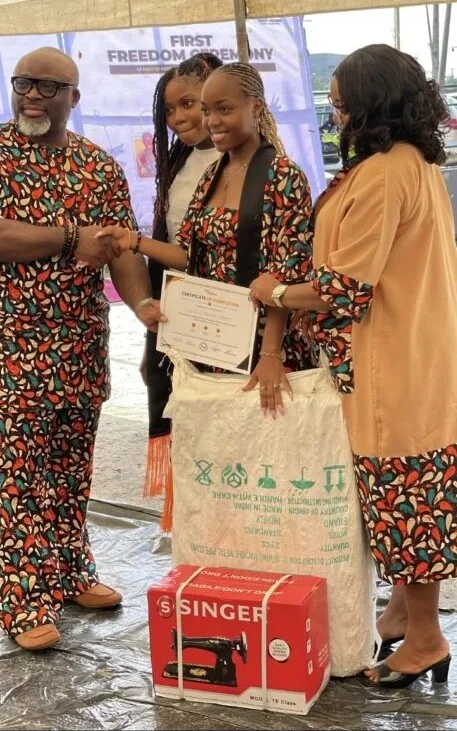
- The charity graduated the first five beneficiaries of its free 12-month tailoring programme.
- The organisation says it has sponsored at least 20 students through secondary school and provides digital skills training for hundreds of children.
- It plans to install a solar power system to improve learning at its community resource centre.
Main story
The Founder of Path to Possibilities, a UK-registered charity, Ms Titilolami Bello, has called for increased investment in education and vocational training to equip young Nigerians with practical skills and reduce the growing number of out-of-school children.
Bello made the appeal during the organisation’s 10th anniversary and graduation ceremony for beneficiaries of its tailoring programme at its community resource centre in Ikota, Ajah.
She said Nigeria continues to have one of the world’s largest populations of out-of-school children, stressing the need to diversify education by expanding access to vocational training and practical skills.
According to her, greater investment by governments at all levels would strengthen education and improve skills development among young people.
Bello explained that Path to Possibilities was founded in 2009, while its community resource centre was established in 2016 to provide underserved children and youths with access to books, computer training and vocational education.
She said the centre operates a library and computer laboratory with free internet access, where full-time instructors teach children basic digital skills and computer literacy.
According to her, many schools in the community lack computer laboratories and depend on the centre to provide pupils with practical computer education through scheduled visits.
She added that the centre also serves as a safe space where vulnerable girls can access sanitary products while young people receive training on curriculum vitae writing and interview preparation to improve their employment prospects.
Bello said the organisation introduced its tailoring programme in 2025 to equip out-of-school youths and secondary school graduates with employable skills.
She announced the graduation of the first five beneficiaries who completed the tuition-free 12-month tailoring programme.
The founder identified unreliable electricity supply as one of the organisation’s biggest challenges and disclosed plans to install a solar power system to ensure uninterrupted learning and reduce operating costs.
She said thousands of children had benefited from the organisation’s computer literacy, digital drawing and vocational training programmes, as well as sanitary pad distribution supported by donors and charitable partners.
Bello also appealed to established fashion designers to offer apprenticeship opportunities to graduates of the tailoring programme to help them acquire advanced skills and build sustainable careers.
She stressed that addressing youth unemployment and education challenges would require stronger collaboration between government and the private sector.
Also speaking, the organisation’s Trustee and Director, Ms Funmilola Akanmu, said the charity was established to expand educational opportunities for underprivileged children.
She said the organisation currently sponsors students through six years of secondary education by covering school fees, uniforms, books and other educational expenses.
According to her, at least 20 students have benefited from the sponsorship programme, with plans to support more children this year.
Akanmu disclosed that the resource centre receives about 500 children daily for reading programmes, library services and computer training, while schools in the Ikota area regularly bring pupils for educational sessions.
She expressed optimism that improved funding and stronger support for public schools would expand access to secondary education for more children.
One of the tailoring graduates, Jimoh Orilowo, who has one hand, said the training enabled him to overcome the challenges posed by his disability.
He expressed gratitude to the organisation for giving him the opportunity to acquire tailoring skills, saying he could now cut and sew despite his physical condition.
Another graduate, Destiny Godwin, thanked the charity for supporting her throughout the programme and said she intended to continue her education while further developing her tailoring skills.
The issues
Millions of Nigerian children remain out of school, while youth unemployment continues to drive demand for vocational education and skills acquisition programmes. Charities and non-governmental organisations have increasingly stepped in to complement government efforts by providing scholarships, digital literacy and vocational training.
What’s being said
“We need to diversify education through vocational training and practical skills to engage more out-of-school children.” — Titilolami Bello, Founder, Path to Possibilities
“Path to Possibilities covers the school fees, uniforms, books and every educational requirement of these students for six years without any financial contribution from their parents.” — Funmilola Akanmu, Trustee and Director, Path to Possibilities
What’s next
The organisation plans to install a solar power system at its resource centre, expand its educational and vocational programmes, and secure apprenticeship opportunities for graduates of its tailoring initiative.
Bottom line
Path to Possibilities is combining education sponsorship, digital literacy and vocational training to improve opportunities for disadvantaged young Nigerians while calling for greater public investment in practical skills development.