Key points
- President Bola Tinubu has urged Nigerians living abroad to shift from sending remittances home to making long-term investments in Nigeria.
- He spoke at the inaugural Nigeria Diaspora Economic Conference (NIDEC) 2026 in Toronto, Canada.
- Tinubu said Diaspora Nigerians possess capital, expertise and global networks that can help accelerate Nigeria’s economic transformation.
- He called for professionally managed investment clubs, sector funds, co-investment vehicles and venture networks.
- Priority sectors identified include agriculture, healthcare, technology, energy, housing, logistics, mining, education, creative industries and export manufacturing.
- The President said Nigeria was working to create a more predictable regulatory environment and stronger safeguards for investors.
- He cited recent economic indicators as evidence that government reforms were improving macroeconomic stability.
- NiDCOM said the conference was designed to convert Diaspora engagement from dialogue into actual capital deployment.
- The push comes as Nigeria seeks to attract more foreign and Diaspora capital to support job creation, enterprise expansion and economic growth.
Main Story
President Bola Tinubu has stepped up efforts to attract Diaspora capital into Nigeria, urging Nigerians living abroad to move beyond supporting families through remittances and take strategic positions in businesses and investment opportunities capable of creating jobs and expanding the economy.
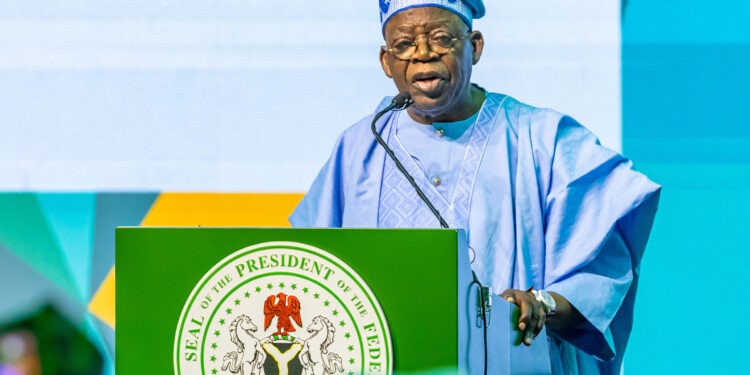
Tinubu made the call at the inaugural Nigeria Diaspora Economic Conference (NIDEC) 2026 in Toronto, Canada, where he told Nigerians abroad that the country was increasingly positioning itself as an investment destination.
Represented by his Chief of Staff, Femi Gbajabiamila, the President said Nigeria’s estimated Diaspora community possessed three critical assets — capital, expertise and international networks — that could be deployed more strategically to accelerate national development.
The three-day conference, organised by the Nigerians in Diaspora Commission (NiDCOM) under the theme “Thrive Abroad, Invest in Nigeria,” brought together government officials, investors, business leaders and Nigerians living abroad.
“Nigeria sees you. Nigeria values you. Nigeria needs you,” Tinubu told participants.
The President acknowledged the importance of remittances to Nigerian households, noting that money sent home by Nigerians abroad supports education, healthcare, household expenses and small businesses.
He, however, argued that remittances should serve as the starting point rather than the end goal of Diaspora economic participation.
“Remittances must now become the floor of Diaspora engagement rather than its ceiling.”
From Remittances to Investment
Tinubu’s central message was that Nigeria needs to transform the relationship between the country and its Diaspora from one primarily based on family support to productive investment.
He urged Nigerians abroad to consider opportunities in agro-processing, healthcare, technology, energy, housing, logistics, mining, education, creative industries and export-oriented manufacturing.
The President also encouraged collective investment rather than scattered individual transactions.
He proposed professionally managed investment clubs, sector-specific funds, co-investment vehicles and venture networks through which Diaspora investors could pool their resources and demand proper corporate governance.
Such structures, he said, would allow investors to insist on audited accounts, conduct due diligence and reduce the risks associated with informal or personality-driven investments.
The Investment Confidence Question
One of the biggest challenges to attracting Diaspora capital remains investor confidence.
Tinubu acknowledged that Nigerians abroad would only commit significant capital if they were confident that Nigeria’s regulatory and financial environment could protect their investments.
He said the Federal Government was therefore working towards predictable regulations, transparent project pipelines, more efficient consular services and stronger safeguards against fraud.
The administration is also seeking to make participation in Nigeria’s financial system easier for Nigerians living overseas through instruments including the Non-Resident Nigerian Ordinary Account, Non-Resident Nigerian Investment Account and Non-Resident Bank Verification Number.
Tinubu Makes Economic Case
Seeking to strengthen his administration’s investment pitch, Tinubu highlighted recent economic indicators which he said demonstrated improving macroeconomic stability.
He said Nigeria’s economy grew by 3.89 per cent in real terms in Q1 2026, while manufacturing expanded by 3.29 per cent.
He also cited an inflation rate of 15.91 per cent and foreign reserves of $45.4 billion at the end of 2025.
Tinubu said the International Monetary Fund had projected Nigeria’s economy to grow by 4.1 per cent in 2026, arguing that the indicators reflected the impact of reforms introduced since his administration came into office.
He also referenced the World Bank’s assessment of progress in macroeconomic stability, the external sector and fiscal position.
According to the President, the new tax architecture is designed to simplify compliance while reducing pressure on low-income earners and small businesses.
He further disclosed that the Bank of Industry disbursed N636 billion to businesses in 2025, describing the figure as the institution’s highest annual financing volume.
Infrastructure as Investment Catalyst
Tinubu said the Federal Government was simultaneously investing in infrastructure required to make Nigeria more attractive to private capital.
The areas highlighted include:
- Roads and rail;
- Ports;
- Electricity;
- Digital infrastructure;
- Healthcare;
- Housing;
- Agriculture and agro-processing.
The administration’s argument is that better infrastructure will reduce the cost of doing business and create conditions for investors to operate profitably.
For Diaspora investors, the availability of infrastructure could be particularly important because many potential investors remain familiar with Nigeria but operate from countries with more predictable business environments.
What’s Being Said
NiDCOM Chairman/CEO Abike Dabiri-Erewa said the conference was designed to move Diaspora engagement beyond discussions and harness Nigerians abroad as a source of expertise, capital and international connections.
She urged Nigerians in the Diaspora to view Nigeria not only as home but also as an investment destination.
Minister of Industry, Trade and Investment Jumoke Oduwole similarly called for a shift from investment conversations to actual capital deployment.
“The best time for investment is now.”
Anambra State Governor Charles Soludo commended the Federal Government’s economic reforms, saying they could help Nigeria attract global capital and compete more effectively in the international investment market.
Zamfara State Governor Dauda Lawal said the conference offered an opportunity for his administration to position the state to attract fresh investments.
The Issues
While the Federal Government’s investment pitch may resonate with Nigerians abroad, converting interest into actual capital will depend on whether investors see improvements in several areas.
Key issues include exchange-rate stability, taxation, infrastructure, security, regulatory consistency, contract enforcement and protection against fraud.
Diaspora investors may also require greater transparency around government-backed investment opportunities, particularly where public institutions or state governments are involved.
Another challenge is ensuring that Diaspora investment produces productive economic activity rather than simply financing consumption or speculative assets.
For Nigeria to derive maximum value, capital should increasingly flow into enterprises that produce goods, generate employment, expand exports and deepen domestic value chains.
Diaspora Capital and Political Participation
Tinubu also linked the growing economic influence of Nigerians abroad to their potential political influence.
He suggested that increased economic participation could strengthen the Diaspora’s voice in national conversations, including the longstanding debate over Diaspora voting.
However, with the 2027 general election approaching, he urged Nigerians to protect national cohesion and ensure political competition does not undermine Nigeria’s stability.
What’s Next
The major test for NIDEC 2026 will be whether discussions in Toronto translate into actual investment commitments.
Government agencies will need to provide credible project pipelines, clear investment structures and reliable information to prospective investors.
NiDCOM and the relevant economic agencies will also need to maintain engagement with Diaspora investors beyond the conference through investment facilitation, project tracking and aftercare.
For Diaspora Nigerians, the next step is similarly clear: moving from interest to due diligence, partnerships and measurable capital deployment.
Bottom Line
Tinubu’s message in Toronto represents a deliberate attempt to reposition Nigerians abroad from remittance providers to economic partners and investors.
The opportunity is significant. Diaspora Nigerians possess capital, professional expertise and access to international markets that could help Nigeria finance businesses, create jobs and expand its productive capacity.
But the investment pitch will ultimately be judged by the business environment.
If Nigeria can combine economic reforms with predictable regulation, stronger institutions, infrastructure and investor protection, Diaspora capital could become a much more powerful engine of growth.
The real test now is whether “Thrive Abroad, Invest in Nigeria” moves from a conference slogan to billions of naira and dollars committed to productive Nigerian businesses and projects.