







For many Lagos residents, the words government acquisition often evoke anxiety rather than optimism.
They bring back memories of demolished homes, displaced families and prolonged legal battles over whether compensation was ever paid, or whether it reflected the true value of what was lost. From Maroko to Makoko and, more recently, the controversy surrounding properties affected by the Lagos-Calabar Coastal Highway, compulsory acquisition has remained one of the most sensitive aspects of urban development in Nigeria’s commercial capital.

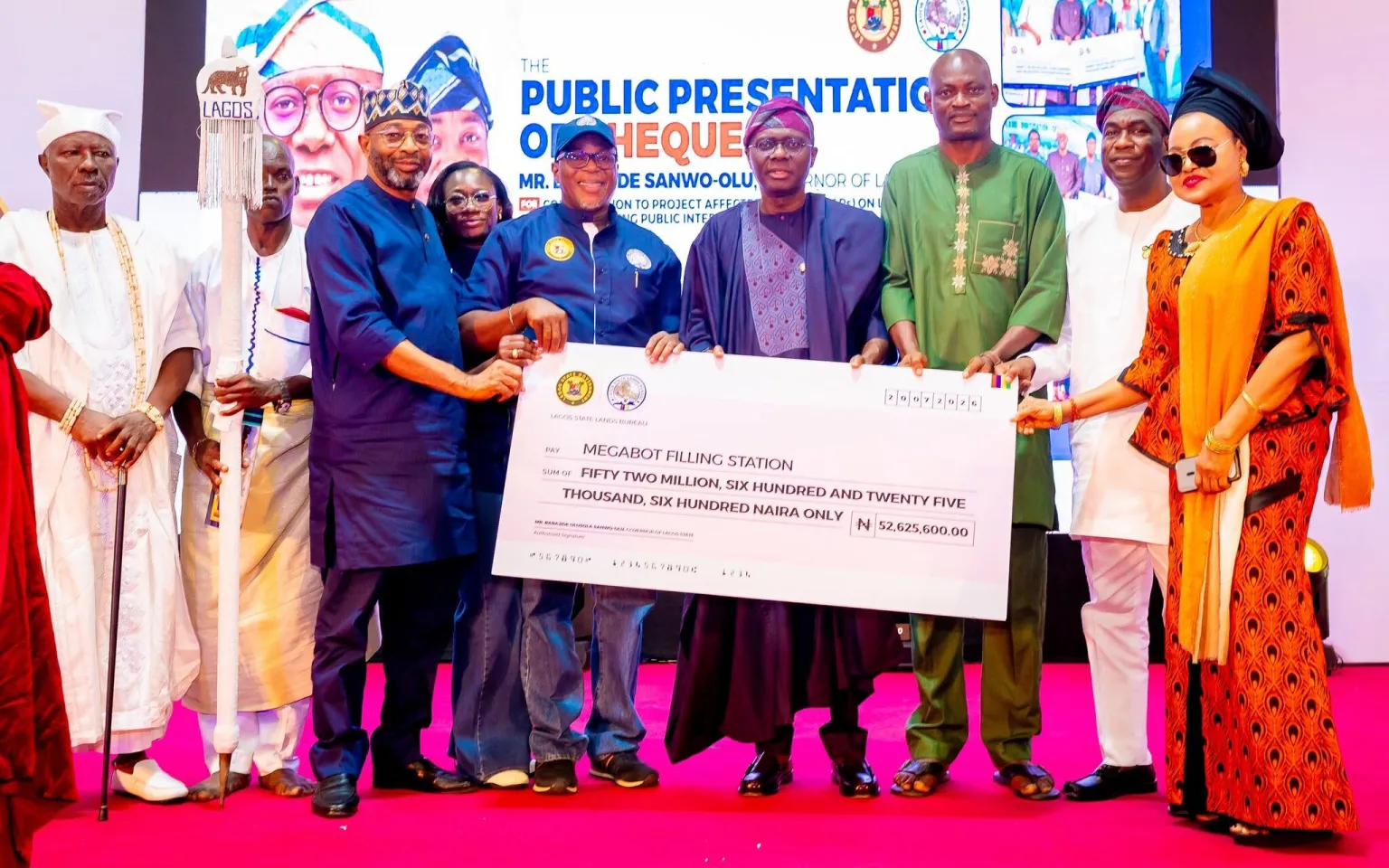
That is why Governor Babajide Sanwo-Olu’s announcement on Monday deserves attention beyond the N3.1 billion figure attached to it.
The governor disclosed that the Lagos State Government had paid N3.1 billion in compensation to 331 property owners whose lands and buildings were acquired for infrastructure projects in Badagry, Epe, Ikorodu, Igbogbo and Ogba. According to him, the payments followed a verification process and reflected the state’s commitment to fairness and accountability in the execution of public projects.
“Behind every property is a family, a home or a business,” the governor wrote on his X account. “While these projects will benefit millions of Lagosians, I do not take the sacrifice of those who made them possible for granted.”
It was a statement that appeared carefully chosen.
Governments are expected to compensate owners when land is acquired for public purposes. The principle is not new. It is provided for under Nigeria’s Land Use Act and reinforced by constitutional provisions requiring compensation where property is compulsorily acquired for overriding public interest. Yet, compliance has often been the source of controversy rather than consensus.
Lagos, perhaps more than any other state, has lived with that controversy for decades.
In July 1990, the military administration of Raji Rasaki demolished the Maroko community on Victoria Island, displacing tens of thousands of residents in one of the largest urban evictions in Nigeria’s history. While government defended the action as necessary for urban renewal, many former residents argued that they received little or no adequate compensation. The episode became a defining moment in debates about land rights and the human cost of development.
More than two decades later, another dispute emerged at Makoko. In 2012, parts of the waterfront settlement were demolished after the state declared sections of the community illegal. Human rights organisations accused the government of carrying out forced evictions without adequate consultation or compensation. Similar allegations resurfaced during demolitions in Otodo-Gbame, Badia East and other informal settlements, where residents challenged both the process and the treatment they received after losing their homes.
The debate has not been confined to low-income communities.
Last year, the Lagos-Calabar Coastal Highway project reignited national discussions over compulsory acquisition after businesses and property owners along the Lekki coastline were affected by demolitions linked to the project. Some accepted that major infrastructure would inevitably require difficult decisions. Others questioned the valuation process, the level of compensation and whether enough effort had been made to reduce the impact on affected businesses.
Against that backdrop, Monday’s announcement carries significance beyond its monetary value.
The payment itself is not unprecedented. Governments routinely compensate property owners whose land is acquired for roads, rail lines and other public infrastructure. What is notable is the prominence Lagos has given to the exercise and the language accompanying it.
Governor Sanwo-Olu repeatedly framed the compensation as a matter of fairness rather than obligation. He spoke of keeping promises, recognising sacrifice and governing with accountability. Those words suggest an awareness that infrastructure projects cannot be judged solely by the roads they deliver, but also by how they treat the people who bear their immediate costs.
Whether that represents a genuine shift in policy will depend on what happens beyond Monday’s ceremony.
The questions that matter now are practical ones. Were all affected property owners compensated? How were valuations determined? Were payments made before demolition or after? Are there outstanding disputes? Will this approach become the standard for future acquisitions across the state?
Those answers will determine whether this marks a turning point or simply another announcement.
Lagos is growing at a pace that demands constant investment in roads, bridges, drainage systems and public transport. More land will inevitably be required as the city expands. The real test for government is not whether it can build infrastructure. It is whether it can do so without leaving citizens convinced that development always comes at their expense.
The N3.1 billion paid to 331 property owners may not settle that debate.
It has, however, reopened an important conversation about what fair compensation should look like in a city where the pursuit of development has too often collided with the rights of those who call it home.