







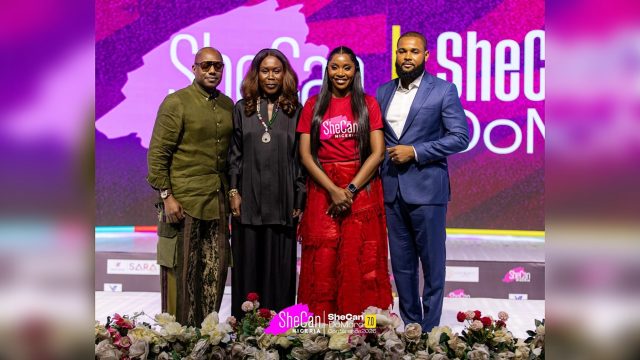
In a country where conversations around women’s empowerment often end with motivational speeches and social media hashtags, the seventh edition of the SheCan Conference sought to move the conversation from inspiration to implementation.
Inside the Balmoral Convention Centre at the Federal Palace Hotel, Victoria Island, Lagos, thousands of women arrived not merely to listen but to learn, connect, reposition themselves and unlock opportunities capable of transforming their personal and professional journeys.
With more than 13,800 registrations before the event, SheCan 7.0 has become one of Nigeria’s largest privately-driven women’s leadership and empowerment platforms, reflecting the growing appetite among Nigerian women for practical knowledge, mentorship and economic opportunities rather than symbolic conversations about gender equality.
Held under the theme “She Can Do More,” the conference assembled entrepreneurs, corporate executives, policymakers, creatives, business founders and emerging professionals around a central proposition: that women’s greatest limitation is often not a lack of ability, but limited access to knowledge, networks, confidence and opportunities.
Unlike many conferences where keynote addresses dominate the agenda, SheCan deliberately blended leadership conversations with career development, financial literacy, entrepreneurship, mentorship, networking and direct economic support, reinforcing its identity as a year-round movement rather than an annual gathering. The organisation’s initiatives extend beyond the conference through mentorship programmes, business support, skills acquisition, networking opportunities and community outreach.
Redefining excellence
General Manager, Enterprise Sales at MTN Nigeria, Febisola Oyeniyi, encouraged participants to abandon perfectionism in favour of consistent excellence.
Drawing from decades of corporate leadership, she argued that excellence is not measured by flawlessness but by intentional effort, competence and the willingness to acknowledge one’s accomplishments.
For many women, particularly within highly competitive corporate environments, this message resonated strongly. Across many African societies, women often carry the additional burden of proving themselves repeatedly before receiving recognition equal to their male counterparts. Oyeniyi’s message therefore shifted the focus from external validation to internal confidence.
More than an annual conference
Convener and Founder of SheCan Nigeria, Dr Ezinne Ezeani, described the initiative as a movement committed to transforming women through continuous engagement rather than a one-day event.
“SheCan Nigeria is not just an event; it is a movement,” she said.
Her remarks reflected a broader evolution taking place within Nigeria’s women-focused development ecosystem.
Rather than limiting empowerment to inspirational gatherings, organisations are increasingly investing in structured mentorship, entrepreneurship development, financial inclusion and leadership training that continue long after conference halls empty.
This model aligns with global evidence showing that mentorship, access to professional networks and practical skills significantly improve women’s career progression and business success.
Success without comparison
One of the conference’s defining moments came from beauty entrepreneur and founder of House of Tara, Tara Durotoye.
Rejecting society’s tendency to compare women against one another, she encouraged participants to define success according to their own values and aspirations. Her message reflected an increasingly important shift within leadership development.
In the era of social media, success has become highly visible but also heavily distorted. Many women measure their progress against carefully curated online achievements rather than their personal journeys.
Durotoye urged attendees to replace comparison with self-awareness, arguing that sustainable fulfilment begins when individuals establish their own definitions of achievement.
Her husband, leadership coach and business strategist Fela Durotoye, reinforced this perspective by challenging deeply rooted cultural assumptions that often define a woman’s success through the accomplishments of her husband or family.
He argued that women deserve recognition for their individual contributions to society, leadership and national development.
Looking beyond obstacles
Several speakers shifted attention from personal development to economic empowerment.
Group Managing Director of Mojec International Limited, Chantelle Abdul, challenged participants to develop the discipline of recognising opportunities hidden within difficult circumstances.
Rather than seeing economic uncertainty as a barrier, she encouraged women to explore emerging sectors including agriculture and innovation, where significant opportunities remain underutilised.
Her message resonated particularly in Nigeria’s current economic climate, where inflation, unemployment and business uncertainties continue to reshape career choices and entrepreneurial decisions.
Similarly, Chairman of Loft & Keys Advisory, Austin Albert, shared lessons from his entrepreneurial journey while highlighting real estate as a viable pathway towards long-term wealth creation.
His presentation extended the conference beyond motivation into financial education, emphasising the importance of informed investment decisions.
Choosing purpose over pressure
Non-Executive Director of Wema Bank, Yewande Zaccheaus, reminded participants that success is not determined by accepting every opportunity but by identifying the right ones.
According to her, clarity of purpose enables individuals to distinguish meaningful opportunities from distractions. Her message reflected a recurring theme throughout the conference—that intentionality remains one of the most valuable leadership skills in an increasingly competitive world.
Chief Operating Officer and Executive Director of SAS Textiles Limited, Toyin Bakare, complemented this perspective by encouraging women to remain resilient during periods of uncertainty.
She stressed that progress often occurs quietly before becoming visible, urging participants to remain faithful to their goals even when immediate results appear absent.
Leadership through people
One of the conference’s most engaging sessions featured a panel discussion involving Managing Director of Seven-Up Bottling Company, Sari El-Khalil, alongside Chantelle Abdul and Toyin Bakare. The conversation explored workplace leadership, organisational culture and personal growth.
El-Khalil argued that organisations perform best when people feel genuinely valued. His remarks underscored an increasingly recognised leadership principle that sustainable business performance depends as much on employee wellbeing and engagement as on financial strategy.
Joining virtually, President of the Africa CEO Club, Dr Fatoumatta Gaye, reminded participants that starting points do not determine final destinations. Her personal journey from modest beginnings to international leadership reinforced the conference’s broader message that circumstances need not define ambition.
Actor and filmmaker Ruth Kadiri also challenged participants, particularly women in the creative economy, to pursue unconventional ambitions despite criticism or scepticism.
She encouraged attendees to dream beyond traditional limitations and resist defining their futures through a single career pathway.
Closing the event, business consultant Olushola Olaleye brought the day’s conversations together with a simple but enduring reminder: success is built daily through consistency, discipline and continuous improvement.
Empowerment with measurable impact
Selected participants received business grants and financial support, while members of the deaf community and individuals living with sickle cell disorder also benefited from targeted assistance.
These interventions reinforced the organisers’ commitment to translating conversations into measurable impact.
This practical dimension reflects a growing trend among leadership conferences globally, where empowerment is increasingly assessed not by attendance figures but by tangible outcomes such as funding, mentorship, employment opportunities and enterprise development.
A growing movement
The growth of SheCan mirrors broader changes taking place across Nigeria’s leadership landscape. As women continue expanding their influence across business, politics, technology, finance and entrepreneurship, the demand for platforms that combine inspiration with practical opportunities continues to rise.
SheCan’s sustained expansion—from an annual conference into a wider ecosystem supporting mentorship, skills development, financial inclusion and entrepreneurship—illustrates how empowerment initiatives are evolving to meet those expectations.
By the close of the conference, one message had echoed consistently across keynote addresses, panel sessions and personal conversations: leadership is no longer about waiting for permission.
It is about recognising one’s value, building the necessary capacity and stepping confidently into opportunities.
As participants filtered out of the convention centre carrying notebooks, business cards, mentorship connections and renewed ambition, the conference’s central message remained unmistakable.
For today’s Nigerian woman, the question is no longer whether she can. It is how much more she is prepared to become.