









Key points
- Nigeria’s crude oil production surged to an 11-month high in May 2026, officially exceeding its allocated OPEC production quota.
- The country’s average crude oil output reached 102% of its 1.5 million barrels per day OPEC production limit.
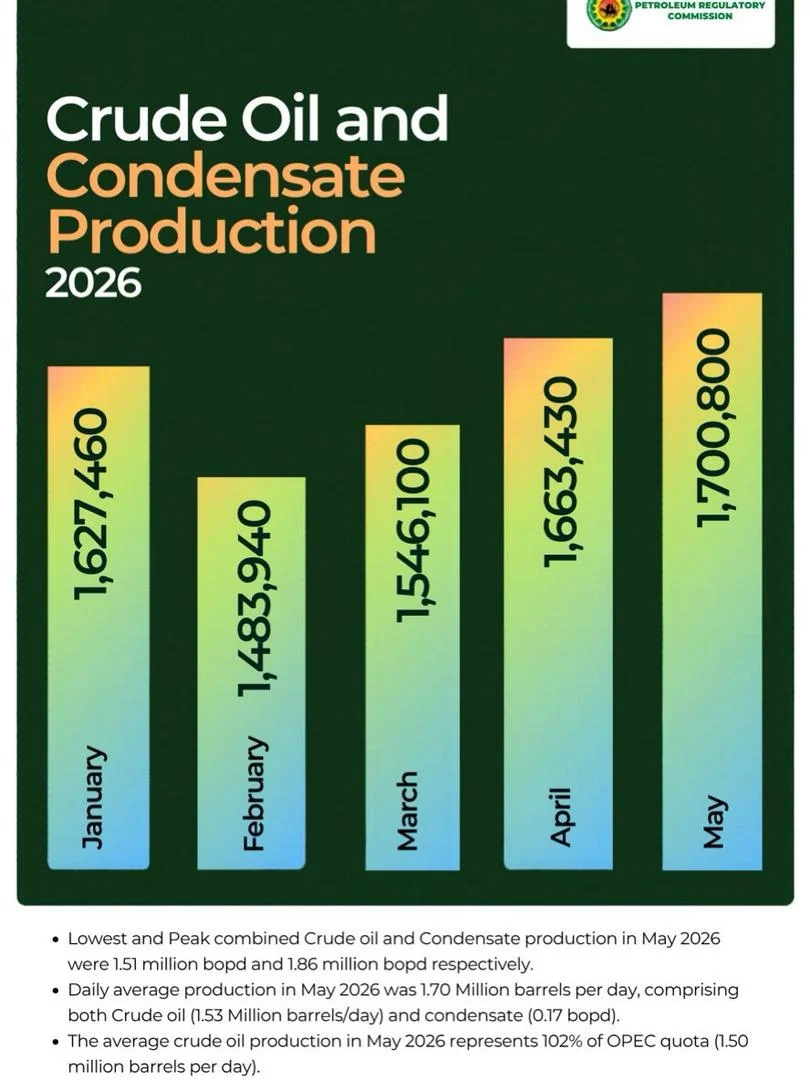
- Combined output of crude and condensates averaged 1,700,800 barrels per day, consolidating Nigeria’s position as Africa’s top producer.
- In strict crude oil terms, the 1.53 million barrels per day output represents a 15-month high for the country.
- The Bonny and Forcados terminals led the nation’s production streams, contributing the highest volumes during the review period.
Main Story
According to the latest production report released on Thursday by the Nigerian Upstream Petroleum Regulatory Commission (NUPRC), Nigeria’s average crude oil production during the month represented 102% of the 1.5 million barrels per day (mbpd) quota allocated to the nation by OPEC.
The NUPRC data disclosed that Nigeria’s oil production averaged 1,530,354 barrels of crude oil and 170,446 barrels of condensates per day (bpd). This brings the total combined hydrocarbon volume to 1,700,800 bpd, firmly consolidating Nigeria’s position as Africa’s largest oil producer. The production performance remained robust throughout the review period, with combined crude and condensate output fluctuating between a low of 1.51 million bpd and a peak of 1.86 million bpd.
This milestone represents the highest overall volume recorded by the country since July 2025, when combined output reached 1,712,282 bpd. In strict crude oil terms—excluding condensates—the 1.53 million bpd output is the highest Nigeria has witnessed since January 2025, representing a 15-month high and a 2.77% month-on-month increase from the 1.48 mbpd recorded in April 2026.
This multi-month positive trend underscores sustained growth across Nigeria’s upstream hydrocarbon sector, with combined output steadily climbing from 1.48 million bpd in February to 1.54 million bpd in March, 1.66 million bpd in April, and ultimately 1.7 million bpd in May. Among the country’s active production streams, the Bonny Terminal led the pack with a total blend of 293,870 bpd, closely followed by the Forcados Terminal at 289,900 bpd. The Qua Iboe terminal ranked third with 173,360 bpd, while the Escravos Oil Terminal and Odudu (Amenam Blend) completed the top five streams, contributing 135,470 bpd and 63,250 bpd respectively.
The regulatory commission attributed this significant rise to sustained positive operational momentum, noting that production infrastructure remained entirely stable with no major pipeline or facility outages recorded, alongside the successful completion of all previously scheduled turnaround maintenance activities.
The Issues
- Managing diplomatic alignments with OPEC leadership after exceeding the strictly allocated 1.5 mbpd crude production quota.
- Maintaining the current zero-outage momentum across vulnerable pipeline networks to sustain high-volume terminal deliveries.
- Optimizing secondary and smaller production streams to buffer output if major terminals like Bonny or Forcados experience technical hitches.
What’s Being Said
- Highlighting the historic context of the strict crude oil figures, the Nigerian Upstream Petroleum Regulatory Commission (NUPRC) stated: “In strict crude oil terms (excluding condensates), the 1.53 million barrels recorded in May 2026 represents the highest Nigeria has witnessed since January 2025 when crude oil production hit 1.538mbpd. The latest crude oil production statistics thus represents a 15-month high on a month on month basis, production rose by 2.77 per cent in May 2026 as against 1.48mbpd in April,”.
- Explaining the underlying structural stability driving the output spike, the NUPRC attributed the rise in production to a sustained positive momentum as operations remained stable throughout the reporting period with no significant pipeline or facility outages recorded.
What’s Next
- Upstream operators will continue monitoring terminal pipelines to maintain the current outage-free operations.
- Nigerian energy officials will prepare production compliance briefs ahead of future OPEC quota review meetings.
- Asset managers at the Bonny and Forcados terminals will deploy continuous efficiency protocols to preserve their leading output capacities.
Bottom Line Supported by completed facility maintenance and stable pipeline operations, Nigeria’s combined crude and condensate output hit 1,700,800 barrels per day in May 2026, pushing the nation past its official OPEC limit to hit an 11-month production high and protect its rank as Africa’s top oil exporter.





, ...)