






Key points
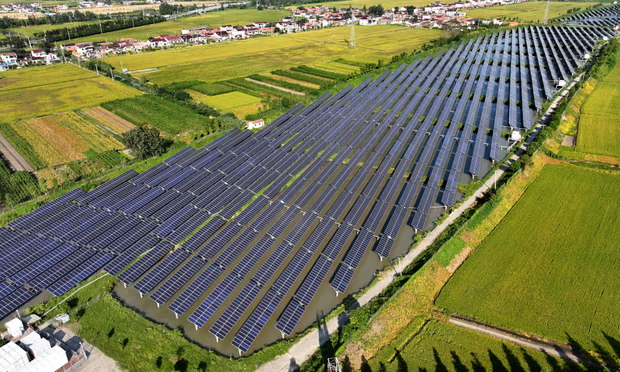
- Reuters reports that China’s green industries, like solar panels and electric cars, are booming and driving a third of the country’s economic growth.
- Despite these major green advances, China is burning more coal than ever and building new coal power stations to protect its energy supply.
- The Chinese government’s official plan aims for a modest 10% cut in greenhouse gas emissions by 2035, with a target to hit net-zero by 2060.
- Electric cars now make up half of all new vehicle sales in China, but they account for only 12% of the total number of cars currently on the road.
- China uses its vast domestic coal reserves to manufacture chemical alternatives, intentionally reducing its dependence on expensive foreign natural gas imports.
Main Story
China’s massive shift toward clean energy is a mix of big successes and major contradictions, Reuters reported on Wednesday. On one hand, cities are visibly cleaner, and green businesses like solar panel manufacturing and electric vehicles (EVs) now drive about 30% of the country’s overall economic growth.
On the other hand, China is burning more coal than ever before and continues to build new power stations to run on it. This dual approach has led critics to label Beijing’s official climate goals, such as cutting emissions by just 10% by 2035 and reaching net-zero a decade after most developed countriesas far too cautious.
According to the report, China’s green transformation is driven by two main goals: making the country completely self-sufficient and cleaning up severe pollution. By 2015, decades of rapid, factory-led growth had left urban areas covered in thick smog and much of the country’s water heavily polluted. In response, the government made green development a top national priority. Today, clean energy sectors make up 11% of China’s total economy, with the country installing enough new solar, wind, and water power capacity each year to meet the entire electricity needs of Germany.
However, China’s overall demand for electricity has grown much faster than anyone expected. Following severe power shortages that hit the country in 2021 and 2022, China built 78 gigawatts of new coal power stations in 2025 alone out of an abundance of caution, more than India built over a whole decade. Because coal is cheap and readily available inside China, factories also burn it to create gas for fertilizers and plastics, which stops the country from needing to import expensive foreign natural gas.
A similar slow transition is happening on the roads. Even though battery-powered electric rides now make up half of all new car sales, they only represent about 12% of all the vehicles currently driving in China. Experts point out that replacing an entire country’s fleet of cars takes a very long time; even in Norway, where 90% of new cars sold have been electric for years, EVs still only make up a third of all cars on the road. Ultimately, the report concludes that if China wants to successfully lower its emissions, the real solution will depend on cutting back on coal rather than just selling more electric cars.
The Issues
- Upgrading national power grids so they can handle and store the massive amount of solar and wind power being generated every day.
- Navigating trade conflicts and high tariffs from Western nations that accuse China of flooding global markets with cheap green tech.
- Finding a way to safely shut down relatively new coal factories in the future without causing unexpected power cuts for local industries.
What’s Being Said
- Highlighting the environmental triggers behind the shift, Muyi Yang, a senior analyst at the energy think tank Ember, noted that by 2015, the environmental costs of burning fossil fuels had become completely unsustainable, forcing the government to prioritize green growth.
- Explaining the challenge of keeping up with energy demand, Lauri Myllyvirta, co-founder of the Centre for Research on Energy and Clean Air, stated that except for 2025, China’s total power needs have consistently outpaced its new renewable energy installations, making coal cuts essential for real progress.
What’s Next
- Power companies will focus on building long-distance transmission lines to carry clean electricity from remote sunny regions to busy coastal cities.
- Government planners are expected to adjust energy pricing structures to discourage local factories from relying entirely on coal power during peak hours.
- International trade observers will track China’s green technology exports to developing regions as Western trade barriers tighten through the end of the year.
Bottom Line
According to the Reuters report, China’s rise as a clean energy superpower is a balancing act: the country is using massive solar and electric vehicle manufacturing to drive its economy while keeping its coal factories running to shield itself from global energy crises.