


Dakar is colder than I expected. Not the bone–freezing cold of Europe, but the kind that sneaks up on you in the morning breeze from the Atlantic. The wind cuts gently through the city, making the early mornings feel almost meditative. You wrap your hands around a cup of coffee, watch the ocean roll quietly in the distance, and for a moment, the chaos of our part of the world feels very far away.
I arrived in Senegal’s capital for a week-long communications writeshop with professionals working around artificial intelligence research across Africa. On paper, it was a training on storytelling, research communication, and translating technical work into narratives people can understand. In reality, it became something more profound, a reminder that stories shape how societies understand progress.
But Dakar itself had its own lessons. The city carries a fascinating blend of cultures. French colonial influence is everywhere: from the architecture to the language flowing through the streets. Yet the Arab and Islamic cultural imprint is equally visible in the mosques, the rhythm of daily life, and the cuisine.
Food here tells its own story. There is thieboudienne, Senegal’s national dish of rice and fish, cooked in tomato sauce with vegetables and spices. The famous Senegal Jollof, grilled meat, warm bread, fragrant sauces and loads of sugary drinks that feel both North African and unmistakably West African. The meals are simple but thoughtful, generous without being excessive.
And then there is the order. One evening, we walked along the beach expecting the familiar West African choreography: touts offering everything from boat rides to sunglasses, someone insisting I must buy something, another guiding me somewhere I never asked to go, or seeking to ‘obtain’ from us before anything.
Nothing. Just the ocean. Boats conveying people to and fro the little island, a few people walking quietly along the shore. It felt almost surreal. No harassment. No pressure. Just people minding their business. It makes you wonder how two countries in the same region can produce such different public environments.
Later in the week, we visited Gorée Island. If Africa has sacred historical spaces, this is one of them. The island sits quietly off the coast of Dakar, but its past is heavy. Gorée was one of the major slave trading posts during the transatlantic slave trade. Walking through the narrow corridors of the Maison des Esclaves (House of Slaves) is a sobering experience. You see the tiny holding cells. You see the “Door of No Return,” the final exit through which millions of Africans were forced onto ships bound for the Americas.
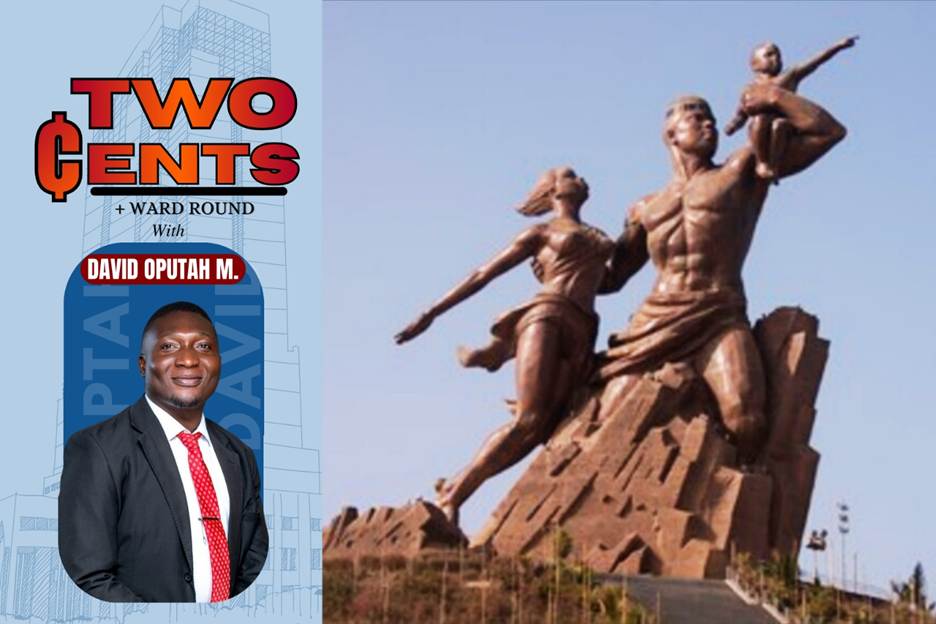
Back in Dakar, the African Renaissance Monument, a towering bronze statue symbolizing Africa emerging from centuries of struggle toward a new future, rises dramatically over the city skyline. It’s impossible to miss.
Whether one agrees with its politics or not, the symbolism is powerful: a continent reaching forward. And that symbolism connects directly to why we were in Dakar. The writeshop focused on a deceptively simple idea: Africa is doing incredible work in artificial intelligence research, but the world rarely hears the story properly.
Across African universities and research labs, people are building language models, developing health diagnostics, designing agricultural prediction systems, and solving problems that Silicon Valley never considered.
But if the stories are not told well, the impact remains invisible.
Ward Round
Major Defections & New Parties
Nigeria’s political chessboard keeps shifting. Former Bayelsa Governor Seriake Dickson has left the PDP to join a new political movement: the National Democratic Coalition (NDC), warning about the danger of Nigeria drifting toward a one-party state. At the same time, Zamfara State Governor Dauda Lawal is reportedly finalizing plans to defect to the APC, a move that could push the ruling party’s control to 31 governors out of 36 states.
Let’s be honest: defections in Nigerian politics rarely follow ideology. They follow power. Politicians move where survival looks most guaranteed. The question Nigerians must ask is whether democracy can remain vibrant when the opposition keeps dissolving into the ruling structure. A democracy without a credible opposition slowly becomes theatre.
OPL 245 Dispute Resolved
After 15 years of legal drama, international arbitration, court battles, and diplomatic tension, the OPL 245 dispute has finally been resolved under the Tinubu administration. For Nigeria’s oil and gas sector, this is a significant moment. The case had become one of the most controversial oil licensing disputes in global energy history, discouraging investment and complicating Nigeria’s reputation in international energy markets.
Resolution should restore some confidence and potentially unlock fresh investment in Nigeria’s upstream sector. With global energy politics shifting and local refining capacity expanding, clarity around such major assets could help Nigeria stabilize its oil output and reposition itself competitively. The real test now is ensuring transparency and avoiding future disputes of this magnitude.
Power Grid Collapse
Nigeria’s power crisis deepened again this week as electricity generation dropped to 2,898 megawatts, an 11 percent decline driven largely by gas supply constraints. For a country of over 200 million people, this number is almost surreal. It barely powers a fraction of what the economy needs.
Meanwhile, here in Dakar, the lights simply stay on. No drama. No sudden darkness. No “system collapse” explanations every few weeks. Power infrastructure may not be glamorous politics, but it is the foundation of economic growth. Until Nigeria fixes electricity decisively, every other development conversation remains theoretical.
Ransom Allegations
Reports emerged this week suggesting that the Federal Government paid a substantial ransom to Boko Haram to secure the release of more than 200 abducted students and staff from a Catholic school, despite official policies prohibiting ransom payments. At the same time, a kidnapped corps member was reportedly killed even after ransom demands were met.
The contradiction is unsettling. Publicly, the government insists it does not negotiate with terrorists. Privately, reality often tells a different story. Add to recent comments from the National Security Adviser (NSA) suggesting rehabilitation for bandits, and a troubling imbalance appears: sympathy for perpetrators while victims remain largely forgotten. Sad!
Israel / USA vs Iran
What began as geopolitical brinkmanship now feels dangerously close to a full regional escalation. Airstrikes, retaliations, airspace closures, evacuations, and rising civilian casualties have turned the Middle East into a tense theatre once again.
History has shown repeatedly that once multiple global powers become entangled in a regional conflict, the consequences spread far beyond the battlefield affecting energy markets, global security, and millions of civilians who had no role in the conflict. At moments like this, diplomacy is not weakness; it is survival. Peace, please.