








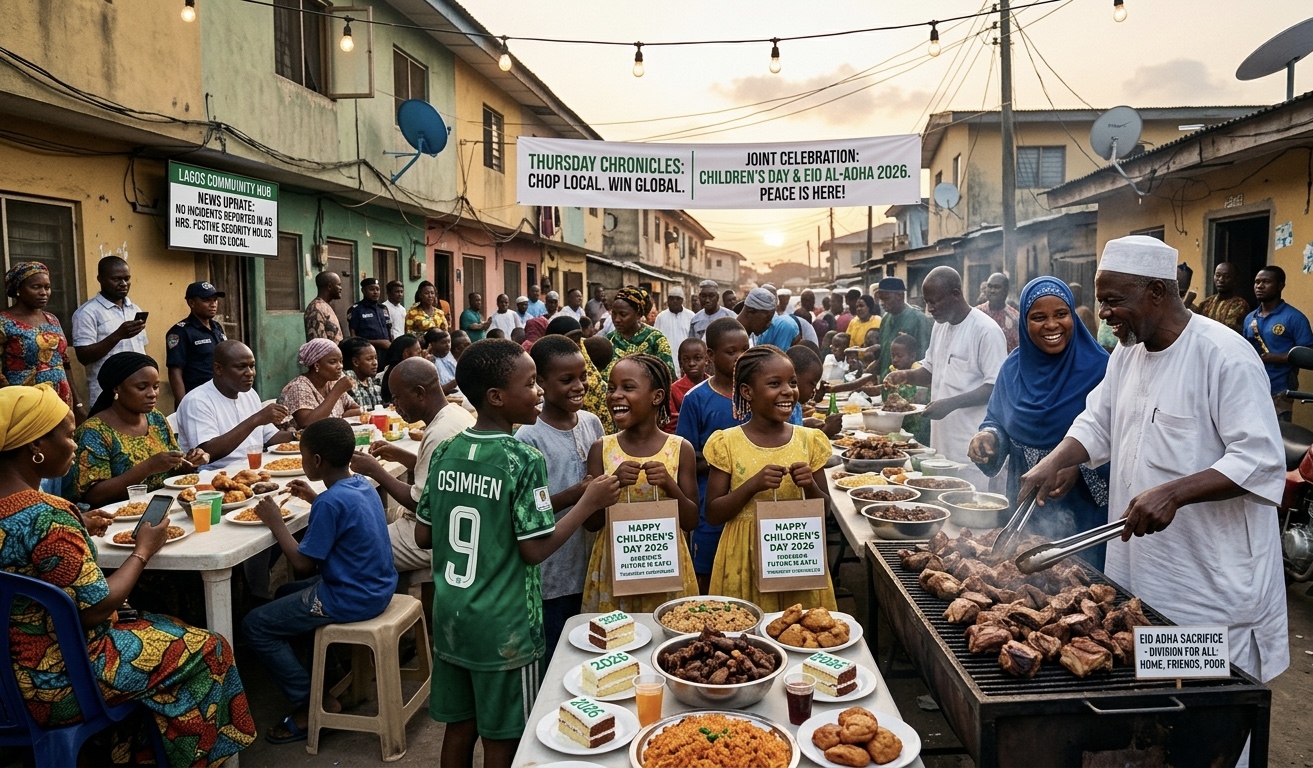
Hello, my fellow Dream-Defenders and Keepers of the Faith. Welcome back to our weekly sanctuary. Today is Thursday, May 28, 2026, and if you woke up yesterday, looked at your calendar, and realized your household was trying to balance the innocent joy of Children’s Day with the profound spiritual weight of Eid al-Adha (Eid-el-Kabir)—all while navigating the heavy reality of national security—pull up a plastic chair.
Yesterday, May 27, was a rare, historic convergence. Because the lunar Islamic calendar shifts every year, the solar and lunar calendars aligned to give Nigeria a dual reality: a day dedicated to celebrating our future, sharing the exact same date with a festival dedicated to ultimate faith and sacrifice.
But as the aroma of fried Sallah meat mixed with the scent of Children’s Day birthday cakes and party packs, a silent, heavy sigh rippled through millions of Nigerian homes. This is a comprehensive, deeply empathetic audit of a milestone week where our celebrations met our survival instincts.
The underlying script of Eid al-Adha is one of unwavering devotion through a parent’s ultimate vulnerability. It honors the willingness of Prophet Ibrahim to sacrifice his son in obedience to a divine command, before a ram was provided in his place.
Yesterday, as Nigerian parents dressed their children in beautiful new Lace and Agbadas for the Eid praying grounds, that ancient story felt raw, visceral, and incredibly close to home. In an era where sanctuaries of learning—like the recent, heartbreaking raid in Oriire, Oyo State, where classrooms were breached and an educator was lost—have become targets, letting your child out of your sight feels like an act of terrifying, profound faith.
We found ourselves celebrating the beauty of our children on the exact same day we honored a story about the willingness to surrender a child. It forced every parent to look at their kids not just as “the future,” but as a fragile, precious present that must be guarded with every breath.
Because we are Nigerians, our resilience always finds a way to blend humor with hardship. The economic and security logistics of yesterday’s dual celebration required a mathematical genius.
With inflation transforming the price of a healthy ram into something resembling a down payment on a plot of land, the trend yesterday was “The Sallah Cooperative.” Neighbors and friends pooled resources to buy cows or shares of livestock, but the real security audit happened before the knife even touched the animal.
“Alhaji, did the truck from the North take the bypass? Are the rams safely in the compound, or do we need the local vigilante to watch the backyard overnight so the ‘unauthorized holiday makers’ don’t harvest our sacrifice before the Imam prays?”
Even the traditional Children’s Day party packs underwent a risk assessment. Parents weren’t just checking if the juice boxes were expired; they were auditing the party venues. Bouncy castles were stationed far from main roads, and uncles were deployed at estate gates, keeping a sharp eye out for “strange movements.” We have successfully turned festive planning into a tactical security brief.
While many homes were blessed to share meat and laughter yesterday, we cannot ignore the empty seats at the table. In various parts of the country, there are parents whose children are still missing in forest reserves, and families whose providers never made it home from school runs or road trips.
The beauty of yesterday’s dual holiday was the built-in mechanism for empathy. The tenets of Eid al-Adha command that the sacrificial meat be divided into three parts: one-third for the family, one-third for friends, and one-third specifically for the poor and vulnerable.
Yesterday, that third portion wasn’t just food; it was a communal blanket. Neighbors wrapped their arms around the grieving. We saw communities using the holiday to quietly drop off provisions for families displaced or broken by recent tragedies. In a land where formal safety nets can feel invisible, our shared faith and humanity became the shield.
In behavioral psychology, what Nigerians are currently practicing is called Contextual Resilience. We have learned how to compartmentalize terror so that joy can breathe. If we allowed the fear of insecurity to dictate our calendar, yesterday’s double celebration would have been cancelled.
By insisting on putting festive clothes on our children, by gathering at the praying grounds, and by sharing food across religious and tribal lines, we performed a massive act of psychological warfare against criminality. We asserted that our culture, our faith, and our children are sovereign, and they will not be governed by fear.
Key Take-Home Points for the Post-Festive Week
The Soft-Target Warning: The holiday might be winding down, but schools and community centers remain areas that require constant alertness. Security structures built for the holiday must not be dismantled; vigilance is a full-time job.
Digital Boundaries for Children: We love sharing beautiful photos of our kids holding sparklers or eating Sallah meat. Do not post their school names, locations, or real-time whereabouts online. Keep their digital footprint invisible to predators who audit social media for targets.
Informant Elimination: The logistics of insecurity rely on local eyes. As communities gather during festive seasons, look closer at the fringes. Security is local, and it begins with knowing who enters your street.
Modesty in Abundance: If your household was blessed to celebrate fully yesterday, remember those around you who could only offer prayers. True sacrifice is measured by how much you extend your table to the broken.
Lessons to Carry into June
Teach Children Situational Awareness: Use the festive stories to teach them wisdom. Children should know emergency contacts, family code words, and how to identify safe authorities in a crowd.
Support Local Security Initiatives: When your neighborhood association or village council asks for contributions to support local hunters or fix the streetlights, see it as part of your security premium. Light chases away the shadow.
Never Let the Outrage Go Cold: As we return to our normal routines, do not forget the schools that are still closed and the families still waiting for good news. Our collective voice is the only thing that keeps accountability alive.
As we wrap up this historic and emotional edition of the Chronicles, let us take a moment to look at our children—whether they are taking a nap after yesterday’s excitement or getting ready for the next school day. May the blessings of the dual celebration of innocence and sacrifice bring a permanent dawn of peace, security, and restoration to our beloved Nigeria.
Keep them close, keep your eyes open, and let your faith be your compass.
See you next Thursday, hopefully with a nation that feels a little more like a playground and a lot less like a fortress!










—all while navigating the heavy reality of national security—pull up a plastic chair.)